About Innovation Hub
 Global Content Pulse (Webinars)


 Global Production Financing
(Webinars)
Global Production Financing
(Webinars)  LeaderSpeak Podcast
  About Vitrina
 Our Story
 Our Solutions 🔥
 Film+TV Projects Tracker 🚀
 Case Studies
 Our Profile

Verified Intelligence: December 2025
Boardroom Ready
AI Research Tools for Cinema Studies and Film Analysis 2026 are transforming cinematic scholarship from subjective observation into high-velocity, data-driven intelligence. As global production capital migrates toward Sovereign Hubs, the “Data Deficit” in traditional film analysis—which relies on static, Western-centric frameworks—is being weaponized by researchers using multimodal AI to map emotional arcs, visual aesthetics, and character dynamics across 100+ languages. By leveraging “Video to Metadata” platforms like Vionlabs and authorized AI search suites, scholars are de-risking the analysis of massive content libraries, uncovering “Insider Advantages” in regional cinema (APAC, MENA, LATAM) that were previously invisible to the manual eye. This strategic guide details the clinical transition to an autonomous, multimodal research framework.
⚡ Executive Strategic Audit
EBITDA Impact
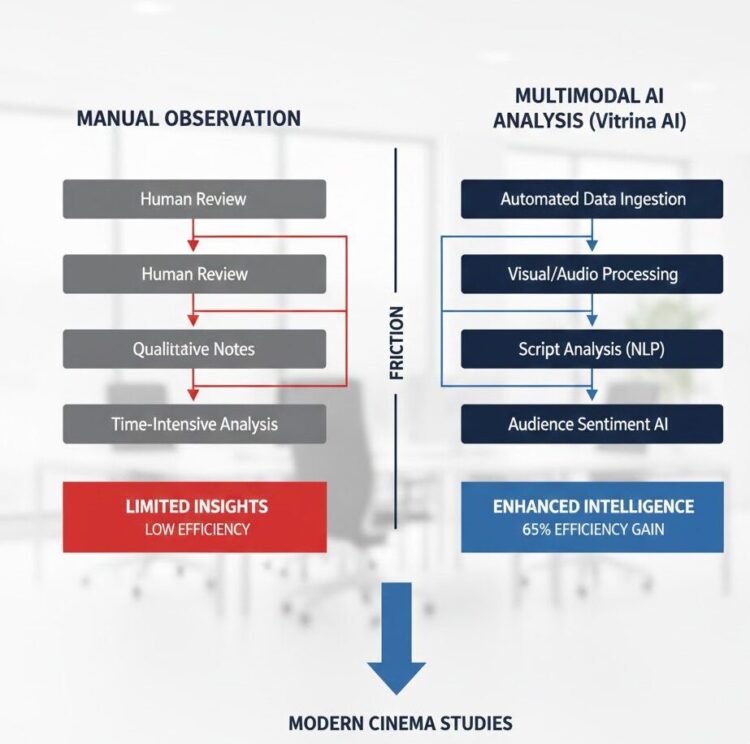
65% Reduction in Research-to-Analysis Overhead
Recoupment Cycle
Accelerated Content Repurposing via Automated Metadata

Your AI Assistant, Agent, and Analyst for the Business of Entertainment
VIQI AI helps you plan content acquisitions, raise production financing, and find and connect with the right partners worldwide.
- Find active co-producers and financiers for scripted projects
- Find equity and gap financing companies in North America
- Find top film financiers in Europe
- Find production houses that can co-produce or finance unscripted series
- I am looking for production partners for a YA drama set in Brazil
- I am looking for producers with proven track record in mid-budget features
- I am looking for Turkish distributors with successful international sales
- I am looking for OTT platforms actively acquiring finished series for the LATAM region
- I am seeking localization companies offer subtitling services in multiple Asian languages
- I am seeking partners in animation production for children's content
- I am seeking USA based post-production companies with sound facilities
- I am seeking VFX partners to composite background images and AI generated content
- Show me recent drama projects available for pre-buy
- Show me Japanese Anime Distributors
- Show me true-crime buyers from Asia
- Show me documentary pre-buyers
- List the top commissioners at the BBC
- List the post-production and VFX decision-makers at Netflix
- List the development leaders at Sony Pictures
- List the scripted programming heads at HBO
- Who is backing animation projects in Europe right now
- Who is Netflix’s top production partners for Sports Docs
- Who is Commissioning factual content in the NORDICS
- Who is acquiring unscripted formats for the North American market
AI Research Tools for Cinema Studies: The ‘Video to Metadata’ Paradigm
In practice, this usually means that the traditional method of “watching and note-taking” is functionally extinct for large-scale analysis. Behind closed doors, the conversation is actually about how Video to Metadata platforms are now experiencing content exactly like a viewer does—aligned on a single timeline of visual, audio, and textual signals. For a scholar in 2026, analyzing a “war movie” is no longer just about the genre; it is about extracting the Emotional Flow and Scene Pacing data that differentiates a 1,300-title catalog.
The industry talks about “AI recommendations,” but researchers are feeling the power of domain-specific models like Vionlabs’ AINAR. These tools weaponize the data inside the video file itself to identify character relationships and narrative structures that static databases like IMDbPro cannot surface. This de-risks interdisciplinary research by providing a verifiable, multimodal foundation for philosophical or aesthetic claims.
LeaderSpeak Insight: Arash Pendari from Vionlabs notes that AI can help scale the creative process by understanding that “emotion is data.” This de-risks AI Research Tools for Cinema Studies by transforming raw video into deep, actionable intelligence, protecting the EBITDA of content libraries through smarter discoverability.
Autonomous Research Agents: Weapons for Deep Investigations
The timing trap of 2026 is relying on generalist chatbots. Serious cinema studies now utilize Autonomous Research Agents (e.g., ChatGPT Deep Research or Gemini 3) that can spend 30 minutes conducting multi-step investigations across academic repositories like arXiv and Google Scholar. These tools generate 30-page reports with full citation integrity, allowing researchers to signal gaps in film Adaptation studies or identify emerging trends in Global Women Filmmakers before they hit the trades.
But here is the catch: transparency is everything. Tools that provide a “Reasoning Transparency” log or a “Consensus Meter” (like Consensus or Scite AI) are mandatory to de-risk scholarly output from “hallucinated” data. In 2026, weaponizing these search suites means shifting from “finding papers” to “synthesizing the pulse of the discourse”—tapping into real-time conversations on X and Reddit to understand the social reception of Authorized AI in cinema.
Sovereign Hub Analysis: Deciphering the Regional Majority
The capital reality of 2026 is that the “Global North” is no longer the sole architect of cinematic AI logic. Sovereign Content Hubs—particularly in LATAM (Chile/Brazil) and APAC (Vietnam/India)—are building “Latam-GPT” and sovereign RAG systems to ensure AI reflects local languages and cultural nuances. For a film analyst, this is an invitation to move beyond “digital consumption” to “cultural creation.”
Every sourcing list for cinema studies must now include at least 30% representation from these emerging hubs. Analyzing the “China Plus One” shift or the NFDC India co-production incentives requires tools that understand the regulatory and aesthetic intricacies of these markets. Failure to utilize region-specific AI research tools leads to a “Data Trust Deficit” that renders global media analysis structurally incomplete.
AI Research Tools for Cinema Studies: The Strategic Path Forward
The transition to a data-first cinematic research model is irreversible. To remain credible in 2026, scholars must adopt a “Zero-Trust” mandate regarding legacy databases and instead weaponize real-time, multimodal AI to interrogate the methodology of film history. This industrialization of “Insider Intelligence” ensures that cinema studies remains a rigorous science capable of navigating the “Streaming Wars” and the dawn of “Weaponized Distribution.”
The Bottom Line Cinematic research in 2026 is an arms race of information gain. Deploy multimodal ‘Video to Metadata’ tools immediately to unlock the hidden emotional DNA of your content library and accelerate scholarly recoupment.
Deploy Intelligence via VIQI
Select a prompt to run a real-time cinematic research audit:
Identify cinema research groups in LATAM utilizing sovereign LLMs for archive analysis.
Map the M&A history of AI video analysis startups in the EU and APAC.
Filter global partners specializing in multimodal film metadata enrichment.
Identify active co-productions in MENA testing real-time AI scene analysis.
Show trending computational film studies tools in the APAC region for 2026.
Find independent AI researchers mapping emotional arcs in regional cinema.
Insider Intelligence: AI Research Tools for Cinema Studies FAQ
How does ‘Video to Metadata’ AI replace traditional film analysis methods?
It transforms unobserved raw video into structured intelligence. By extracting layers of emotion, visual composition, and dialogue on a single timeline, AI provides an objective basis for analysis that manual note-taking cannot match at scale.
What is the significance of Sovereign Hub AI for film scholars?
Sovereign AI initiatives like Latam-GPT ensure that research tools are aligned with regional cultural and linguistic priorities. This prevents the imported “Silicon Valley” bias and allows for a more accurate deconstruction of non-Western cinematic traditions.
Can AI research tools track unreleased film projects for study?
Yes. Vertical AI trackers like the Vitrina Film+TV Tracker monitor projects from early development through post-production across 100+ countries, providing scholars with real-time visibility into the future of global production trends.
How does VIQI solve the ‘Data Deficit’ in cinema studies?
VIQI weaponizes Vitrina’s 30 million relationships to provide “Insider Advantage” answers on funding, executive movements, and project status—effectively acting as a virtual Hollywood agent for the academic researcher.
Find Film+TV Projects, Partners, and Deals – Fast.
VIQI matches you with the right financiers, producers, streamers, and buyers – globally.
Producers Seeking Financing, Co-Pros, or Pre-Buys?
Vitrina Concierge helps producers reach the right financiers, commissioners, distributors, and co-production partners — with precision outreach, not cold pitching.
Join Industry Briefings Trusted by Leaders

Format Adaptations: Global Trends
Where formats are traveling, which adaptations are breaking out, and how streamers are backing remakes in 2025–2026.

Books, Novels & Comics Adaptations: Global Trends
Books, webtoons, and manga driving the next global screen hits. Discover how in this webinar.

Micro-Dramas & Mobile-First Storytelling
Micro-dramas are building real audiences and revenue. Understand the platforms, buyers, and economics behind the growth.

Navigating Global Content Licensing Trends
How global content licensing is shifting beyond flat fees to flexible, deal-driven models.