

 About Innovation Hub
 Global Content Pulse (Webinars)


 Global Production Financing
(Webinars)
Global Production Financing
(Webinars)  LeaderSpeak Podcast
  About Vitrina
 Our Story
 Our Solutions 🔥
 Film+TV Projects Tracker 🚀
 Case Studies
 Our Profile
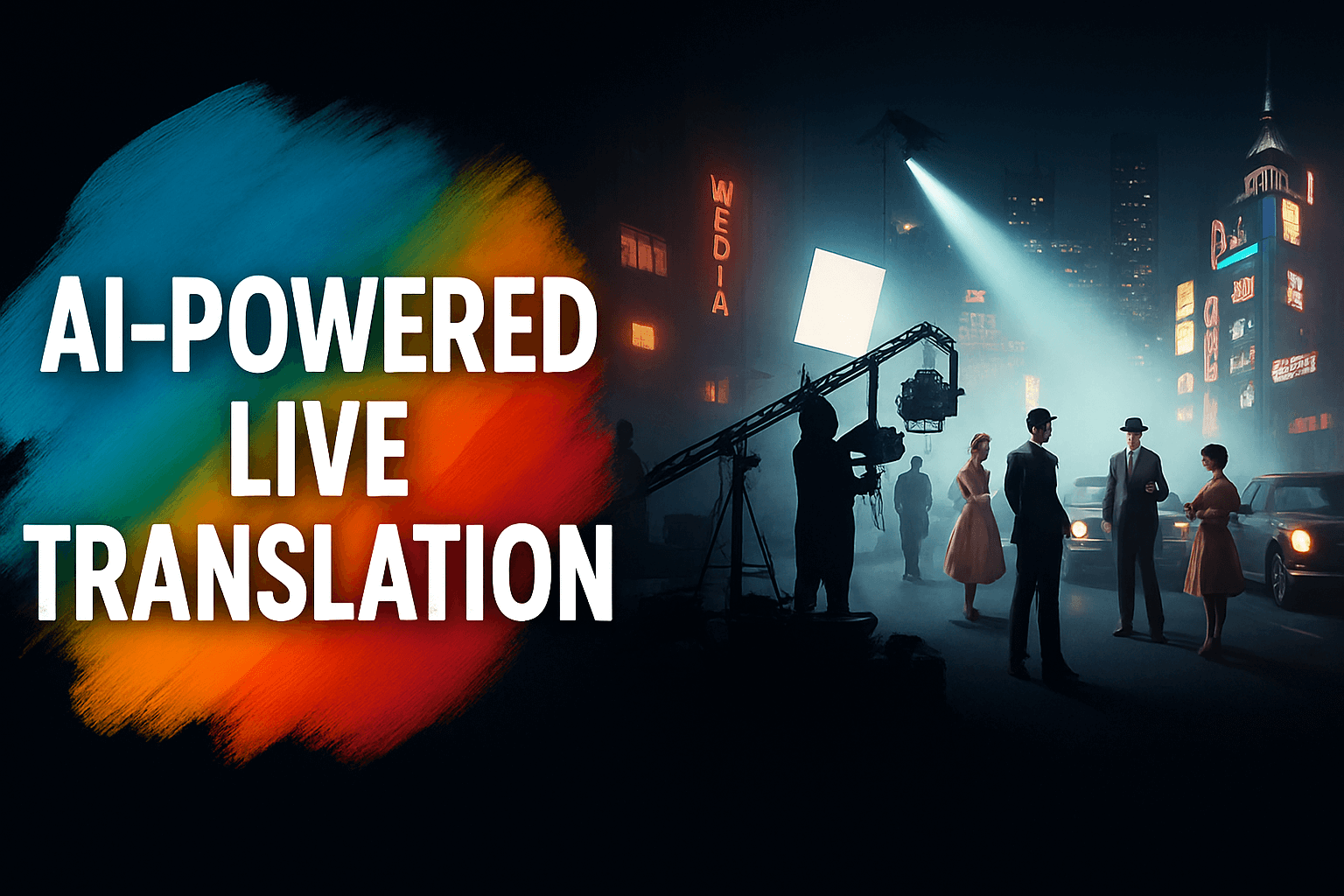
AI-powered live translation is the integration of neural machine translation and emotional voice synthesis into real-time broadcast and streaming workflows.
This technology involves capturing live audio signals, processing them through low-latency AI engines, and delivering localized captions or dubbed audio in under 2 seconds.
According to industry intelligence from Vitrina AI, the global localization market is expanding rapidly as platforms shift toward “weaponized distribution,” where content is instantly adapted for 100+ territories to maximize ROI.
In this guide, you will learn the mechanics of real-time localization, how to navigate the emerging “Authorized Data” landscape, and why supply chain intelligence is the key to finding the right technical partners.
While traditional localization relied on weeks of post-production, current market demands for live events and FAST channels require immediate multilingual accessibility. Many professionals still struggle with latency issues and high human-in-the-loop costs that restrict global scalability.
This comprehensive guide addresses these gaps by providing a roadmap for implementing AI-driven translation—moving from legacy post-production models to real-time, data-powered global delivery.

Your AI Assistant, Agent, and Analyst for the Business of Entertainment
VIQI AI helps you plan content acquisitions, raise production financing, and find and connect with the right partners worldwide.
- Find active co-producers and financiers for scripted projects
- Find equity and gap financing companies in North America
- Find top film financiers in Europe
- Find production houses that can co-produce or finance unscripted series
- I am looking for production partners for a YA drama set in Brazil
- I am looking for producers with proven track record in mid-budget features
- I am looking for Turkish distributors with successful international sales
- I am looking for OTT platforms actively acquiring finished series for the LATAM region
- I am seeking localization companies offer subtitling services in multiple Asian languages
- I am seeking partners in animation production for children's content
- I am seeking USA based post-production companies with sound facilities
- I am seeking VFX partners to composite background images and AI generated content
- Show me recent drama projects available for pre-buy
- Show me Japanese Anime Distributors
- Show me true-crime buyers from Asia
- Show me documentary pre-buyers
- List the top commissioners at the BBC
- List the post-production and VFX decision-makers at Netflix
- List the development leaders at Sony Pictures
- List the scripted programming heads at HBO
- Who is backing animation projects in Europe right now
- Who is Netflix’s top production partners for Sports Docs
- Who is Commissioning factual content in the NORDICS
- Who is acquiring unscripted formats for the North American market
Producers Seeking Financing & Partnerships?
Book Your Free Concierge Outreach Consultation
(To know more about Vitrina Concierge Outreach Solutions click here)
Table of Contents
Key Takeaways for Localization Professionals
-
Cost Efficiency Gains: AI-powered translation tools like Lexi Voice can reduce broadcast translation costs to as low as $30 per hour, a 90% drop from traditional methods.
-
Authorized Data Strategy: Studios are shifting toward authorized IP licensing for AI training, as seen in the $1B Disney-OpenAI deal, to ensure ethical voice replication.
-
Supply Chain Visibility: Using platforms like Vitrina to track 140,000+ companies allows broadcasters to qualify vendors based on specialized AI-dubbing track records.
-
Weaponized ROI: Broadcasters are now using “rotational windows,” licensing high-value content to rivals 18-24 months post-release through rapid automated localization slates.
What is AI-Powered Live Translation?
AI-powered live translation is a technological framework that automates the conversion of spoken dialogue into multiple languages instantly during a broadcast. Unlike traditional captioning, which often relies on human stenographers, this system uses “Vertical AI” trained on proprietary datasets to understand industry-specific terminology. This allows for near-zero latency delivery across global streaming platforms.
The evolution of this technology is driven by the industry’s shift from relationship-based workflows to data-powered frameworks. As M&E executives face a “data deficit,” AI tools fill the gap by providing structured, verifiable translation outputs that scale without the bottleneck of manual talent availability. This is critical for live news, sports, and episodic streaming where speed dictates market share.
Find AI localization partners for your broadcast slate:
How Does Real-Time Localization Work?
Industry Expert Perspective: Merging AI, Cloud, and Broadcast: Inside AI-Media’s Next Chapter
Tony Abrahams, CEO of Ai-Media, explains how groundbreaking AI products like Lexi Voice are transforming live translation by delivering multilingual content at scale for just $30 an hour.
Ai-Media has transitioned from captioning pioneer to AI global innovator. Their Lexi Voice product unlocks multilingual access to real-time content at a fraction of legacy costs, enabling broadcasters to meet global compliance and engagement standards through cloud-native workflows.
The technical workflow for real-time localization begins with high-fidelity audio capture via IP-based delivery systems like Zixi. Once the signal reaches the cloud, ASR (Automated Speech Recognition) converts speech to text, which is then passed to neural machine translation engines. The final step involves TTS (Text-to-Speech) using “emotional scene analysis” to ensure the tone of the translated voice matches the original performance.
For broadcasters, this solves the “fragmentation paradox.” While production is global, sourcing human talent for 50+ languages simultaneously was historically impossible. By using Vitrina’s Company & People Intelligence, studios can now identify tech-enabled vendors who offer API-ready data feeds that plug directly into existing broadcast pipelines, ensuring a “single source of truth” for global output.
Weaponized Distribution and Translation
The entertainment industry has entered the era of “Weaponized Distribution.” This strategy involves licensing premium content to rival platforms 18-24 months post-release to maximize ARPU and market efficiency. For example, Netflix’s content acquisition now functions as a data-driven science, where “rotational windows” allow sunk production costs to be recouped through massive secondary licensing deals.
“The industry is moving beyond walled gardens. Collaboration between platforms like the ‘Frenemy Pact’ between Amazon and Netflix proves that ROI now prioritizes flexible distribution over rigid exclusivity.”
AI-powered live translation is the engine behind this strategy. To license a catalog of 1,000+ titles to a new territory like Brazil or South Korea, broadcasters use automated dubbing tools to compress years of localization work into weeks. Vitrina’s Deals Intelligence helps strategy teams track these shifts, identifying which rivals are acquiring specific genres and matching them with the necessary localization infrastructure.
Analyze recent content acquisition trends for weaponized distribution:
The Authorized Data Market vs. Infringement
A critical challenge in AI translation is the “Authorized Data” market. Disney’s $1 billion deal with OpenAI establishes a precedent where IP is licensed for AI training in a controlled environment. This ensures that character voices and environments are protected from “deepfake” unauthorized usage. Simultaneously, Disney’s legal action against Google highlights the risk of using copyright content without consent to train Large Language Models (LLMs).
For localization vendors, this means due diligence is mandatory. You must verify if an AI dubbing provider uses ethical data sourcing or if they are vulnerable to SAG-AFTRA objections regarding performers’ likenesses. Vitrina AI helps users perform this objective vetting by providing deep profiles of 72,000+ executives and mapping their track records in authorized AI integration.
Qualifying High-Tech Localization Vendors
When identifying partners for AI-powered live translation, look for “Supply-Chain Intel” indicators. Traditional databases like IMDbPro focus on historical credits, but strategic intelligence requires tracking unreleased projects in the pipeline. Vitrina’s Global Film+TV Projects Tracker monitors 1.6 million titles, allowing you to see which vendors are currently attached to high-profile AI-dubbing contracts.
-
1. Verify Technical Latency Standards
Real-time translation must maintain under 2 seconds of latency to remain viable for live broadcast. Ensure the vendor uses cloud-native distribution tools like Zixi for signal integrity.
-
2. Check for Vertical AI Training
Generic AI often fails on entertainment jargon. Vendors should have proprietary datasets (like VIQI’s 30 million industry relationships) to handle nuanced media metadata.
-
3. Evaluate Reputation Scores
Use Vitrina to view verified profiles and specialization scores. A high score in “Localization Technology” is more critical than general post-production experience.
Target localization projects entering production in your region:
Moving Forward
The shift from manual translation to AI-powered live delivery is not just a cost-saving measure; it is a structural metamorphosis of the entertainment supply chain. By adopting real-time localization, broadcasters fill the critical “data trust deficit,” ensuring their content is accessible and compliant in every global market instantly.
Whether you are a broadcaster looking to scale your FAST channel portfolio, or a localization vendor trying to pivot to AI-dubbing services, the principle remains: actionable intelligence drives success. Transitioning to cloud-native, AI-enhanced workflows is no longer optional in a “streaming wars” environment that demands hyper-efficient ROI.
Outlook: Over the next 12-18 months, we expect to see the “Authorized Data” market formalize, with 70% of major studios establishing direct AI-training licensing agreements to protect creative IP while scaling global distribution.
Frequently Asked Questions
Quick answers to the most common queries about AI-powered live translation.
What is AI-powered live translation?
How much does AI live translation cost?
Is AI live translation accurate?
What is weaponized distribution?
How does the Disney-OpenAI deal affect localization?
What are the ethical risks of AI translation?
Can AI translation handle emotional delivery?
How do I find high-quality AI vendors?
About the Author
Written by the Vitrina AI Intelligence Team. With over 20 years of experience mapping the global entertainment supply chain, our team provides data-driven insights to senior executives at Netflix, Disney, and GoogleTV. Connect with our network on Vitrina.
Find Film+TV Projects, Partners, and Deals – Fast.
VIQI matches you with the right financiers, producers, streamers, and buyers – globally.
Producers Seeking Financing & Partnerships?
Book Your Free Concierge Outreach Consultation
(To know more about Vitrina Concierge Outreach Solutions click here)
Producers Seeking Financing, Co-Pros, or Pre-Buys?
Vitrina Concierge helps producers reach the right financiers, commissioners, distributors, and co-production partners — with precision outreach, not cold pitching.
Join Industry Briefings Trusted by Leaders

Deep dive into Co-Pros
Ambitious co-productions are key to global hits, but most deals collapse. This deep-dive briefing is the strategic playbook. We’ll break down the financing models, partnership structures, and market insights behind today’s successful deals.

Film & TV Financing: Tax Credits & Incentives
A focused look at how 2025 tax credits and incentives are reshaping Film & TV financing decisions — and where the real value now sits.

Film & TV Financing: Pre-Buys
Learn how pre-buys work in current Film and TV financing, how they differ from pre-sales, and how they are used to close real finance plans.
Streamers – Netflix vs. Amazon – The 2026 Strategy
How Netflix and Amazon’s content and revenue strategies are diverging ahead of 2026.