IHUB
IHUB
 Private Briefings (Webinars)


 LeaderSpeak Podcast
  Global Entertainment Digest (Newsletter)
  Premium Lists
 Membership Benefits
 About Vitrina
 Our Story
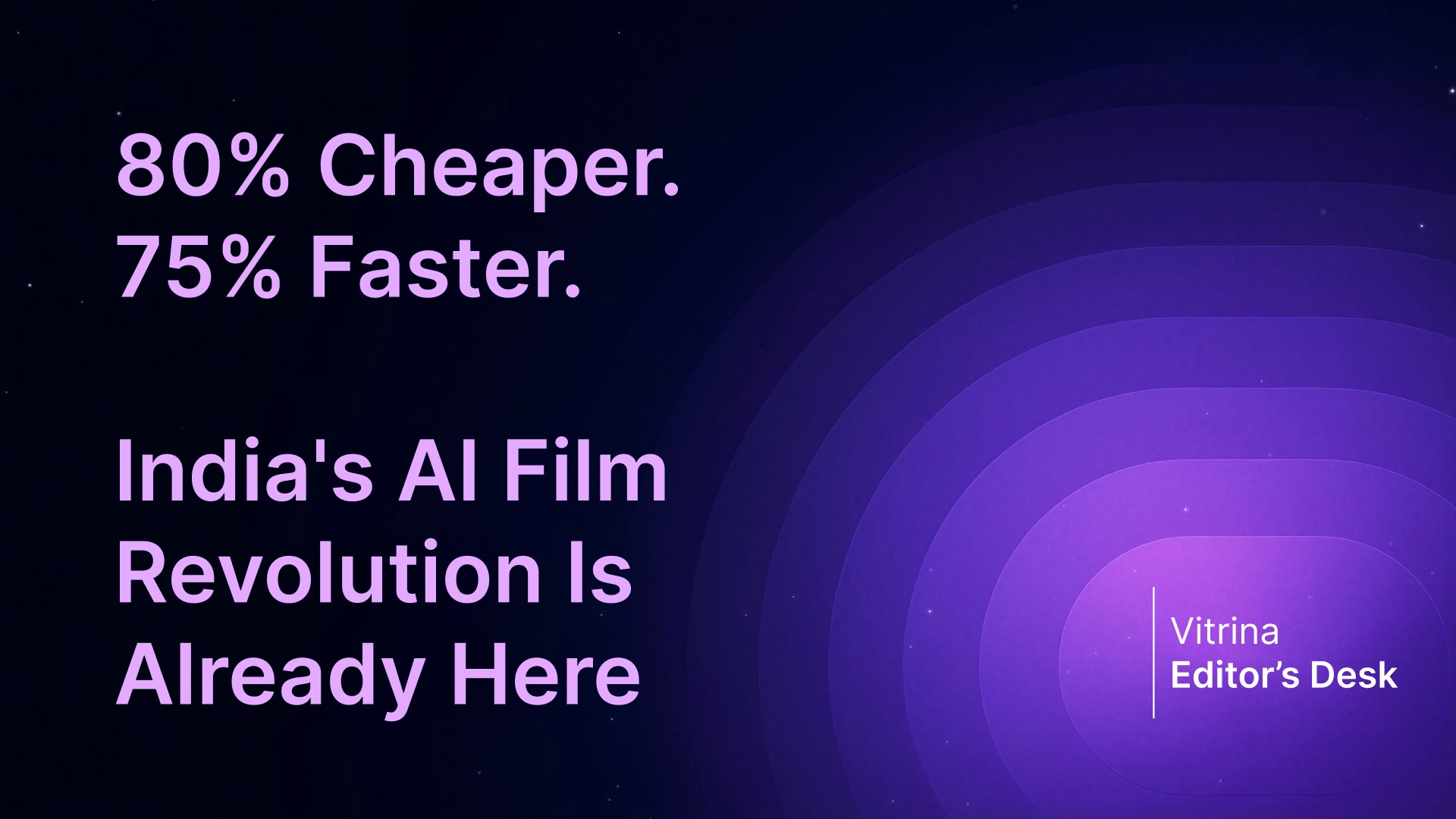
India is now the world’s most aggressive testing ground for generative AI in film production — with major studios cutting costs by 80% and timelines by 75% while Hollywood is still debating the rules.
AI Film Production in India: What It Costs and How to Source It (2026)
Find AI-capable production partners in India
Vitrina tracks AI-native and AI-adopting production companies by capability, credits, and territory.
AI film production in India is now a standard line item in studio budgets, not an experiment. For a producer or financier evaluating a project in this market, the questions that matter are what AI actually changes about cost and schedule, which genres and formats it handles well today, and which studios have shipped work at scale rather than in a lab. This guide covers the flagship projects setting the benchmark, the cost data behind them, the legal exposure that differs sharply from Hollywood, and how to source a vetted partner. If you want to skip straight to sourcing, Vitrina lists verified VFX, animation, and AI production companies in India, filterable by capability and credits.
Key Takeaways
- AI production in India now spans four flagship cases across genre and budget tiers: JioStar’s 100-episode Mahabharat, Abundantia’s 11 million dollar AI studio, Eros’s Raanjhanaa legal dispute, and Amazon MX Player’s targeted VFX use.
- Verified cases show AI pipelines running at roughly 20% of traditional production cost and 25% of traditional timelines, with EY estimating a sector-wide 10% revenue uplift and 15% cost reduction.
- AI performs best on stylized, fantastical, or historical content. Realistic human performance and physics-critical simulation still carry meaningful quality risk, as shown by Mahabharat’s 1.4 out of 10 IMDb score.
- India has no guild structure equivalent to SAG-AFTRA or the WGA, so producer-held copyright generally supersedes moral rights, a legal gap the Eros-Raanjhanaa dispute is actively testing at the National Company Law Tribunal.
- Vitrina lists verified AI-capable production, VFX, and animation companies in India, filterable by capability and credits, with direct contact to decision-makers.
What Is Actually Shipping: Four Cases That Set the Benchmark
JioStar’s Mahabharat: Scale Without Consensus on Quality
JioStar’s Mahabharat: Ek Dharmayudh, a 100-episode retelling of the Kurukshetra War produced through Collective Artists Network’s Galleri5 AI lab in Bengaluru, launched in October 2025 and drew 6.5 million views on day one, 2.1 times the platform average according to JioStar. Total views reached 26.5 million by April 2026, against a 1.4 out of 10 IMDb rating, with reviewers citing lip-sync failures and styling that felt inauthentic for a sacred epic. The lesson for a buyer is not that the show failed commercially. Audience volume and audience approval moved in opposite directions, and JioStar treated that gap as acceptable enough to commit further, recruiting roughly 80 AI specialists and building a full slate that includes an AI-generated feature on Hanuman and a set of micro-dramas.
Abundantia Entertainment: A Capital Commitment, Not a Pilot
Abundantia Entertainment is building a dedicated AI studio for 11 million dollars and has set a target of one-third of total company revenue from AI-assisted content within three years. Its first theatrical release, Chiranjeevi Hanuman: The Eternal, is directed by National Film Award winner Rajesh Mapuskar, previously known for 3 Idiots and Munnabhai MBBS. A credentialed mainstream director attached to an AI-native production tells a financier that AI production is now a legitimate delivery method to people with reputations to protect, not only to technologists.
Eros Media World and Raanjhanaa: The Legal Case Every Rights Holder Should Read
Eros re-released the 2013 drama Raanjhanaa in August 2025 with an AI-generated alternate ending that reversed the protagonist’s death. Attendance ran 12 percent above comparable re-releases, according to Reuters, but director Aanand L Rai publicly disassociated from the version and lead actor Dhanush said the change stripped the film of its meaning. Eros held its position, citing copyright ownership under Indian law and the director’s contractual waiver of moral rights. The dispute reached the National Company Law Tribunal and stands as India’s first AI filmmaking legal case. Any producer or financier holding library rights in India should read it before assuming what an existing contract permits.
Amazon MX Player: AI as a Line Item, Not a Full Replacement
Made in India: The Titan Story used more than 100 AI-generated VFX shots to recreate 1970s Mumbai, applying AI to a specific visual task rather than full-generation production. AI artist Prasad Gori, who worked on the project, told CNBC his weekly volume of AI production offers went from chasing work three years ago to fielding 10 to 15 offers per week now: vendors doing targeted AI VFX work are growing faster than full-generation shops.
What This Actually Costs
The financial case for AI production in India is not a marginal efficiency gain. A hybrid production model described by Manesh Muthu Swamy, co-founder and CCO of FirstAI Consultancy, shows the scale of the shift. His team shot footage with human actors, then used AI to generate animated characters from those actors’ facial expressions. A comparable project built with traditional tools would have cost several million dollars and taken six to twelve months. Built this way, it cost a few hundred dollars and took weeks.
| Metric | Traditional | AI Pipeline |
|---|---|---|
| Production cost | Baseline (100%) | ~20% of baseline |
| Time to market | Baseline (100%) | ~25% of baseline |
| Revenue uplift (EY estimate) | Not applicable | +10% |
| Cost reduction (EY estimate) | Not applicable | -15% |
Source: Collective Artists Network and EY India M&E Report 2026.
That order of magnitude changes what is commercially viable to greenlight. Regional-language mythology adaptations, micro-dramas, and episodic fantasy content for niche streaming audiences move from uneconomic to fundable.
“With AI in co-pilot mode, we had 11 editors knock off 10,000 titles in nine months. Without it, I’m not sure we would have made that window, and if we did, it would have required hundreds of editors.”
Ramki Sankaranarayanan, Prime Focus Technologies
Where AI Production Works, and Where It Puts Your Project at Risk
AI currently performs best on visually stylized, fantastical, or historical content, where authenticity standards are lower or its output serves as a reference rather than a final asset. Mythology and fantasy suit this because they call for imagined worlds rather than photoreal human performance. Period reconstruction, as in Made in India’s 1970s Mumbai sequences, works for the same reason: AI is combining archival reference with generative synthesis, not inventing a believable human face from nothing.
The hybrid approach FirstAI Consultancy uses, capturing real actor performance first and then rendering stylized output from that base, avoids the failure mode that has done the most visible damage to audience confidence: flat emotion and dead-eye characters in fully generated human faces.
The Mahabharat data makes the risk side concrete. A 1.4 out of 10 IMDb score is one of the lowest ever recorded for a major platform production, and criticism concentrated on exactly this failure mode. Genre and cultural stakes multiply each other. A buyer greenlighting AI production on a revered text should expect a harder audience than one greenlighting it on a genre thriller.
AI is also giving independent creators without financing relationships a path to a finished feature. Tamil industry executive producer Sudharshan Srinivasan plans to produce his own feature this way if he cannot secure a backer within two years. For a buyer doing early discovery, that expanding pool of independent content is upside, not a risk to manage.
The Legal Gap Between India and Hollywood
The difference in AI adoption speed between India and Hollywood comes from regulation, not technology. In Hollywood, SAG-AFTRA contracts limit AI use of a performer’s likeness, and WGA agreements govern AI use in writing, so studios operate under negotiated ceilings and active union scrutiny.
India has no equivalent guild structure, and producer-held copyright generally supersedes director and actor moral rights in most contracts. That is what made Eros’s re-engineering of Raanjhanaa without the director’s consent legally defensible, even while it was contested in public. The net effect: Indian studios can deploy AI across writing, animation, voice, visual effects, and post-production with no contractual ceiling on how fast they move.
For a financier, that speed is not free upside. The precedent this case sets will help define what ownership of an AI-modified work means for any studio holding legacy rights it might want to re-exploit with AI later. Producers structuring cross-border India deals should build this into deal terms now, not after a dispute. Vitrina’s guide to structuring an India-Europe co-production covers this in more depth.
VITRINA INTELLIGENCE
See Which AI Production Deals Are Actually Closing
Vitrina tracks AI-native and AI-adopting production companies in India by capability, credits, and deal activity.
Who Is Building the Supply Side
Google, Microsoft, and Nvidia are treating India as a production-scale test market. JioStar has early access to Google’s Veo 3 video generation platform and Flow AI tools, a relationship that gives it a quality edge and a direct line to Google’s product roadmap. India’s more than 22 official languages also make it the most demanding available testbed for AI dubbing and localization, giving the platforms a commercial reason to be here.
A new class of AI-native production houses has emerged alongside legacy studios adapting to AI. Studio Blo and Floating Tiger Films were built from the ground up around generative workflows rather than retrofitted onto older pipelines. Floating Tiger won the Economic Times AI Award, the first time that recognition went to a film production entity. A studio whose cost structure assumes AI-first workflows will quote and deliver differently than a legacy house running AI as an add-on.
This growth carries a consequence for India’s existing service economy. Neil Hatton of UK Screen Alliance has pointed out that the roto, tracking, and prep work that built India’s VFX outsourcing industry are the functions AI automates fastest.
“The disciplines where AI is going to impact first are rotoscoping, tracking, the preparation phases. Companies in India who specialised in being a white-label outsourcing operation, that’s a business model they would need to pivot quite rapidly.”
Neil Hatton, UK Screen Alliance
When choosing between an AI-native studio and a traditional outsourcing vendor bolting on AI tools, ask how much of the prospective partner’s business still depends on the prep work AI is compressing fastest. India’s animation and VFX outsourcing studios are the ones most exposed to that shift.
How to Choose an AI Production Partner in India
- Genre and format fit. Ask for finished work in your genre, not a generic reel. Strong mythology or fantasy credits do not automatically transfer to a photoreal drama.
- Human-in-the-loop workflow. Ask whether they use a hybrid model, real performance directed into AI-rendered output, or full generation from prompts alone. Hybrid work has a better track record on the failure modes audiences notice first.
- Tool access. Studios with early access to platforms like Google’s Veo 3 work with a different quality ceiling than studios on consumer-tier tools. Ask what they use and under what license.
- Rights clarity. Get explicit contract language on what the studio can modify, whose consent is required, and how AI-generated elements are owned, before a dispute rather than after one.
- Delivery track record. Ask how many finished episodes or shots they have delivered on a comparable schedule, not how many they can theoretically produce.
How to Find and Vet AI Production Partners
Sourcing in this market moves faster than most producers’ existing networks. Vitrina lists verified VFX, animation, and AI-capable production companies in India, filterable by capability, credits, and studio size, with direct contact to decision-makers.
For animation-specific sourcing, Vitrina’s directory covers dedicated animation studios alongside VFX vendors. For a cross-border deal, Vitrina’s guide to India-Europe co-production covers structure directly. Indian production houses are already using VIQI to find European streaming partners for exactly this kind of deal.
Financiers evaluating technology risk on a specific project should also read Vitrina’s guide to generative AI in VFX pre-visualization, written directly for that audience. Vitrina’s directory of top VFX companies in India is also filterable by capability, territory, and credits.
VITRINA INTELLIGENCE
Shortlist an AI Production Partner by Capability and Territory
Ask VIQI: “Show me AI-native production studios in India with mythology or fantasy genre credits and hybrid human-AI workflows.”
Frequently Asked Questions
How much does AI film production cost compared to traditional production in India?
Cost data from projects tracked through 2026 shows AI pipelines running at roughly 20 percent of traditional production cost for comparable work, with EY estimating a 15 percent cost reduction and a 10 percent revenue uplift at the sector level. Actual savings depend on genre and how much of the pipeline runs on AI versus a hybrid human-AI workflow.
How long does AI-assisted production take compared to a traditional schedule?
Timelines compress to roughly 25 percent of a traditional schedule in comparable cases. One hybrid animation project that would have taken six to twelve months with traditional tools was completed in weeks. Full-generation projects on tighter budgets can move even faster, usually at a higher quality risk.
Which genres and content types is AI production best suited for right now?
Mythology, fantasy, and period content perform best because they call for stylized or archival visual language rather than photoreal human performance. Realistic contemporary drama, and any project resting on emotional nuance in facial performance, carries more risk with current tools.
What are the legal risks of using AI on an India-based production?
India has no guild structure equivalent to SAG-AFTRA or the WGA, and producer-held copyright typically supersedes director and actor moral rights in most contracts. That gives Indian producers more room to deploy AI without a contractual ceiling, but the precedent set by the Eros-Raanjhanaa dispute at the National Company Law Tribunal is still being tested and could shift what future contracts need to specify.
How do I find and vet an AI production partner in India?
Confirm their genre credits match your project, ask whether they use a hybrid human-AI workflow or full generation, check what frontier tools they have licensed access to, and get explicit contract language on rights and consent before signing. Vitrina’s verified directory and VIQI can shortlist studios against these criteria directly.