About Innovation Hub
 Global Content Pulse (Webinars)


 Global Production Financing
(Webinars)
Global Production Financing
(Webinars)  LeaderSpeak Podcast
  About Vitrina
 Our Story
 Our Solutions 🔥
 Film+TV Projects Tracker 🚀
 Case Studies
 Our Profile

⚡ Executive Summary & Takeaways
|
Strategic Roadmap

Your AI Assistant, Agent, and Analyst for the Business of Entertainment
VIQI AI helps you plan content acquisitions, raise production financing, and find and connect with the right partners worldwide.
- Find active co-producers and financiers for scripted projects
- Find equity and gap financing companies in North America
- Find top film financiers in Europe
- Find production houses that can co-produce or finance unscripted series
- I am looking for production partners for a YA drama set in Brazil
- I am looking for producers with proven track record in mid-budget features
- I am looking for Turkish distributors with successful international sales
- I am looking for OTT platforms actively acquiring finished series for the LATAM region
- I am seeking localization companies offer subtitling services in multiple Asian languages
- I am seeking partners in animation production for children's content
- I am seeking USA based post-production companies with sound facilities
- I am seeking VFX partners to composite background images and AI generated content
- Show me recent drama projects available for pre-buy
- Show me Japanese Anime Distributors
- Show me true-crime buyers from Asia
- Show me documentary pre-buyers
- List the top commissioners at the BBC
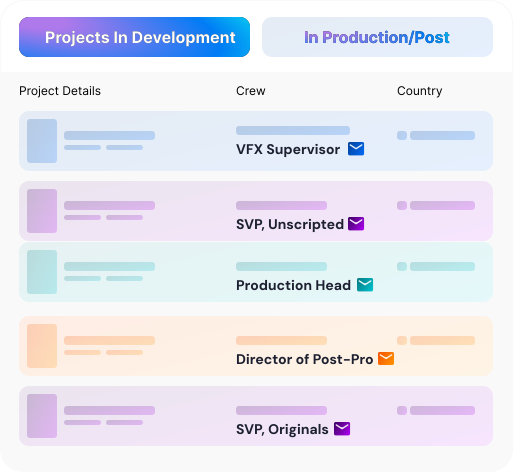
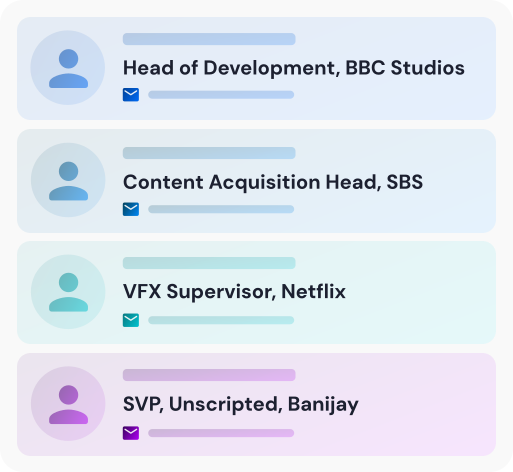
- List the post-production and VFX decision-makers at Netflix
- List the development leaders at Sony Pictures
- List the scripted programming heads at HBO
- Who is backing animation projects in Europe right now
- Who is Netflix’s top production partners for Sports Docs
- Who is Commissioning factual content in the NORDICS
- Who is acquiring unscripted formats for the North American market
The Macro Shift: Moving from Manual Sourcing to Predictive Intelligence
The global entertainment supply chain has historically been a world of “who you know” and “when you hear it.” However, in a market where content is produced across 190+ countries simultaneously, human networks are no longer sufficient to maintain a competitive edge. According to recent data from Omdia, the volume of international co-productions has increased by 22% year-over-year, creating a data density that traditional research teams can no longer manage manually.

The integration of AI in Entertainment Supply Chain Industry signals the end of the guesswork era. We are seeing a move toward “Predictive Sourcing,” where AI models analyze project milestones—from script registration to local tax credit applications—to predict when a studio will require VFX, localization, or distribution partners. This allows service vendors to pivot from “cold outreach” to “contextual engagement,” significantly increasing the probability of a successful match.
For the executive, this isn’t about replacing the human element; it’s about empowering it with high-fidelity signals. The transition from static lists to live, census-level tracking means that decision-makers can now monitor the movements of 150,000+ companies and 3 million executives in real-time, identifying shifts in production capacity and creative slates before they become public trade news.
Acquisition Intelligence: Identifying the “Green-Light Signal” Early
Content acquisition leaders are facing a “Discovery Paradox”: there is more content than ever before, but finding the right IP at the right stage is increasingly difficult. Traditional acquisition involves waiting for “Screeners” or attending major markets like MIPCOM. However, by the time a project hits the market floor, the most lucrative rights are often already spoken for.
AI-driven supply-chain tracking reshapes this timeline. By monitoring “Early Warning” signals—such as a specific showrunner attaching to a regional studio in South Korea or a spike in pre-production activity in the Andean region—acquisition teams can secure pre-buy rights or financing positions months in advance. This “Early Discovery” model is what separates the streamers who lead the charts from those who merely react to them.
The bottom line is this: AI allows for the automation of the “Qualification” phase. Instead of reviewing 500 pitches, an AI-powered agent like VIQI can filter the global supply chain for projects that match specific genre benchmarks, budget scales, and regional requirements. This efficiency ensures that executive time is spent on “Closing,” not “Sifting.”
Localization & VFX: The AI-Enhanced Delivery Pipeline
In the “Post-Production” segment of the supply chain, AI is delivering the most immediate ROI. The demand for non-English content (e.g., K-Dramas, Spanish Thrillers) has created a bottleneck in the dubbing and subtitling industry. Traditional dubbing is expensive and slow, often taking 8-12 weeks for a full series.
New AI-powered localization models are now surfacing that maintain the emotional nuance of the original actor’s voice while translating into 30+ languages simultaneously. According to industry analysis from Ampere Analysis, this technology is reducing localization costs by up to 50% while accelerating global release windows. This allows a project to debut globally on the same day, preventing piracy and maximizing the “Watercooler Effect” across territories.
Similarly, in VFX, AI is reshaping the “Render War.” Instead of labor-intensive manual rotoscoping, AI tools are automating the “utility work” of post-production, allowing creative leads to focus on high-level world-building. For the executive, this means more “On-Screen Value” for every dollar spent, as the supply chain becomes leaner and more agile.
Market Intelligence: Tracking AI-Ready Supply Chain Partners
To master the AI in Entertainment Supply Chain Industry, you must partner with companies that have already integrated these protocols into their business logic. Using the Market Discovery Protocol, we have identified three leaders currently defining the AI-enhanced supply chain:
Leveraging VIQI for supply-chain de-risking
In an ecosystem where project velocity is increasing, the ability to surface meaningful signals from the noise is a competitive necessity. Vitrina’s VIQI AI Assistant serves as a “Virtual Agent” for supply-chain professionals, transforming census-level data into qualified connections through natural language interactions.
Whether you are a CFO looking to reallocate production budget to more tax-efficient regions or an Acquisition Lead scouting for trending genre IP in Southeast Asia, VIQI provides the real-time intelligence required to de-risk those decisions. By analyzing the collaborative history of 150,000+ companies, VIQI can predict the reliability of a partner before the first meeting is even scheduled.
Run Your Own Live Intelligence Search
Tap a query below to launch VIQI and identify your next partner in seconds.
Conclusion: The Path Forward
The bottom line is this: The AI in Entertainment Supply Chain Industry has transitioned from a technical “nice-to-have” to a strategic “must-possess.” By moving from manual sourcing to predictive intelligence, the global supply chain is becoming more transparent, efficient, and profitable. Studios and streamers who embrace AI-driven discovery and localization will not only lower their operational costs but will also secure a “First-Mover” advantage in the world’s most competitive content markets.
The path forward for 2025/26 involves moving beyond static spreadsheets to census-level, real-time tracking. Utilizing Vitrina and its AI-powered agent, VIQI, allows you to de-risk your supply chain by connecting with pre-vetted partners who have the proven “Hero Project” history to deliver. The future of entertainment is being built on data; make sure your studio is at the center of the signal.
Strategic FAQ
How is AI reshaping the content acquisition process?
AI allows acquisition teams to monitor “Early Warning” signals—such as production milestones or tax credit applications—to identify high-value IP months before it hits the traditional market floor, enabling better pre-buy rights negotiation.
What is the ROI of AI in film localization?
Industry reports signal that AI localization can reduce dubbing and subtitling costs by up to 50% and turnaround times by 60%, allowing for simultaneous global releases that maximize theatrical and streaming impact.
Can AI help in finding reliable co-production partners?
Yes. By analyzing the collaborative history and “Hero Project” track records of 150,000+ companies, AI agents like VIQI can surface partners based on specific project needs and verified reputation scores.
Does Vitrina use AI for project tracking?
Vitrina utilizes AI-driven data intelligence to monitor daily movements across the global supply chain, linking projects to companies and decision-makers to provide real-time updates for industry professionals.
Find Film+TV Projects, Partners, and Deals – Fast.
VIQI matches you with the right financiers, producers, streamers, and buyers – globally.
Producers Seeking Financing, Co-Pros, or Pre-Buys?
Vitrina Concierge helps producers reach the right financiers, commissioners, distributors, and co-production partners — with precision outreach, not cold pitching.
Join Industry Briefings Trusted by Leaders

Format Adaptations: Global Trends
Where formats are traveling, which adaptations are breaking out, and how streamers are backing remakes in 2025–2026.

Books, Novels & Comics Adaptations: Global Trends
Books, webtoons, and manga driving the next global screen hits. Discover how in this webinar.

Micro-Dramas & Mobile-First Storytelling
Micro-dramas are building real audiences and revenue. Understand the platforms, buyers, and economics behind the growth.

Navigating Global Content Licensing Trends
How global content licensing is shifting beyond flat fees to flexible, deal-driven models.