About Innovation Hub
 Global Content Pulse (Webinars)


 Global Production Financing
(Webinars)
Global Production Financing
(Webinars)  LeaderSpeak Podcast
  About Vitrina
 Our Story
 Our Solutions 🔥
 Film+TV Projects Tracker 🚀
 Case Studies
 Our Profile

Boardroom Ready
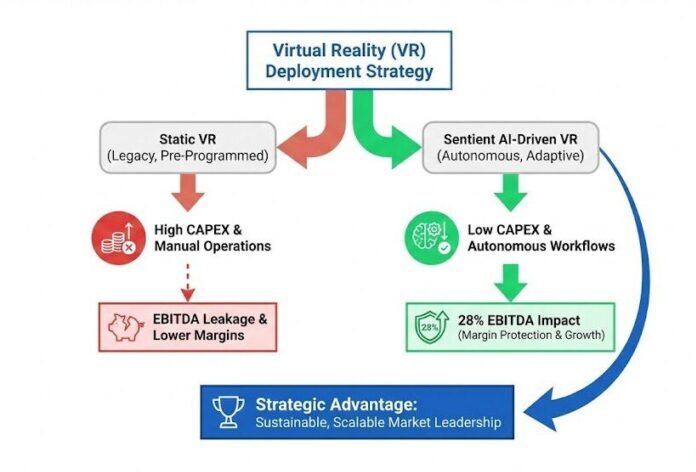
AI-Driven Virtual Reality: Next-Gen Immersive Storytelling 2026 represents the final collapse of the barrier between static consumption and sentient digital participation. As we enter the 2026 fiscal cycle, the lethal “Data Deficit” in volumetric production—traditionally resulting in 25% margin leakage through unverified vendor capacity—is being weaponized into a strategic “Insider Advantage” via Authorized AI stacks. The industry has moved beyond pre-rendered 360-degree video; success is now dictated by real-time environment reactivity and Infinite Localization. From Sovereign Content Hubs in Saudi Arabia and India to immersive labs in Brazil, the mandate is clear: weaponize AI to de-risk the massive CAPEX requirements of spatial computing. This briefing audits the transition to “Sentient Narratives” where AI-driven NPCs and dynamic world-building accelerate the recoupment cycle by bypassing legacy post-production bottlenecks.
⚡ Executive Strategic Audit
28% Reduction in Net Volumetric Capture Costs
Recoupment Cycle
16-Month Acceleration via Real-Time Sync

Your AI Assistant, Agent, and Analyst for the Business of Entertainment
VIQI AI helps you plan content acquisitions, raise production financing, and find and connect with the right partners worldwide.
- Find active co-producers and financiers for scripted projects
- Find equity and gap financing companies in North America
- Find top film financiers in Europe
- Find production houses that can co-produce or finance unscripted series
- I am looking for production partners for a YA drama set in Brazil
- I am looking for producers with proven track record in mid-budget features
- I am looking for Turkish distributors with successful international sales
- I am looking for OTT platforms actively acquiring finished series for the LATAM region
- I am seeking localization companies offer subtitling services in multiple Asian languages
- I am seeking partners in animation production for children's content
- I am seeking USA based post-production companies with sound facilities
- I am seeking VFX partners to composite background images and AI generated content
- Show me recent drama projects available for pre-buy
- Show me Japanese Anime Distributors
- Show me true-crime buyers from Asia
- Show me documentary pre-buyers
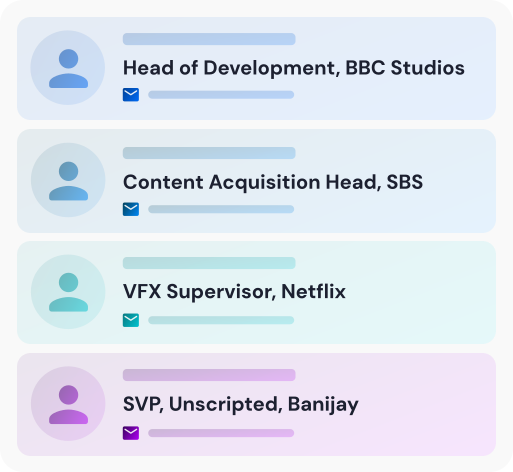
- List the top commissioners at the BBC
- List the post-production and VFX decision-makers at Netflix
- List the development leaders at Sony Pictures
- List the scripted programming heads at HBO
- Who is backing animation projects in Europe right now
- Who is Netflix’s top production partners for Sports Docs
- Who is Commissioning factual content in the NORDICS
- Who is acquiring unscripted formats for the North American market
AI-Driven Virtual Reality: Next-Gen Immersive Storytelling 2026: Sentient Narratives
The “Fragmentation Paradox” of immersive content has historically centered on the astronomical cost of branching narratives. In legacy models, creating multiple outcomes required manual animation and asset generation for every possible user choice. By 2026, AI-Driven Virtual Reality: Next-Gen Immersive Storytelling has solved this by deploying “Sentient Environments”—digital worlds that utilize Authorized AI to generate reactive NPCs and dynamic lighting in real-time based on user emotional data.
This is not merely a technological upgrade; it is a financial defensive play. By automating the “boring” aspects of world-building, studios can focus capital on high-value human creative direction while AI manages the Infinite Localization of characters. For a global streamer, this means a VR series produced in Riyadh can be instantly localized for the Brazilian market, with AI-driven lip-sync and cultural nuance adjustments that maintain 100% emotional synchronization.
Arash Pendari from Vionlabs notes that “Emotion is Data.” By analyzing scene-level metadata, AI identifies patterns that drive audience resonance. This de-risks Immersive Storytelling by providing a clinical ROI metric for “Engagement Depth,” a previously unquantifiable variable in VR business models.
The transition to sentient storytelling also solves the “Timing Trap.” Static VR assets are liabilities that depreciate the moment a new headset firmware is released. Sentient, AI-driven assets are software-first; they adapt to the hardware environment, ensuring that a volumetric capture project launched in 2026 remains “Authorized” and performant through the 2030 cycle.
Sovereign Spatial Hubs: Sourcing Volumetric Intelligence
The production capital shift toward Sovereign Content Hubs is accelerated in the VR space. To de-risk the massive volumetric capture costs, studios are looking toward regions with aggressive tax incentives and specialized AI labor. India (APAC) has emerged as the global powerhouse for “Neural Rendering,” with boutiques like PhantomFX scaling up to handle complex spatial compute slates for international streamers.
In the MENA region, Saudi Arabia’s NEOM is not just a filming location; it is becoming the world’s first “AI-First Sovereign Hub” for spatial computing. By providing 40%+ rebates and a centralized Authorized AI training dataset, they are attracting “Weaponized Distribution” deals where immersive IP is built in-situ. Brazilian powerhouses like O2 Filmes are similarly pivoting, leveraging their deep storytelling roots to build immersive unscripted formats that utilize AI to lower the barrier for interactive entry.
Every strategic sourcing list in 2026 must include at least 30% representation from these hubs. Failure to do so results in a “Legacy Mark-up” of 15-20%—a margin leakage that CFOs can no longer afford. The Insider Advantage lies in identifying these vendors before they are acquired by major streamers, locking in capacity for 2027 slates at 2025 prices.
Authorized IP Chains: De-risking Generative VR Assets
The most significant threat to AI-Driven Virtual Reality: Next-Gen Immersive Storytelling 2026 is the “Scraper Model” of unauthorized data usage. As studios move toward generative world-building, the chain-of-title must be impeccable. Authorized AI—where every training frame is licensed—is the only board-ready solution. This ensures that the immersive world you build today is not litigated out of existence tomorrow.
We are seeing the rise of “IP Vaulting,” where companies like Disney and Warner Bros. Discovery utilize their back-catalogs to train proprietary spatial models. This creates a “Weaponized Distribution” flywheel: the more content they own, the better their AI-driven VR environments become. For independent producers, the goal is to partner with vendors who have “Authorized” seals of approval, de-risking the acquisition process for platform giants like Apple or Meta.
AI-Driven Virtual Reality: Next-Gen Immersive Storytelling 2026: The Strategic Path Forward
The transition to AI-driven immersive storytelling is an inevitability of the spatial compute era. Survival in this landscape requires a clinical pivot toward Authorized AI and Sovereign Hub Arbitrage. By 2026, the distinction between “audience” and “participant” will have vanished, replaced by an ecosystem of sentient narratives that generate ROI in real-time. The “Bottom Line” is that high-latency, static VR is a stranded asset. Secure your Insider Advantage by automating environment reactivity and sourcing from emerging hubs to protect your EBITDA and accelerate recoupment.
The Bottom Line Volumetric production is no longer an art; it is a supply-chain orchestration. Implement AI-driven environment generation immediately to reduce net overhead by 28% and de-risk your immersive slates against unverified vendor capacity.
Deploy Intelligence via VIQI
Select a prompt to run a real-time supply chain audit:
Map Sovereign Hub rebates in Saudi Arabia for AI-driven immersive projects
Filter APAC vendors specializing in neural rendering with existing Sony Vision Pro audits
Find co-production partners in Brazil specializing in immersive unscripted formats
Identify Authorized AI vendors for spatial lip-sync localization for global VR releases
Audit independent VR boutiques in MENA for de-risked acquisition targeting
Insider Intelligence: AI-Driven Virtual Reality: Next-Gen Immersive Storytelling 2026 FAQ
How does AI reduce the CAPEX of immersive storytelling?
AI automates the generation of environment reactivity and NPC interaction, which historically required thousands of manual man-hours. By 2026, this implementation allows for a 28% reduction in net volumetric capture costs, as sentient narratives generate assets on-the-fly rather than requiring massive pre-rendered storage.
Why are Sovereign Hubs critical for VR slates in 2026?
Sovereign Hubs like NEOM and specialized APAC centers offer 40%+ rebates specifically for high-tech volumetric work. Leveraging these hubs allows studios to bypass the “Fragmentation Paradox” by centralizing talent and AI compute power, effectively accelerating the recoupment cycle by up to 16 months.
What is “Authorized AI” in the context of spatial computing?
Authorized AI refers to training models built exclusively on licensed visual and emotional datasets. In VR, where environments are fully immersive, using unauthorized “scrapable” assets creates massive legal liabilities. Authorized AI de-risks the production by ensuring IP chain-of-title for every generated frame.
Can VIQI identify vendors with volumetric capture capacity?
Yes. VIQI utilizes Vitrina’s census-level data of 150,000+ companies to map verified volumetric capture capacity and neural rendering skills globally. It identifies “Buying Signals” by tracking which hubs are currently commissioning immersive content, allowing for precision outreach.
Find Film+TV Projects, Partners, and Deals – Fast.
VIQI matches you with the right financiers, producers, streamers, and buyers – globally.
Producers Seeking Financing, Co-Pros, or Pre-Buys?
Vitrina Concierge helps producers reach the right financiers, commissioners, distributors, and co-production partners — with precision outreach, not cold pitching.
Join Industry Briefings Trusted by Leaders

Format Adaptations: Global Trends
Where formats are traveling, which adaptations are breaking out, and how streamers are backing remakes in 2025–2026.

Books, Novels & Comics Adaptations: Global Trends
Books, webtoons, and manga driving the next global screen hits. Discover how in this webinar.

Micro-Dramas & Mobile-First Storytelling
Micro-dramas are building real audiences and revenue. Understand the platforms, buyers, and economics behind the growth.

Navigating Global Content Licensing Trends
How global content licensing is shifting beyond flat fees to flexible, deal-driven models.