

 About Innovation Hub
 Global Content Pulse (Webinars)


 Global Production Financing
(Webinars)
Global Production Financing
(Webinars)  LeaderSpeak Podcast
  About Vitrina
 Our Story
 Our Solutions 🔥
 Film+TV Projects Tracker 🚀
 Case Studies
 Our Profile
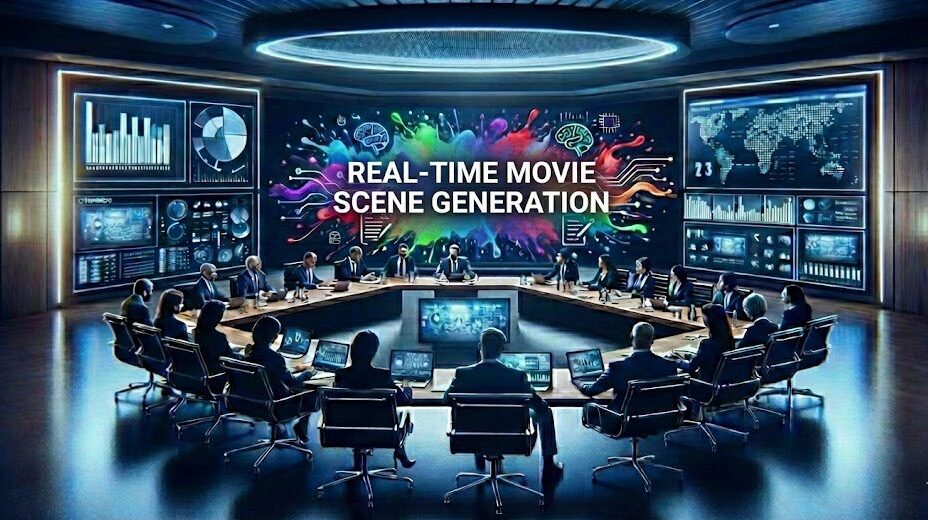
AI-driven real-time movie scene generation is the use of generative AI models and real-time rendering engines to create high-fidelity cinematic environments and characters instantaneously.
This involves integrating tools like Stable Diffusion and Runway with virtual production workflows to compress traditional post-production timelines into live, interactive sessions.
According to recent industry analysis, studios adopting real-time AI workflows have seen a 40% reduction in environment iteration time during principal photography.
In this guide, you’ll learn the specific technical methodologies, toolsets, and supply chain strategies to implement real-time scene generation immediately.
While the current content landscape focuses on the broad impact of AI, it often fails to provide the technical depth required to execute real-time scene generation on a professional level.
This guide fills those gaps by bridging the divide between theoretical AI capabilities and practical on-set application for production teams.

Your AI Assistant, Agent, and Analyst for the Business of Entertainment
VIQI AI helps you plan content acquisitions, raise production financing, and find and connect with the right partners worldwide.
- Find active co-producers and financiers for scripted projects
- Find equity and gap financing companies in North America
- Find top film financiers in Europe
- Find production houses that can co-produce or finance unscripted series
- I am looking for production partners for a YA drama set in Brazil
- I am looking for producers with proven track record in mid-budget features
- I am looking for Turkish distributors with successful international sales
- I am looking for OTT platforms actively acquiring finished series for the LATAM region
- I am seeking localization companies offer subtitling services in multiple Asian languages
- I am seeking partners in animation production for children's content
- I am seeking USA based post-production companies with sound facilities
- I am seeking VFX partners to composite background images and AI generated content
- Show me recent drama projects available for pre-buy
- Show me Japanese Anime Distributors
- Show me true-crime buyers from Asia
- Show me documentary pre-buyers
- List the top commissioners at the BBC
- List the post-production and VFX decision-makers at Netflix
- List the development leaders at Sony Pictures
- List the scripted programming heads at HBO
- Who is backing animation projects in Europe right now
- Who is Netflix’s top production partners for Sports Docs
- Who is Commissioning factual content in the NORDICS
- Who is acquiring unscripted formats for the North American market
Producers Seeking Financing & Partnerships?
Book Your Free Concierge Outreach Consultation
(To know more about Vitrina Concierge Outreach Solutions click here)
Table of Contents
Key Takeaways for Production Leaders
-
Workflow Compression: Real-time AI compresses months of environment design into minutes, enabling immediate creative feedback loops on set.
-
Tool Convergence: Success requires integrating Stable Diffusion for static assets with Runway or Unreal Engine for dynamic, high-fidelity scene generation.
-
Intelligence Edge: Platforms like Vitrina allow producers to identify active VFX vendors specializing in AI-driven real-time workflows 5x faster.
What is AI-Driven Real-Time Movie Scene Generation?
Real-time movie scene generation represents a fundamental shift from “offline” rendering to instantaneous creation. In a traditional supply chain, scenes are conceptualized, built as 3D assets, and rendered over weeks or months. AI-driven solutions bypass this latency by using neural networks to synthesize pixels in response to camera movements or lighting changes.
This technology is increasingly integrated into LED volumes and virtual production stages. By leveraging “Authorized Data” markets—similar to Disney’s investment in OpenAI—studios can now generate high-fidelity backgrounds that react to live actors in real-time. This eliminates the “green screen gap” where actors cannot see the world they are inhabiting.
Find VFX studios specializing in AI scene generation:
How Do the Tech Stacks Differ for Real-Time Generation?
The “Winning Angle” in AI scene generation isn’t just about one tool; it’s about interoperability. Stable Diffusion remains the gold standard for high-resolution static asset generation, particularly when trained on custom LoRAs (Low-Rank Adaptation) that match a project’s specific art direction. This ensures visual consistency across thousands of generated elements.
For motion, Runway Gen-2 and Sora-like models are being utilized for rapid pre-visualization. However, true on-set real-time generation often requires Unreal Engine 5.4 with AI-powered plugins that can ingest text prompts and generate 3D geometry or volumetric clouds instantly. This convergence of neural synthesis and game engine physics is where the industry is concentrating its investment.
Industry Expert Perspective: AI in Entertainment Supply-Chain
This session explores how AI is reshaping the post-production and VFX landscape, specifically addressing how technical workflows are being demystified for broader studio adoption.
Seth Hallen and Craig German discuss the practical impact of AI on the entertainment supply chain, emphasizing the need for collaboration and cross-functional intelligence to move beyond pilot projects to enterprise-scale production.
Step-by-Step Guide: Implementing AI-Driven Scene Generation
1. Establish an “Authorized Data” Strategy
Following the Disney model, secure licensing agreements for the datasets you use to train your models. This protects your project from copyright infringement claims and ensures that your generated assets are legally sound for global distribution.
2. Integrate Generative LoRAs into Virtual Production
Work with your VFX vendor to create custom LoRAs trained on your production’s concept art. On-set, your DP can then use a tablet to swap textures, weather conditions, or architectural styles in the LED volume background instantaneously.
3. Utilize Real-Time Intelligence Platforms
The supply chain for real-time AI is fragmented. Use Vitrina’s Global Film+TV Projects Tracker to monitor which studios are successfully deploying these workflows. This allows you to vet partners based on verifiable track records rather than marketing claims.
Find projects using real-time AI workflows:
Moving Forward
The shift toward AI-driven real-time scene generation is no longer a futuristic concept—it is a production reality that addresses the critical market gaps in post-production efficiency and creative control. By leveraging supply chain intelligence, producers can compress months of work into live, interactive on-set sessions.
Whether you are a VFX supervisor looking to optimize rendering pipelines or a producer trying to slash environment budgets, the data shows that those who integrate “Authorized AI” workflows now will hold the competitive edge in 2025.
Outlook: Over the next 18 months, we expect a 50% increase in LED volume productions utilizing live AI texture synthesis, effectively ending the era of the “fixed” background.
Frequently Asked Questions
Quick answers to common queries about real-time AI in filmmaking.
Are there AI-driven solutions for real-time movie scene generation today?
How does AI-driven scene generation benefit independent filmmakers?
Can AI generate scenes that react to camera movement in real-time?
What is the risk of using unauthorized AI for scene generation?
About the Author
Vitrina’s Content Architect has over 15 years of experience in the entertainment supply chain, specializing in the intersection of VFX technology and AI integration. Connect on Vitrina.
Find Film+TV Projects, Partners, and Deals – Fast.
VIQI matches you with the right financiers, producers, streamers, and buyers – globally.
Producers Seeking Financing & Partnerships?
Book Your Free Concierge Outreach Consultation
(To know more about Vitrina Concierge Outreach Solutions click here)
Producers Seeking Financing, Co-Pros, or Pre-Buys?
Vitrina Concierge helps producers reach the right financiers, commissioners, distributors, and co-production partners — with precision outreach, not cold pitching.
Join Industry Briefings Trusted by Leaders

Deep dive into Co-Pros
Ambitious co-productions are key to global hits, but most deals collapse. This deep-dive briefing is the strategic playbook. We’ll break down the financing models, partnership structures, and market insights behind today’s successful deals.

Film & TV Financing: Tax Credits & Incentives
A focused look at how 2025 tax credits and incentives are reshaping Film & TV financing decisions — and where the real value now sits.

Film & TV Financing: Pre-Buys
Learn how pre-buys work in current Film and TV financing, how they differ from pre-sales, and how they are used to close real finance plans.
Streamers – Netflix vs. Amazon – The 2026 Strategy
How Netflix and Amazon’s content and revenue strategies are diverging ahead of 2026.