About Innovation Hub
 Global Content Pulse (Webinars)


 Global Production Financing
(Webinars)
Global Production Financing
(Webinars)  LeaderSpeak Podcast
  About Vitrina
 Our Story
 Our Solutions 🔥
 Film+TV Projects Tracker 🚀
 Case Studies
 Our Profile
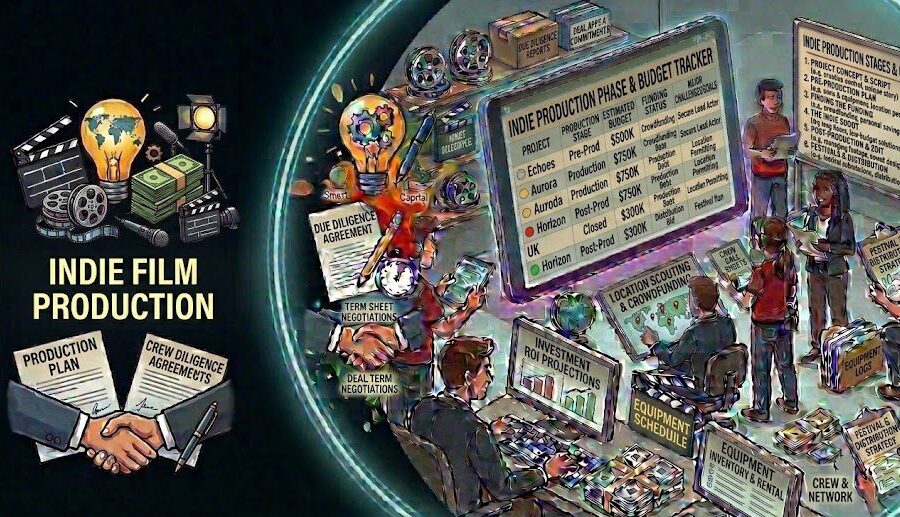
The best affordable cameras for indie film production in 2025 span a surprisingly wide price range — from $795 to just under $3,000 — and each one makes a different trade-off between image quality, workflow flexibility, and what you’ll spend rigging it out before a single frame gets shot.
The camera body itself is only part of the equation. But it’s the part that locks you into a codec, a sensor size, a color science, and a post-production workflow for the duration of your project.
Here’s what most gear guides won’t tell you: the camera decision isn’t just a creative one. It’s a financial one. Lenses for your chosen mount, rigging, audio accessories, media cards — your total kit cost can easily double or triple the body price. A $1,000 body with an incompatible lens ecosystem costs more in practice than a $1,800 body with a mature, affordable glass selection. So the real question isn’t “what’s the cheapest camera?” It’s “what’s the most cost-effective camera system for the way I actually shoot?”
This guide ranks 7 affordable cinema and hybrid cameras across 3 budget tiers, based on verified specs, real-world filmmaker reviews, and production workflow fit. Whether you’re shooting your first feature, building a micro-budget documentary, or sourcing a capable B-camera alongside a premium A-camera rental, one of these options belongs in your production plan. For context on finding camera and production equipment suppliers across 140,000+ verified companies, our equipment sourcing guide covers the full supply chain.
In This Guide
- What “Affordable” Actually Means for Indie Film Cameras
- Tier 1: Under $1,000 — Entry Point That Doesn’t Compromise
- Tier 2: $1,000–$2,000 — The Indie Sweet Spot
- Tier 3: $2,000–$3,000 — Cinema-Grade Without ARRI Pricing
- The Real Decision Framework
- Buy vs. Rent: What Experienced Producers Actually Do
- FAQ
Find Production Companies and Camera Crews for Your Indie Film
VIQI is Vitrina’s AI assistant — trained on 140,000+ production companies, 400,000+ film and TV projects, and 3 million verified professionals. Ask it which crew, equipment suppliers, or production partners match your budget and genre.
✓ 200 free credits | ✓ No credit card required
What “Affordable” Actually Means for Indie Film Cameras
Affordable is relative — but for this guide it means under $3,000 for the body, which covers the realistic budget range for independent filmmakers who aren’t using rental house economies of scale. That’s the threshold where you start making real trade-offs: RAW recording vs. compressed codecs, autofocus reliability vs. manual cinema control, sensor size vs. lens ecosystem cost. Every camera in this guide makes a different set of those trade-offs, and understanding them clearly is more valuable than any spec sheet comparison.
Four specs actually matter for indie production decisions. Dynamic range — measured in stops — determines how much detail you retain in highlights and shadows. Anything below 12 stops feels like a consumer camera in mixed lighting. Codec quality determines your post-production flexibility; Blackmagic RAW and Apple ProRes are industry-standard. Sensor size affects depth of field, low-light capability, and which lenses you can use. And autofocus — or the lack of it — decides whether you need a dedicated focus puller on your crew or can shoot single-operator. Budget for those four factors, not for headline megapixels or 8K specs that your DCP delivery will never use. As No Film School consistently notes, most DCPs still deliver at 2K, which means the technical race to 6K and 8K matters far less than the quality of your codec and color science.
Tier 1: Under $1,000 — The Entry Point That Doesn’t Compromise
1. Blackmagic Pocket Cinema Camera 4K — ~$795
The BMPCC 4K has earned near-legendary status among indie filmmakers — and for good reason. For under $800, you get a Micro Four Thirds HDR sensor with 13 stops of dynamic range, dual native ISO (400 and 3200) for clean low-light performance, and internal recording in both Blackmagic RAW 12-bit and Apple ProRes 10-bit. That’s a professional codec stack that rivals cameras costing three times the price. And it ships with a DaVinci Resolve Studio activation key — the same color grading software used in Hollywood post houses — included free. No extra software purchase required.
But there are real trade-offs. The Micro Four Thirds sensor has a 2x crop factor, which means your 35mm lenses behave like telephoto glass and wide-angle coverage gets expensive. Battery life is notoriously short — plan on a multi-battery rig or external power for anything beyond short takes. And there’s no usable autofocus; you’ll need a dedicated focus puller or a well-rehearsed manual focus workflow. For controlled shoots — dialogue scenes, planned documentary interviews, narrative projects where you’re setting up each shot carefully — this camera delivers cinematic image quality at a price that leaves budget for lights and sound, where micro-budget films usually suffer most.
Best for: First-time feature directors. Controlled narrative and documentary shoots. B-camera that matches higher-end Blackmagic systems in color science.
Watch out for: Battery management. MFT crop factor. No reliable autofocus.
Tier 2: $1,000–$2,000 — The Indie Filmmaker’s Sweet Spot
This is where the most interesting cameras live in 2025. You’re getting Super 35 sensors, mature lens ecosystems, professional codecs, and bodies that can handle demanding production environments. Three cameras dominate this tier — and they’re all genuinely excellent in different ways.
2. Canon EOS R7 — ~$1,500
The Canon EOS R7 is the outlier in this list — it’s not a dedicated cinema camera. But it’s a 32MP APS-C mirrorless with exceptional autofocus, Canon’s Dual Pixel CMOS AF system (widely regarded as one of the best in the industry), up to 15fps burst, and solid 4K video output. At $1,500, it’s the right choice for producers who are shooting hybrid content — stills and video on the same project — or for documentary-style work where fast, reliable autofocus matters more than RAW codec flexibility. The RF-S lens ecosystem is expanding rapidly, with Sigma now making APS-C RF lenses that add affordable prime options.
Best for: Run-and-gun documentary. Hybrid stills/video productions. Solo operators who can’t dedicate someone to focus pulling.
Watch out for: 4K video has limitations compared to dedicated cinema cameras. Not a RAW workflow without external recorder.
3. Sony FX30 — ~$1,799
The FX30 is the best all-around affordable cinema camera in 2025. Full stop. It packs a Super 35 APS-C back-illuminated 6K sensor, oversampled to deliver 4K at 10-bit 4:2:2 XAVC with 14+ stops of dynamic range in S-Log3. The color science — S-Cinetone — is borrowed directly from Sony’s FX6, FX9, and VENICE. That means consistent looks when you’re pairing it with higher-end Sony bodies on set, and professional-grade color out of the box without extensive grading. Add in 4K at up to 120fps, Sony’s industry-leading autofocus with face, eye, and subject tracking, 5-axis in-body image stabilization (IBIS), dual card slots, active cooling, and a compact magnesium alloy body — and you have a camera that punches well above its price class in almost every scenario.
Where does the FX30 fall short? No internal RAW — you’ll need an external Atomos Ninja V to capture 16-bit RAW via HDMI, which adds around $500–700 to your kit. And since it’s APS-C rather than full-frame, low-light performance tops out at ISO 32,000, which trails the FX3’s extraordinary ISO 409,600. For the vast majority of indie productions shooting in reasonably controlled lighting conditions, neither of those limitations will be the thing standing between you and a great film.
Best for: Narrative features, music videos, branded content, fast-paced documentary. Solo shooters and small crews. Gimbal work.
Watch out for: No internal RAW. APS-C low-light ceiling lower than full-frame alternatives.
Track 400,000+ Indie Film Projects Actively in Development Right Now
Trusted by Netflix, Warner Bros, Paramount, and Google TV. Join 140,000+ production companies and industry professionals using Vitrina to track deals, find co-production partners, and connect with active buyers.
✓ 200 free credits | ✓ No credit card required | ✓ Full platform access
4. Blackmagic Pocket Cinema Camera 6K G2 — ~$1,895
If internal RAW recording is non-negotiable for your workflow — and for many colorists and DPs working on festival-circuit films, it is — the BMPCC 6K G2 is your camera at this price point. It shoots a Super 35 sensor at 6144 x 3456 resolution in Blackmagic RAW natively, with 13 stops of dynamic range and an EF lens mount that opens the door to Canon’s vast library of cinema and stills glass. ProRes is also available internally. DaVinci Resolve Studio is included. The result is a complete post-production pipeline from a $1,895 body.
The honest trade-off: Blackmagic essentially has no reliable autofocus. There’s limited single-AF capability with native lenses, but it’s not usable in any real production context. You’re committing to manual focus — which means either budgeting a dedicated AC or building a workflow around carefully planned shots with actors hitting marks. For controlled narrative productions, that’s standard practice. For run-and-gun work, it’s a significant operational burden. The camera also lacks IBIS, though Blackmagic has added gyro data support for post-stabilization. And the body requires rigging — cages, handles, external power — before it’s comfortable for a full shooting day.
Best for: Narrative features where image quality and RAW post-production flexibility are the top priorities. Teams with a dedicated AC.
Watch out for: No usable autofocus. Needs rigging. Requires a structured manual focus workflow.
Tier 3: $2,000–$3,000 — Cinema-Grade Without the ARRI Price Tag
Push your budget to the $2,000–$3,000 range and you’re accessing full-frame sensors, Netflix-approved specs, and purpose-built cinema ergonomics. These aren’t compromises anymore — these are professional production tools that happen to be accessible to independent filmmakers.
5. Panasonic Lumix S5 II — ~$2,000
The S5 II is the full-frame hybrid that finally gave Panasonic a competitive autofocus system. Phase detection arrived with this generation — a massive upgrade over the contrast-based system in previous Lumix bodies — and paired with the camera’s 6K open gate full-frame sensor, wide V-Log dynamic range, dual native ISO, and anamorphic support, you’ve got a remarkably capable production tool. The 6K image from the S5 II is widely considered among the best value-for-money full-frame video outputs in this price bracket. Panasonic’s IBIS remains class-leading — it’s the stabilization benchmark against which Sony and Canon are measured.
Best for: Full-frame narrative work. Documentary productions requiring hybrid stills/video. Anamorphic projects.
Watch out for: AF still trails Sony and Canon for fast-moving subjects. L-mount lens ecosystem smaller than RF or E-mount.
6. Panasonic S1H — ~$1,100 Used / Originally $4,000
Here’s the insider move most affordable camera guides miss. The Panasonic S1H — historically the first and only mirrorless camera certified by Netflix for use as a primary A-camera on Netflix Originals productions — has dropped dramatically on the used market. You can find well-maintained bodies for around $1,100 now. That means you’re getting 6K full-frame recording, 14+ stops of dynamic range in V-Log, 10-bit 4K at up to 60fps with 4:2:2 ALL-I codec at 400Mbps, unlimited recording times, and a Netflix badge — all for what a used consumer mirrorless costs. The S1H’s color science matches Panasonic’s VariCam cinema cameras. Productions that shot with VariCam 35s used the S1H as their matched B-camera and crash camera.
Best for: Any indie producer with documentary content targeting streaming platforms. Matched B-camera to higher-end Panasonic rigs.
Watch out for: Pre-phase-detect Lumix AF — lacks the tracking performance of S5 II. Buy from reputable used dealers with sensor checks.
7. Blackmagic PYXIS 6K — ~$2,995
The PYXIS 6K is Blackmagic’s most filmmaker-friendly body to date — a purpose-built box-style cinema camera with an aerospace aluminum chassis, full-frame 36×24mm sensor at 6048×4032 native resolution, 13 stops of dynamic range, and dual native ISO up to 25,600. It records internally in 12-bit Blackmagic RAW with simultaneous H.264 proxy files, features dual CFexpress Type-B card slots, and includes a 4-inch HDR touchscreen at 1,500 nits that’s actually readable in direct sunlight. The box form factor is purpose-built for rigging — multiple ¼-inch and 3/8-inch mount points throughout the body means you’re building your rig, not fighting the camera’s ergonomics.
This is a camera that’s been explicitly designed for the indie film set. At $2,995 (with frequent sales bringing it closer to $2,400–$2,500), it competes directly with the Sony FX3 and Canon R5 C — but unlike those hybrid options, the PYXIS is pure cinema. No photo mode diluting the video feature set. No compromises for stills shooters. Just a full-frame cinema sensor, BRAW, DaVinci Resolve Studio included, and a modular body that grows with your production needs. That said: no IBIS, no autofocus (same Blackmagic limitation), and the accessory budget for a full rig will add $500–$1,500 before your first day of shooting.
Best for: Serious indie features. Filmmakers who want a pure cinema workflow — BRAW → DaVinci Resolve — without the ARRI price.
Watch out for: No IBIS. No autofocus. Factor in rigging budget before committing.

Your AI Assistant, Agent, and Analyst for the Business of Entertainment
VIQI AI helps you plan content acquisitions, raise production financing, and find and connect with the right partners worldwide.
- Find active co-producers and financiers for scripted projects
- Find equity and gap financing companies in North America
- Find top film financiers in Europe
- Find production houses that can co-produce or finance unscripted series
- I am looking for production partners for a YA drama set in Brazil
- I am looking for producers with proven track record in mid-budget features
- I am looking for Turkish distributors with successful international sales
- I am looking for OTT platforms actively acquiring finished series for the LATAM region
- I am seeking localization companies offer subtitling services in multiple Asian languages
- I am seeking partners in animation production for children's content
- I am seeking USA based post-production companies with sound facilities
- I am seeking VFX partners to composite background images and AI generated content
- Show me recent drama projects available for pre-buy
- Show me Japanese Anime Distributors
- Show me true-crime buyers from Asia
- Show me documentary pre-buyers
- List the top commissioners at the BBC
- List the post-production and VFX decision-makers at Netflix
- List the development leaders at Sony Pictures
- List the scripted programming heads at HBO
- Who is backing animation projects in Europe right now
- Who is Netflix’s top production partners for Sports Docs
- Who is Commissioning factual content in the NORDICS
- Who is acquiring unscripted formats for the North American market
The Real Decision Framework — Match Camera to Production Reality
Stop choosing cameras based on spec sheets. Choose based on your actual production conditions. Four questions determine the right camera for your project — not your aspirations, your actual shoot.
How many people are on your camera team? Solo shooter or small crew without a dedicated AC → you need autofocus. Sony FX30 or Canon EOS R7. Two-person camera team with a trained AC → manual focus is viable → BMPCC 6K G2 or PYXIS 6K open up.
What are your lighting conditions? Shooting in uncontrolled mixed lighting, night exteriors, or documentary-style available light → prioritize low-light performance → Sony FX30 (ISO 32,000) or Panasonic S1H/S5 II (dual native ISO). Controlled studio or well-lit locations → Blackmagic’s sensors shine in these conditions.
What’s your post-production pipeline? If you’re delivering to a platform that requires specific camera specs — check the Netflix approved camera list before committing. If you’re targeting festival circuit, BRAW gives you the most grading latitude. If you’re delivering compressed for streaming, Sony’s XAVC S is proven and widely accepted.
What lenses do you already own or can afford? This matters more than most producers realize. EF mount (BMPCC 6K G2, PYXIS EF) gives you access to the widest selection of affordable cinema and stills glass. E-mount (Sony FX30) has the largest mirrorless lens selection. L-mount (PYXIS L, S5 II, S1H) is growing fast but still smaller. Knowing your lens situation before choosing a body can save you thousands.
Need Production Partners Who Can Help Execute Your Indie Film?
Vitrina Concierge connects indie producers directly to verified production service companies, co-production partners, and equipment suppliers across 100 markets.
- LA producer → Netflix UK in 48 hours
- Korean animation studio → Netflix Adult Animation (week one)
- Middle Eastern producer → Legendary Pictures (direct access)
Buy vs. Rent — What Experienced Indie Producers Actually Do
Veteran indie producers — the ones who’ve made 3, 5, 10 films — rarely own every camera they shoot on. They own the body they use constantly: B-roll work, development shoots, proof-of-concept short films. And they rent what they need for principal photography. A Sony VENICE or ARRI Alexa Mini LF costs $400–$600 per day from a rental house — expensive on a $20,000 micro-budget, but potentially the right call for a $300,000 feature where distribution conversations hinge on image quality.
The hybrid strategy: own an affordable camera in this guide for development, documentary, and B-camera work. Budget the A-camera rental separately, priced against what the distribution outcome demands. For producers building their first production company infrastructure — our equipment rental guide covers how to identify and vet qualified rental house partners globally. And once you’ve defined your production team, hiring verified production crew with the right camera experience for your chosen system is the next critical step. The camera is only as good as the DP running it.
Which Affordable Camera Is Right for You?
The fragmentation paradox of the affordable camera market is real: there are more genuinely excellent options in 2025 than at any point in film history, which makes the decision harder, not easier. But the decision tree is cleaner than it looks.
Need autofocus and versatility? Sony FX30. Need full-frame on a tight budget? Used Panasonic S1H. Want the best internal RAW under $2,000? BMPCC 6K G2. Building a serious indie feature pipeline around DaVinci Resolve? Blackmagic PYXIS 6K. Shooting hybrid stills and film for a full-frame look? Panasonic S5 II. Just starting out and want a complete system under $1,000? BMPCC 4K — and spend the rest on lenses, lights, and sound.
Key Takeaways:
- The Sony FX30 (~$1,799) is the best all-around affordable cinema camera in 2025 — Super 35, 14+ stops DR, 4K120fps, best-in-class autofocus, IBIS, Sony’s cinema color science in a compact body.
- The Blackmagic BMPCC 4K (~$795) remains the entry-point king — 13 stops DR, internal BRAW/ProRes, DaVinci Resolve Studio included, for under $800.
- Internal RAW is only worth paying for if your post-production workflow actually exploits it — don’t pay the RAW premium if you’re delivering compressed H.264 for web distribution.
- The used Panasonic S1H is the most underrated option in 2025 — Netflix-approved, full-frame, 14+ stops DR, for ~$1,100 on the used market.
- Autofocus matters more than most narrative filmmakers admit — if you can’t afford a dedicated AC, prioritize AF performance over codec quality.
- The total system cost — body + lenses + rigging + media — is always 1.5–3x the body price. Budget accordingly before committing to a mount ecosystem.
Frequently Asked Questions: Affordable Cameras for Indie Film
What are the best affordable cameras for indie film production in 2025?
The best affordable cameras for indie film production in 2025, ranked by tier, are: Blackmagic Pocket Cinema Camera 4K (~$795, best under $1,000), Canon EOS R7 (~$1,500, best autofocus hybrid), Sony FX30 (~$1,799, best all-around), Blackmagic BMPCC 6K G2 (~$1,895, best internal RAW under $2,000), Panasonic S1H (~$1,100 used, best value Netflix-approved), Panasonic S5 II (~$2,000, best full-frame hybrid), and Blackmagic PYXIS 6K (~$2,995, best purpose-built cinema box).
Is the Sony FX30 good for indie filmmaking?
Yes. The Sony FX30 is widely considered the best all-around affordable cinema camera for indie filmmakers in 2025. It features a Super 35 APS-C sensor with 14+ stops of dynamic range in S-Log3, 4K recording at up to 120fps in 10-bit 4:2:2 XAVC, S-Cinetone color science (from Sony’s FX6 and FX9), 5-axis IBIS, and Sony’s industry-leading autofocus with face and eye detection. At approximately $1,799 for the body, it bridges the gap between consumer and professional cinema in a compact, gimbal-friendly form factor. Its main limitations are APS-C sensor (not full-frame) and no internal RAW (requires external recorder for RAW workflow).
What is the cheapest cinema camera for indie filmmakers?
The Blackmagic Pocket Cinema Camera 4K (BMPCC 4K) is the most affordable true cinema camera for indie filmmakers, available for approximately $795–$995. It features a Micro Four Thirds HDR sensor with 13 stops of dynamic range, dual native ISO (400 and 3200), internal recording in Blackmagic RAW 12-bit and Apple ProRes 10-bit, and ships with a DaVinci Resolve Studio activation key. Its main limitations are Micro Four Thirds crop factor (2x), short battery life, and no reliable autofocus.
Is the Blackmagic Pocket Cinema Camera good for professional film production?
Yes, the Blackmagic Pocket Cinema Camera lineup (4K, 6K G2, and PYXIS 6K) is widely used in professional indie film production. The cameras record in Blackmagic RAW, an industry-standard codec trusted by professional colorists, and include DaVinci Resolve Studio. The 6K G2 features a Super 35 sensor with 13 stops of dynamic range and an EF lens mount compatible with a wide range of cinema glass. The main limitation across the lineup is the lack of reliable autofocus — all Blackmagic cameras require a manual focus workflow with a dedicated focus puller in professional production contexts.
What camera should I use for a micro-budget indie feature film?
For a micro-budget indie feature (under $100,000), the Sony FX30 (~$1,799) or Blackmagic Pocket Cinema Camera 6K G2 (~$1,895) are the most common professional choices in 2025. The FX30 is best if you have a small crew and need autofocus reliability. The BMPCC 6K G2 is best if you have a dedicated AC and want internal RAW recording in Blackmagic RAW for maximum post-production flexibility. Both deliver image quality that rivals far more expensive systems and are widely accepted by festivals and streaming platforms.
What is the Blackmagic PYXIS 6K and how does it compare to the Pocket Cinema Camera?
The Blackmagic PYXIS 6K (~$2,995) is Blackmagic’s latest generation cinema box camera featuring a full-frame 36×24mm sensor at 6048×4032 native resolution — approximately 3x larger than a Super 35 sensor. It records internally in 12-bit Blackmagic RAW with simultaneous H.264 proxy files, features dual CFexpress Type-B card slots, a 4-inch HDR touchscreen, dual native ISO up to 25,600, and a box-style body designed for modular rigging. Compared to the Pocket Cinema Camera 4K and 6K G2, the PYXIS offers a larger full-frame sensor, better low-light performance, more professional I/O (SDI, 12G output), and a cinema-optimized ergonomic design, at approximately double the price of the BMPCC 6K G2.
Should indie filmmakers buy or rent their camera for production?
Most experienced indie producers use a hybrid approach: own an affordable camera in the $800–$2,000 range for development shoots, proof-of-concept work, and B-camera use; rent a higher-end A-camera for principal photography when distribution conversations demand premium image quality. A Sony VENICE or ARRI Alexa Mini LF typically rents for $400–$600 per day. For a 20-day shoot on a feature film targeting theatrical or premium streaming distribution, the rental cost is justified against the production value it adds. The key is matching the camera budget to the distribution outcome you’re actually targeting, not to an aspirational standard.
Find Production Partners, Equipment Suppliers & Active Buyers for Your Indie Film
Trusted by Netflix, Warner Bros, Paramount, and Google TV. Search 400,000+ projects, 3 million executives, and 140,000+ verified production companies across 100 markets.
✓ 200 free credits | ✓ No credit card required | ✓ Cancel anytime
Or let Vitrina Concierge make warm introductions to co-production partners and buyers actively acquiring indie films. Explore Concierge Service →
Find Film+TV Projects, Partners, and Deals – Fast.
VIQI matches you with the right financiers, producers, streamers, and buyers – globally.
Producers Seeking Financing & Partnerships?
Book Your Free Concierge Outreach Consultation
(To know more about Vitrina Concierge Outreach Solutions click here)
Producers Seeking Financing, Co-Pros, or Pre-Buys?
Vitrina Concierge helps producers reach the right financiers, commissioners, distributors, and co-production partners — with precision outreach, not cold pitching.
Join Industry Briefings Trusted by Leaders

Film & TV Financing: Pre-Buys
Learn how pre-buys work in current Film and TV financing, how they differ from pre-sales, and how they are used to close real finance plans.
Streamers – Netflix vs. Amazon – The 2026 Strategy
How Netflix and Amazon’s content and revenue strategies are diverging ahead of 2026.
Format Adaptations: Global Trends
Where formats are traveling, which adaptations are breaking out, and how streamers are backing remakes in 2025–2026.