IHUB
IHUB
 Private Briefings (Webinars)


 LeaderSpeak Podcast
  Global Entertainment Digest (Newsletter)
  Premium Lists
 Membership Benefits
 About Vitrina
 Our Story
By Vitrina Research Team | Published: October 12, 2026 | 10 min read
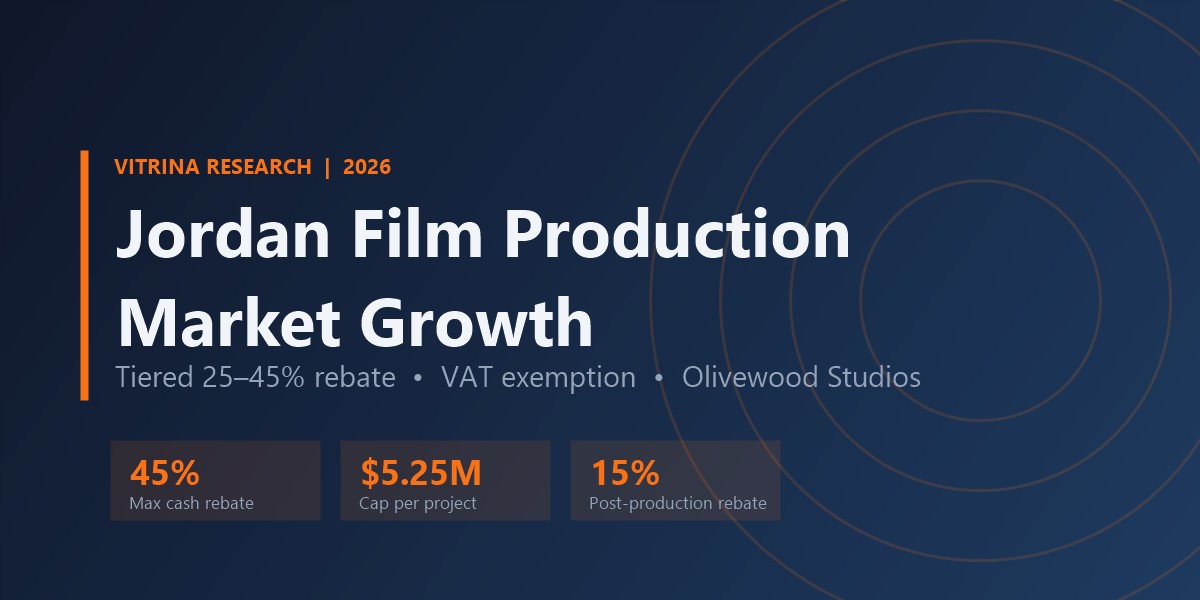
Jordan film production market growth is being driven by a deliberate policy reset. The Royal Film Commission’s tiered cash rebate now returns between 25% and 45% of eligible spend, with a cash-back cap of $5.25 million per project and an additional rebate of up to 15% on post-production performed locally, according to the Royal Film Commission – Jordan. For producers, financiers, and studio executives, a country famous for the deserts of “Lawrence of Arabia,” “The Martian,” and “Dune” is building the incentive and studio structure to win entire productions, not just a few weeks of location work.
The momentum is institutional. Jordan pairs the rebate with automatic exemptions from its 16% value added tax and 10% withholding tax, and its first purpose-built studio, Olivewood Film Studios, is now managed in partnership with U.S. operator Shadowbox Studios, as reported by Variety in June 2026. Combined with a crew base trained on some of the largest productions of the past decade, that gives Jordan a credible pitch as a full-service production territory in the Middle East.
Key Takeaways
- Jordan’s cash rebate ranges from 25% to 45% of eligible spend, rising with budget tier and a points-based assessment, capped at $5.25 million per project.
- An additional rebate of up to 15% applies to post-production performed in Jordan, and productions benefit from automatic exemptions from 16% VAT and 10% withholding tax.
- The minimum qualifying spend starts at $250,000, opening the scheme to independent features, series, documentaries, and commercials.
- Olivewood Film Studios near Amman offers two soundstages of about 1,500 square metres each and a 16-acre backlot, now managed with Shadowbox Studios.
- Jordan’s track record includes “Lawrence of Arabia,” “The Martian,” “Aladdin,” “Star Wars: The Rise of Skywalker,” and the “Dune” films.
Why Jordan Is Emerging as a Middle East Production Hub
Jordan has hosted major international productions for more than 60 years. David Lean shot “Lawrence of Arabia” in Wadi Rum, Steven Spielberg ended “Indiana Jones and the Last Crusade” at Petra, and Ridley Scott used Wadi Rum as Mars in “The Martian.” For most of that time, Jordan functioned as a location, with crews flying in for desert sequences before moving on.
Jordan film production market growth now rests on three reinforcing factors. First, a cash rebate overhauled in 2025 to compete with larger Gulf incentives. Second, a stable, well-organized film commission, established in 2003, that coordinates permits, security, and logistics across government agencies. Third, a local crew base that has repeatedly serviced studio-scale productions and now has dedicated stage space to work in.
For producers and financiers, the question is no longer whether Jordan can deliver spectacular locations. It is whether the rebate tiers, points score, and local capacity support a specific budget and schedule. The table below summarizes the core numbers.
| Metric | Detail | Source |
|---|---|---|
| Cash rebate range | 25% to 45% of eligible spend, by budget tier and points score | Royal Film Commission |
| Spend tiers | $250K–$1M: 25%; $1M–$10M: 30%; $10M+: 35% to 45% | Royal Film Commission |
| Rebate cap | $5.25 million cash back per project | Royal Film Commission |
| Post-production rebate | Up to 15% of post-production performed in Jordan | Royal Film Commission |
| Tax exemptions | Automatic exemption from 16% VAT and 10% withholding tax | Variety, June 2026 |
How Big Is Jordan’s Film Production Market?
Jordan’s domestic market is small, with a population of around 11 million and a modest theatrical sector. Its production economy depends on inbound international work, co-productions, and a growing slate of Arabic-language streaming series. That shapes Jordan film production market growth: success is measured by how much international spend the country captures and how much of it stays with local crews and vendors, rather than by local box office.
Jordan Base Cash Rebate by Eligible Spend Tier
Source: Royal Film Commission – Jordan. Rates above 35% depend on a cultural relevance test; points bonuses can add up to 10%.
The Tiered Cash Rebate Program
The rebate scales with eligible spend: 25% for $250,000 to $1 million, 30% for $1 million to $10 million, and 35% to 45% above $10 million, with rates above 35% tied to a cultural relevance test. On top of the base rate, a points system scored out of 120 rewards cultural representation, local employment and training, economic contribution, international promotion, environmental responsibility, and co-production. Projects need at least 70 points, and higher scores add between 2% and 10%. Eligible formats include feature films, series, documentaries, TV shows, commercials, and music videos. Producers comparing the scheme internationally can use Vitrina’s country-by-country comparison of film production tax incentives.
Tax Exemptions and Post-Production Incentive
Beyond the cash rebate, productions receive automatic exemption from Jordan’s 16% VAT and 10% withholding tax, which reduces upfront costs rather than waiting for a refund. A separate rebate of up to 15% applies to post-production services performed in Jordan, an incentive aimed at keeping more of the value chain in the country after principal photography wraps. For producers, the practical effect is that the tax exemptions improve cash flow during the shoot, while the rebate and post-production incentive arrive after audit, so financing plans should treat them as separate timing streams.
Studio and Crew Infrastructure
Olivewood Film Studios, about 15 minutes from Amman, is Jordan’s first purpose-built studio complex, with two soundstages of roughly 1,500 square metres each and a 16-acre backlot. Shadowbox Studios, which operates facilities in Atlanta, the UK, and New York, took on a management role in 2025. Jordanian crews have worked on productions including “Aladdin,” “Star Wars: The Rise of Skywalker,” and the “Dune” films, giving the market experienced department heads in areas such as locations, construction, and logistics.
Why International Producers Are Choosing Jordan Now
Jordan’s location record is hard to match. Denis Villeneuve’s “Dune” and “Dune: Part Two” both used Wadi Rum’s red sand and rock formations, following “The Martian,” “Rogue One: A Star Wars Story,” and “Star Wars: The Rise of Skywalker.” Disney’s live-action “Aladdin” also filmed in the country. Each of these productions added to local crew experience and to Jordan’s reputation for handling large, security-sensitive desert shoots.
Arabic-language streaming has opened a second line of demand. Netflix’s first Arabic original series, “Jinn,” and the drama “AlRawabi School for Girls” were both produced in Jordan, and Jordanian filmmakers continue to build international profiles, from Naji Abu Nowar’s Oscar-nominated “Theeb” to Amjad Al Rasheed’s “Inshallah a Boy,” which premiered in Cannes Critics’ Week in 2023. That talent base supports majority Jordanian co-productions as well as service work.
The rebate overhaul is what turns that reputation into local spend. Lower entry thresholds and higher top-tier rates let Jordan compete for a wider range of budgets, while the cap keeps the program predictable for the government. Producers also weighing larger Gulf incentives can compare Jordan with Vitrina’s guide to Saudi Arabia film production investment.
VITRINA INTELLIGENCE
Who’s Actually Producing in Jordan Right Now?
Trade headlines show you the “Dune” shoots. VIQI shows you the verified production service companies, vendors, and financiers behind them — searchable by capability, budget tier, and deal activity across 159,223 companies, instead of chasing referrals.
How Producers Access Jordan’s Incentives and Local Partners
Accessing the rebate runs through a licensed local production services company, so choosing that partner is the first financing decision.
Applying for the Cash Rebate
The local production services company submits the application before filming begins. After approval, the production signs an agreement, shoots, and submits audited spend reports, with payment due within 150 days of the audit submission. Producers can request an advance of 10% of the rebate, capped at $100,000, against a standby bank guarantee, which helps with early cash flow.
Structuring Co-Productions and Financing
Co-production is one of the scoring categories in the points system, so structuring a project with a Jordanian co-producer can raise the rebate rate as well as improve access to local crews and locations. Regional financiers and funds increasingly back projects shot in the Levant and Gulf; Vitrina’s directory of top film financing companies in the Middle East is a useful starting point for building the rest of the capital stack.
What Are the Core Challenges in Producing in Jordan?
Jordan film production market growth faces two practical constraints that producers should plan for.
Capacity and Scale
With one purpose-built studio complex, stage availability can tighten when a large production is in the country, and crew depth in specialized roles such as VFX supervision is thinner than in major European hubs. Productions that need extensive stage work alongside desert exteriors should confirm availability early. Remote desert locations also add cost: base camps, power, water, and crew transport for Wadi Rum shoots need to be budgeted as their own line items, and summer heat narrows the practical shooting window for exterior work.
Regional Perception and Insurance
Jordan is stable and has hosted major studio productions continuously, but regional conflict can affect how insurers, completion guarantors, and talent perceive risk. Clear security planning through the Royal Film Commission and early conversations with insurers help prevent last-minute schedule or cost changes.
Which Regions Within Jordan Are Attracting the Most Production?
Production activity concentrates in three areas.
Amman: Studios, Crews, and Post-Production
Amman is home to Olivewood Film Studios, the Royal Film Commission, production service companies, and post-production facilities. It also offers urban locations that can double for other Middle Eastern cities.
Wadi Rum and the South: Desert Locations
Wadi Rum is Jordan’s best-known location, used for “Lawrence of Arabia,” “The Martian,” and the “Dune” films. Its scale and accessibility make it one of the most practical large desert locations for international crews.
Petra and the Dead Sea: Heritage and Unique Landscapes
Petra’s rock-cut architecture and the Dead Sea’s salt flats and shoreline offer distinctive settings. Heritage sites require additional permissions and careful scheduling around tourism, and productions typically work with the Royal Film Commission to coordinate access with site authorities well before the shoot.
What Makes a Production a Good Fit for Jordan?
Jordan film production market growth does not benefit every project equally, and fit should be checked before committing.
Budget Tier and Rebate Efficiency
Productions with $10 million or more of eligible spend reach the higher tiers, but the $5.25 million cap means effective rates fall for the largest budgets. Mid-budget features and series that can place most of their spend locally tend to capture the most value.
Genre and Location Fit
Science fiction, fantasy, action, war, and biblical or historical stories benefit most from Jordan’s deserts and ancient sites. Arabic-language series and regional co-productions also score well on the cultural and co-production criteria.
How Jordanian Service Vendors and Studios Are Getting Discovered by International Productions
As incentives improve, international producers considering Jordan face a familiar problem: there is no central, verified view of which production service companies, equipment houses, and post facilities can support their budget and genre. Most introductions still come through the film commission, festivals, and personal referrals.
For Jordanian vendors and studios, that is a business development opportunity. Producers and streaming sourcing teams researching the country are looking for verified local partners, and being visible to them is becoming a real competitive advantage.
VITRINA INTELLIGENCE
Invisible to the Producers Looking at Jordan?
International interest in Jordan is growing, and most of it still moves through referrals. List your service company, studio, or vendor business on Vitrina and get found by the producers actively sourcing Jordanian partners.
How Vitrina Helps Producers and Financiers Navigate the Jordanian Market
Acting on Jordan film production market growth requires knowing who is actively producing in the country, which service companies can file rebate applications, and which financiers and co-producers are structuring regional deals. That intelligence has historically been scattered across trade coverage, festival catalogs, and personal networks. VIQI, Vitrina’s M&E intelligence platform, consolidates it into a searchable database of 159,223 verified companies worldwide.
Producers and financiers use VIQI to identify Jordanian production companies, studios, and vendors by capability, budget tier, and deal activity, cutting partner research from weeks to hours. Film commissions use it to understand which producers are evaluating their territory.
For Jordanian studios and vendors, a VIQI listing puts their credits and capabilities in front of the international producers and streaming teams evaluating the market.
VITRINA INTELLIGENCE
Still Finding Jordanian Partners by Cold Email?
See how producers and financiers use VIQI to go from weeks of cold outreach to a focused, hours-long search — verified service companies, vendors, and co-production partners across 159,223 companies.
Conclusion
Jordan film production market growth is a structural shift built on decades of location credibility. A tiered rebate of up to 45%, automatic tax exemptions, a post-production incentive, and a professionally managed studio complex have moved Jordan from a desert backdrop toward a full-service production territory.
The opportunity comes with conditions. Producers and financiers need to model the tiers, points score, and cap correctly, and plan around studio capacity. Jordanian vendors and studios are positioned to capture more international work, if buyers can find them.
For producers and acquisition executives, the practical challenge is intelligence: who is producing in Jordan, who holds verified local capacity, and who is structuring regional deals. That is the gap VIQI is built to close. Start your search for Jordanian production partners today.
Frequently Asked Questions
What is the cash rebate for filming in Jordan?
Jordan offers a tiered cash rebate of 25% to 45% of eligible spend: 25% for $250,000 to $1 million, 30% for $1 million to $10 million, and 35% to 45% above $10 million. A points system can add up to 10%, the cap is $5.25 million per project, and post-production in Jordan can earn up to 15%.
What is driving Jordan film production market growth in 2026?
An overhauled rebate with lower entry thresholds and higher top rates, automatic VAT and withholding tax exemptions, the Olivewood Film Studios partnership with Shadowbox, and a track record of major productions such as the “Dune” films, “The Martian,” and “Aladdin.”
How long does it take to receive the Jordan cash rebate?
Payment is due within 150 days of submitting the audited spend reports. Productions can request an advance of 10% of the rebate, capped at $100,000, against a standby bank guarantee.
What are the biggest challenges of producing in Jordan?
Limited studio capacity and thinner crew depth in specialized roles are the main operational constraints. Regional perception can also affect insurance and talent decisions, so early security planning with the Royal Film Commission is important.
How can Jordanian studios and vendors get discovered by international productions?
Most Jordanian service companies and vendors still rely on the film commission, festivals, and referrals. Listing on an M&E intelligence platform like Vitrina’s VIQI puts verified credits and capabilities in front of producers and streaming platforms sourcing partners for Jordan shoots.
About the Author
Vitrina Research Team
The Vitrina Research Team produces intelligence-led analysis on media and entertainment industry structure, deal activity, and market trends. Our research draws on VIQI’s proprietary dataset of 159,223 M&E companies worldwide.