IHUB
IHUB
 Private Briefings (Webinars)


 LeaderSpeak Podcast
  Global Entertainment Digest (Newsletter)
  Premium Lists
 Membership Benefits
 About Vitrina
 Our Story
By Vitrina Research Team | Published: October 12, 2026 | 11 min read
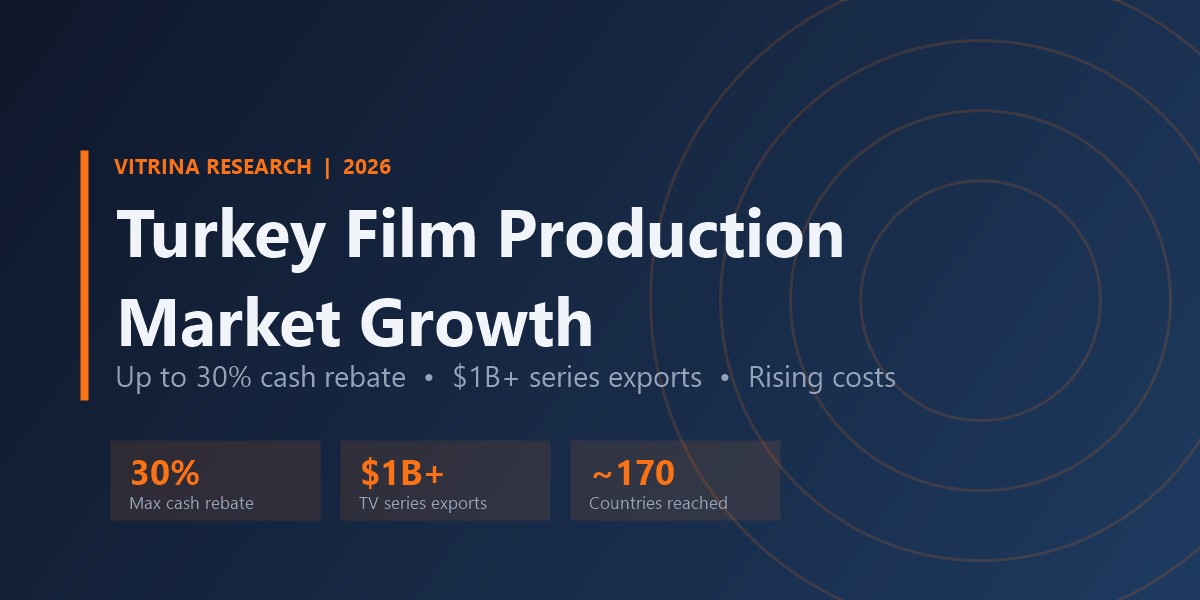
Turkey film production market growth is built on a number few territories can match: Turkish TV series now earn more than $1 billion in export revenue and reach close to 1 billion viewers in nearly 170 countries, according to Culture and Tourism Minister Mehmet Nuri Ersoy, as reported by Anadolu Agency in December 2025. For producers, financiers, and acquisition executives, Turkey is no longer just a supplier of long-running melodramas to the Middle East and Latin America. It is a full-service production territory with a state cash rebate, a deep Istanbul vendor base, and a government now paying directly for export-ready drama.
The momentum is policy-backed. In February 2026, Ankara announced support of up to the lira equivalent of $100,000 per episode for Turkish series broadcast abroad, according to Turkish Minute. That sits on top of a cash rebate of up to 30% for international productions. The same year exposed the market’s biggest risk: production costs that have climbed far faster than advertising revenue. Understanding both sides of that equation is now essential for anyone structuring a deal in Turkey.
Key Takeaways
- Turkish TV series exports have passed $1 billion, reaching nearly 170 countries and close to 1 billion viewers (Ministry of Culture and Tourism, December 2025).
- Turkey’s cash rebate returns up to 30% of eligible local spend under Law 5224, filed through a qualified Turkish co-producer or production service company.
- A February 2026 scheme adds up to $100,000 (paid in lira) per episode for series broadcast in at least 10 countries across three continents.
- Hourly production costs have roughly tripled to more than $240,000, and advertising now covers only about half of an episode’s budget (Financial Times, February 2026).
- Netflix’s 2026 Turkish slate, Prime Video’s ad-funded investment, and Hollywood shoots like “The Night Agent” signal sustained international demand for Turkish production capacity.
Why Turkey Is Emerging as a Global Film and TV Production Hub
Turkey has hosted Hollywood for years. “Skyfall” opened with a rooftop chase over Istanbul’s Grand Bazaar, “Taken 2” was set in the city, and “Argo” used Istanbul to stand in for Tehran. Those were location visits. What has changed is the scale of the domestic industry behind them. Turkey produces more TV series episodes each year than any other country, and officials place it among the world’s three largest TV exporters alongside the US and UK.
Turkey film production market growth now rests on three reinforcing factors. First, a dizi engine that trains crews on punishing weekly schedules, often delivering feature-length episodes every week. Second, a cash rebate that gives international productions a direct financial reason to base work in the country. Third, a government that treats series exports as soft power and tourism promotion, and is now funding them accordingly. Minister Ersoy called Turkish series “Türkiye’s greatest soft power” when announcing the latest export figures.
For producers and financiers, the question is no longer whether Turkey can deliver. It is whether the rebate math, lira cost exposure, and local partner quality line up for a specific budget and format. The table below summarizes the core numbers.
| Metric | Detail | Source |
|---|---|---|
| Cash rebate rate | Up to 30% of eligible spend in Turkey (features, documentaries, TV series) | Ministry of Culture and Tourism |
| Who applies | Turkish co-producer or service company with recent credits (two features or one full TV season in five years) | Filming in Türkiye |
| Export series support | Up to $100,000 per episode (paid in lira) for series aired in 10+ countries on three continents | Turkish Minute, Feb 2026 |
| TV series export revenue | More than $1 billion; nearly 170 countries | Anadolu Agency, Dec 2025 |
| Production cost pressure | Hourly costs roughly tripled to more than $240,000 | Financial Times, Feb 2026 |
How Big Is Turkey’s Film and TV Production Market?
The headline figure is exports. Turkish series earned roughly $10 million abroad in the early 2000s, according to Turkey’s Directorate of Communications, and have since passed $1 billion, a hundredfold increase in about two decades. Domestically, output is driven by six broadcasters, five commercial channels plus state broadcaster TRT, each airing a dizi every weeknight for up to 75 hours of scripted programming a week, per Parrot Analytics data cited by the Financial Times. Turkey film production market growth is therefore TV-led first and theatrical second, which shapes where the capacity, crews, and financing actually sit.
Turkish TV Series Export Revenue (USD)
Source: Turkish Directorate of Communications; Ministry of Culture and Tourism via Anadolu Agency, 2025
The 30% Cash Rebate Program
Turkey’s cash rebate returns up to 30% of eligible expenses incurred in the country for feature films, documentaries, and TV series. It is run by the Ministry of Culture and Tourism’s General Directorate of Cinema under Law 5224, according to the official Filming in Türkiye portal. Foreign producers cannot apply directly. The application must come from a Turkish co-producer or production service company that has delivered at least two feature films or one full TV season in the past five years. Industry guides describe the scheme as selective: projects are scored on a points test, and 30% is a ceiling rather than a guaranteed rate. Minimum spend thresholds are set in lira and revised periodically, so they should be confirmed with the Ministry at budgeting stage. Producers layering the rebate with other public money can benchmark it against the instruments in Vitrina’s guide to soft money film financing.
The 2026 Export Series Support Scheme
The newest instrument targets drama exports directly. Announced in February 2026, it offers up to the lira equivalent of $100,000 per episode for series broadcast in at least 10 countries across three continents that promote Turkey and the Turkish language. Support is channeled through the General Directorate of Cinema and the Turkey Tourism Promotion and Development Agency (TGA). Assessment factors reportedly include the number of countries sold, total sales revenue, ratings, and alignment with Turkey’s tourism target markets. For distributors, the practical effect is that a series’ international sales footprint now feeds back into its production financing. That makes early territory sales more valuable than ever, a dynamic explored in Vitrina’s analysis of Turkish drama distribution strategies.
Studio and Crew Infrastructure
Istanbul holds most of the country’s production infrastructure: stage complexes such as TIMS Productions’ 25,973-square-metre Hadımköy studio site, large equipment rental houses, and post-production facilities handling dailies through final grade. Bozdağ Film Studios, built for historical epics like “Diriliş: Ertuğrul” and “Kuruluş: Osman,” is one of the largest standing outdoor sets in Europe. The dizi model also produces something rarer than stage space: crews used to shooting close to a feature’s worth of material every week. Producers sourcing finishing work locally can compare options in Vitrina’s directory of top VFX companies in Turkey.
Why International Producers and Streamers Are Choosing Turkey Now
Netflix’s third season of “The Night Agent” opened its shoot in Istanbul, with showrunner Shawn Ryan confirming around 14 days of filming in the city in late 2024, including the Bosphorus and the historic districts, before the production moved on to New York, Washington and Mexico City, according to What’s on Netflix. The season premiered in February 2026. It is the kind of booking that shows a market being used as a credible production base by a major streamer, not just a backdrop.
Local-language demand is just as strong. Netflix’s 2026 Turkish originals slate is led by a nine-episode adaptation of Orhan Pamuk’s novel “The Museum of Innocence,” alongside returning series including “Ethos,” “Thank You, Next,” and “Another Self,” per Broadcast Pro ME. Amazon is introducing limited advertising to Prime Video in Türkiye in 2026, positioning the move as a way to keep growing its local content investment. Theatrically, Turkey was among the European markets where box office rose in 2025 even as admissions across Europe fell, led by local hits such as “Yan Yana,” which drew more than two million admissions.
The rebate is the mechanism that converts that interest into local spend, and the main driver of Turkey film production market growth on the international side. A return of up to 30%, combined with Istanbul’s crew depth and its position between Europe, the Middle East, and Central Asia, makes Turkey a logical base for productions that need to double multiple regions from one hub. Producers comparing it with other jurisdictions often start with Vitrina’s country-by-country comparison of film production tax incentives, where rates, caps, and qualifying spend rules sit side by side.
VITRINA INTELLIGENCE
Who’s Actually Producing in Turkey Right Now?
Trade headlines show you the Netflix slates and the Hollywood shoots. VIQI shows you the verified production companies, service vendors, and distributors behind them — searchable by capability, budget tier, and deal activity across 159,223 companies, instead of chasing referrals.
How Producers Access Turkey’s Incentives and Local Partners
Because the rebate can only be claimed through a Turkish entity, choosing a local partner is the first financing decision, not a logistics detail to settle after the schedule is locked.
Applying for the Cash Rebate
The Turkish co-producer or service company files with the General Directorate of Cinema before principal photography, supported by a co-production or service agreement with the foreign producer, a budget breakdown of qualifying Turkish spend, and the project details needed for the points assessment. Disbursement follows an audit of actual spend after the shoot, so the rebate is a back-end receivable that has to be cash-flowed during production. Turkey’s official portal also lists a separate VAT refund program for foreign productions, which should be modeled alongside the rebate rather than assumed.
Structuring Co-Productions and Local Partnerships
Turkey has been a member of Eurimages, the Council of Europe’s co-production fund, since 1990, giving European co-productions with a Turkish partner access to an additional layer of soft money. In practice, the partner’s track record determines both rebate eligibility and the quality of crew and vendor access, so vetting should start early. Vitrina’s verified directory of top production houses in Turkey is a practical starting point. Rebate timing, co-production equity splits, and lending against the rebate itself should be modeled together, as covered in Vitrina’s guide to post-production financing options for producers.
What Are the Core Challenges in Producing in Turkey?
Turkey film production market growth comes with two frictions that any producer or financier needs to price in before committing.
Inflation and Rising Production Costs
Inflation peaked at 85% in late 2022 and was still running at about 30% in early 2026. One European media executive told the Financial Times that hourly production costs had roughly tripled to more than $240,000, and that advertising now covers only about half of an episode’s cost. Global Agency founder İzzet Pinto said shows “now have to be superhits to survive.” For international productions the picture is mixed: lira depreciation can offset some local inflation for dollar- or euro-funded budgets, but cost assumptions from even two years ago are unreliable. Budgets need current local quotes and contingency for currency movement between approval and audit.
Permits, Heritage Sites, and Content Sensitivities
Filming permits run through the General Directorate of Cinema, but heritage locations such as Hagia Sophia, Topkapı Palace, or Ephesus need separate cultural-heritage authorization with longer lead times. Drone work requires its own civil aviation approval. Content rules also matter: series built for Turkish broadcast must work within the broadcast regulator RTÜK’s standards, and the new export subsidy explicitly rewards projects that promote Turkey’s image. Producers should confirm that creative, permit, and incentive requirements are compatible before locking a script.
Which Regions Within Turkey Are Attracting the Most Production?
Production activity clusters in three areas, each serving a different part of the pipeline.
Istanbul: Studios, Crews, and Post-Production
Istanbul is where nearly every dizi is made, and where most stages, rental houses, and post facilities sit. Its mix of Ottoman, Byzantine, and modern architecture lets a single base double for multiple cities, which is why international action productions keep returning to it.
Cappadocia and Central Anatolia: Landscape Locations
Cappadocia’s rock formations and cave settlements offer distinctive terrain for fantasy, historical, and sci-fi projects. Most crew and equipment still travel from Istanbul, so location logistics and accommodation need to be built into the budget early.
The Aegean and Mediterranean Coasts: Period and Coastal Shoots
Antalya, Bodrum, and İzmir, with nearby ancient sites such as Ephesus, Pergamon, and Aphrodisias, draw period dramas and coastal stories. The government has signaled plans to open more restored archaeological sites to filming, though heritage permits remain the main scheduling constraint.
What Makes a Production a Good Fit for Turkey?
Turkey film production market growth does not benefit every project equally, and fit should be tested before a shoot date is set.
Format and Volume
High-volume scripted series benefit most, because Turkish crews are built for long episodic runs and the 2026 export scheme rewards internationally sold drama. Format adaptations are a strong use case too: Turkish producers have adapted international IP for global distribution, and Turkish originals are frequently remade abroad. International features using Istanbul as a multi-city base also capture the rebate efficiently.
Budget Exposure and Rebate Certainty
Because the rebate is discretionary and points-based, financiers should not lend against the full 30% until approval is confirmed. Projects with significant spend in hard currency, a qualified local partner, and flexibility on currency timing are best placed. Productions that need certainty of a fixed percentage at greenlight may find automatic schemes elsewhere in Europe easier to finance, as compared in Vitrina’s European film financing guide.
How Turkish Service Vendors and Studios Are Getting Discovered by International Productions
Turkey film production market growth has created a discoverability problem. The domestic industry is large, but much of it has been built to serve local broadcasters. International producers scouting the market for the first time have no single, reliable way to see which service companies hold the credits needed to file a rebate claim, which vendors have handled streamer delivery specs, and which studios have capacity in a given window. Most introductions still run through trade press, festival markets, and personal referrals.
For Turkish production companies, equipment houses, and post facilities, rising local costs and a shrinking domestic slate make international work a structural business development priority. Being discoverable to the producers and platform sourcing teams evaluating Turkey, rather than waiting for referrals, is now a measurable competitive advantage.
VITRINA INTELLIGENCE
Invisible to the Producers Looking at Turkey?
International demand for Turkish production is growing, and most of it still moves through referrals. List your production company, studio, or service business on Vitrina and get found by the producers and platforms actively sourcing Turkish partners.
How Vitrina Helps Producers and Financiers Navigate the Turkish Market
Acting on Turkey film production market growth requires knowing who is actively producing, which service companies qualify to file rebate claims, and which distributors and co-producers are already moving Turkish content into international markets. That intelligence has historically been scattered across trade coverage, market catalogs, and personal networks. VIQI, Vitrina’s M&E intelligence platform, consolidates it into a searchable database of 159,223 verified companies worldwide.
Producers and financiers use VIQI to identify Turkish production companies, studios, and vendors by capability, budget tier, and deal activity, cutting partner research from weeks of cold outreach to hours of targeted search. Distributors and acquisition teams use it to track which Turkish producers are developing and selling new series before they reach the major markets.
For Turkish studios and vendors, a VIQI listing puts their credits and capabilities in front of the international producers and platform teams evaluating the market, at the moment local economics make that work most important.
VITRINA INTELLIGENCE
Still Finding Turkish Partners by Cold Email?
See how producers and financiers use VIQI to go from weeks of cold outreach to a focused, hours-long search — verified production companies, vendors, and co-production partners across 159,223 companies.
Conclusion
Turkey film production market growth is real, and it rests on something most incentive-led markets lack: an established industry that already sells to nearly 170 countries. A cash rebate of up to 30%, a new per-episode subsidy for exported drama, and growing streamer commitments have moved Turkey from a scenic stop for Hollywood action scenes to a production base in its own right.
The opportunity comes with clear conditions. Producers and financiers must model a discretionary rebate, lira cost exposure, and partner eligibility correctly. Distributors can use the export scheme to strengthen early sales. Turkish studios and vendors, facing domestic cost pressure, have every reason to compete harder for international work, if international buyers can find them.
For producers and acquisition executives, the practical challenge is intelligence: who is producing in Turkey right now, who qualifies as a rebate partner, and who is actively selling Turkish content abroad. That is the gap VIQI is built to close. Start your search for Turkish production partners today.
Frequently Asked Questions
What is the cash rebate for filming in Turkey?
Turkey offers a cash rebate of up to 30% of eligible expenses incurred in the country for feature films, documentaries, and TV series. It is administered by the Ministry of Culture and Tourism’s General Directorate of Cinema under Law 5224. Applications must be filed by a qualified Turkish co-producer or production service company, and the final rate depends on a points-based assessment.
What is driving Turkey film production market growth in 2026?
Several factors: TV series exports of more than $1 billion reaching nearly 170 countries, a February 2026 scheme offering up to $100,000 per episode for exported series, Netflix’s expanding Turkish originals slate, Prime Video’s ad-funded local investment, and international shoots such as “The Night Agent” season 3 using Istanbul as a production base.
Can foreign producers apply directly for Turkey’s film incentive?
No. The rebate must be claimed through a Turkish co-producer or production service company that has delivered at least two feature films or one full TV season in the last five years, and that has signed a co-production or service agreement with the foreign producer.
What are the biggest risks of producing in Turkey?
Cost inflation and currency volatility are the main financial risks, with hourly production costs reported to have roughly tripled to more than $240,000. Operationally, heritage-site and drone permits add lead time, and the discretionary nature of the rebate means financiers should wait for approval before lending against it.
How can Turkish studios and vendors get discovered by international productions?
Most Turkish production companies and vendors still rely on trade press, markets, and personal referrals to reach international buyers. Listing on an M&E intelligence platform like Vitrina’s VIQI puts verified credits and capabilities directly in front of producers and streaming platforms sourcing partners for Turkish shoots.
About the Author
Vitrina Research Team
The Vitrina Research Team produces intelligence-led analysis on media and entertainment industry structure, deal activity, and market trends. Our research draws on VIQI’s proprietary dataset of 159,223 M&E companies worldwide.