What Is an Entertainment Industry Platform? A Complete Guide for Media Professionals

Share
Share
entertainment industry platform guide 2026

By Vitrina Research Team | Published: July 6, 2026 | 9 min read

The global media and entertainment industry is projected to surpass $2.8 trillion by 2028, yet most professionals still rely on scattered spreadsheets, outdated directories, and word-of-mouth to find partners and track deals. An entertainment industry platform changes that equation entirely. It consolidates company data, deal intelligence, and market signals into a single, searchable workspace built for how media professionals actually work.

Key Takeaways

  • Entertainment industry platforms centralize company data, deal tracking, and market intelligence in one place.
  • The global M&E market is on track to exceed $2.8 trillion by 2028, making structured data essential for competitive decisions (PwC Global Entertainment & Media Outlook, 2024).
  • Three core platform types exist: company intelligence, production tracking, and distribution platforms, each serving distinct workflow needs.
  • Effective platforms filter by territory, genre, deal type, and company tier to surface actionable leads, not noise.
  • VIQI (Vitrina’s Intelligence platform) indexes over 400,000 companies across 130+ territories, making it one of the broadest M&E databases available.
  • Choosing the right platform depends on use case: research-heavy buyers need different features than sellers building distribution pipelines.

What Is an Entertainment Industry Platform?

An entertainment industry platform is a structured digital tool that aggregates, organizes, and surfaces data about companies, deals, and market activity across the media and entertainment sector. According to PwC’s Global Entertainment & Media Outlook, M&E now spans over 190 countries with distinct licensing, production, and distribution ecosystems in each. No single professional can track that manually.

At its core, such a platform replaces fragmented research with a single, queryable database. Users can search by company type, territory, genre focus, or deal history. The best platforms layer in signals like funding rounds, co-production activity, and content acquisitions to give users a live view of market momentum.

This category is distinct from general business databases like LinkedIn or Crunchbase. Entertainment platforms are purpose-built for M&E workflows: they understand the difference between a sales agent and a distributor, between a co-production treaty and a pre-sale agreement. That specificity is what makes them genuinely useful for professionals working deals in this space. For broader context on the industry, see our entertainment industry overview.

Why Do Media Professionals Need an Entertainment Industry Platform?

The fragmentation problem in M&E is real and growing. The Motion Picture Association reports that global theatrical and streaming markets now operate across more than 100 distinct regulatory frameworks. A producer scouting distribution partners in Southeast Asia faces an entirely different landscape than one working Western Europe. Without structured data, that research takes weeks, not hours.

The scale of global media and entertainment companies compounds this problem. Tens of thousands of active entities operate across production, financing, distribution, and post-production worldwide. Identifying the right partners requires filtering by criteria that general business tools simply don’t support: genre specialization, territorial rights, deal structure preferences, or company size by revenue tier.

Professionals who skip structured platforms tend to rely on festival directories, outdated trade press lists, and personal networks. Those sources aren’t wrong. They’re just incomplete. A platform fills the gaps systematically, surfacing companies and deals that never make it into the trades but represent real commercial opportunities.

A media analytics dashboard showing global entertainment industry data visualizations on multiple screens in a modern office environment.
Structured data platforms consolidate market intelligence that would otherwise require weeks of manual research.

What Key Features Should You Look For?

The most effective global entertainment intelligence platforms share four core capabilities. Company databases with verified, regularly updated records form the foundation. Deal tracking, territory filtering, and genre-level segmentation sit on top. Together, these features determine whether a platform saves time or creates new research burdens.

Company Database and Verification

A platform’s database is only as good as its verification process. Outdated contact records and defunct company listings are common failure points in M&E databases. Look for platforms that indicate data freshness, show activity signals like recent deal announcements, and differentiate between active and dormant entities. The International Film & Television Alliance (IFTA) maintains member directories, but those cover only a fraction of the global market.

Territory and Genre Filtering

Territory filtering is non-negotiable for international co-production and distribution work. A buyer in South Korea needs to identify sellers with experience in Korean regulatory frameworks, not just Asian content broadly. Genre filtering operates similarly: an animation studio seeking co-production partners needs to find companies with animation credits, not general children’s content distributors. Platforms that lack this granularity force users to do the filtering manually, which defeats the purpose entirely.

Deal Tracking and Market Intelligence

Deal tracking surfaces acquisition patterns, co-production activity, and licensing history. This intelligence tells you not just who a company is, but what they’ve been doing recently. A distributor that closed 12 deals in Latin America over the past 18 months is a fundamentally different prospect than one with a strong historical presence but no recent activity. Our deeper coverage of data analytics in entertainment explores how these signals are used in practice.

Research Companies on VIQI

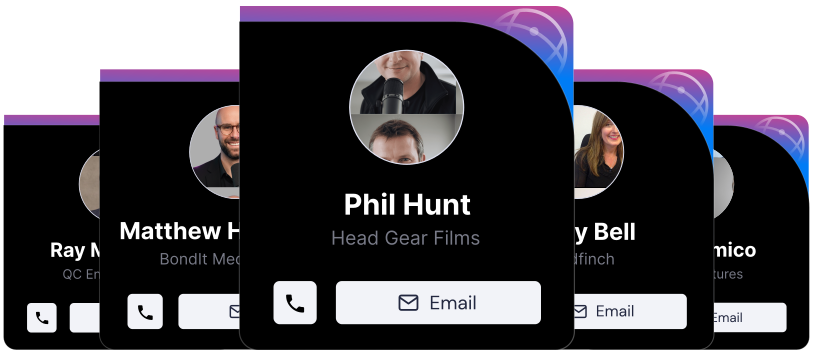
Access profiles on 400,000+ verified media and entertainment companies. Filter by territory, genre, deal type, and company tier to build targeted partner lists in minutes, not weeks.

Start Researching on VIQI

What Are the Main Types of Entertainment Industry Platforms?

Three distinct platform categories serve M&E professionals, and understanding which type fits your workflow saves considerable evaluation time.

Company Intelligence Platforms

Company intelligence platforms focus on profiling entities across the M&E value chain — producers, distributors, financiers, broadcasters, and streaming platforms — with searchable attributes. Users primarily research prospective partners, track competitor activity, and identify new entrants. This category is most valuable for business development professionals, acquisition executives, and co-production scouts. VIQI sits firmly in this category, with particular emphasis on breadth across 130+ territories.

Production Tracking Platforms

Production tracking platforms monitor what’s in development, in production, and in post across the industry. Their primary users are talent agents, equipment vendors, post-production facilities, and service providers who need to identify active productions before public announcement. The data tends to be narrower in company scope but deeper in project-level detail.

Distribution and Deal Platforms

Film distribution and deal platforms focus on connecting content rights holders with buyers. These platforms are transactional in orientation — they exist to facilitate deals rather than to provide broad market intelligence. Sales agents and independent producers use them most actively during major market periods like Cannes, AFM, or Berlin. They complement, rather than replace, a company intelligence layer.

Business professionals reviewing entertainment market data and strategy documents during a planning meeting in a conference room.
Strategy sessions powered by structured intelligence move faster and reach better decisions than those relying on anecdote alone.

How Do You Evaluate and Choose the Right Platform?

Choosing a media industry data platform starts with an honest assessment of your primary use case. A distributor building a new territory pipeline needs robust filtering and contact data. A producer evaluating co-production partners needs company financials, track record, and deal history. A market analyst needs trend data and aggregated sector signals. Few platforms excel at all three simultaneously.

Coverage Depth vs. Coverage Breadth

Depth refers to how much detail a platform holds per company. Breadth refers to how many companies are indexed. Most platforms sacrifice one for the other. Platforms covering 10,000 companies deeply often serve established markets well but miss the long tail of emerging market players. Conversely, broad databases sometimes hold shallow profiles. Clarify which matters more for your team before committing.

Data Freshness and Update Cadence

Ask any prospective platform vendor directly: how often is the data updated, and what’s the methodology? Annual updates are insufficient in a market where companies pivot, merge, or close within a single fiscal year. Platforms that track live signals, including press coverage, regulatory filings, and festival announcements, maintain significantly more accurate profiles than those relying on periodic manual reviews.

Integration with Existing Workflows

A platform that can’t export to your CRM or doesn’t support team collaboration adds friction rather than removing it. Check for CSV/API export options, team seat pricing, and whether the platform integrates with tools your team already uses. The best platform is the one your team actually uses consistently, not the one with the most features on paper.

What Role Does Data Play in Modern M&E Decision-Making?

Data’s role in media decisions has shifted from supplementary to central. A 2024 Deloitte survey found that 67% of entertainment executives now rate data access as “critical” to greenlight and acquisition decisions, up from 41% in 2020. The shift reflects a broader industry recognition that intuition doesn’t scale across 190 markets with different audience preferences, regulatory structures, and content consumption habits.

Private equity in entertainment has accelerated this data dependency. PE firms acquiring media assets require rigorous market maps before committing capital — understanding competitive positioning, deal multiples in comparable transactions, and the distribution infrastructure available for acquired content. That level of analysis isn’t possible without structured data at scale.

The emerging use case is predictive intelligence: identifying which companies are likely to become acquisition targets or distribution partners before they appear on anyone else’s radar. Platforms that layer trend signals on top of company profiles begin to offer this capability. It’s not widespread yet, but it’s where the leading platforms are heading.

How Vitrina’s Entertainment Intelligence Platform Works

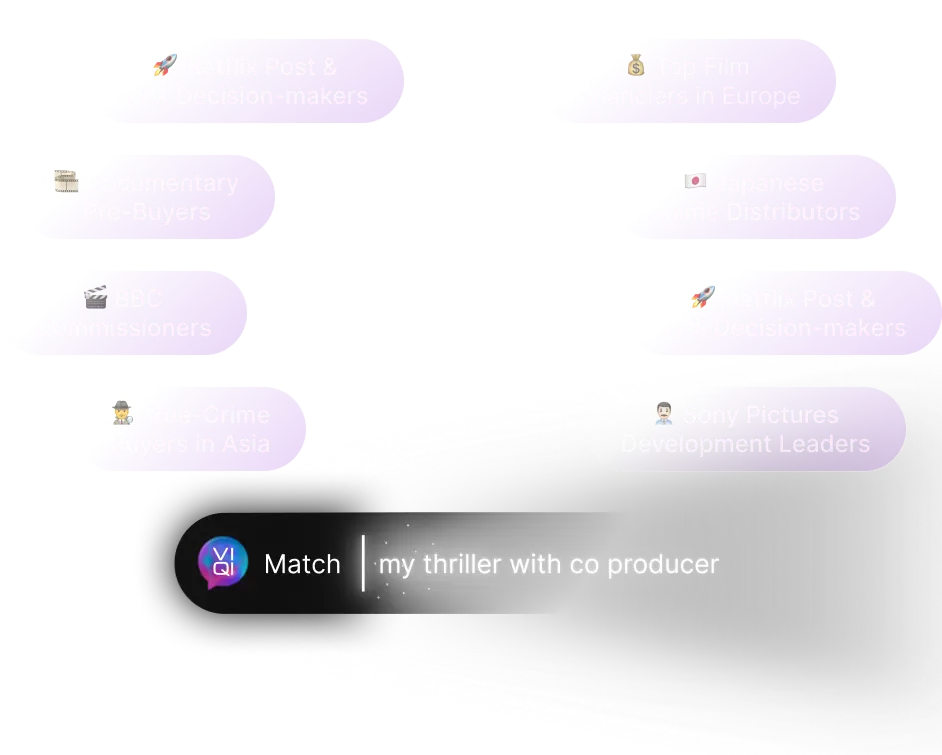
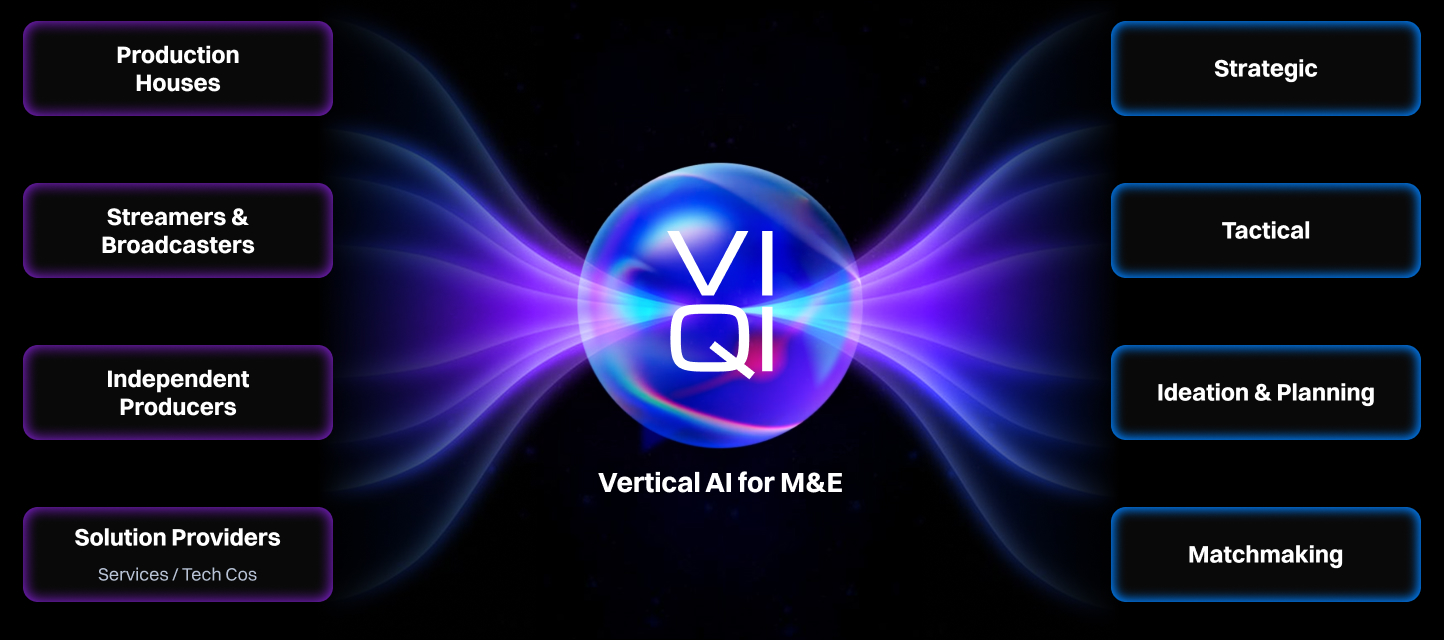
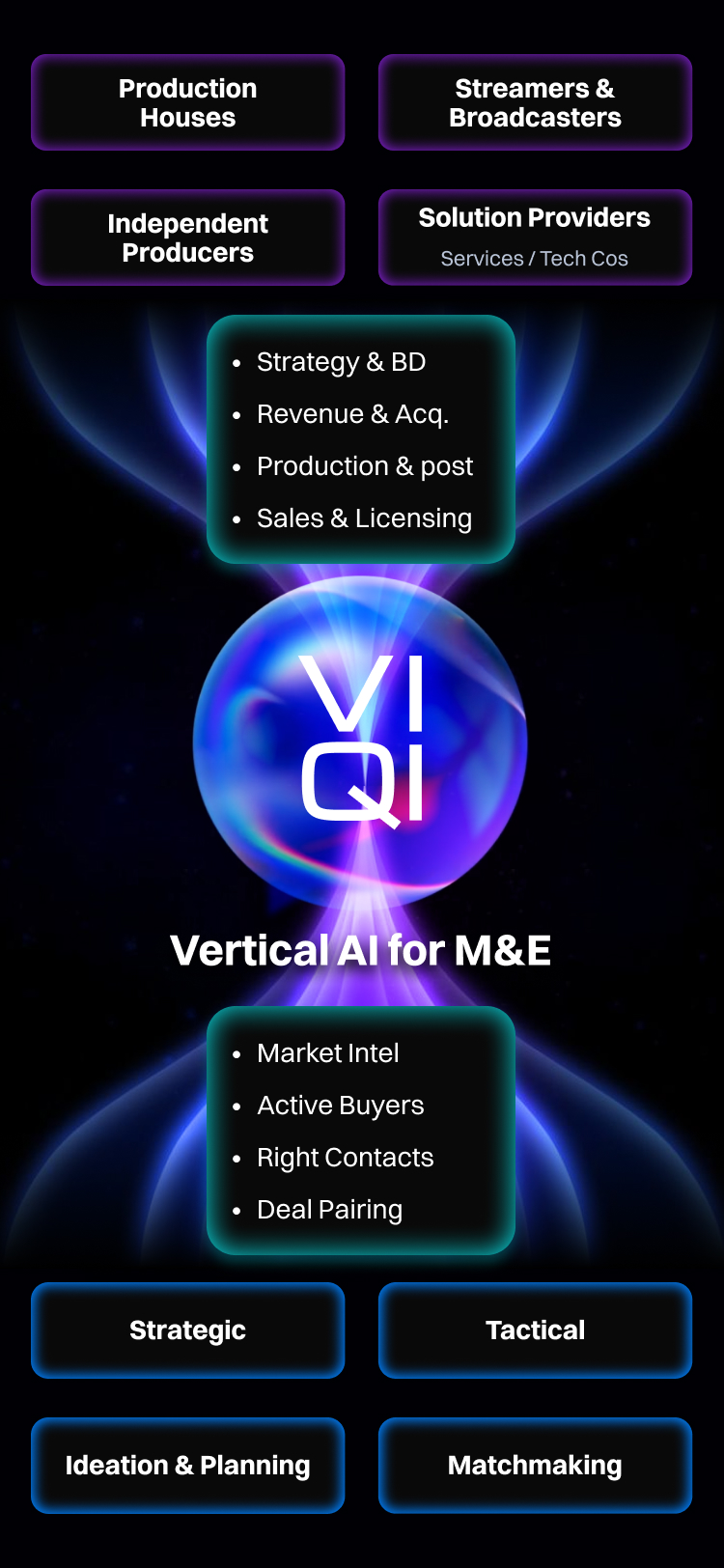
VIQI (Vitrina Intelligence) is a global entertainment intelligence platform indexing over 400,000 companies across 130+ territories. It’s purpose-built for the media and entertainment sector, covering producers, distributors, broadcasters, streamers, sales agents, financiers, and service providers. Users can filter by territory, genre, company type, deal history, and content focus to surface highly specific partner or prospect lists.

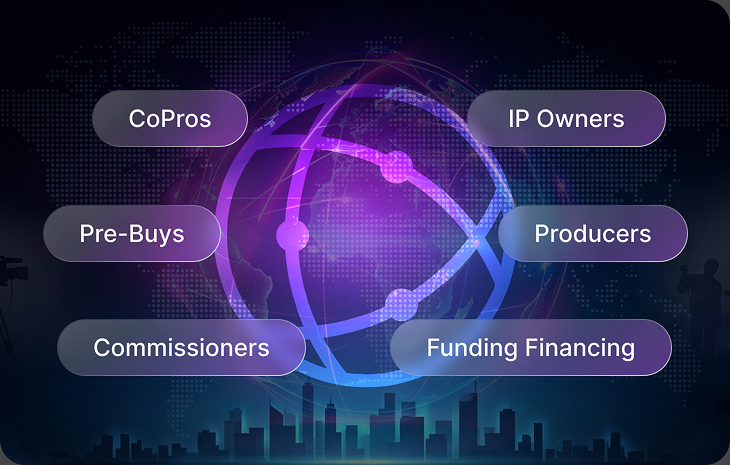
The platform supports both demand-side and supply-side workflows. Buyers and acquirers use VIQI to research prospective partners, map competitive landscapes, and track deal activity in target markets. Sellers and service providers use it to understand who’s active in their territory, identify potential buyers for their content, and benchmark their positioning against comparable companies. This dual-use design reflects how real M&E professionals work: most organizations play both roles at different times.
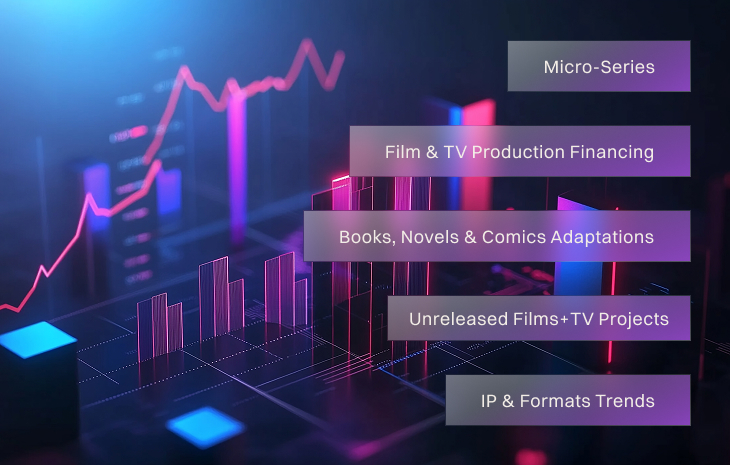
VIQI’s filtering system covers deal type — including co-production, pre-sale, licensing, and acquisition — alongside genre, format, and company tier. A streaming platform acquiring scripted drama in Europe is a fundamentally different prospect than one licensing unscripted content in Latin America. Broad filters produce broad results. VIQI’s layered approach produces actionable shortlists that match the criteria professionals actually use when making real partnership decisions.

List Your Company on Vitrina

Put your company in front of buyers, distributors, and partners actively researching in your territory and genre. Over 400,000 companies are already indexed. Add yours and get discovered.

List Your Company Free

Conclusion

The case for structured entertainment industry platforms has never been stronger. Global M&E activity spans too many territories, company types, and deal structures for any professional to track manually at meaningful scale. Platforms that consolidate company intelligence, deal tracking, and territory-level filtering don’t just save time — they surface opportunities that would otherwise stay invisible. That asymmetry between informed and uninformed decision-makers will only grow as the market becomes more fragmented.

Choosing the right platform still requires matching the tool to the job. Company intelligence platforms suit research-heavy teams doing partnership development and competitive analysis. Production tracking tools suit service providers and talent-side professionals. Distribution platforms suit rights holders moving content through market cycles. Most sophisticated organizations end up using more than one.

Data is no longer a back-office function in media and entertainment. It’s a front-line competitive tool. The organizations that treat it as such — investing in platforms that give them real-time intelligence about their market — will consistently outperform those that don’t. The infrastructure exists. The data is available. The question now is whether your team is using it.

Get Free Access to VIQI

Explore Vitrina’s global entertainment intelligence database at no cost. Search 400,000+ companies, filter by territory and genre, and see why M&E professionals across 130 countries use VIQI for partner research.

Explore VIQI Free


FAQ: Entertainment Industry Platforms

What is an entertainment industry platform, in simple terms?

An entertainment industry platform is a structured database and research tool built specifically for media and entertainment professionals. It aggregates information about companies, deals, and market activity across the global M&E sector, understanding industry-specific categories like distribution rights, co-production agreements, and content genre segmentation.

Who typically uses a media industry data platform?

Primary users include producers scouting co-production partners, distributors mapping territory opportunities, buyers researching acquisition targets, financiers evaluating investment landscapes, and business development teams building partner pipelines. Broadcasters, streaming platforms, and service providers also use them regularly.

How is a global entertainment intelligence platform different from LinkedIn or IMDb Pro?

LinkedIn is optimized for individual contact discovery. IMDb Pro focuses on credits and production tracking for talent. A global entertainment intelligence platform indexes company types, deal histories, territorial activity, and genre specializations in a searchable structure designed for B2B market research — which neither LinkedIn nor IMDb Pro supports.

What makes territory filtering important in an entertainment platform?

Media deals are territorial by nature. Rights are licensed and co-produced on a territory-by-territory basis, with different regulatory frameworks and commercial norms in each market. Territory filtering surfaces only companies with active presence and track record in the specific markets relevant to a given project, preventing missed opportunities.

How often should company data be updated on an entertainment industry platform?

Annual updates are insufficient. Companies merge, pivot, or cease operations within single fiscal years. The most reliable platforms update records on a rolling basis using live signals including press coverage, regulatory filings, festival activity, and deal announcements. Always ask a vendor directly about their update cadence before committing.

Is VIQI suitable for smaller production companies, or only large studios?

VIQI is designed for the full spectrum of M&E companies. Independent producers, regional distributors, and boutique sales agents are indexed alongside major studios. For smaller companies, the platform is particularly useful for discovering mid-market partners in territories where personal networks don’t yet reach. Free access is available at vitrina.ai/viqi.


About the Author

Vitrina Research Team

The Vitrina Research Team produces editorial intelligence on global media and entertainment markets, covering company data, deal trends, and industry strategy for M&E professionals worldwide. Our analysis draws on VIQI’s database of 400,000+ companies across 130+ territories.