IHUB
IHUB
 Private Briefings (Webinars)


 LeaderSpeak Podcast
  Global Entertainment Digest (Newsletter)
  Premium Lists
 Membership Benefits
 About Vitrina
 Our Story
Author: By Kunal Barai
Kunal Barai leads Global Markets at Vitrina.AI, working with producers and financiers across 100+ countries to facilitate content financing and co-production matchmaking. He recently hosted a roundtable on AI for Film Financing at MIP London 2026. Earlier, he spent 12+ years at Nielsen/Gracenote and completed MIT Sloan’s executive program on AI strategy.
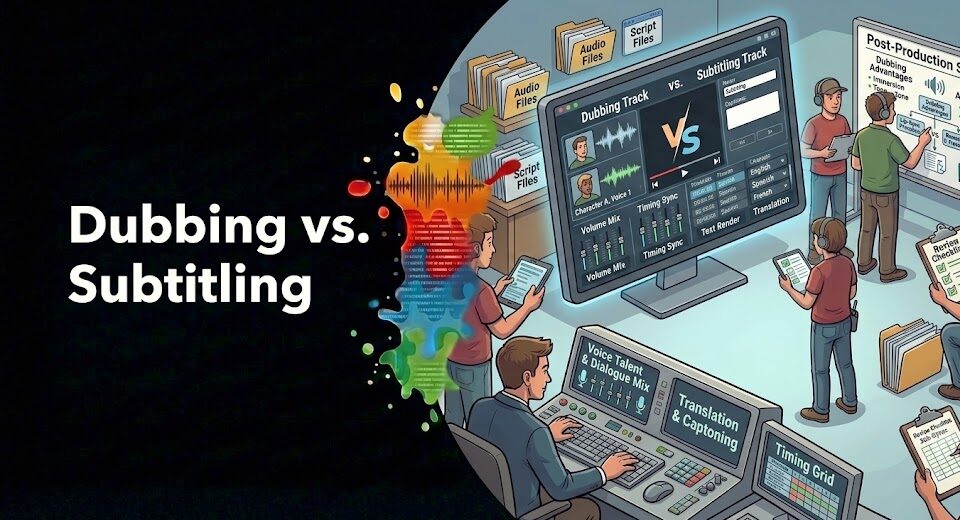
The battle between dubbing and subtitling is no longer a matter of simple text vs. audio preference. In a streaming marketplace where quarterly subscriber retention hinges on domestic expansion across EMEA, LATAM, and APAC, localization strategy dictates the global Return on Investment (ROI) of your entire original content slate.
The Streaming Imperative: Maximizing Regional Retention
Behind closed doors, content acquisition executives are rewriting territory strategy metrics. The old paradigm of dropping a single, subtitled asset into a non-English-speaking territory and hoping for viral traction is dead. Streaming infrastructure giants recognize that expanding global market reach means removing all consumer friction. To drive engagement in fiercely competitive international corridors, you cannot view dubbing vs. subtitling as an interchangeable choice. They represent two entirely different retention metrics, budget stacks, and consumer behavior curves.
Historically, subtitling was the default strategy for independent studios and scaling platforms due to its lower cost and rapid turnaround. But the consumer dynamics of 2026 have shifted. Viewers consuming content on mobile devices, tablets, or in multi-tasking environments show an overwhelming preference for high-quality audio dubbing. For original slates targeting mainstream demographics, failing to provide a localized voice track acts as an immediate barrier to entry, shrinking your addressable audience by up to 70% in traditional dubbing-heavy strongholds like Germany, France, Brazil, or Japan.
Table of Contents
The Economics of Subtitling: Capital Efficiency and Agility
Subtitling remains the foundational pillar of rapid cross-border distribution. From a capital deployment standpoint, text-based localization offers unmatched efficiency, enabling platforms to scale their catalogs into dozens of target languages simultaneously without crushing their post-production budgets. For niche genres, prestige indie titles, and documentary formats where preserving the original, authentic vocal track is part of the artistic proposition, subtitling is the mathematically correct choice.
The time-to-market advantage is absolute. While traditional theatrical-grade voice casting and automated dialogue replacement (ADR) setups require weeks of studio coordination, subtitling workflows can be heavily compressed. Leading cloud-native localization giants—including Iyuno, Deluxe, and Zoo Digital—leverage proprietary media management software to translate and time text stems in near-real-time, delivering flawless multi-language files in days. This speed allows distribution executives to respond instantly to trending global signals, capital-efficiently unlocking unexpected new markets.
The catch? Subtitling demands undivided visual attention. On modern streaming platforms, where a massive percentage of consumption occurs on secondary screens or mobile layouts, text-based localization increases the cognitive load on the casual viewer. If your target demographic is forced to stare continuously at the lower third of the frame, completion rates tumble—negatively impacting the platform’s algorithmic recommendation metrics and accelerating subscriber churn.
The Dominance of Dubbing: The Consumer Experience Engine
If subtitling wins on upfront cost, dubbing absolutely dominates on long-term engagement metrics. Multilingual voice adaptation completely redefines how audiences absorb premium series. In territories with historical dubbing infrastructure, such as Southern Europe and Latin America, audio localization is a baseline commercial expectation. When a platform introduces a fully dubbed title, viewer drop-off patterns mirror native local productions, vastly extending average watch times and maximizing customer lifecycle value.
The historical bottleneck of dubbing has always been its complex cost model and extended schedule. Traditional localization requires manual script adaptation for lip-sync matching, localized actor casting, and extensive multi-track audio mixing. However, the post-production supply chain of 2026 has been fundamentally reshaped by synthetic performance preservation and advanced voice synthesis technology. Post-production innovators are completely changing the financial calculus of worldwide localization.
By leveraging secure frameworks, vendors like Respeecher and DeepDub can clone an original actor’s voice and adapt the emotional performance into multiple target languages simultaneously—with strict talent consent protocols at the core. This synthetic voice layer doesn’t just translate text; it completely de-risks multi-market delivery timelines by compressing scheduling windows by 40% to 70% compared to legacy human voice-talent loops. The result is a highly immersive, culturally adapted viewing experience that allows international content to travel seamlessly into mainstream global markets.
The Vitrina Strategic Framework: Localization ROI Index™
To eliminate guesswork at the packaging stage, Vitrina utilizes the Localization ROI Index™. This framework provides distribution executives with a definitive guide to asset adaptation, balancing upfront budget allocation against projected subscriber engagement.
| Content Category | Target Demographics | Recommended Strategy | Primary Commercial Objective |
|---|---|---|---|
| Premium Scripted Drama | Mainstream Four-Quadrant | Full Voice Dubbingpass | Completion Rate Optimization |
| Prestige / Arthouse Feature | Cinephiles / Niche Audiences | High-Fidelity Subtitling | Artistic Integrity Preservation |
| Children & Animation | Kids Under 12 Years | Mandatory Localized Dubbing | Addressing Literacy Boundaries |
| Factual / True Crime Docs | Adult Information Seekers | Hybrid (VO + Subtitles) | Rapid Catalog Scaling |
Deploying this framework allows platforms to systematically isolate the Fragmentation Paradox™—the industry friction where over 600,000 global production service entities operate in siloed networks, causing buyers to overpay for unvetted localization setups. By mapping regional consumer preferences directly to specific production profiles, your desk avoids budget overruns while maximizing international title performance.
Industry Implications: Three Structural Conclusions
The ongoing expansion of streaming content spend requires severe discipline regarding post-production outlays. Every single dollar spent on regional versioning must tie back to measurable long-term watch time.
1. Audiences Watch Subtitles, but They Experience Dubbing
Text translation perfectly handles semantic comprehension, but it limits emotional impact. Content localized through premium dubbing studios preserves performance nuance, secondary character intonation, and native cultural references. This acoustic fidelity transforms international titles from a foreign viewing experience into an authentic local product that retains audiences far longer.
2. Technology Integration Shields Downstream Margins
The traditional distinction between cheap text and cost-prohibitive voice re-recording has collapsed. Relying entirely on manual ADR networks erodes your net profit corridor. Platforms implementing automated cloud infrastructures and verified synthetic voice loops achieve massive EBITDA Protection™, lowering localized versioning costs while maintaining strict studio-grade compliance.
3. Supply Chain Visibility Accelerates Market Entry
Waiting until principal photography wraps to select a regional versioning partner delays your day-and-date release timeline. Aligning with cloud-native vendors during early post-production allows versioning pipelines to run parallel to final grading and sound design. This strategic planning directly triggers Recoupment Acceleration™, allowing international distribution footprints to generate revenue from day one.
Conclusion
The ultimate winner of the localization battle depends entirely on your product type and target market footprint. For high-volume catalog scaling, arthouse cinema, or testing regional audience signals on a limited budget, subtitling remains an indispensable, capital-efficient strategy. It provides the agility required to establish cross-border footprints rapidly.
However, if your commercial goal is long-term subscriber retention and maximizing the lifetime value of original four-quadrant franchises, dubbing wins the streaming war. Driven by the commercial maturity of voice synthesis and automated workflows, voice localization now provides the massive reach required to turn regional productions into worldwide mainstream phenomena. The platforms that move fastest build integrated, multi-format localization networks that systematically align adaptation choices with specific consumer data sets.
Frequently Asked Questions (FAQ)
What is the primary cost difference between dubbing and subtitling?
Subtitling is highly cost-effective, using text-based pipelines that require zero recording studio overhead. Traditional dubbing requires significant capital for localized voice casting, director fees, and extensive studio ADR time. However, the rise of specialized AI dubbing systems has dropped voice re-recording costs by 40% to 70%, vastly closing the budget gap between the two methods.
How does regional consumer behavior affect localization strategy?
Consumer expectations are deeply regional. Central and Southern European markets (such as Germany, France, and Spain) along with Latin America have entrenched voice dubbing infrastructures and show immense preference for audio localization. Conversely, Nordic territories and the Netherlands have traditionally favored subtitling, meaning viewers there are highly comfortable with on-screen text.
Can a single film or series combine both localization methods?
Absolutely, and this is standard practice for modern tier-one streaming pipelines. Global platforms routinely deploy a hybrid approach—offering full audio dubbing files for mainstream target markets where audience completion rates heavily depend on audio, while utilizing text subtitles to efficiently broaden catalog footprint across long-tail language requirements.
What are the main operational bottlenecks when setting up international dubbing?
The primary bottlenecks center around script adaptation for natural lip-sync matching, actor availability, and securing compliance standards like the Trusted Partner Network (TPN). Managing these across multiple regions manually creates operational friction, which is why modern distribution teams rely on cloud-native vendor systems featuring full API connectivity to automate pipeline asset management.