IHUB
IHUB
 Private Briefings (Webinars)


 LeaderSpeak Podcast
  Global Entertainment Digest (Newsletter)
  Premium Lists
 Membership Benefits
 About Vitrina
 Our Story
Author: By Kunal Barai
Kunal Barai leads Global Markets at Vitrina.AI, working with producers and financiers across 100+ countries to facilitate content financing and co-production matchmaking. He recently hosted a roundtable on AI for Film Financing at MIP London 2026. Earlier, he spent 12+ years at Nielsen/Gracenote and completed MIT Sloan’s executive program on AI strategy.
Summary: The international pre-sales ecosystem is facing structural shifts, making soft money allocations and precise territory modeling foundational mechanics rather than optional math. In 2026, securing a Minimum Guarantee (MG) is no longer a downstream distribution win—it is the senior collateral required to de-risk your capital stack and trigger production greenlights. For independent producers trying to close budgets before entering cameras, mastering these upfront cash floors separates viable slates from stalled packages.
Closing an independent film budget has become an exercise in precise risk mitigation. With global streaming content spend hitting $101 billion in 2026 and major digital platforms pivoting toward highly disciplined licensing arrangements, the era of relying purely on speculative backend equity is effectively over. Producers must engineer a predictable waterfall long before principal photography begins.
Behind closed doors, the conversation always returns to the capital stack. How much soft money can you stack? Which territory rights can you pre-sell? And, most critically, how can you leverage a distributor’s balance sheet to advance production cash? This is where the Minimum Guarantee emerges as the primary financing lever for independent filmmakers.
But navigating international distribution requires more than simple sales pitches. It demands a forensic understanding of how upfront capital de-risks senior debt and how corporate buyers evaluate project bankability. If you approach sales agents or regional distributors without a clear strategy for your MG structure, you risk trapping your IP in unfavorable, long-term options.
Table of Contents
- Deconstructing the Minimum Guarantee: The Upfront Cash Floor
- How MGs Function inside Independent Film Capital Stacks
- The Vitrina Project Bankability Framework™
- Protecting the Back-End: Essential Negotiation Benchmarks
- Industry Implications: Three Structural Conclusions for Producers
- Conclusion
- Frequently Asked Questions (FAQ)
1. Deconstructing the Minimum Guarantee: The Upfront Cash Floor
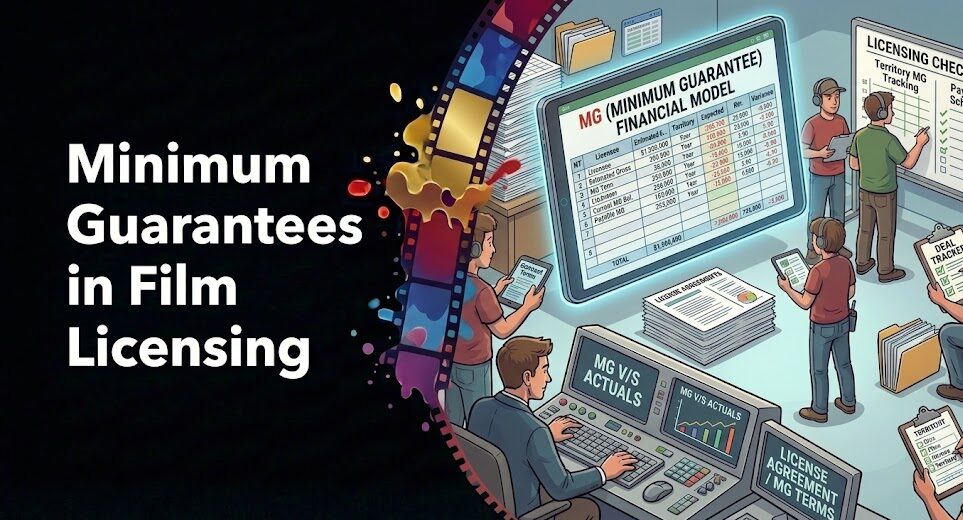
In the global entertainment supply chain, a Minimum Guarantee (MG) is a financial floor. It represents a distributor’s non-refundable commitment to pay a producer a baseline sum for the licensing rights to a title within a specific territory and window. Unlike a straight profit-share or commission deal, where your revenue is tied purely to downstream box office or streaming performance, an MG ensures that the distributor assumes the initial market risk.
The layout of a typical distribution arrangement dictates that the distributor must fully recoup that upfront advance from gross receipts before they start sharing “overages” with your production team. And that’s where the strategy becomes interesting: because the distributor has capital exposed from day one, they are incentivized to deploy their Print and Advertising (P&A) budgets aggressively to protect their investment.
But let’s look at what actually happens during the financing lifecycle. An MG is rarely paid as a lump sum upon signing the contract. Instead, it moves along a cascading milestone schedule: typically 10-20% upon executing the deal memo, a chunk during principal photography, and the remaining balance upon delivery of the technical master. For an independent producer, this structure ensures a baseline of cash flow that keeps the physical production pipeline moving.
2. How MGs Function inside Independent Film Capital Stacks
Understanding the difference between an MG on paper and cash on set is critical when structuring your financing. Because an MG is paid out over a timeline that extends past physical production, you cannot immediately use the full sum to pay your crew or lock locations. Instead, producers utilize these executed distribution contracts as collateral to secure production loans from specialized debt lenders.
In a standard independent capital stack, senior debt lenders will advance capital against the face value of your territory pre-sales, typically discounting the contract by 15-20% to account for interest and fees. This positioning is precise: the gap or senior debt sits on top of equity, meaning the incoming MG payments from your international buyers are routed directly into an escrow account to pay down the bank loan first.
Look at how global funding networks are adjusting to this dynamic. For example, the government-backed UK Global Screen Fund (UKGSF) recently introduced an international distribution strand allocating up to £100,000 specifically to help UK sales agents offer competitive MGs when boarding independent projects. This structural push proves that upfront guarantees are universally recognized as the engine that drives independent project packaging and market visibility.
3. The Vitrina Project Bankability Framework™
To accurately gauge whether a project can secure a premium territory advance, we utilize a standardized metric system that reflects current market sentiment across global supply networks. The matrix below outlines how buyers evaluate package elements before putting capital on the line:
The 4-Pillar Package Evaluation Matrix™
| Pillar | Evaluation Criteria | Impact on Territory MG |
|---|---|---|
| Genre Clarity | Action, thriller, and sci-fi with cross-border appeal. | High elasticity; drives multi-territory volume. |
| Talent Attachments | A-list or historically bankable regional cast. | Reduces distributor risk; solidifies pre-sales. |
| Soft Money Alignment | Confirmed tax incentives or local cash rebates. | Lowers the required MG floor to break even. |
| Chain of Title | Fully cleared underlying IP and legal options. | Non-negotiable prerequisite for debt closing. |
By assessing these variables against live deal data, independent filmmakers can establish realistic financing expectations. For instance, tracking historic milestones reveals that specialized distributors like A24 or Lionsgate Films look for extreme genre clarity and package precision before committing substantial upfront marketing resources.
4. Protecting the Back-End: Essential Negotiation Benchmarks
Here is the thing most producers figure out too late: a massive headline Minimum Guarantee can easily be hollowed out by a poorly structured distribution contract. Distributors naturally look to shield their own balance sheets by shifting operational expenses onto the film’s post-delivery waterfall. If you do not explicitly negotiate contract parameters, you might find your back-end profit participation completely eroded.
When reviewing terms with sales agents or global streaming platforms, independent producers must focus on three primary variables:
- Marketing Expense Caps: Distributors recoup every dollar spent on trailer creation, artwork, and local advertising before paying out net revenues. Always demand a strict cap on recoupable P&A expenses (e.g., matching a fixed percentage of the MG) to prevent inflated marketing lines.
- Rights Duration & Term Lengths: In the age of hybrid distribution and expanding SVOD windows, distributors frequently ask for 10-15 years of territory control. Independent filmmakers should aggressively push for shorter horizons—typically 3-5 years—allowing rights to revert back to the production company for secondary window monetization.
- Cross-Collateralization Blocks: If a distributor buys multiple films or multiple territories from your sales agent, they will try to use profits from a successful market (like Germany) to pay off an MG deficit in a weaker one. Insist that every territory deal stands on its own accounting feet.
5. Industry Implications: Three Structural Conclusions for Producers
The global framework governing content distribution is moving toward data-driven, highly targeted territory positioning. This structural shift yields specific operational realities for independent producers looking to close budgets in 2026:
1. Pre-Sales are the Prerequisites for Independent Debt Control
Relying on post-production festival acquisitions to save your investors is a statistically high-risk play. Lenders operating across the content supply chain require executed, bankable pre-sale contracts with verified MGs before they will close a production loan. If you want to keep operational control of your set, you must secure territory commitments during the packaging phase.
2. Digital Windows Demand Segmented Territory Rights Modeling
The global film distribution market is projected to expand to $178.6 billion by 2034, with digital online platforms capturing a massive 48.7% share of total distribution revenue. Because SVOD and digital transactions dominate global monetization, blanket “all international rights” deals are inherently inefficient. Sophisticated independent producers carve out specific streaming windows while maintaining traditional regional theatrical distribution pipelines to optimize overall revenue.
3. Content Packaging Requires Forensic Benchmark Intelligence
Distributors hold a significant information advantage during initial contract negotiations because they possess private historical data on regional performance metrics. Independent producers cannot afford to negotiate blindly based on general trade rumors. Accessing live, structured deal tracking that maps active corporate buyers and historical MG parameters by territory is the only way to establish true leverage at the deal table.
Conclusion
The total value of the global film distribution market is projected to reach $105.1 billion across the current 2026 fiscal year, underlining a resilient yet heavily fragmented ecosystem. Within this economic reality, the Minimum Guarantee stands out as the ultimate mechanism for shifting financial risk away from the independent producer’s balance sheet. When structured with precise parameter caps, a solid territory pre-sale doesn’t just provide security—it becomes the foundational engine that unlocks production debt and closes your capital stack.
Producers who fail to benchmark their project’s international value against real supply-chain data will continue to find themselves at a structural disadvantage. The cost of executing deals based on outdated relationship networks is measured in margin erosion and prolonged development cycles. To succeed in a data-driven distribution landscape, production companies must leverage verified supply-chain analytics to discover exactly which regional buyers possess an active appetite for their specific package.
Frequently Asked Questions (FAQ)
What is the difference between a Minimum Guarantee and a distribution commission?
A Minimum Guarantee is a non-refundable, fixed upfront payment made by a distributor to a producer regardless of how the film performs in the market. In contrast, a commission-only deal involves no upfront cash; the distributor handles the release and only pays the producer a percentage of net profits after deducting distribution fees and operational marketing expenses from the backend receipts.
Is a Minimum Guarantee recoupable by the distributor?
Yes. While an MG is completely non-refundable to the producer, it is fully recoupable by the distributor from gross revenues generated in that specific territory. The distributor retains 100% of incoming market receipts until they have recovered the exact value of the MG, along with their contractually agreed distribution fees and localized P&A marketing expenses.
Can independent producers secure an MG before a film is completed?
Absolutely. This process is known as a pre-sale arrangement. A distributor reviews the project’s packaging elements—such as the screenplay, attached talent, budget allocations, and director tracking data—and signs a binding contract guaranteeing a minimum payment upon delivery of the final master. Producers then use this contract as collateral to secure bank debt.
How does cross-collateralization affect an MG deal waterfall?
Cross-collateralization allows a distributor to pool the revenues and deficits of multiple media windows or territories under a single accounting ledger. For independent filmmakers, this is highly disadvantageous: it means a distributor can use the net profits from a highly successful theatrical release in one country to offset an unrecouped MG deficit from a streaming window in another territory.