About Innovation Hub
 Global Content Pulse (Webinars)


 Global Production Financing
(Webinars)
Global Production Financing
(Webinars)  LeaderSpeak Podcast
  Global Entertainment Digest (Newsletter)
  About Vitrina
 About VIQI
 Our Story
 Our Solutions 🔥
 Film+TV Projects Tracker 🚀
 Case Studies
 Our Profile
The global film and television industry produced an estimated 60,000 scripted titles in 2023 alone, according to AMPERE Analysis — a number that has nearly doubled over the past decade as streaming platforms expanded their international commissioning footprints. For studios, vendors, financiers, and distributors trying to keep pace with this output, tracking productions manually has become functionally impossible. A global film tracker solves this by aggregating project data from hundreds of sources into a single, continuously updated intelligence layer — giving decision-makers visibility into what is being made, where, by whom, and at what stage of production.
Key Takeaways
- A global film tracker consolidates project-level data — including cast, crew, budget tier, stage, and financier — from festivals, trade press, government filings, and broadcaster slates.
- Studios, streamers, distributors, vendors, and financiers each use tracker data differently, from competitive intelligence to vendor prospecting and market-entry analysis.
- Manual tracking via spreadsheets or IMDb Pro creates significant blind spots: data is incomplete, infrequently updated, and geographically skewed toward English-language markets.
- Vitrina AI’s Global Film & TV Project Tracker monitors 300,000+ productions across 100+ countries with real-time updates sourced from thousands of data points.
- The most immediate commercial value comes from pairing tracker data with workflow triggers — surfacing the right project at the right production stage to the right business development team.
What Is a Global Film Tracker and What Data Does It Cover?
According to PwC’s Global Entertainment & Media Outlook 2023–2027, global filmed entertainment revenue is on track to exceed $100 billion by 2027, driven by streaming expansion in Asia-Pacific, Latin America, and MENA. A global film tracker is the intelligence infrastructure that maps the supply side of that market — cataloguing productions at every stage from development through distribution.
At its core, a film tracker is a structured database of projects. Each record typically includes the project title, format (feature film, limited series, documentary, animation), production stage (announced, in development, pre-production, production, post-production, completed), country of origin, primary language, budget tier, key creatives (director, showrunner, lead cast), production company, distributor or commissioning broadcaster, and co-production partners. The best trackers also capture financial signals: tax credit jurisdiction, equity financier, pre-sales market and buyer, and completion bond status.
That combination of creative and financial data is what distinguishes a genuine global production database from a simple project list. When you can cross-reference “feature films in post-production in Poland with a budget above €5 million backed by a streaming co-producer,” you are doing market intelligence — not just searching a filmography.
Who Uses a Global Film Tracker — and Why
A 2024 survey by Ampere Analysis found that content acquisition executives at major streaming platforms now evaluate an average of 1,400 projects per quarter when considering international originals and co-productions. Without systematic tracking, that evaluation process defaults to relationships and recency bias rather than market coverage.
The user base for a film tracking platform spans five broad categories:
- Studios and streamers use tracker data to monitor competitor slates, identify co-production targets, track talent availability, and benchmark their own pipeline against the broader market.
- Distributors and sales agents use it to find projects seeking international distribution — particularly those that have completed principal photography but have not yet closed distribution deals in key territories.
- Production vendors — including VFX houses, post-production facilities, dubbing studios, and equipment rental companies — use it for business development: identifying which productions are entering their service window and have not yet locked a vendor relationship.
- Financiers and co-producers use tracker data to evaluate the volume and quality of projects seeking equity partners or gap financing in their target genres or territories.
- Market analysts and consultants use aggregate tracker data to model output trends, genre cycles, territory-specific commissioning patterns, and the competitive intensity of various market segments.
Each of these user types benefits from the same underlying data layer, but the query patterns and alert logic differ significantly. A VFX studio wants to know about projects entering pre-production with confirmed visual effects budgets. A financier wants to know about projects with partial finance in place seeking co-production partners. A distributor wants to know about completed films with limited territorial coverage. A film production tracker that serves all of these use cases needs depth, breadth, and configurable filtering — not just a searchable list.
The Data Sources Behind a Production Tracker
The European Audiovisual Observatory tracks more than 30 national film institutes and funding bodies across Europe alone — each publishing project announcements, funding decisions, and completion data on independent timelines and in multiple languages. Aggregating that data manually across a single continent would require a dedicated research team working full time.
Production trackers draw from a mix of structured and unstructured sources:
- Trade press and industry publications: Variety, The Hollywood Reporter, Screen International, Deadline, regional trades including C21Media, Cineuropa, Film New Europe, and dozens of territory-specific outlets publish production announcements, casting news, and deal coverage that signal project status changes.
- Film markets and festivals: Cannes, Berlin, Toronto, Sundance, AFM, MipTV, MipCom, and their equivalents in Asia, Africa, and Latin America produce project catalogues, co-production market listings, and deal announcements that represent structured, high-confidence data points.
- Government and funding body filings: National film commissions, regional development funds, and tax credit certification bodies in countries including the UK, France, Germany, Australia, Canada, India, Brazil, and South Korea publish project approvals that confirm budget tier, production company, and sometimes principal photography windows.
- Broadcaster and streamer slate announcements: Quarterly earnings calls, upfront presentations, and press releases from Netflix, Amazon, Disney+, Apple TV+, and their regional equivalents surface commissioning decisions that anchor a large portion of high-budget production activity.
- Social and professional networks: Crew announcements on LinkedIn, filming permit records, location scout reports, and casting agency bulletins provide real-time signals that a project has moved from development into active pre-production.
The challenge is not the availability of these sources — it is the normalization, deduplication, and entity resolution required to turn them into a coherent project record. A single production may be referenced under different titles, with different spellings of the production company name, across fifteen separate sources over eighteen months. A reliable global film tracker must resolve those references into a single canonical record and maintain it as new data arrives.
Key Use Cases: Vendor Prospecting, Competitive Intelligence, and Market Entry
According to Deloitte’s 2024 Digital Media Trends report, content production costs for major streaming platforms rose an average of 17% between 2020 and 2023, intensifying pressure on every participant in the supply chain to operate with greater efficiency. Tracker data directly addresses that pressure in at least three high-value use cases.
Vendor prospecting is the most immediate commercial application for production service companies. By filtering tracker data to show projects entering pre-production within a specific genre, territory, and budget tier, a VFX studio or post-production facility can identify qualified leads weeks before a production issues a formal RFP. The window between project announcement and vendor engagement is often narrow — tracker data allows service companies to begin relationship-building at the right moment rather than discovering an opportunity after a competitor has already been engaged.
Competitive intelligence applies primarily to studios, streamers, and distributors. Tracking a competitor’s slate — including announced projects, production starts, and distribution deals in development — provides a live view of their strategic priorities. If a major streamer is accelerating Spanish-language crime drama production in Latin America, that signal is valuable to every other market participant making format, talent, or acquisition decisions in that space.
Market entry analysis uses aggregate tracker data to evaluate the depth and structure of a production market before a company commits resources. If a US independent production company is evaluating whether to establish a co-production relationship in South Korea, tracker data can quantify how many qualifying projects are active in that market, what budget tiers dominate, which local production companies are most prolific, and which international partners are already engaged. That analysis replaces expensive due diligence trips and consultant engagements with data that is available on demand.
The Limitations of Manual Tracking: Spreadsheets and IMDb Pro
IMDb Pro — the industry standard for individual project and talent lookup — covers approximately 11 million titles in its database, but its production status data has well-documented latency issues, with many projects remaining listed as “in development” months or years after they have completed principal photography, according to production coordinators surveyed in a 2023 ProductionHub industry report.
The limitations of manual tracking fall into four categories:
Coverage gaps: IMDb Pro and comparable tools have historically strong coverage of Hollywood and English-language European productions, but significant gaps in Asia-Pacific, MENA, Latin America, and Sub-Saharan Africa — precisely the markets where production volume growth has been fastest over the past five years. A company trying to source VFX work in Southeast Asia or identify co-production partners in the GCC using IMDb Pro is working with incomplete market visibility.
Data freshness: Manually maintained spreadsheets and periodic database updates introduce structural latency. A project that moved from development into pre-production three weeks ago may not appear in a manually updated tracker for another month. In fast-moving markets, that delay means missed opportunities.
No signal layer: A static database tells you what exists; it does not tell you what changed. Business development teams need alerts when a project they are monitoring moves from development into pre-production, or when a production in their target genre receives a commissioning order from a new streaming platform. Spreadsheets and directory-style tools do not provide that triggering capability.
Scalability: A company tracking 200 projects manually with a small team is close to the operational ceiling of what spreadsheet-based systems can sustain. As market scope expands — into new territories, new formats, new budget tiers — manual tracking does not scale without proportional headcount growth.
How Vitrina AI’s Global Film & TV Project Tracker Works
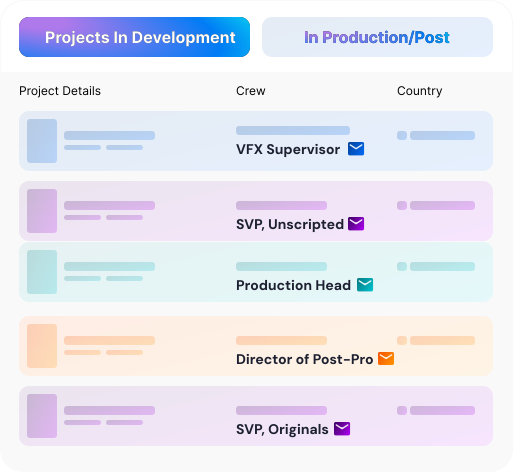
Vitrina AI’s Global Film & TV Project Tracker monitors more than 300,000 film and television projects across 100+ countries, drawing from thousands of structured and unstructured data sources that are continuously ingested, normalized, and resolved into project-level records. The platform covers every production stage from development through distribution, with real-time updates that surface status changes, new financing announcements, and vendor engagement signals as they occur.
The tracker’s filtering architecture allows users to query across multiple dimensions simultaneously — territory, format, genre, production stage, budget tier, commissioning platform, language, and co-production jurisdiction — and to save those queries as persistent alerts that generate notifications when new projects match the criteria. That capability transforms the tracker from a lookup tool into a proactive intelligence system.
The data model also captures vendor-level relationships: when a production record shows an existing post-production partner, VFX vendor, or dubbing studio relationship, competing vendors can use that information to identify timing windows for future engagement. When no vendor relationship is recorded for a project entering pre-production, that absence is itself a commercial signal.
For companies that need to act on tracker data at scale — running systematic market mapping exercises or qualifying large prospect lists — Vitrina AI’s Vitrina Concierge, an AI-powered sourcing layer available through Vitrina AI’s solutions platform, automates the research and outreach preparation work that would otherwise require significant analyst time.
How to Use Tracker Data to Find New Business Opportunities
A 2024 Content London industry survey found that 68% of production service companies described their new business development process as primarily reactive — responding to inbound inquiries and referrals rather than systematically prospecting from market intelligence. Tracker data provides the foundation for a shift to proactive, data-driven business development.
The practical workflow for converting tracker data into business opportunities follows a consistent pattern across user types:
- Define the target segment: Specify the territory, format, genre, budget tier, and production stage that represents your ideal opportunity. Be specific — “feature films in post-production in Central Europe with a budget tier of €3–10 million” will yield more actionable results than a broad query.
- Set production-stage alerts: Configure the tracker to notify you when a project matching your criteria moves from development into pre-production, or from pre-production into active production. Those transitions represent the commercial windows when vendor engagement is most effective.
- Qualify against existing relationships: Cross-reference tracker results against your CRM to identify projects where you have an existing relationship with the production company, director, or line producer — and prioritize those for outreach.
- Research the production team: Before reaching out, use the tracker’s entity data to understand the production company’s prior project history, their typical vendor relationships, and their financing pattern. That context significantly improves the relevance of initial outreach.
- Track competitive engagement: Monitor which of your competitors are being listed as vendor partners on productions in your target segment. That data reveals competitive intensity in specific niches and surfaces opportunities where incumbent relationships are weak.
Across all of these steps, the underlying value of a global film tracker is the same: replacing guesswork and relationship dependency with systematic, scalable market intelligence. For companies operating across multiple territories and formats, that shift from reactive to proactive business development is not incremental — it is structural.
Evaluating a Film Tracking Platform: What to Look For
According to Grand View Research’s 2024 Media Intelligence Market Report, the market for entertainment data and intelligence platforms grew at a CAGR of 14.3% between 2019 and 2023, with increased adoption driven by streaming platform expansion and growing demand for international co-production intelligence. As the market has grown, so has the number of tools claiming to offer production tracking capabilities — with significant variation in the depth and reliability of their data.
When evaluating a film tracking platform, the key criteria are:
- Geographic coverage: Does the tracker genuinely cover non-English-language markets with the same depth as Hollywood productions? Ask for specific project counts by territory and verify coverage of markets that matter to your business.
- Data freshness: What is the typical latency between a project status change occurring and appearing in the tracker? Real-time or near-real-time updating is substantially more valuable than weekly or monthly batch updates.
- Source diversity: Is the tracker drawing from trade press alone, or does it incorporate government filings, festival catalogues, and broadcaster announcements? Source diversity directly correlates with coverage completeness.
- Entity resolution quality: Are production companies, distributors, and talent consistently resolved to canonical entities, or do the same organizations appear under multiple variant names? Poor entity resolution creates duplicate records and corrupts aggregate analysis.
- Alerting and workflow integration: Can you configure persistent alerts and integrate tracker data with your existing CRM or business development workflow? A tracker that requires manual querying on a scheduled basis delivers a fraction of the value of one that proactively surfaces relevant changes.
Vitrina AI’s platform has been built to meet all of these criteria at scale, with 300,000+ projects across 100+ countries continuously updated. You can explore the full capability set through Vitrina AI’s solutions overview.
Frequently Asked Questions
What is a global film tracker?
A global film tracker is a continuously updated database of film and television productions at every stage of the production lifecycle, from development through distribution. It aggregates project-level data — including format, stage, territory, budget tier, key creatives, production company, and financing structure — from sources including trade press, film markets, government funding body filings, and broadcaster announcements. Unlike a filmography or credits database, a film tracker is focused on active and upcoming productions rather than completed works, and it is used primarily for commercial intelligence purposes by studios, vendors, financiers, and distributors.
How is a film production tracker different from IMDb Pro?
IMDb Pro is primarily a credits and contact database — its value lies in understanding who has worked on what and how to reach key decision-makers. A dedicated film production tracker is oriented toward pipeline intelligence: what is in active development or production right now, across which territories, at which budget tiers, and at which stage. IMDb Pro has significant latency in production status data and limited coverage of non-English-language markets. A purpose-built production tracker like Vitrina AI’s provides real-time status updates, multi-territory coverage, and filtering capabilities designed specifically for business development and market intelligence workflows.
Who benefits most from a global production database?
The most intensive users of a global production database are production service vendors — VFX studios, post-production facilities, dubbing and localization companies, and equipment rental firms — who use tracker data to identify projects entering their service window before a formal vendor search process begins. Studios and streamers use it for competitive intelligence and co-production identification. Distributors use it to find completed or near-complete projects seeking distribution deals. Financiers use it to identify projects with partial financing seeking equity partners. Market analysts use aggregate data for trend analysis and territory benchmarking.
How frequently is production tracker data updated?
Update frequency varies significantly by platform. Directory-style tools and manually curated databases may be updated weekly or monthly. Platforms like Vitrina AI ingest data from thousands of sources continuously, with project records updated in real time as new information becomes available. For business development purposes, real-time or near-real-time updating is substantially more valuable than periodic batch updates, because the commercial windows around production stage transitions are often narrow — a project that moves from development into pre-production may engage its key vendors within a matter of weeks.
Can a film tracker be used for market entry research?
Yes, and this is one of the most underutilized applications of tracker data. By querying a global film tracker for all active productions within a specific territory, format, and budget tier, a company can rapidly build a quantitative picture of a production market: how many qualifying projects are active, which local production companies are most prolific, which international partners are already engaged, what budget tiers dominate, and which genres are growing or declining. That analysis replaces expensive market research engagements and scouting trips with on-demand intelligence. Vitrina AI’s Project Tracker is specifically designed to support this kind of multi-territory, multi-dimensional market mapping. For a full view of how the platform supports market entry and business development workflows, visit Vitrina AI Solutions.
About the Author
Rutuja is a content writer at Vitrina AI, specialising in the entertainment supply chain and translating complex production-to-distribution workflows into clear, strategic insights for studios, streamers, and vendors operating across global markets.