IHUB
IHUB
 Private Briefings (Webinars)


 LeaderSpeak Podcast
  Global Entertainment Digest (Newsletter)
  Premium Lists
 Membership Benefits
 About Vitrina
 Our Story
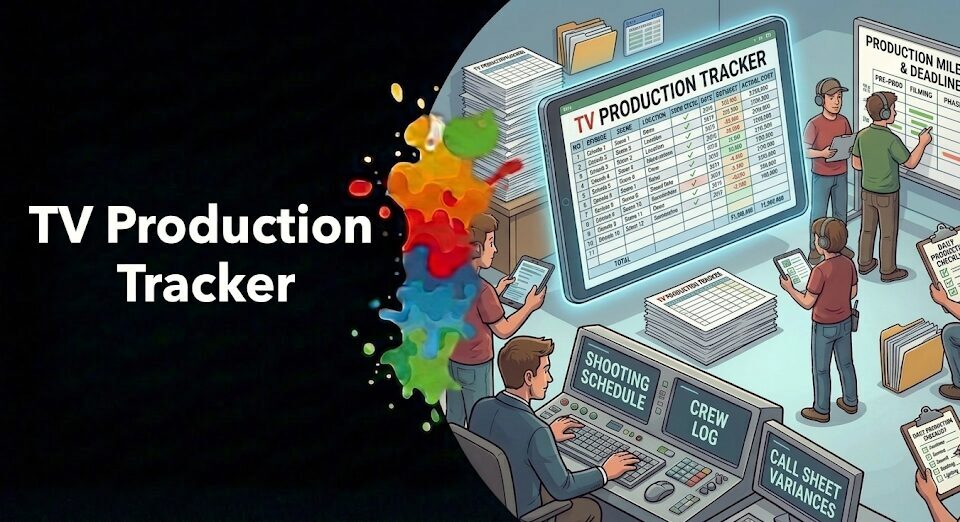
Television production has always been a global enterprise, but the scale of activity across 100+ countries today makes manual tracking impossible. A dedicated TV production tracker gives studios, distributors, and vendors real-time visibility into what’s being commissioned, greenlit, and actively shot — before the press release ever lands.
This guide covers what production tracking is, why it matters more than ever in a fragmented commissioning market, and what to look for in a platform that actually delivers actionable intelligence. Throughout, we link to Vitrina AI’s Global Film & TV Project Tracker as a reference for professional-grade capability.
Key Takeaways
- Global Film & TV production volume grew 34% in Q1 2025 year-on-year, driven by the US and India ramping post-strike slates (Señal News, 2025).
- Global streaming content spend reached \$95 billion in 2025, surpassing commercial broadcaster spend for the first time (Ampere Analysis, 2025).
- Global streamer scripted commissions fell 24% in H1 2025 while unscripted formats accelerated — the most significant format shift since Peak TV (Ampere Analysis, 2025).
- International co-productions grew 35% between January 2023 and December 2024, with Europe and Asia-Pacific posting the highest cross-border activity.
- Vitrina AI tracks 300,000+ film and TV projects across 100+ countries in near-real time.
What Is a TV Production Tracker?
A TV production tracker is a structured intelligence system that monitors television projects from early development through post-production and delivery. According to Vitrina AI’s platform data, active global tracking covers more than 300,000 film and TV projects at any given time — a volume no team can monitor manually.
Trackers aggregate data from broadcasters, streamers, production companies, and trade sources. The best platforms update continuously, flagging status changes the moment a project enters production, pauses, or wraps. That speed advantage is what separates intelligence from noise.
For vendors — VFX houses, post-production facilities, equipment suppliers — a tracker answers the fundamental sales question: who needs what, and when? For distributors and financiers, it maps the entire forward slate of content coming to market over the next 12–24 months. For studios, it benchmarks competitor commissioning strategies in real time.
Why TV Production Volume Demands Better Tracking Tools
Global Film & TV production grew 34% in Q1 2025 compared to the same period in 2024, fuelled by the US and India ramping up post-strike slates (Señal News, 2025). That pace means thousands of new projects entering the pipeline every quarter — far more signal than any spreadsheet can handle.
The volume problem is compounded by fragmentation. Content is now commissioned by free-to-air broadcasters, pay-TV networks, global streamers, local streamers, and hybrid FAST channels simultaneously. Netflix, Amazon, Disney+, HBO Max, Apple TV+, and Paramount+ combined commissioned 242 scripted shows in H1 2025 alone — and that’s just six companies out of hundreds of active commissioners worldwide (Ampere Analysis, 2025).
Each commissioner operates on a different timeline, has different format preferences, and works with a different vendor ecosystem. A production tracker that normalises this data into a single, searchable interface is no longer a nice-to-have — it’s operational infrastructure for anyone who earns revenue from the production supply chain.
Chart 1 — Global TV Commissioning Mix, H1 2025 (Scripted vs. Unscripted)
63%ScriptedScripted — 63%Unscripted — 37%Source: Vitrina AI platform data, 2025Scripted vs. Unscripted: The Commissioning Shift
Global streamer scripted commissions dropped nearly 24% in H1 2025, with Amazon Prime Video cutting its scripted slate by more than half compared to H1 2024 (Ampere Analysis, 2025). The reason is straightforward: scripted drama is expensive and its returns are increasingly uncertain, while unscripted formats deliver lower-cost content with more predictable audience engagement.
Documentaries now account for more than half of all unscripted production globally. Reality, competition, and factual formats are accelerating in Latin America, Southeast Asia, and the Middle East — regions where local-language unscripted content attracts both domestic and diaspora audiences. For a production tracker user, understanding this shift is critical: unscripted productions operate on compressed schedules and reach procurement decisions faster than scripted drama.
For vendors selling into the production ecosystem, the scripted-to-unscripted shift matters enormously. A high-end drama might spend 12 months in pre-production; a factual series might move from greenlight to shoot in 8 weeks. A TV production tracker that separates scripted from unscripted — and filters by commissioning entity — gives sales teams targeting precision that generic databases simply can’t provide.
The shift from scripted to unscripted isn’t a content trend — it’s a financial restructuring. Global streamers reduced scripted commissions 24% in H1 2025 while unscripted held steady. Production vendors who track this in real time can redirect outreach before competitors notice the change.
Ampere Analysis, H1 2025 Commissioning Report
Broadcaster vs. Streamer: Who’s Commissioning What
In 2025, global streaming content spend reached \$95 billion — surpassing commercial broadcaster spend for the first time ever (Ampere Analysis, 2025). Commercial broadcasters’ share of global content spending fell to 37%, down from 39% the previous year. That crossover is a structural marker: streamers are now the dominant buyers of television content worldwide.
But broadcaster commissioning hasn’t disappeared — it’s concentrated. Public service broadcasters in the UK (BBC), Germany (ARD, ZDF), France (France Télévisions), and Japan (NHK) maintain substantial scripted and documentary slates. In emerging markets, free-to-air broadcasters remain the primary commissioners because streaming penetration is still growing rapidly.
A smart TV production tracker surfaces both. It shouldn’t just follow Netflix and Amazon — it should track SonyLIV (which tied with Netflix for commissioning lead in Q3 2025 per Vitrina AI data), SBS Australia, TBS Television Japan, and dozens of regional commissioners that never make Western trade headlines but collectively represent enormous production volume. That’s where the competitive intelligence gap lies for most teams.
Chart 2 — Global Content Spend 2025: Streamers vs. Commercial Broadcasters (USD Billions)
Streamers\$95BBroadcasters\$59B*0\$30B\$65B*Estimated. Source: Ampere Analysis, 2025International Co-Productions: The Tracking Complexity
International co-productions increased 35% between January 2023 and December 2024, with Europe and Asia-Pacific posting the highest activity levels. When a project involves a French broadcaster, a South Korean production company, and a US streamer as co-commissioners, tracking it requires linking multiple territory databases — something generic project management tools simply can’t do.
Documentary co-productions saw a 49% rise between 2023 and 2024. This is partly driven by OTT platforms seeking premium factual content with built-in international appeal — a nature series or historical documentary travels across language barriers in ways that scripted drama often doesn’t. For distributors and sales agents, these co-productions create both opportunity and rights complexity that demands structured tracking.
Rights splits, territory exclusions, and delivery schedules are all more intricate in co-production structures. Tracking these projects requires more than a greenlight date — it requires visibility into which partners hold which rights in which windows. That’s the kind of structured data that professional platforms like Vitrina AI are designed to surface.
International co-productions grew 35% in just two years, creating a visibility problem for everyone in the supply chain. When rights are split three ways across three continents, the only teams that move fast are the ones who’ve already mapped the project structure before the first sales call.
Industry analysis, 2024–2025
Regional Hotspots: Where TV Production Activity Is Growing Fastest
According to Vitrina AI’s October 2025 data, the Americas posted 28% production growth and EMEA posted 24% growth year-on-year — both driven by active slates from Netflix, Hulu, BBC, and ARD. Asia-Pacific maintains high absolute volume led by India, South Korea, and Japan, where local commissioners compete with global streamers for the same production talent.
India’s production pipeline is particularly notable. The country produces approximately 2,000 films per year across 20 languages and has become one of the world’s most active TV production markets, with SonyLIV, Netflix India, Amazon Prime Video India, and Disney+ Hotstar all running parallel commissioning operations. Tracking the Indian market alone requires a platform with deep local-language data sourcing.
In the Middle East, Saudi Arabia, UAE, and Egypt are expanding original production budgets significantly, driven by both state-backed commissioning and regional streaming platforms. These markets rarely appear in English-language trade coverage until projects are already in production — making a comprehensive tracker essential for vendors and co-producers targeting the region.
What to Look for in a Professional TV Production Tracker
Not all trackers are equal. The key capabilities that separate professional-grade platforms from basic databases are depth of coverage, update frequency, and actionable filtering. Here’s what matters most when evaluating a platform for business use.
Geographic Coverage Across All Major Production Markets
A tracker limited to English-language markets misses the majority of global production. India, South Korea, Turkey, Brazil, and Mexico collectively produce thousands of hours of original content annually. Any platform that can’t track non-English-language markets leaves its users with a fundamentally incomplete picture of the global opportunity.
Update Frequency and Signal Quality
Weekly updates aren’t enough in a market that moves daily. Projects get greenlit, stall, recast, and wrap on timelines that make stale data useless for sales outreach. Real-time or near-real-time tracking — sourced from trade publications, regulatory filings, production announcements, and on-set signals — is the professional standard in 2025.
Filtering by Stage, Genre, Budget, and Commissioner
The most valuable feature of any production tracker is the ability to filter by production stage. A VFX vendor wants projects entering post-production. A location scout wants projects in pre-production. A distributor wants projects approaching delivery. Without stage filtering, the database is noise. Combine stage with genre, budget tier, and commissioner type and you have a precision targeting tool.
Vendor Intelligence Integration
The next level beyond project tracking is vendor intelligence — knowing not just which projects are in production, but which vendors are attached and what their track record looks like. Vitrina AI’s VIQI (Vendor Intelligence Quality Index) score provides a standardised quality signal across the global supply chain, giving buyers a structured way to evaluate partners beyond self-reported capability.
How Vitrina AI’s Production Tracker Works
Vitrina AI’s Global Film & TV Project Tracker aggregates data on 300,000+ projects across 100+ countries, updated continuously. Users can filter by country, genre, production stage, commissioner type, budget range, and more. The platform is designed for professional users — studios, streamers, vendors, distributors, and financiers — who need actionable intelligence, not raw data.
The Vitrina Concierge service layers human expertise on top of the platform data, delivering curated project shortlists for clients with specific targeting needs. For a VFX facility looking for mid-budget drama in a specific territory, Concierge turns a search query into a qualified prospect list within hours. Explore the full product range at Vitrina AI Solutions.
With global production up 34% in Q1 2025 and commissioning fragmented across hundreds of buyers worldwide, the production tracker has become core intelligence infrastructure for the entertainment supply chain. The question isn’t whether you need one — it’s whether yours covers the markets your competitors are already watching.
Vitrina AI, 2025
Frequently Asked Questions
What does a TV production tracker actually track?
A TV production tracker monitors television projects from development through delivery — covering project title, commissioner, genre, production stage, territory, production company, key cast and crew, budget range, and delivery timeline. Advanced platforms like Vitrina AI cover 300,000+ projects across 100+ countries, updated in near-real time from trade and primary sources. The goal is structured, filterable data rather than editorial summaries.
How is production tracking different from a trades subscription?
Trade publications report on notable projects when there’s news to report. A production tracker maintains a continuous, structured database of all active projects — including the thousands that never generate a press release. You get machine-filterable data rather than editorial coverage. For sales teams, that difference translates directly into pipeline coverage and earlier outreach windows than relying on published announcements.
Which regions have the fastest-growing TV production pipelines?
According to Vitrina AI’s October 2025 data, the Americas (+28%) and EMEA (+24%) posted the strongest year-on-year production growth, while Asia-Pacific maintains high absolute volume led by India, South Korea, and Japan. Streaming investment from Netflix, Amazon, and local platforms is driving commissioning across Southeast Asia and Latin America at particularly high rates in 2025, making regional tracking tools increasingly valuable.
Can a production tracker help vendors identify new clients?
Yes — this is one of the primary commercial use cases. A VFX studio, audio post house, or equipment rental company can filter for projects entering their preferred production stage, in target territories, within budget ranges they typically serve. Vitrina AI’s platform enables exactly this targeting, turning a project database into a qualified prospect list for business development teams who would otherwise rely on industry events and word of mouth.
How often does global TV production data change?
Production statuses change daily. Projects get greenlit, delayed, recast, or wrapped without any public announcement. In a market that grew 34% in a single quarter (Q1 2025), the pace of change means weekly updates create dangerous blind spots. Professional tracking platforms ingest signals continuously, giving subscribers the most current picture of the global pipeline available — and the earliest outreach window in their competitive set.
About the Author
Rutuja is a content writer at Vitrina AI, specialising in the entertainment supply chain and translating complex production-to-distribution workflows into clear, strategic insights for studios, streamers, and vendors operating across global markets.