About Innovation Hub
 Global Content Pulse (Webinars)


 Global Production Financing
(Webinars)
Global Production Financing
(Webinars)  LeaderSpeak Podcast
  About Vitrina
 Our Story
 Our Solutions 🔥
 Film+TV Projects Tracker 🚀
 Case Studies
 Our Profile
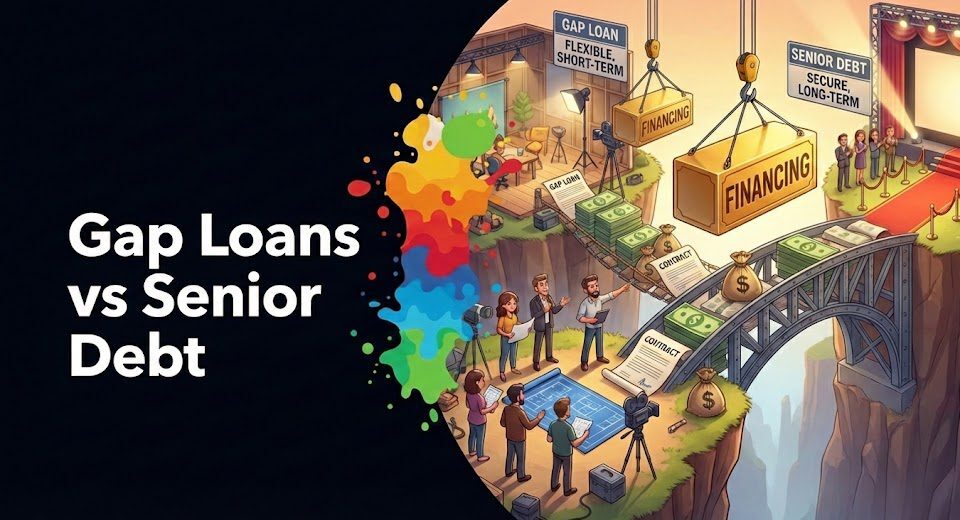
In the brutal math of film financing, where you sit in the waterfall determines whether you get paid or get wiped out. Gap loans vs senior debt isn’t just a semantic debate; it’s the difference between “hard money” secured by bankable paper and “soft money” betting on market appetite.
Senior debt sits at the top of the recoupment stack (first out), while gap loans function as mezzanine financing, recouping after the senior lender but before equity investors.
Understanding these layers is essential for any producer looking to de-risk their project. If you’re building a budget in today’s tight credit environment, knowing how to balance these two instruments can save you 200–500 basis points in effective interest.
Here’s the real dynamic behind how gap loans differ from senior debt, what they cost in 2025, and how to navigate the inter-creditor battles that happen behind closed doors.
Table of Contents
Stop Guessing Who’s Financing. Get Targeted Outreach.
Stop searching and start getting funded. We identify the exact decision-makers currently backing projects like yours, turning raw data into risk-aligned capital partnerships.
Major Studios
Scouting early stage projects, IP, and Regional partners for global studio pipelines.
IP Owners & Leads
Connecting creative leads with qualified financiers and major streaming platforms.
Streamers
Securing high-value pre-buy content and discovering early-stage global IP for platforms.
Indie Producers
Bridging the gap for indie filmmakers to reach executive production partners and capital.
Global Financing Ecosystems
Mapping complex markets and pairing projects with disciplined, risk-aligned capital across global territories worldwide.
Senior Debt: The Foundation of the Capital Stack
Senior debt is the “least risky” money for a lender, which makes it the cheapest money for a producer. It’s typically provided by specialized entertainment banks or well-capitalized private credit funds. In a standard deal, senior debt is secured by hard collateral—assets with a high degree of certainty for repayment.
What qualifies as hard collateral? Usually, it’s a combination of tax incentives (like the UK’s 40% rebate or Saudi’s 40% cash back) and executed distribution pre-sales. If you have a signed contract from Netflix or a major territory distributor, the bank will “discount” that paper, advancing you roughly 80–90% of the contract value.
Strategic players understand that senior debt lenders aren’t in the business of taking content risk. They don’t care if the movie is good; they care if the tax office is solvent and the distributor’s credit is strong. Because they are the first to get paid back once the revenues start flowing, their interest rates are the lowest in the stack—currently hovering around SOFR plus 200–400 basis points.
Producers looking to optimize their production financing often start by maximizing this layer. It’s the anchor. But rarely does senior debt cover the whole budget. That’s where the “gap” appears.
Gap Loans: Bridging the Estimate Void
Gap loans—often referred to as mezzanine financing—are the “riskier” sibling of senior debt. While the senior lender sits comfortably behind signed contracts, the gap lender is betting on the future. They lend against the unsold territories. If you’ve sold the US and UK but still have the rest of the world (ROW) available, those unsold rights are the collateral.
The mechanics? A sales agent provides “estimates” for what those unsold territories are worth. The gap lender then advances a percentage of those estimates—usually 50–70%. It’s speculative. The lender is essentially saying, “We believe your sales agent can actually get $10 million for the rest of the world, so we’ll give you $5 million now.”
Now, here’s the thing: because the risk is higher, the cost is higher. You aren’t paying bank rates for gap. You’re paying mezzanine rates, which in 2025 often range from SOFR plus 600 to 1000 basis points. For a detailed breakdown of your specific project needs, you can ask VIQI about gap loan requirements for your territory.
The Vitrina Recoupment Priority Ladder™
To visualize the gap loans vs senior debt dynamic, we use the Vitrina Recoupment Priority Ladder™. This framework shows who gets the first dollar through the door after the sales agent takes their commission and expenses.
The Vitrina Recoupment Priority Ladder™
| 1. Senior Debt | First Out. Secured by tax credits & signed pre-sales. Lowest risk. |
| 2. Gap Loan / Mezzanine | Second Out. Secured by unsold territory estimates. Moderate risk. |
| 3. Equity Investors | Third Out. Participation in net profits. Highest risk. |
| 4. Deferrals / Back-end | Last Out. Talent and producer fees paid from remaining pool. |
As shown, the gap lender is squeezed between the senior bank and the equity investors. If the film underperforms and only makes back 60% of its projected ROW value, the senior lender is likely safe, but the gap lender might only get partially repaid. The equity? They’re wiped out. That’s the capital reality.
Key Differences: Collateral, Cost, and Position
The real dynamic between these two instruments comes down to three levers: what you’re pledging, what you’re paying, and where you stand.
1. Collateral (The “Paper” vs the “Promise”)
Senior debt requires fixed assets. If you don’t have a tax incentive certificate or a signed long-form distribution agreement, a bank won’t even open the file. Gap loans, however, allow you to weaponize your project’s potential. They rely on the credibility of your sales agent. If your agent is a Tier 1 powerhouse with a track record of meeting their estimates, a gap lender will trust the “promise” of those unsold territories.
2. All-in Costs
It’s not just about the interest rate. Senior lenders often charge an origination fee of 1–1.5%. Gap lenders, taking more risk, often charge 2–3% upfront. Furthermore, gap lenders may demand a “corridor” of the film’s net profits—something a senior bank almost never does. This “equity kicker” can significantly impact your back-end IRR.
Phil Hunt, CEO of Head Gear Films, explains the shift in lending appetite:

Find the Financiers Backing Your Genre
Stop searching and start getting funded. We identify the exact decision-makers currently backing projects like yours, turning raw data into risk-aligned capital partnerships.
The Inter-creditor Agreement: Where the Battle is Won
Behind the scenes, the most important document in your capital stack isn’t the loan agreement—it’s the inter-creditor agreement. This is where the senior lender and the gap lender fight for dominance. Since the senior lender is “senior,” they want total control over the collateral. They want to ensure that if things go sideways, they can seize every territory, even the ones the gap lender is relying on.
Insiders recognize that these negotiations can stall a project for weeks. A senior lender might refuse to allow the gap lender to “step into the shoes” of the producer if there’s a default. Without those step-in rights, the gap loan is virtually uncollateralized. If you’re currently navigating these terms, Vitrina’s Concierge service can help match you with lenders who have pre-negotiated inter-creditor templates, compressing your closing timeline by weeks.
The “super-senior” position is another trend we’re tracking. This is when a lender provides the bridge for the tax credit but demands that they are repaid even before the traditional senior debt. It adds another layer of complexity—and cost—to the waterfall.
How Vitrina Helps with Film Financing
Finding the right mix of gap loans and senior debt requires proximity to the lenders who are actually deploying capital. Vitrina is the “Insider’s Insider” for the supply chain, offering the data you need to structure your deal with precision.
- Verified Database: Access 140+ gap and senior lenders filtered by budget range and territory.
- VIQI Research: Ask our AI assistant for specific lender requirements and current market spreads.
- Concierge Support: Get direct introductions to financing partners tailored to your project’s capital stack.
Frequently Asked Questions
Is gap financing considered senior debt?
No. While both are debt instruments, gap financing is “mezzanine” or junior debt. It recoups after the senior debt has been fully repaid. If a lender says they are “senior gap,” it usually means they are taking a priority position within the gap layer, but they are still junior to the main production bank.
Can I use the same lender for senior and gap loans?
Yes, and it’s often more efficient. Some private credit funds offer “blended” facilities where they provide both layers. This simplifies the inter-creditor process and can reduce legal fees, though you’ll likely pay a higher weighted average interest rate than if you sourced them separately.
What happens if the film doesn’t sell all territories?
This is the gap lender’s nightmare. If territories remain unsold or sell for less than the estimates, the gap lender may not be fully recouped. They usually require a “completion bond” to ensure the film is at least delivered, but they still bear the market risk of the content itself.
Do gap loans require cast attachments?
Almost always. Because gap lenders lend against sales agent estimates, those estimates must be based on something tangible—usually the “bankability” of the cast and director. Without cast, your estimates will likely be too low to support a meaningful gap loan.
Find Film+TV Projects, Partners, and Deals – Fast.
VIQI matches you with the right financiers, producers, streamers, and buyers – globally.
Producers Seeking Financing, Co-Pros, or Pre-Buys?
Vitrina Concierge helps producers reach the right financiers, commissioners, distributors, and co-production partners — with precision outreach, not cold pitching.
Join Industry Briefings Trusted by Leaders

Format Adaptations: Global Trends
Where formats are traveling, which adaptations are breaking out, and how streamers are backing remakes in 2025–2026.

Books, Novels & Comics Adaptations: Global Trends
Books, webtoons, and manga driving the next global screen hits. Discover how in this webinar.

Micro-Dramas & Mobile-First Storytelling
Micro-dramas are building real audiences and revenue. Understand the platforms, buyers, and economics behind the growth.

Navigating Global Content Licensing Trends
How global content licensing is shifting beyond flat fees to flexible, deal-driven models.