IHUB
IHUB
 Private Briefings (Webinars)


 LeaderSpeak Podcast
  Global Entertainment Digest (Newsletter)
  Premium Lists
 Membership Benefits
 About Vitrina
 Our Story

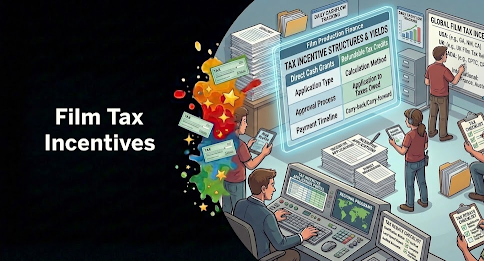
Your filming location can determine 15-40% of your total production budget. Not through lower crew rates or cheaper gear rentals—though those matter—but through soft money: the tax incentives, rebates, and grants that governments use to attract production dollars.
Soft money is non-repayable funding. Unlike equity (which dilutes ownership) or debt (which requires interest payments and recoupment priority), soft money from jurisdictions just… reduces your net costs. California’s expanded program now offers up to 40% refundable on qualified spend. Georgia delivers 30% transferable with no annual cap. The UK provides 25.5% cash rebate after cultural testing. Stack Canada’s federal and provincial credits and you can hit 61% effective on resident labor.
But here’s the thing: chasing the highest percentage is the wrong strategy. Because soft money programs have wildly different qualifying rules—what counts as “qualified spend,” whether above-the-line costs are included, if you need to pass cultural tests, how long until payment. Location drives what soft money you can access, and that access determines your capital stack. This is The Spend Matrix.
📑 Table of Contents
- What is Soft Money in Film Financing?
- The Vitrina Spend Matrix™
- How Location Drives Soft Money Access
- The Stacking Opportunity
- Modeling Total Economics, Not Just Percentages
- Strategic Location Decisions by Project Type
- Common Mistakes in Chasing Soft Money
- Frequently Asked Questions
- How Vitrina Maps Global Soft Money
Stop Guessing Who’s Financing. Get Targeted Outreach.
Stop searching and start getting funded. We identify the exact decision-makers currently backing projects like yours, turning raw data into risk-aligned capital partnerships.
Major Studios
Scouting early stage projects, IP, and Regional partners for global studio pipelines.
IP Owners & Leads
Connecting creative leads with qualified financiers and major streaming platforms.
Streamers
Securing high-value pre-buy content and discovering early-stage global IP for platforms.
Indie Producers
Bridging the gap for indie filmmakers to reach executive production partners and capital.
Global Financing Ecosystems
Mapping complex markets and pairing projects with disciplined, risk-aligned capital across global territories worldwide.
What is Soft Money in Film Financing?
Soft money refers to government-backed financial incentives that reduce production costs without requiring repayment or equity dilution. It’s called “soft” because it’s non-recourse—you don’t pay it back, and you don’t give up ownership in exchange.
Soft money comes in five main forms:
1. Cash Rebate
Direct government refund based on qualifying local spend. Works like a check or wire transfer paid after production completes and costs are audited. Australia’s 30% Location Offset is a cash rebate. So is Abu Dhabi’s 50% program. Simplest mechanism for international producers because it doesn’t require local tax liability.
2. Refundable Tax Credit
Reduces your company’s tax liability in the jurisdiction—and if the credit exceeds what you owe in taxes, the government refunds the difference in cash. Functions nearly identically to a cash rebate. California’s new 35-40% program is refundable. So is Quebec’s 25% base rate. The “gold standard” of tax credits because you get cash either way.
3. Transferable Tax Credit
Can be sold to third parties who have tax liability in that jurisdiction. Georgia’s 30% credit is transferable. So is New Jersey’s 30-40%. You sell the credit to a Georgia taxpayer for 85-95 cents on the dollar, and they use it to offset their state taxes. Adds a transaction layer but monetizes credits even if your production company has no tax liability in-state.
4. Non-Refundable, Non-Transferable Tax Credit
Only offsets your company’s own tax liability in that specific jurisdiction—and if you don’t owe taxes there, it’s worthless. Can’t be refunded, can’t be sold. Least valuable type. Rare in competitive markets because most production companies are special-purpose entities with minimal local tax exposure.
5. Grants
Direct government payments, often discretionary. No tax filing required. Common in Europe (Germany’s DFFF is technically a grant). May be tied to cultural criteria or specific project types. Film funds in places like Saudi Arabia’s Vision 2030 combine grants with rebates.
The distinction matters because it determines cash flow timing and transaction costs. A cash rebate paid 6 months post-completion is different from a transferable credit you can sell during production (at a discount). And both are different from a refundable credit that requires filing local tax returns.
In your capital stack, soft money sits alongside—not instead of—equity and debt. A $20M production might be financed with $10M equity, $5M gap financing (debt), $4M pre-sales, and $1M soft money (tax incentive). The soft money doesn’t fund production directly; it reduces net cost after the fact, which improves ROI for equity investors and de-risks the debt position.
The Vitrina Spend Matrix™
Not all soft money programs are created equal. The type of soft money you can access depends on how and where you spend your budget. That’s The Vitrina Spend Matrix™—a framework for mapping spend patterns to soft money tiers.
The matrix has two axes:
Axis 1: Spend Type
- ATL (Above-the-Line): Cast, director, producer, writer compensation
- BTL (Below-the-Line): Crew, equipment, locations, physical production
- Post/Digital: Editorial, VFX, color, sound post, deliverables
Axis 2: Location Flexibility
- Fixed Location: Story requires specific geography (e.g., New York-set series)
- Flexible Location: Can shoot anywhere that doubles for the setting
- Location-Agnostic: Animated, virtual production, or post-only work
Where you land on this matrix determines which soft money programs you can realistically access—and how much of your budget qualifies.
Quadrant 1: Fixed Location + High ATL Spend
Example: $50M feature filming in Los Angeles with A-list cast.
Soft Money Access: California’s program (now up to 40% refundable) BUT excludes ATL costs. So your $15M in cast salaries doesn’t qualify. Only BTL and some post costs count. Net benefit: Maybe 20-25% of total budget if you structure carefully.
Alternative: Georgia has no ATL cap and includes cast compensation. But if your story is set in LA, doubling Georgia for California has creative costs (VFX budget to replace skylines, licensing issues with recognizable LA landmarks). Trade-off: Save 10-15% more in soft money but spend 5-8% more on VFX and production design workarounds.
Quadrant 2: Flexible Location + Balanced Spend
Example: $30M action thriller, can shoot anywhere with mountains and infrastructure.
Soft Money Access: Maximum optionality. Can evaluate New Mexico (25-40%, no ATL cap), UK (25.5%, cultural test required), Canada stacked programs (federal + provincial), Czech Republic (25-35%), Australia (30% Location Offset). Optimize for total economics—not just headline rate.
Strategic Move: If 40% of your budget is VFX, prioritize UK (29.25% VFX rate, no cap on VFX costs) or Quebec (41% effective on VFX/animation labor). If you have high ATL, lean toward Georgia or UK. If budget is tight and you need cash during production, consider locations where credits are transferable (sell during production) vs. refundable (wait 6-12 months).
Quadrant 3: Location-Agnostic + Post-Heavy
Example: Animated feature, 90% of budget is digital production and VFX.
Soft Money Access: PDV (Post, Digital, VFX) programs specifically. Australia’s 30% PDV Offset doesn’t require physical shooting—just that the digital work happens in Australia. UK allows VFX-only claims. Ireland’s 40% VFX uplift (for projects spending €1M+ on Irish VFX) is accessible even if you filmed elsewhere. Quebec’s 41% effective rate on VFX labor is a go-to.
Strategic Move: Split work across jurisdictions to stack incentives. Rough animation in India (40% rebate, low labor costs), rendering/compositing in Quebec (41%), final color/conform in UK (29.25% VFX rate). Each jurisdiction’s soft money applies only to work done locally—but you’re optimizing three separate rebates instead of chasing one.
Quadrant 4: Fixed Location + Post-Heavy
Example: Netflix series set in New York, heavy VFX but must shoot in NYC.
Soft Money Access: New York’s programs (30% base + 10% upstate, but you’re shooting in NYC so just 30%). Post-Production Credit available. Stack with any PDV work done upstate or out-of-state (though splitting post reduces NY’s qualified spend base).
Trade-Off: New York’s incentive is refundable and substantial—but the $800M annual cap is competitive. Georgia’s unlimited program tempts you, but narrative authenticity requires NYC. So you shoot in NYC, claim NY’s 30%, then route VFX to Quebec or UK for their higher PDV rates. Total soft money: NY 30% on production + Quebec 41% on VFX = blended ~34% across full budget.
The matrix isn’t prescriptive—it’s diagnostic. It forces you to ask: Given my spend profile and creative requirements, which locations unlock the most valuable soft money?
Ask VIQI about location incentive requirements →
Phil Hunt, CEO of Head Gear Films, discusses the evolving independent film financing landscape and how producers can navigate tightening capital availability.
How Location Drives Soft Money Access
Three examples illustrate how location decisions determine soft money type and value:
California: High Rate, Narrow Eligibility
California’s Film & Television Tax Credit Program 4.0 (launched July 2025) offers 35-40% refundable credit—one of the highest rates in the US. Annual cap: $750M. But:
- ATL costs excluded (cast, director, producer salaries don’t qualify)
- Must spend 75% of budget in-state
- Competitive lottery-based allocation
- Application windows are narrow (2-3 days, twice yearly)
- VFX gets 5% uplift but only if performed in California
A $40M feature with $12M ATL spend nets maybe $7-10M in soft money (25% of total budget). Compare to the 35-40% headline rate and you see the gap. California works if your story demands LA, you have strong in-state vendor relationships, and you can navigate the application lottery. Otherwise, you’re chasing a rate that doesn’t apply to a third of your budget.
Georgia: Unlimited Access, Includes Everything
Georgia’s program: 30% transferable tax credit with no annual cap, no per-project limit, and—critically—no restriction on ATL costs. Your $40M feature with $12M in cast salaries qualifies for the full 30% = $12M soft money. Add the 10% Georgia promotional logo uplift (most productions include it) and you’re at 40% effective.
Georgia spent $4.2B on production in 2024. Why? Because there’s no cap, no lottery, and the credit is transferable (meaning you can sell it during production for ~90 cents on the dollar and use that cash to fund the next phase). For producers, this is predictability. You know Georgia will pay 30%, you know you can monetize it mid-production, and you know there’s no annual funding cliff.
Trade-off: Georgia’s not cheap. Atlanta crew rates have climbed as demand saturates capacity. And if your project requires specific geography (mountains, deserts, coastal), Georgia’s pine forests limit you. But for studio tentpoles, prestige TV, and volume production, Georgia’s combination of no-cap + ATL inclusion + transferability makes it the US default.
UK: Lower Rate, VFX Advantage, Cultural Test
UK’s AVEC (Audio-Visual Expenditure Credit): 25.5% for live-action features and high-end TV. Sounds mid-tier. But dig deeper:
- VFX costs: 29.25% (5% uplift) and exempt from the 80% qualifying spend cap
- No annual cap, no per-project cap
- Refundable (paid 6-12 months post-completion)
- Cultural test required: 18 of 35 points (based on UK cast, crew, locations, subject matter)
- Generative AI costs for VFX qualify (confirmed 2025)
A $50M feature with $20M VFX spend and enough UK shooting to pass cultural test could net $12-14M soft money. The VFX enhancement (29.25% + no cap on VFX costs) is competitive with Quebec’s 41%—and the UK has Framestore, DNEG, ILM London. If your project is VFX-heavy and you can hit 18 cultural test points, UK soft money economics work.
Trade-off: The cultural test. If you’re shooting a US-set story with minimal UK cast or locations, you probably can’t pass. Official co-productions auto-qualify, but that requires partnering with a UK producer and meeting co-production treaty terms. Not a fit for every project—but for Marvel/DC episodics or UK-set prestige drama, it’s a strategic lock.
These three examples—California’s narrow but high rate, Georgia’s unlimited inclusion, UK’s VFX advantage—show that location choice isn’t about finding the “best” program. It’s about finding the program that aligns with your spend profile, creative requirements, and cash flow needs.
Compare locations on Vitrina →
The Stacking Opportunity
Some jurisdictions let you combine multiple soft money programs. Stacking amplifies return—but compliance gets complex.
Federal + Provincial (Canada)
Canada’s federal CPTC (Canadian Film or Video Production Tax Credit): 25% on eligible labor. Stack with provincial programs:
- BC: 36% on resident labor (increased from 28% in 2025)
- Ontario: 21.5-40% depending on project type
- Quebec: 25% base + 16% VFX/animation labor bonus = 41% effective
For a Canadian-qualifying production shooting in BC, you can access 25% federal + 36% provincial = 61% on Canadian labor costs. That’s extraordinary. But nuance: The federal 25% only applies to Canadian-content productions or official co-productions. For pure service work (US studio hiring Canadian vendor), you get the provincial rate but not federal. Still, BC’s 36% standalone is competitive.
National + Regional (Australia)
Australia’s 30% Location Offset (for international productions) can stack with state incentives:
- New South Wales: 10% additional
- Queensland: 15% additional
- South Australia: 10% additional
- Victoria: 10% additional
Shoot in Queensland and you’re at 30% national + 15% state = 45% effective. Australia also has a 30% PDV Offset for post/digital/VFX work. Separate program, separate qualifying spend. So if you shoot in Queensland (45%) and do post in Sydney (30% PDV), you’re stacking across phases.
National + Regional (Spain)
Spain’s federal program: 25-30% cash rebate/tax credit. But regional programs in Canary Islands (45-50%), Basque Country (35-70%), and Navarre (35%) often exceed the national rate. Canary Islands at 45-50% is the highest in Europe—higher than even Abu Dhabi’s 50% in some scenarios because Spain’s labor costs are lower.
For a $30M feature shooting in Canary Islands, you could net $13.5-15M soft money. That’s 45-50% of budget. Trade-off: Canary Islands aren’t London or Paris. Infrastructure is improving but you’re working with smaller crew pools and limited stage space. Great for location-heavy projects (deserts, volcanic landscapes, coastal). Less ideal for sound-stage tent poles.
Co-Production Treaty Stacking
Official co-productions between treaty countries (e.g., Canada-UK, France-Germany, Australia-China) unlock both countries’ national incentive programs. A Canada-UK co-production can claim:
- Canada: 25% federal CPTC + provincial (say, Ontario 21.5%) = 46.5%
- UK: 25.5% AVEC
But you can’t double-dip on the same costs. If 60% of production happens in Canada, you claim Canada’s incentives on that 60%. If 40% happens in UK, you claim UK’s incentive on that 40%. Net: You’re accessing two programs, but on separate qualifying spend. Still, for a $40M co-production, that could be $12M (Canada on $26M spend) + $4M (UK on $16M spend) = $16M total soft money. 40% of budget.
The catch: Co-production treaties have strict requirements—minimum financial contributions (usually 20-80%), creative personnel from each country, cultural tests, application approval 4+ weeks before shooting. Not trivial. But for projects with natural multi-country stories (European dramas, Canada-UK historical epics), co-production stacking is a financing unlock.
Find the Financiers Backing Your Genre
Stop searching and start getting funded. We identify the exact decision-makers currently backing projects like yours, turning raw data into risk-aligned capital partnerships.
Modeling Total Economics, Not Just Percentages
A 40% rebate on inflated costs isn’t better than a 25% rebate on market rates. You have to model total landed cost—not just headline percentages.
Base Production Costs Matter
Example: Shooting in London vs. Mumbai.
- London: UK crew rates $800/day average, 25.5% AVEC rebate → Net $596/day per crew member after rebate
- Mumbai: Indian crew rates $150/day, 40% rebate → Net $90/day per crew member after rebate
Even with a lower rebate percentage, London is still 6x more expensive per crew day than Mumbai. The soft money reduces costs in both cases, but base economics dominate. For high-volume TV series (200+ shoot days, 100+ crew), that gap compounds to millions.
This doesn’t mean “always shoot in the cheapest location.” Quality matters, infrastructure matters, talent pool matters. But when modeling soft money value, you must account for base costs. A jurisdiction offering 40% on $1000/day labor is giving you $400 back. A jurisdiction offering 25% on $500/day labor is giving you $125 back—and your net cost is still $375 vs. $600.
Currency Exchange Impact
Canada and Australia benefit from weaker currencies vs. USD/GBP. When CAD trades at 0.70 USD, a $1M CAD expenditure costs $700K USD. Apply Quebec’s 41% rebate and your net USD cost is ~$413K. That’s a ~59% discount from a US equivalent at par currency.
Exchange rates fluctuate, but over the past decade, CAD and AUD have traded 10-30% below USD on average. That structural discount stacks with soft money. It’s why Vancouver and Montreal remain competitive even as their rebate percentages lag Georgia’s 30% or California’s 35-40%. The currency arbitrage offsets the rate gap.
Cash Flow Timing
Soft money is backend capital. You spend first, claim later, get paid 6-18 months post-completion. That creates a cash flow gap most productions bridge with:
- Rebate loans: Banks lend 80-90% of approved incentive value during production. You pay interest until the rebate arrives. Typical rates: 8-12% annually. Net effect: A $5M rebate becomes $4.5M after discounting for the loan fee and interest.
- Gap financing: Debt secured against unsold territories and/or expected rebates. Sits senior to equity but subordinate to production loans. Expensive (10-15% annually) but fills the funding gap.
- Equity discounting: Equity investors model soft money into their returns, but discount for risk and timing. A $10M equity raise might assume $3M in rebates, but only value those at $2.4M net (20% discount) due to timing and execution risk.
Cash flow timing is why transferable credits (Georgia, New Jersey) are attractive—you can sell them mid-production for 85-95 cents on the dollar and use that cash immediately. Refundable credits (California, Quebec) are valuable but require waiting. And grants (Europe, MENA) are fastest but often smallest in dollar terms.
True Net Cost Calculation
Here’s the formula producers use to model total net cost:
True Net Cost = Gross Budget - (Soft Money × Discount Factor) + Financing Costs + Compliance Costs
Where:
- Soft Money: Headline rebate amount
- Discount Factor: 0.80-0.95 depending on monetization method (rebate loan vs. transfer vs. wait)
- Financing Costs: Interest on rebate loans, gap financing fees
- Compliance Costs: Production accountant, audit fees, legal counsel, application fees
Example: $30M feature in Georgia
- Gross Budget: $30M
- Georgia 30% rebate: $9M
- Sell credit for 90%: $8.1M realized
- Financing cost (bridge loan at 10% for 12 months): -$300K
- Compliance cost (accountant, audit, legal): -$150K
- True Net Cost: $30M – $8.1M + $300K + $150K = $22.35M
- Effective rebate: 25.5% of gross budget (not 30%)
Now compare to UK alternative:
- Gross Budget: $32M (higher base costs in UK)
- UK 25.5% AVEC: $8.16M
- Refundable, wait 10 months: Finance at 8% = -$544K
- Compliance cost: -$180K
- True Net Cost: $32M – $8.16M + $544K + $180K = $24.56M
- Effective rebate: 23.25% of gross budget
Georgia’s true net cost is $22.35M. UK’s true net cost is $24.56M. Georgia wins by $2.2M even though headline rates are 30% vs. 25.5%. Why? Lower base costs ($30M vs. $32M gross) and faster monetization (sell credit during production vs. wait 10 months).
This kind of modeling—total economics, not just percentages—is how studios and independent producers actually make location decisions. Vitrina’s platform helps you run these comparisons across multiple jurisdictions simultaneously.
Andrea Scarso, Managing Partner at IPR VC, explains how equity investors evaluate soft money when structuring film and TV financing, and why location decisions impact capital stack design.
Strategic Location Decisions by Project Type
Different project types optimize for different soft money strategies.
VFX-Heavy Productions
Prioritize: UK (29.25% VFX, no cap), Quebec (41% on VFX labor), Ireland (40% if >€1M VFX spend), Australia PDV (30%).
Strategy: Split work if possible. Shoot anywhere, route VFX to these four jurisdictions. Each applies its rate to work done locally. Net: You’re accessing multiple soft money programs across the pipeline.
High-Budget Features ($75M+)
Prioritize: Georgia (unlimited cap, includes ATL), UK (no per-project cap), Australia (30% Location Offset uncapped), MENA (Abu Dhabi 50%, Saudi 40%).
Strategy: Avoid capped programs (California, New York, Louisiana) unless you apply early and secure allocation. High-budget features consume caps fast—California’s $750M annual cap can fill in 2-3 application rounds. Georgia’s unlimited structure removes that risk.
Indie Films ($2-15M)
Prioritize: Ireland Scéal Uplift (40% for films <€20M), New York Indie Fund ($100M reserved), regional programs with lower minimums.
Strategy: Indie budgets often can’t absorb compliance costs for complex international structures. Stick to one primary location with strong regional support and simple refundable/rebate structures. Ireland’s Scéal is designed for this tier. So is New York’s dedicated indie fund.
Episodic TV (Multi-Season)
Prioritize: Georgia (volume capacity, no cap), Canada provincial programs (crew depth), UK (Pinewood/Leavesden infrastructure).
Strategy: Lock in a home base for consistency across seasons. Crew continuity matters more than chasing an extra 5% in another jurisdiction. Georgia’s uncapped program + Atlanta’s vendor ecosystem supports 30-40 concurrent series. That scale matters for episodic.
Animated Projects
Prioritize: Ireland (40% Scéal or VFX uplift), Czech Republic (35% animation rate), Quebec (41% on animation labor), UK (29.25% for animation), India (40% federal including animation).
Strategy: Animation is location-agnostic. Optimize purely on soft money + labor costs + talent. Quebec and India offer the best blended economics (high soft money, skilled labor, reasonable rates). Czech Republic is emerging as European hub with 35% rate and tripled cap.
Common Mistakes in Chasing Soft Money
Mistake 1: Chasing Headline Percentages
A 50% rebate sounds better than 25%. But if the 50% jurisdiction has double the base costs, your net spend is higher. Always model total economics—not just the incentive rate.
Mistake 2: Ignoring Qualification Requirements
UK’s cultural test, Canada’s CPTC Canadian-content requirements, California’s 75% in-state spend threshold—these aren’t suggestions. Miss them and your soft money disappears. Budget time and money for compliance counsel early.
Mistake 3: Missing Application Deadlines
California and New York have narrow application windows (2-3 days). If you miss the window, you wait 6 months for the next one—or film elsewhere. Set calendar reminders 60 days before application windows open. Some producers file placeholder applications just to secure a spot.
Mistake 4: Underestimating Compliance Costs
Production accountants familiar with local incentive programs charge $5-15K/month. Audit fees run $20-50K depending on program. Legal counsel for co-production treaties: $30-80K. These costs eat into soft money value. A $500K rebate with $100K compliance cost nets $400K—20% haircut.
Mistake 5: Not Planning for Cash Flow Gaps
Soft money pays 6-18 months post-completion. If your capital stack assumes you’ll have that cash during production, you’ll run short. Either finance against the rebate (rebate loan) or raise additional equity/debt to bridge. Don’t assume backend money is available upfront.
Research soft money programs with VIQI →
FAQ: Soft Money & Location-Based Financing
Q: What’s the difference between soft money and hard money in film financing?
A: Soft money is non-repayable funding (tax incentives, rebates, grants) that reduces net costs without diluting ownership or requiring interest payments. Hard money is repayable capital—equity (dilutes ownership), debt (requires interest + recoupment priority), or pre-sales (commits distribution rights). Most films use both: equity + debt + soft money.
Q: Can you stack multiple tax incentives from different countries?
A: Yes, but you can’t double-dip on the same costs. If you shoot in Canada and do post in the UK, you claim Canada’s incentive on Canadian spend and UK’s incentive on UK spend. Co-production treaties let you access both countries’ programs, but each applies only to work done in that country. You can’t claim two incentives on the same dollar of spend.
Q: Which US state offers the best film tax incentive?
A: Depends on your project. Georgia (30% transferable, unlimited cap, includes ATL) is best for high-budget or volume production. California (35-40% refundable, $750M cap, excludes ATL) is best if story requires LA and you can navigate the lottery. New York (30% refundable + indie fund) is best for prestige TV and features. Model your specific scenario—don’t just chase the highest percentage.
Q: How long does it take to receive tax incentive payments?
A: Varies by jurisdiction and incentive type. Cash rebates: 6-12 months post-completion after audit. Refundable tax credits: 8-14 months (requires tax filing + audit). Transferable credits: Sell during production for 85-95% immediate cash. Grants: Can be faster (3-6 months) but often smaller amounts. Always finance against the rebate if you need cash during production.
Q: Do above-the-line costs (cast salaries) qualify for tax incentives?
A: Depends on the program. Georgia, New Mexico, UK, and many international programs include ATL. California, Louisiana (post-2024), and some others exclude ATL or cap it. This is a critical distinction—if 30-40% of your budget is cast/director salaries and your jurisdiction excludes ATL, you’re only accessing the incentive on 60-70% of spend. Always check ATL eligibility before committing to a location.
Q: Can you shoot in one location and claim tax incentives from another?
A: No—with rare exceptions. Tax incentives apply to work performed in that jurisdiction. If you shoot in Georgia, you claim Georgia’s incentive. If you then do post in Quebec, you claim Quebec’s incentive on that post work. The exception: Some co-production treaties allow work done in third countries to count toward qualification (but usually capped at 20-30% of budget). You can’t shoot entirely in Location A and claim Location B’s incentive.
Q: What happens if your production doesn’t meet the minimum spend threshold?
A: You don’t qualify for the incentive. California requires $1M minimum spend. New York (outside NYC) requires $250K. If your budget is below the threshold, the program isn’t available. Some states have lower thresholds for specific project types (documentaries, short-form). Check minimum spend requirements during budgeting—don’t assume you’ll qualify.
Q: Are film tax incentives worth the compliance costs?
A: For budgets above $5M, yes—the return typically justifies the compliance cost. For budgets under $2M, maybe not—compliance can eat 10-20% of a small incentive. A $100K budget claiming a $25K rebate might spend $15K on accountants and legal, netting only $10K. At scale, though, soft money is transformative. A $50M feature claiming $15M in incentives ($200K compliance cost) nets $14.8M—30% budget reduction. That’s worth it.
Q: Can independent films access the same tax incentives as studio productions?
A: Mostly yes, but capacity is an issue. Georgia’s unlimited cap benefits both indies and studios. California’s lottery system technically treats them equally, but studios have dedicated teams to navigate applications—indies often lose in practice. New York created a dedicated $100M indie fund (separate from the $700M main program) specifically to address this. Ireland’s Scéal Uplift targets films under €20M. Look for programs with indie-specific carve-outs or lower minimum spend thresholds.
Q: What’s the best strategy for maximizing soft money on a limited budget?
A: Pick one primary location with a simple, refundable/rebate structure and high effective rate. Don’t try to split across multiple jurisdictions unless budget is $20M+—the compliance overhead on multi-location structures eats indie budgets. Ireland (40% Scéal), Quebec (41% on specific spend types), or regional US programs with low minimums are good targets. Hire a production accountant who specializes in that jurisdiction. And file early—capped programs allocate first-come, first-served or by lottery.
How Vitrina Maps Global Soft Money
Navigating soft money programs across 50+ jurisdictions is complex. Which locations match your spend profile? What are the true net costs after incentives, financing, and compliance? How do you model stacking opportunities?
Vitrina’s platform gives you global soft money intelligence:
Location Comparison Tool: Compare tax incentive programs side-by-side across jurisdictions. Filter by incentive type (cash rebate, refundable credit, transferable), ATL eligibility, minimum spend, and annual caps. See which locations fit your project’s spend matrix.
VIQI Incentive Research: Ask questions like “Which countries let me stack federal and regional incentives?” or “What’s the cultural test scoring for UK film tax credits?” VIQI pulls from Vitrina’s knowledge base of global incentive programs, application requirements, and compliance details.
Vendor Network by Location: Once you’ve identified target locations, explore verified vendors in those jurisdictions. Search for production services, post facilities, VFX studios, equipment rentals—all filtered by location and capability. Build your vendor stack alongside your soft money strategy.
Concierge for Complex Structures: For multi-jurisdiction productions, co-production treaties, or high-budget projects with stacking opportunities, Vitrina’s Concierge service provides hands-on support. We help you model total economics, navigate applications, and connect with local production accountants and legal counsel.
Whether you’re planning a $3M indie in Ireland or a $100M feature across Georgia + UK + Quebec, Vitrina maps the soft money landscape so you can optimize location decisions with real data—not just chase headline percentages.
Sign Up – Compare Locations →
Ask VIQI – Research Incentives →
Concierge – Get Hands-On Support →
Conclusion
Location determines 15-40% of your production budget through soft money access. But the highest percentage isn’t always the best deal. Georgia’s 30% with no ATL cap often beats California’s 40% that excludes cast. UK’s 25.5% with VFX enhancement can outperform jurisdictions offering 35% on general spend if your project is effects-heavy. Quebec’s 41% on VFX labor is unmatched—if you can structure work through Quebec vendors.
The Vitrina Spend Matrix™ maps how your spend profile (ATL vs. BTL vs. Post) and location flexibility determine which soft money programs you can realistically access. Use it to diagnose optimal locations before you commit creative or budget resources.
And model total economics—not just incentive percentages. Base costs, currency exchange, cash flow timing, compliance overhead all matter. A jurisdiction with lower gross costs and a 25% rebate can net cheaper than one with higher costs and a 40% rebate.
Soft money is backend capital. It doesn’t fund production directly—it reduces net cost after the fact. But when deployed strategically, it’s the difference between a $30M production that costs $22M and one that costs $27M. That $5M gap is equity dilution avoided, debt capacity preserved, or margin captured.
Location drives financing. Choose wisely.
Get Expert Soft Money Guidance – Vitrina Concierge →