About Innovation Hub
 Global Content Pulse (Webinars)


 Global Production Financing
(Webinars)
Global Production Financing
(Webinars)  LeaderSpeak Podcast
  About Vitrina
 Our Story
 Our Solutions 🔥
 Film+TV Projects Tracker 🚀
 Case Studies
 Our Profile
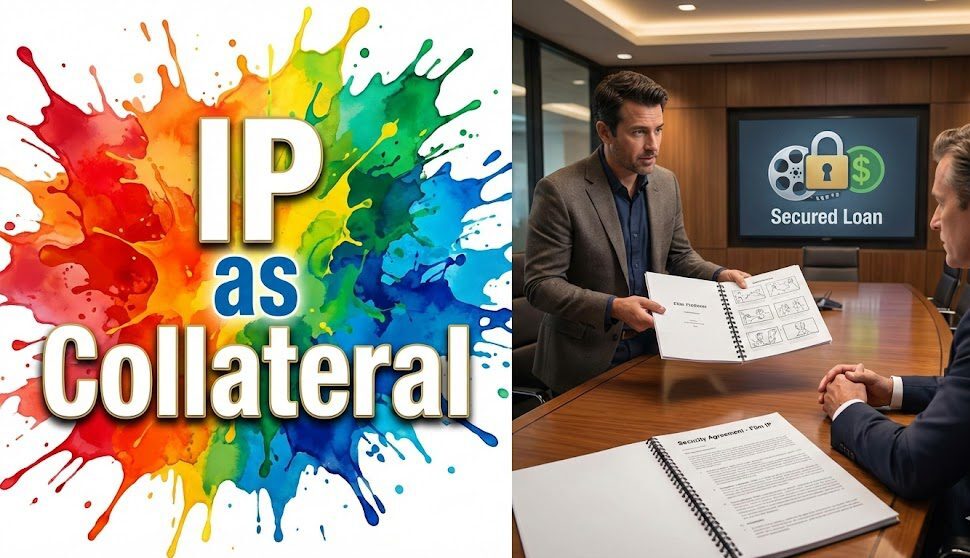
Using IP as collateral is the process of pledging intellectual property—typically a film’s copyright—to secure debt or gap financing for production.
Lenders don’t just look at the creative value; they analyze the “bankability” of the copyright chain and the projected revenue from unsold territories. In 2025, this mechanism provides 10-30% of indie film budgets, sitting senior to equity in the capital stack.
Let’s be blunt: creative potential doesn’t close a loan. Bankability does. While every producer believes their script is a “valuable asset,” lenders only see it as collateral once it’s wrapped in a clean legal framework and backed by sales estimates. If you’re looking to leverage your copyright, you aren’t just selling a story—you’re structuring a financial instrument.
Table of Contents
Stop Guessing Who’s Financing. Get Targeted Outreach.
Stop searching and start getting funded. We identify the exact decision-makers currently backing projects like yours, turning raw data into risk-aligned capital partnerships.
Major Studios
Scouting early stage projects, IP, and Regional partners for global studio pipelines.
IP Owners & Leads
Connecting creative leads with qualified financiers and major streaming platforms.
Streamers
Securing high-value pre-buy content and discovering early-stage global IP for platforms.
Indie Producers
Bridging the gap for indie filmmakers to reach executive production partners and capital.
Global Financing Ecosystems
Mapping complex markets and pairing projects with disciplined, risk-aligned capital across global territories worldwide.
The Legal Framework: Security Interest vs. Ownership
Here’s where many producers get it wrong: using IP as collateral doesn’t mean you’re signing over your copyright to the bank. It means you’re granting them a security interest. Think of it like a mortgage on a house. You keep living in it, but if you stop paying the bills, the bank has the right to take the keys and sell the place to recoup their cash.
In the U.S., this requires two critical steps that you simply can’t skip. First, the lender files a UCC-1 financing statement. This is a public notice that they have a claim on the asset. But for copyright, that’s not enough. You must also register the security interest with the U.S. Copyright Office. Without both, the lender’s interest isn’t “perfected”—and in the world of high-finance, an unperfected interest is as good as no interest at all.
Strategic players understand that production financing hinges on this legal cleanliness. If your chain of title has even a single “missing link”—an unassigned script polish or a missing music clearance—the collateral value drops to zero instantly. Lenders won’t take the risk of a third-party claim disrupting their recoupment waterfall.
The Vitrina IP Bankability Scale™
How lenders rate your copyright as viable collateral (1-10 Scale).
| Factor | Score 1-3 | Score 8-10 |
|---|---|---|
| Chain of Title | Vague/Missing LOIs | Clean/Registered |
| Talent Attachment | “In talks” | Firm/Escrowed |
| Territory Value | Estimates only | Confirmed Pre-Sales |
Producers scoring below a 7 on this scale typically struggle to secure IP-based debt without significant personal guarantees.
Valuation Mechanics: Library vs. Single Project
Not all IP is created equal. Lenders view a single-project copyright (an “orphan” asset) very differently than a content library. Library lending is the current darling of private equity—think Blackstone or Apollo. Why? Because a library has a proven revenue history. We call this “Trailing 12” (T12) revenue. If a library has consistently made $1M a year from licensing for the last five years, a lender can model that risk with surgical precision.
Single projects, on the other hand, are valued based on projections. This is much riskier. To mitigate this, lenders use distribution guarantees as the primary yardstick. They’ll hire a third-party sales agent to estimate the “Low” and “High” values for every major territory. If the total “Low” estimate for unsold territories is $10M, a gap lender might advance you $2M to $3M. That 20-30% “advance rate” is the standard across the industry today.
Want to dig deeper into lender requirements for your specific project? Ask VIQI, Vitrina’s AI research assistant, for personalized IP-backed financing guidance.
Can I Secure Capital Against a Script Alone?
The short answer? No. A script, while legally copyrightable, has no “commercial weight” as standalone collateral for a loan. To a bank, a script is a piece of paper. It only gains collateral value when it becomes a package. This means having a director attached, lead cast with “bankable” international value, and a locked budget. Only then can a sales agent put a number on it, and only then can a lender secure capital against it.
What the trades don’t report is that even A-list scripts often fail to close financing because the underlying IP rights are messy. For example, if you’re adapting a book, but the author retained the “sequel” or “TV” rights, a lender might see that as “encumbered IP.” They want the ability to monetize the asset fully if they ever have to seize it. If they can’t sell the whole pie, they’re less likely to lend you the dough for a slice.
Phil Hunt, CEO of Head Gear Films, explains the shift in IP valuation:

As Phil Hunt notes, the “Big Crunch” has made lenders far more conservative. In years past, a “meaningful” cast LOI might have been enough. Today, lenders want to see the money in escrow or the contract signed in blood. The margin for error has evaporated.
Find the Financiers Backing Your Genre
Stop searching and start getting funded. We identify the exact decision-makers currently backing projects like yours, turning raw data into risk-aligned capital partnerships.
The “Big Crunch”: Market Shifts in 2025
We’re currently navigating The Fragmentation Paradox™. There are more production companies than ever, but fewer “safe” buyers. Streamers like Netflix and Disney+ have moved away from the “cost-plus” model (where they pay 110% of the budget) and toward licensing deals. This forces producers to retain their IP—which is great for long-term equity, but terrible for short-term cash flow.
This shift has weaponized IP as collateral. Because you own the rights, you have to use those rights to borrow money. As of Q1 2025, interest rates for IP-collateralized loans range from 9-14%. If you’re paying 14% interest on $5M, that’s $700,000 a year in “carrying costs.” If your production is delayed by six months? That’s $350k down the drain before you’ve even shot a frame. Timing matters—more than ever.
Producers searching for lenders who specialize in IP-backed debt can explore 140+ lenders on Vitrina filtered by project size and territory focus.
How Vitrina Helps with IP Collateralization
Finding a lender who “speaks IP” is half the battle. Most commercial banks will laugh you out of the room if you try to pledge a horror script as collateral. You need specialist media lenders—the ones who understand waterfall recoupment and territory estimates. Vitrina’s platform is built to solve the information asymmetry eroding your margins.
- Lender Database: Filter 140+ verified lenders by their appetite for IP-backed debt.
- Expert Insights: Access analysis from 62 supply chain experts on valuation trends.
- VIQI AI: Get instant answers on complex financing structures and requirements.
Frequently Asked Questions
What is a security interest in copyright?
It’s a legal claim that a lender holds over your IP. It doesn’t mean they own the film; it means they have the right to take control of the revenue streams or sell the rights if you default on your loan. It’s the standard collateral mechanism for almost all film debt financing.
How do lenders value film IP as collateral?
Lenders use “Sales Estimates” from reputable agents. They’ll typically look at the “low” estimate for unsold territories and advance 20-30% of that value. They also consider the “bankability” of the cast, the genre’s historical performance, and the track record of the production team.
What is “Chain of Title” and why does it matter for IP as collateral?
Chain of Title is the paper trail showing who owns the copyright at every stage—from the first script draft to the final film. If there’s a gap in that trail, a lender won’t touch the project. They need to know that no one else can legally claim the asset they’re using as collateral.
Can I use a content library to fund a new production?
Yes, this is called “Library Lending.” Because a library has a proven track record of licensing revenue, it’s considered much lower risk than a single, new project. Established studios often leverage their back-catalog to secure a “slate” facility for new content.
The Bottom Line
IP as collateral is a powerful tool, but it’s not “free money.” It requires a level of legal and financial rigor that many indie producers find daunting. If you’ve got a clean chain of title and a bankable package, the capital is there—but the market is tight. Don’t go in with just a script; go in with a financial instrument.
Ready to explore your financing options? Vitrina’s Concierge team can connect you with matched IP-specialist lenders in 48 hours.
Find Film+TV Projects, Partners, and Deals – Fast.
VIQI matches you with the right financiers, producers, streamers, and buyers – globally.
Producers Seeking Financing, Co-Pros, or Pre-Buys?
Vitrina Concierge helps producers reach the right financiers, commissioners, distributors, and co-production partners — with precision outreach, not cold pitching.
Join Industry Briefings Trusted by Leaders

Format Adaptations: Global Trends
Where formats are traveling, which adaptations are breaking out, and how streamers are backing remakes in 2025–2026.

Books, Novels & Comics Adaptations: Global Trends
Books, webtoons, and manga driving the next global screen hits. Discover how in this webinar.

Micro-Dramas & Mobile-First Storytelling
Micro-dramas are building real audiences and revenue. Understand the platforms, buyers, and economics behind the growth.

Navigating Global Content Licensing Trends
How global content licensing is shifting beyond flat fees to flexible, deal-driven models.