

 About Innovation Hub
 Global Content Pulse (Webinars)


 Global Production Financing
(Webinars)
Global Production Financing
(Webinars)  LeaderSpeak Podcast
  About Vitrina
 Our Story
 Our Solutions 🔥
 Film+TV Projects Tracker 🚀
 Case Studies
 Our Profile
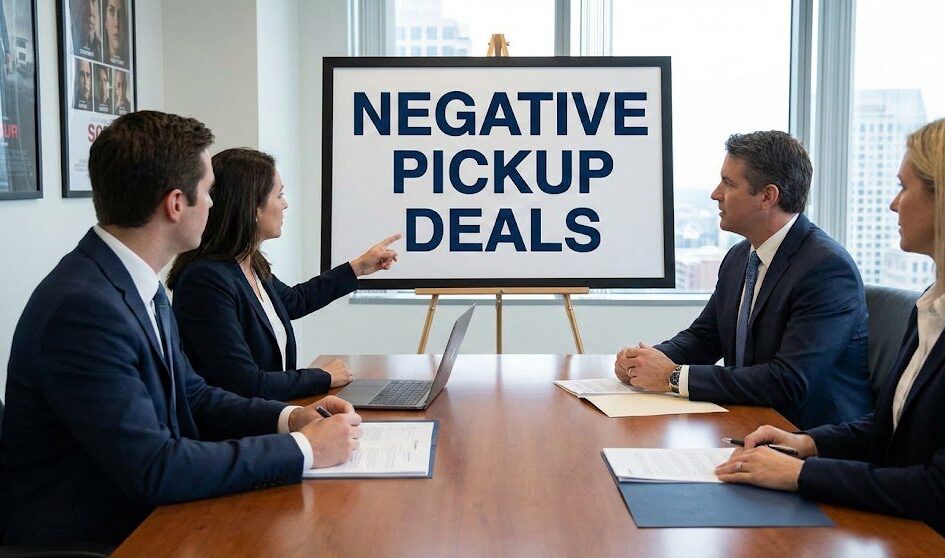
A negative pickup deal is a contract where a distributor agrees to purchase a completed film for a fixed price on a specific date. It’s essentially a “promise to pay” once the negative is delivered.
Producers use this bankable agreement as collateral to secure production loans, effectively selling the film before cameras even roll to de-risk the entire investment stack.
In the current high-interest environment, the classic negative pickup has evolved. It’s no longer just about a major studio writing a check upon delivery. Today’s strategic players—the insiders who actually close deals—recognize that negative pickups are the ultimate weapon for independent producers to bypass traditional equity hurdles.
If you’ve got a contract from a reputable distributor, you’ve got the keys to the bank. But here’s the catch: the lender only cares if the distributor is solvent and the delivery requirements are achievable.
In this guide, you’ll discover:
- The mechanics of “bankable” distribution agreements.
- Why negative pickups are sitting senior to equity in 2025.
- How to avoid the “Delivery Trap” that kills indie productions.
- The Vitrina Pre-Sale Solvency Scale™ for evaluating deal strength.
Stop Guessing Who’s Financing. Get Targeted Outreach.
Stop searching and start getting funded. We identify the exact decision-makers currently backing projects like yours, turning raw data into risk-aligned capital partnerships.
Major Studios
Scouting early stage projects, IP, and Regional partners for global studio pipelines.
IP Owners & Leads
Connecting creative leads with qualified financiers and major streaming platforms.
Streamers
Securing high-value pre-buy content and discovering early-stage global IP for platforms.
Indie Producers
Bridging the gap for indie filmmakers to reach executive production partners and capital.
Global Financing Ecosystems
Mapping complex markets and pairing projects with disciplined, risk-aligned capital across global territories worldwide.
What Is a Negative Pickup Deal?
Let’s get the terminology straight. A negative pickup isn’t a loan; it’s a purchase agreement. The distributor (the “buyer”) says, “I don’t want to fund your production now, but I will buy the finished movie for $5 million the day you hand me the master files.”
For a producer, that contract is a financial asset. You take that $5 million contract to an entertainment bank or a lender like Head Gear Films or BondIt Media Capital. They lend you, say, $4.2 million today so you can actually shoot the movie. They take a fee and interest, and when the distributor pays that $5 million later, the bank gets paid first. It’s a classic production financing maneuver that separates the hobbyists from the pros.
Phil Hunt, CEO of Head Gear Films, discusses the current financing crunch:
How Negative Pickup Agreements Function in 2025
The capital reality is that banks don’t take “creative” risks. They take “paper” risks. In a negative pickup deal, the lender isn’t betting on whether the movie will be a hit. They’re betting on two things: 1) The distributor’s ability to pay (Credit Risk), and 2) The producer’s ability to finish the movie (Performance Risk).
This is why VIQI, Vitrina’s AI research assistant, often points producers toward “bankable” distributors. A deal with a major like Sony or a top-tier indie like A24 is easy to finance. A deal with a brand-new streamer with no balance sheet? That’s just paper.
Find the Financiers Backing Your Genre
Stop searching and start getting funded. We identify the exact decision-makers currently backing projects like yours, turning raw data into risk-aligned capital partnerships.
The Vitrina Pre-Sale Solvency Scale™
Use this framework to evaluate if your negative pickup agreement is actually worth the paper it’s printed on when approaching lenders.
| Grade | Distributor Type | Lendability (LTV) |
|---|---|---|
| AAA | Global Majors (Netflix, Disney, Sony) | 90-95% |
| A | Top Indies (A24, Neon, Lionsgate) | 80-85% |
| B | Regional Mid-Cap (OSN, Canal+, TF1) | 70-75% |
| C | Emerging Digital Platforms | Hard to Collateralize |
*LTV = Loan to Value. Higher grades allow you to borrow more against the contract.
The Strategic Benefits (and Brutal Risks)
Why do producers chase these deals instead of just raising equity? It’s about EBITDA and ownership. If you fund a movie through negative pickups and debt, you keep the copyright. You keep the back-end. You aren’t giving away 50% of your company to a VC for a single project.
But—and it’s a big but—you are now on the hook for delivery. If your director goes over budget and you can’t deliver the film exactly as specified in the contract (the “Technical Specs”), the distributor can legally walk away. Suddenly, your $5 million guarantee evaporates, your lender calls their loan, and you’re in default. Insiders call this the “Delivery Trap.” It’s why Vitrina’s Concierge team emphasizes completion bonds as a mandatory partner for these deals.
Frequently Asked Questions
How does a negative pickup differ from gap financing?
The difference is collateral. A negative pickup is backed by an actual contract (a “known” value). Gap financing is backed by unsold territories (an “estimated” value). Lenders charge much higher interest for gap because they’re taking a market risk, whereas negative pickups are primarily a credit risk.
Can I secure a negative pickup for a TV series?
Yes, though it’s often structured as a “license-to-buy” or a staggered delivery. Streamers frequently use this model for “Originals” where they aren’t the producing entity. They agree to buy each season upon delivery, allowing the production company to bank the license fee to fund the shoot.
Are negative pickup deals still common in 2025?
They’ve seen a massive resurgence. As streamers move away from “cost-plus” models where they fund everything upfront, they are shifting back to acquisition models. They want to see the footage before they commit the full check. This puts the pressure on producers to secure the pickup contract first, then find the bridge capital.
What is the typical interest rate for banking a negative pickup?
Assuming the distributor is AAA-rated, you’re looking at SOFR (or base rate) plus 3-6%. If the distributor is smaller, rates can climb to 10-12%. Don’t forget the legal fees—bank attorneys aren’t cheap, and you’ll be paying for both sides of the closing.
How Vitrina Helps with Negative Pickup Deals
Securing a negative pickup is only half the battle; finding the lender to “cash flow” that contract is where many indie projects stall. Vitrina provides the supply chain intelligence to close that loop.
- Search 140+ lenders who specialized in banking distribution contracts.
- Verify distributor track records before signing an un-bankable deal.
- Use VIQI to benchmark license fees across different regions and genres.
The Bottom Line
Negative pickup deals are the “smart money” play for producers who want to maintain control while leveraging corporate balance sheets. It transforms your film from a speculative dream into a bankable trade asset. If you have a distribution offer on the table and need to bridge the funding gap, Vitrina’s Concierge team can connect you with lenders to cash flow your agreement in 48 hours.
Find Film+TV Projects, Partners, and Deals – Fast.
VIQI matches you with the right financiers, producers, streamers, and buyers – globally.
Producers Seeking Financing & Partnerships?
Book Your Free Concierge Outreach Consultation
(To know more about Vitrina Concierge Outreach Solutions click here)
Producers Seeking Financing, Co-Pros, or Pre-Buys?
Vitrina Concierge helps producers reach the right financiers, commissioners, distributors, and co-production partners — with precision outreach, not cold pitching.
Join Industry Briefings Trusted by Leaders

Deep dive into Co-Pros
Ambitious co-productions are key to global hits, but most deals collapse. This deep-dive briefing is the strategic playbook. We’ll break down the financing models, partnership structures, and market insights behind today’s successful deals.
Film & TV Financing: Tax Credits & Incentives
A focused look at how 2025 tax credits and incentives are reshaping Film & TV financing decisions — and where the real value now sits.

Film & TV Financing: Pre-Buys
Learn how pre-buys work in current Film and TV financing, how they differ from pre-sales, and how they are used to close real finance plans.
Streamers – Netflix vs. Amazon – The 2026 Strategy
How Netflix and Amazon’s content and revenue strategies are diverging ahead of 2026.