About Innovation Hub
 Global Content Pulse (Webinars)


 Global Production Financing
(Webinars)
Global Production Financing
(Webinars)  LeaderSpeak Podcast
  About Vitrina
 Our Story
 Our Solutions 🔥
 Film+TV Projects Tracker 🚀
 Case Studies
 Our Profile
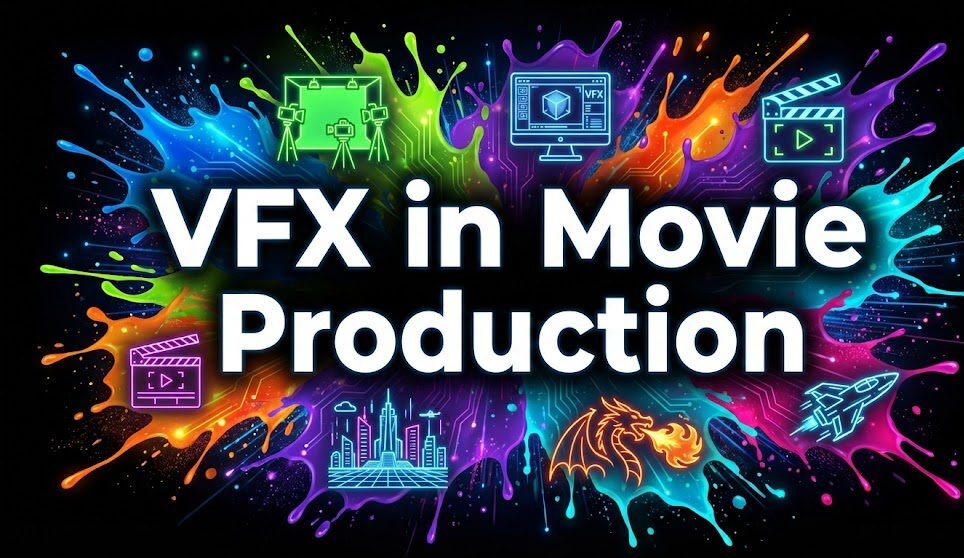
AI improves visual effects in movie production by automating labor-intensive tasks like rotoscoping, enhancing resolution through neural upscaling, and generating hyper-realistic digital doubles using GANs.
This technology works by training deep learning models on vast datasets of imagery to predict movement, texture, and light interaction with mathematical precision.
As the global VFX market scales toward a $18.2 billion valuation, demand is shifting toward high-volume episodic content that requires AI-driven efficiency.
In this guide, you will learn how to integrate specific AI tools into your pipeline, navigate technical architectures like neural networks, and review case studies of successful implementations.
This comprehensive guide fills the industry’s data deficit by providing technical depth and actionable frameworks for VFX supervisors and technical directors.

Your AI Assistant, Agent, and Analyst for the Business of Entertainment
VIQI AI helps you plan content acquisitions, raise production financing, and find and connect with the right partners worldwide.
- Find active co-producers and financiers for scripted projects
- Find equity and gap financing companies in North America
- Find top film financiers in Europe
- Find production houses that can co-produce or finance unscripted series
- I am looking for production partners for a YA drama set in Brazil
- I am looking for producers with proven track record in mid-budget features
- I am looking for Turkish distributors with successful international sales
- I am looking for OTT platforms actively acquiring finished series for the LATAM region
- I am seeking localization companies offer subtitling services in multiple Asian languages
- I am seeking partners in animation production for children's content
- I am seeking USA based post-production companies with sound facilities
- I am seeking VFX partners to composite background images and AI generated content
- Show me recent drama projects available for pre-buy
- Show me Japanese Anime Distributors
- Show me true-crime buyers from Asia
- Show me documentary pre-buyers
- List the top commissioners at the BBC
- List the post-production and VFX decision-makers at Netflix
- List the development leaders at Sony Pictures
- List the scripted programming heads at HBO
- Who is backing animation projects in Europe right now
- Who is Netflix’s top production partners for Sports Docs
- Who is Commissioning factual content in the NORDICS
- Who is acquiring unscripted formats for the North American market
Table of Contents
Key Takeaways for VFX Studios
-
Cost Efficiency: AI-driven rotoscoping and tracking can reduce manual labor by up to 70% in high-volume environments.
-
Neural Upscaling: Leveraging deep learning allows for 4K delivery from 2K renders, lowering compute costs significantly.
-
Strategic Growth: Intelligence platforms like Vitrina help studios identify active projects in post-production with high precision.
Defining AI in Modern VFX for Movie Production
Artificial Intelligence in VFX is not about replacing the human artist, but about augmenting their capabilities through machine learning. By applying deep learning algorithms to traditional tasks like motion tracking and plate cleaning, studios can achieve a level of visual fidelity that was previously cost-prohibitive for independent filmmakers.
The primary benefit lies in the shift from procedural logic to predictive modeling. Instead of an artist manually specifying how light should reflect off a surface, an AI model trained on millions of real-world lighting samples can predict that interaction with hyper-realistic accuracy.
Identify VFX vendors with deep AI expertise:
Technical Architectures: GANs and Neural Networks
To understand the winning angle of AI in VFX, one must look at Generative Adversarial Networks (GANs). This dual-network architecture consists of a generator that creates imagery and a discriminator that critiques it. This competitive process continues until the generated visual—whether a face, a texture, or an environment—is indistinguishable from a real-world reference.
Neural networks, particularly Convolutional Neural Networks (CNNs), are the engines behind automated rotoscoping. By learning the geometric boundaries of subjects across varying lighting conditions, these networks can generate masks that once took weeks of manual labor to create.
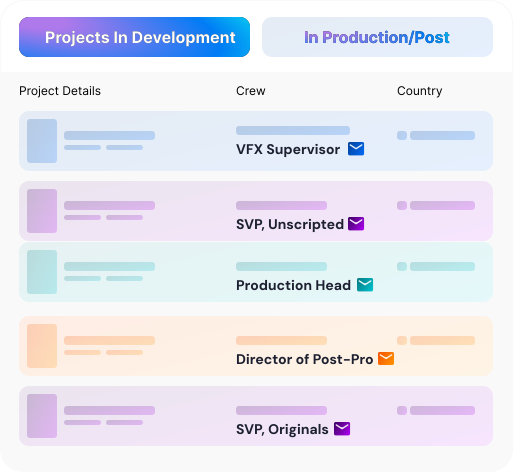
Find films in post-production requiring VFX services:
“The real power of AI in VFX lies in its ability to turn weeks of manual labor into seconds of creative decision-making, allowing artists to reclaim the ‘art’ in their title.”
VFX Industry Veteran & Technical Consultant
Expert Insight: Joseph Bell on Industry Scaling
In this conversation, industry veteran Joseph Bell discusses how technical innovation is essential for scaling startups and established VFX houses in the modern supply chain.

Integrating AI into the Production Pipeline
For VFX supervisors, the integration of AI is a three-step process designed to optimize resources:
- Asset Preparation: Use neural networks to tag and organize raw footage, enabling faster searchability within the production database.
- Automated Cleaning: Deploy AI tools for wire removal and clean-plating, freeing senior artists for complex creative compositing.
- Neural Rendering: Implement neural upscaling to render at lower resolutions and upscale for final delivery, cutting render farm costs by half.
Access verified profiles of over 140,000 entertainment companies:
Real-World Case Studies: PhantomFX and DeepDub
PhantomFX, a leading VFX house, integrated AI-driven tools to manage global expansion and maintain CGI mastery. By leveraging machine learning for lighting prediction and asset tagging, they reduced project lead times for Hollywood clients by over 30%, demonstrating that AI is a structural advantage for studio operations.
In the localization space, DeepDub utilizes emotional AI voice stacks to ensure that visual performances are perfectly matched with localized audio. This eliminates the visual-audio discord that often ruins the immersion of high-fidelity VFX work, ensuring artistry is preserved globally.
Target high-value production companies for outreach:
The Future: Weaponized Distribution and Neural Workflows
As we enter the era of “Weaponized Distribution,” the speed of production becomes the ultimate competitive advantage. Studios that adopt neural workflows can produce premium content at a frequency that matches streaming platform demands. This transition transforms VFX from a bottleneck into a catalyst for global distribution.
Plug Vitrina’s API into your CRM for automated lead enrichment:
Moving Forward
The integration of AI in visual effects has transitioned from a creative experiment to a commercial necessity. By leveraging technical architectures like GANs and neural networks, studios can solve the critical data deficit and operational lag that defines traditional pipelines.
Whether you are a VFX supervisor looking to compress production timelines or a technical director trying to optimize render costs, the principle remains: actionable intelligence drives production velocity.
Frequently Asked Questions
Quick answers for technical professionals exploring AI in VFX.
How can AI improve visual effects in movie production specifically?
What are GANs and how are they used in VFX?
Does AI replace VFX artists?
What is neural upscaling?
How does AI assist in crowd simulation?
Can AI identify projects in post-production?
What is the Clear platform by Prime Focus Technologies?
How do I qualify a VFX vendor for AI expertise?
About the Author
Industry analyst specializing in visual effects and the entertainment supply chain. Former pipeline architect for major UK studios. Connect on Vitrina.
Find Film+TV Projects, Partners, and Deals – Fast.
VIQI matches you with the right financiers, producers, streamers, and buyers – globally.
Producers Seeking Financing, Co-Pros, or Pre-Buys?
Vitrina Concierge helps producers reach the right financiers, commissioners, distributors, and co-production partners — with precision outreach, not cold pitching.
Join Industry Briefings Trusted by Leaders
Format Adaptations: Global Trends
Where formats are traveling, which adaptations are breaking out, and how streamers are backing remakes in 2025–2026.

Books, Novels & Comics Adaptations: Global Trends
Books, webtoons, and manga driving the next global screen hits. Discover how in this webinar.

Micro-Dramas & Mobile-First Storytelling
Micro-dramas are building real audiences and revenue. Understand the platforms, buyers, and economics behind the growth.

Navigating Global Content Licensing Trends
How global content licensing is shifting beyond flat fees to flexible, deal-driven models.