About Innovation Hub
 Global Content Pulse (Webinars)


 Global Production Financing
(Webinars)
Global Production Financing
(Webinars)  LeaderSpeak Podcast
  Global Entertainment Digest (Newsletter)
  About Vitrina
 About VIQI
 Our Story
 Our Solutions 🔥
 Film+TV Projects Tracker 🚀
 Case Studies
 Our Profile
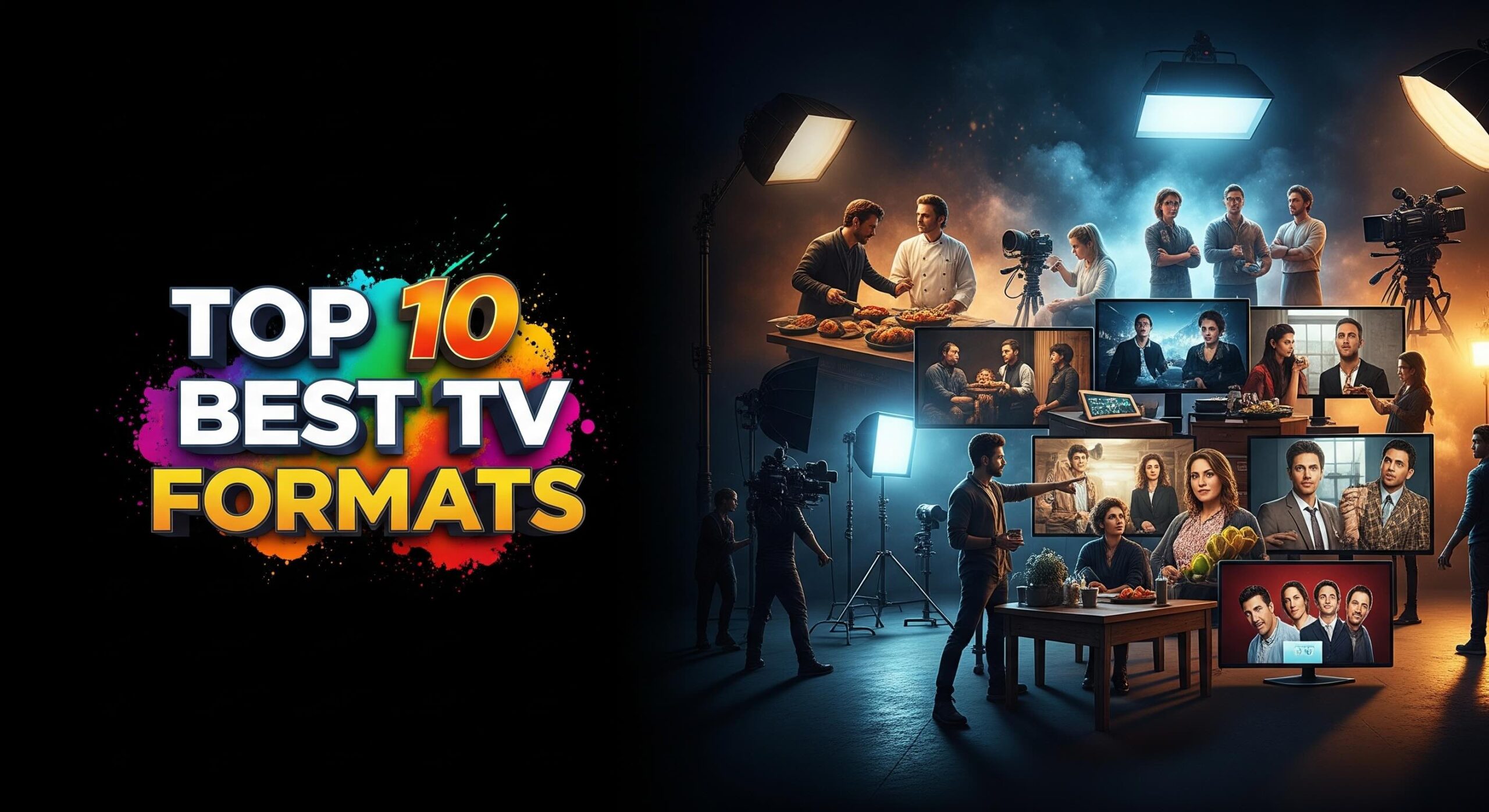
Here’s a number that should stop you mid-pitch: the global TV format licensing market generates over $4 billion annually, according to Variety. And the best TV formats? They don’t just travel — they multiply. A single format can spawn 50+ adaptations across markets, generating licensing fees, production service deals, and format royalties for decades.
But not every format travels equally. Some dominate APAC and stall in MENA. Others crack the US but can’t get past European commissioning gates. You need to know which formats carry global heat right now — and why. That’s exactly what this guide covers.
Whether you’re a commissioner at a broadcaster, a content acquisitions executive, or a format producer looking to license your next project, understanding what drives format success across 140,000+ companies in the Vitrina network tells a very specific story. Let me show you what that looks like.
💡 Vitrina Analyst Note
Our analysts note that with the global TV format market clearing over $4 billion annually and unscripted licensing deals rising 22% year over year in 2025, the acquisition window is narrowing faster than most commissioners expect. From our study of format activity on Vitrina, sustained licensing returns are consistently built on proprietary mechanics, not genre.
Table of Contents
What Makes a TV Format Globally Successful?
Most formats fail. That’s the uncomfortable truth no one says out loud at MIPTV. A format might generate massive ratings in its home market and fall flat the moment it crosses a border. But the best TV formats share specific structural DNA — characteristics that let them adapt to different cultural contexts without losing their core appeal.
Think about what makes a format travel well. It’s not production value — that can be rebuilt locally. It’s not even the cast. What travels is the competitive mechanism, the emotional architecture, and the viewer participation loop. Formats that give local audiences a way to project themselves into the competition — those are the ones that generate 50 adaptations and counting.
Vitrina tracks format licensing activity across 140,000+ companies worldwide. And what the data shows is clear: the formats dominating the current cycle share three traits. They’re emotionally universal, production-scalable across budget ranges, and they generate social conversation that extends beyond the broadcast window. Formats that hit all three? They’re the ones you’re about to read about.
According to Screen International, format adaptations now account for roughly 35% of prime-time schedules across major European broadcasters — a figure that’s climbed steadily since 2020 as original development costs spiraled. That’s your ROI case. Right there.
The Top 10 Best TV Formats of 2026
These aren’t ranked by nostalgia or name recognition. They’re ranked by active licensing velocity, adaptation count, and current market demand — the metrics that actually matter when you’re deciding where to allocate your commissioning budget.
1. Got Talent (Fremantle / Simon Cowell Entertainment)
Seventy-plus adaptations across six continents. Still going. That’s what longevity looks like in format licensing. Got Talent — distributed globally by Fremantle — remains the gold standard for talent competition formats because it does something deceptively simple: it celebrates surprise. The audition episode structure means every single episode can deliver a viral moment. Local producers love it because it’s low-risk to cast, production cost scales efficiently, and broadcaster ad sales love the appointment viewing dynamic.
Got Talent’s continued dominance also reflects a smart Smart Pairing strategy — Fremantle matches the format to local production partners who understand their audiences deeply. That’s not luck. That’s infrastructure.
2. The Voice (ITV Studios / Talpa Network)
John de Mol’s blind audition innovation was worth billions. The Voice has been adapted in over 50 countries, with versions still active in the US (NBC), UK (ITV), Australia (Nine Network), and markets across MENA, APAC, and Latin America. What makes it special isn’t the chairs — it’s the inversion of the typical talent show hierarchy. Coaches compete for talent, not the other way around. That single mechanic shift generates a completely different emotional dynamic for viewers and coaches alike.
Talpa Network, the format owner, has built a licensing infrastructure that’s become a case study in how to De-risk format rollouts for local broadcasters. They provide everything from format bibles to production toolkits — which is why adaptation quality remains consistently high.
3. MasterChef (Endemol Shine / Banijay)
Cooking formats have a fragmentation problem. There are too many of them, and most feel interchangeable. MasterChef doesn’t. Banijay’s acquisition of Endemol Shine brought MasterChef — along with 60+ other formats — into one of the largest format libraries on earth. MasterChef’s genius is its emotional range: it’s aspirational, it’s accessible, and the competition stakes feel real even though no one leaves without knowing how to make a perfect hollandaise.
Active versions currently run in 60+ markets, including flagship productions in Australia (Network Ten), the US (Fox), India (Star Plus), and France (TF1). The format’s durability through streaming disruption is worth noting — it hasn’t been killed by on-demand viewing. It’s thrived because people genuinely want to watch it with others.
4. Survivor (CBS / Banijay Rights)
Survivor invented the “elimination reality” genre. Full stop. Everything from The Apprentice to Love Island owes a structural debt to the format that stranded strangers on an island and asked viewers to decide who deserves to stay. Twenty-five-plus years later, the US version alone has run 45+ seasons — and international adaptations remain active in 40+ markets.
But here’s what most format conversations miss about Survivor: it’s actually a political drama. The alliance-building, the tribal dynamics, the blindside votes — this is social strategy content that happens to take place outdoors. That’s why it crosses cultural barriers so effectively. Betrayal and coalition politics are universal.
5. Big Brother (Endemol Shine / Banijay)
Big Brother is a format that almost killed itself — and came back. The surveillance-house concept launched a reality television revolution in 1999, dominated the 2000s, and seemed to plateau as streaming splintered audiences. Then Paramount+ revived it in the US in 2023 to massive ratings. Why? Because 24/7 surveillance culture doesn’t feel dystopian anymore — it feels familiar. Big Brother adapted to the social media age before the industry understood that would be its salvation.
Current active versions run across Europe, MENA, and Latin America, with the format bible being one of the most detailed in Banijay’s catalog. If you’re a broadcaster looking for a format that generates daily conversation — and daily content — Big Brother remains a top-5 format choice globally.
Track Which Formats Are Being Adapted in Your Territory Right Now
Trusted by Netflix, Warner Bros, and Paramount. Join 140,000+ companies tracking the global entertainment supply chain.
✓ 200 free credits | ✓ No credit card required | ✓ Full platform access
6. Who Wants to Be a Millionaire? (Sony Pictures Television)
The game show format that turned a quiz into high drama. The lifeline mechanics, the dramatic pauses, the “is that your final answer?” — these are design choices so well-executed they’ve entered popular culture. Sony Pictures Television licenses WWTBAM in 120+ territories, making it arguably the widest-distributed format in television history.
What’s kept it current is adaptability. The core rules stay intact, but local versions adjust prize currency, lifeline culture, and host dynamics to feel native. India’s Kaun Banega Crorepati with Amitabh Bachchan became a cultural phenomenon that transcended the format’s UK origins entirely. That’s format licensing working exactly as it should.
7. Love Island (ITV Studios)
Dating formats aren’t new. Love Island is. The format’s innovation was pairing the elimination mechanic with a daily social media feedback loop — viewers can influence the game, islanders know they’re being watched globally, and the recoupling ceremonies deliver appointment-viewing moments every 48 hours. ITV Studios has licensed Love Island to the US (Peacock), Australia (Nine Network), Germany (RTL), France (TF1), and markets across MENA and APAC.
What you need to understand about Love Island’s format architecture: it’s not a dating show. It’s a social experiment with romance as the entry point. That distinction is why it works for 18-34 demographics globally — demographics that your streaming partners are chasing hard right now.
8. Dancing with the Stars / Strictly Come Dancing (BBC Studios)
BBC Studios built one of the most consistent format machines in television history with Strictly Come Dancing. Forty-nine adaptations across five continents. The US version — Dancing with the Stars — has run 32+ seasons on ABC and now streams exclusively on Disney+. That platform migration alone is a case study in how legacy format IP can be Weaponized for streaming transition strategies.
The format’s genius is the celebrity-professional partnership dynamic. It generates 13 genuine human stories per season, with 13 different fan communities rooting for 13 different outcomes. That’s not luck — it’s architecture. Every broadcaster running Strictly knows exactly how to fill their social media calendar for 12 weeks.
9. The Masked Singer (Banijay / Fox)
The Masked Singer came from South Korea — specifically from Mnet’s King of Mask Singer — and its global journey is a textbook Fragmentation Paradox case study. A Korean unscripted format selling to Fox in the US felt counterintuitive in 2019. Then it launched and dominated its time slot. Now it’s running in 70+ countries, making it one of the fastest-adapting formats in television history.
What drives its success is a combination of factors most format buyers underestimate: the visual spectacle (costumes that go viral before the episode airs), the celebrity anonymity mechanic (who’s behind the mask?), and a guessing game that translates perfectly to social media second-screen behavior. This is a format built for the attention economy.
10. The Bridge / Scripted Thriller Formats (Various)
Scripted formats deserve a separate call-out. The Bridge — the Swedish-Danish Nordic noir co-production — spawned remakes in the UK, France, Germany, the US, South Korea, and Malaysia. It proved that prestige drama can be formatted just as effectively as unscripted entertainment, opening an entirely new licensing category that’s now generating significant format revenue for European producers.
If you’re tracking where scripted format deals are heading in 2026, pay attention to Turkish dizi formats traveling to MENA and APAC, Korean romance formats entering the US market, and Nordic crime formats continuing their near-decade of dominance across European broadcasters. These are your next acquisition targets.
Reality Competition Formats: Why They Travel Better Than Drama
There’s a reason 7 of the top 10 best TV formats are unscripted or competition-based. Reality formats have a structural advantage: they don’t require cultural translation of dialogue, character psychology, or narrative logic. The competition mechanic is universal. Viewers in São Paulo and Riyadh both understand what it means to be eliminated.
But don’t confuse “easy to adapt” with “easy to execute well.” The Fragmentation Paradox hits reality formats hard. There are now over 400 active reality format concepts in the market — most of them derivatives of the 10 formats above. The Vitrina platform tracks which of these are actively being optioned versus which are just being pitched. That distinction matters enormously when you’re doing format due diligence.
The formats that separate from the pack share a specific quality: they have a proprietary mechanic that can’t be easily cloned. The Voice’s blind auditions. Love Island’s recoupling. The Masked Singer’s costume reveal. These aren’t concepts — they’re intellectual property in the true sense. Format owners who understand this Accelerate their licensing returns significantly compared to producers who treat their format as a “concept” rather than an architecture.
As reported by The Hollywood Reporter, unscripted format licensing deals increased 22% year-over-year in 2025 as broadcasters sought de-risked commissioning options amid tightening content budgets.
Scripted Drama Formats: The Prestige Play
Here’s the thing about scripted formats that most commissioners don’t fully reckon with: you’re not buying a show. You’re buying a proof of concept with an emotional ROI already validated by another market. When a Korean romance format sells to Netflix US, Netflix isn’t gambling — they’re using market intelligence to de-risk a $20-40M content investment.
The Turkish dizi market is one of the most underappreciated format export machines on earth. Turkey produces some of the highest-volume serialized drama in the world — shows running 100+ episodes at cinema-quality production levels. These formats are traveling to 80+ countries now, particularly across MENA where Rolla Karam, Senior Vice President of Content Acquisition at OSN, confirmed that Turkish content consistently ranks in the top five on their platform across Saudi Arabia and GCC markets.
Korean drama formats are the other story you need to track. The Squid Game effect — a non-English language drama becoming the most-watched Netflix title of all time — validated what Korean format sellers had been arguing for years. There’s now significant format acquisition activity around Korean IP, with multiple major studios bidding for remake rights to proven Korean dramas before they even hit their domestic peak.
What does this mean for your commissioning strategy? It means your format due diligence needs to include markets you may not have historically tracked. Vitrina’s format rights intelligence covers format activity across 100+ countries — including markets where the next Squid Game equivalent is almost certainly already in production.
Ask VIQI: Which TV Formats Are Getting Greenlit in Your Territory Right Now?
VIQI is Vitrina’s AI assistant — trained on 1.6 million titles, 360,000 companies, and 5 million entertainment professionals. Get instant intelligence on which formats are moving in your market.
✓ Included with 200 free credits | ✓ No credit card needed
5 Emerging Format Trends You Can’t Ignore in 2026
The formats above are proven. But the deals that generate outsized returns — the ones that create format empires rather than single licensing agreements — come from identifying format trends before they saturate the market. Here’s what Vitrina’s intelligence is showing right now.
Microdrama: The Vertical Format Revolution
Vertical mobile-first drama — episodes running 60-90 seconds, designed for TikTok and Reels consumption — is generating extraordinary engagement numbers in China and Southeast Asia. The format is now moving westward. P&G’s recent investment in vertical content production infrastructure signals that brand-funded microdrama is about to become a significant commissioning category. If you’re not tracking this, you’re six weeks behind where you need to be.
Social Experiment Formats: Post-Reality Evolution
Traditional competition formats are giving way to hybrid formats where the “competition” is social behavior itself. Shows like Netflix’s The Circle and Love is Blind — both of which have spawned international adaptations — represent a format evolution where psychological and social dynamics replace physical competition. These formats generate extraordinary social media engagement because viewers are actively theorizing rather than passively watching.
Sovereign Hub Documentary Formats
Saudi Arabia, UAE, and other Gulf nations are investing heavily in locally-originated format development — and they’re not just producing adaptations of Western concepts. Original Arabic formats are now actively seeking international format licensing deals. This is the Sovereign Hubs strategy in action: markets that were previously acquisition-only are now actively building format IP that they intend to export. If your acquisition strategy doesn’t include reverse format licensing opportunities from MENA, you’re leaving deals on the table.
True Crime as Format Architecture
True crime isn’t a genre — it’s increasingly a format. The structural DNA of the best true crime series (an unsolved mystery + a new investigation angle + participatory evidence review) is being codified into repeatable format architecture. Networks that own the rights to compelling true crime formats — rather than one-off documentary series — are building significantly more durable IP portfolios.
Sports Reality Hybrids
The success of Drive to Survive (Formula 1 + docuseries + Netflix) created a blueprint that every major sport is now trying to replicate. These sports-reality hybrids aren’t traditional sports coverage — they’re access-driven character dramas that happen to feature athletic competition. The format IP here is the behind-the-scenes access structure, not the sport itself. And these formats are generating significant format licensing fees as sports leagues worldwide race to create their own franchise equivalent.

Your AI Assistant, Agent, and Analyst for the Business of Entertainment
VIQI AI helps you plan content acquisitions, raise production financing, and find and connect with the right partners worldwide.
- Find active co-producers and financiers for scripted projects
- Find equity and gap financing companies in North America
- Find top film financiers in Europe
- Find production houses that can co-produce or finance unscripted series
- I am looking for production partners for a YA drama set in Brazil
- I am looking for producers with proven track record in mid-budget features
- I am looking for Turkish distributors with successful international sales
- I am looking for OTT platforms actively acquiring finished series for the LATAM region
- I am seeking localization companies offer subtitling services in multiple Asian languages
- I am seeking partners in animation production for children's content
- I am seeking USA based post-production companies with sound facilities
- I am seeking VFX partners to composite background images and AI generated content
- Show me recent drama projects available for pre-buy
- Show me Japanese Anime Distributors
- Show me true-crime buyers from Asia
- Show me documentary pre-buyers
- List the top commissioners at the BBC
- List the post-production and VFX decision-makers at Netflix
- List the development leaders at Sony Pictures
- List the scripted programming heads at HBO
- Who is backing animation projects in Europe right now
- Who is Netflix’s top production partners for Sports Docs
- Who is Commissioning factual content in the NORDICS
- Who is acquiring unscripted formats for the North American market
How to Track Format Licensing Opportunities Before They Close
Format licensing moves fast. The window between a format being optioned and it being announced in the trades is often six weeks or less — and the best deals are done before the announcement. Your competitive intelligence needs to move at the same speed as the market.
Here’s what the most sophisticated acquisitions executives are doing right now. They’re not waiting for MIPCOM to discover format opportunities. They’re using real-time production tracking to identify when a format has started development in a new market — which signals that option negotiations are likely already underway. By the time it’s on the trade publications’ front page, the deal window is closing.
Vitrina tracks 400,000+ projects across 140,000+ companies globally. Our format demand tracking shows you not just which formats are licensed — but which are being researched, which are in option discussions, and which markets are actively seeking specific format categories. That’s the intelligence edge you need to move before the market moves on you.
The practical workflow looks like this: you set alerts for format categories relevant to your territory. You see when Banijay or ITV Studios or BBC Studios registers production development activity in a neighboring market. You use VIQI to ask strategic questions about which format owners are actively seeking partners in your territory right now. And you make the call before the opportunity closes.
It’s not complicated. But it requires the right infrastructure — and 3 million verified entertainment professionals in your contact database doesn’t hurt either.
Frequently Asked Questions
What are the best TV formats for international licensing in 2026?
The best TV formats for international licensing include Got Talent, The Voice, MasterChef, Survivor, Big Brother, Who Wants to Be a Millionaire, Love Island, Dancing with the Stars, The Masked Singer, and scripted Nordic/Korean/Turkish drama formats. These formats share universal emotional mechanics, production scalability, and proven track records across 40-120+ territory adaptations. Formats owned by Fremantle, Banijay, ITV Studios, BBC Studios, and Sony Pictures Television dominate current licensing activity.
How much does it cost to license a TV format?
TV format licensing fees vary enormously based on format category, market size, and territory rights. Major established formats (Got Talent, The Voice) command licensing fees in the range of $200,000-$2M+ per season for major markets, plus production royalties and ongoing format fees. Smaller, emerging formats from markets like Turkey or Korea can be licensed for significantly less — sometimes $30,000-$150,000 per series — representing significant ROI opportunities for early movers. Format licensing fees typically cover the right to adapt the concept, access to format bibles, and ongoing production support from the format originator.
What makes a TV format successful across different cultures?
Successful TV formats share three core characteristics: emotionally universal competition mechanics that don’t require cultural translation, production scalability that allows local budgets to execute the concept effectively, and social conversation triggers that extend viewer engagement beyond the broadcast window. Formats built around betrayal, aspiration, romance, and surprise travel best — these emotions are genuinely cross-cultural. The most durable formats also have a proprietary mechanic that competitors can’t easily clone, which is why The Voice’s blind auditions and The Masked Singer’s costume reveal have proven so defensible as intellectual property.
Which TV format companies own the most valuable format libraries?
Banijay (following its Endemol Shine acquisition) owns the largest format library globally, including MasterChef, Big Brother, Survivor, and 60+ other major formats. Fremantle controls Got Talent, Idol, The Price is Right, and Family Feud. ITV Studios owns Love Island, Hell’s Kitchen, and Come Dine with Me. BBC Studios distributes Strictly Come Dancing, Dragon’s Den, and The Apprentice internationally. Sony Pictures Television holds Who Wants to Be a Millionaire and Wheel of Fortune. These five companies control the majority of high-value format licensing activity globally.
Are scripted TV formats different from unscripted format licensing?
Yes — scripted and unscripted format licensing operate quite differently. Unscripted format licenses typically include production toolkits, showrunner support, and detailed format bibles covering casting, mechanics, and broadcast structure. Scripted format licenses (remakes) involve rights to recreate the story and characters with local adaptations, access to original scripts, and sometimes creative consultation. Scripted format deals are often more expensive upfront and involve more complex rights negotiations, but they carry the advantage of a proven narrative that’s already demonstrated audience appeal. Turkish dizi and Korean drama remakes are currently among the most actively traded scripted format categories.
What is the TV format market worth globally?
The global TV format licensing market generates over $4 billion annually, with format adaptations accounting for approximately 35% of prime-time schedules across major European broadcasters. The market has grown significantly since 2020 as original development costs increased and broadcasters sought de-risked commissioning options. Format-adapted content now represents one of the most cost-efficient paths to appointment viewing, particularly for broadcasters competing against streaming platforms with unlimited original content budgets.
How do streaming platforms approach TV format licensing differently from broadcasters?
Streaming platforms like Netflix, Amazon Prime Video, and Peacock approach format licensing as a global content strategy rather than a territory-specific commissioning tool. Netflix’s Love Is Blind and The Circle are formats licensed for global simultaneous release — a fundamentally different model from traditional broadcaster licensing where each territory runs its own local version. Streamers are also increasingly commissioning original formats (rather than licensing existing ones), which is creating new format IP at platform scale. But established proven formats still command significant streaming platform interest because they arrive with validated audience mechanics and built-in brand recognition across demographics.
What are the most popular TV formats in the MENA region?
In the MENA region, US scripted series, crime thriller formats, and Turkish long-running drama series perform exceptionally well, according to Rolla Karam (SVP Content Acquisition, OSN). Turkish content consistently ranks in the top five on OSN’s platform across Saudi Arabia and GCC markets. Local Arabic series are also increasingly important, with a growing “from the region, for the region” content strategy emerging at major platforms like OSN+. Reality and entertainment formats travel well in MENA, though the market skews toward scripted content and easy-watch entertainment rather than factual or documentary formats, which have stronger audiences in Europe and Australia.
Conclusion: The Best TV Formats Win Because of Architecture, Not Luck
The top 10 best TV formats aren’t dominating global screens because someone got lucky. They dominate because their creators built repeatable emotional architecture into the format itself — mechanics that translate across cultures, budgets, and viewing platforms without losing their core appeal. And the format companies that own these IP portfolios — Banijay, Fremantle, ITV Studios, BBC Studios, Sony Pictures Television — have built licensing infrastructure that turns single format concepts into decade-long revenue streams.
Key Takeaways:
- Format architecture matters more than genre: The proprietary mechanic — blind auditions, costume reveals, recoupling ceremonies — is the actual IP. Protect yours the same way.
- Unscripted formats travel fastest: 7 of the top 10 are competition-based because emotional mechanics don’t require cultural translation. But scripted formats from Turkey, Korea, and Nordic markets are closing the gap rapidly.
- MENA is no longer acquisition-only: Gulf market Sovereign Hubs are producing original format IP intended for export. Your acquisition strategy needs to include reverse licensing opportunities from this region.
- The deal window is 6 weeks or less: Format licensing opportunities close before they hit the trades. Real-time intelligence — tracking production development activity across 400,000+ projects — is no longer optional.
- Streaming changed the rules: Platforms aren’t buying formats for local adaptation anymore — they’re commissioning global simultaneous formats. Your licensing strategy needs to account for both models.
The Fragmentation Paradox of the current format market is real: more formats than ever are competing for finite commissioner attention, but fewer than 50 formats generate 80% of total licensing value. Your job is to find the next format that breaks into that top tier — or to lock down licensing on the ones already there before your competitors do.
Discover Format Licensing Opportunities Before Your Competitors Do
Trusted by Netflix, Warner Bros, Paramount, and Google TV. Track 400,000+ projects. Access 3 million verified executives. Ask VIQI strategic questions about format demand in your territory.
✓ 200 free credits | ✓ No credit card required | ✓ Cancel anytime
Need direct introductions to format licensing partners? Explore Concierge Service →