About Innovation Hub
 Global Content Pulse (Webinars)


 Global Production Financing
(Webinars)
Global Production Financing
(Webinars)  LeaderSpeak Podcast
  Global Entertainment Digest (Newsletter)
  About Vitrina
 About VIQI
 Our Story
 Our Solutions 🔥
 Film+TV Projects Tracker 🚀
 Case Studies
 Our Profile
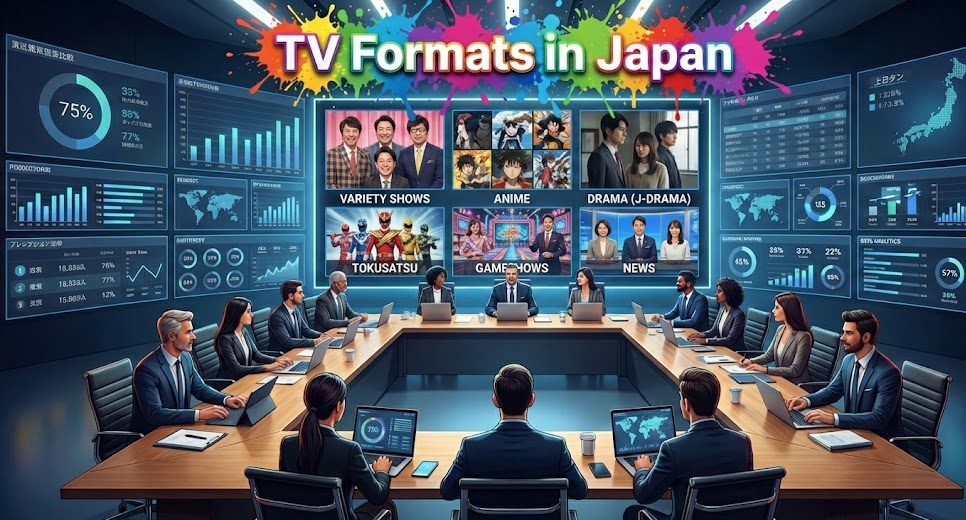
TV Formats in Japan are highly specialized unscripted and scripted intellectual properties (IP) characterized by high-concept “hooks,” repeatable mechanics, and unique cultural appeal.
This involve a complex supply chain of broadcasters like Nippon TV and TBS partnering with global distributors to adapt “zany” or “heartwarming” concepts for international audiences.
According to industry reports, Japanese unscripted format revenue doubled for major players like Fuji TV in 2024, signaling a massive shift toward data-driven global expansion.
In this guide, you’ll learn how to identify high-performing Japanese formats, decode market-specific jargon, and leverage supply chain intelligence to secure the next global phenomenon.
While legacy resources focus on the “wackiness” of Japanese game shows, they often fail to provide the structural data and sourcing frameworks that modern acquisition leads need to mitigate risk in a fragmented market.
This comprehensive guide addresses these gaps by providing actionable intelligence—from identifying emerging “next-gen” formats to using AI-driven tools for partner verification.

Your AI Assistant, Agent, and Analyst for the Business of Entertainment
VIQI AI helps you plan content acquisitions, raise production financing, and find and connect with the right partners worldwide.
- Find active co-producers and financiers for scripted projects
- Find equity and gap financing companies in North America
- Find top film financiers in Europe
- Find production houses that can co-produce or finance unscripted series
- I am looking for production partners for a YA drama set in Brazil
- I am looking for producers with proven track record in mid-budget features
- I am looking for Turkish distributors with successful international sales
- I am looking for OTT platforms actively acquiring finished series for the LATAM region
- I am seeking localization companies offer subtitling services in multiple Asian languages
- I am seeking partners in animation production for children's content
- I am seeking USA based post-production companies with sound facilities
- I am seeking VFX partners to composite background images and AI generated content
- Show me recent drama projects available for pre-buy
- Show me Japanese Anime Distributors
- Show me true-crime buyers from Asia
- Show me documentary pre-buyers
- List the top commissioners at the BBC
- List the post-production and VFX decision-makers at Netflix
- List the development leaders at Sony Pictures
- List the scripted programming heads at HBO
- Who is backing animation projects in Europe right now
- Who is Netflix’s top production partners for Sports Docs
- Who is Commissioning factual content in the NORDICS
- Who is acquiring unscripted formats for the North American market
Table of Contents
Key Takeaways for Content Buyers
-
Format Revenue Surge: Revenue from Japanese unscripted formats is surging, with top broadcasters doubling their international sales through strategic co-production and “next-gen” IP.
-
Sourcing Jargon: Understanding terms like “Batsugame” (punishment game) is critical for identifying the “physical comedy” hooks that drive high viral potential in western markets.
-
Data Intelligence: Supply chain platforms enable buyers to track 140,000+ companies, allowing them to vet Japanese production houses based on verified deal history rather than reputation alone.
What are TV Formats in Japan?
A TV format in Japan is a structured, repeatable concept for a television program, encompassing both unscripted variety shows and scripted dramas. These formats are designed for high engagement, often featuring unique “game mechanics” or emotional arcs that can be localized for different territories.
The Japanese market is globally recognized for its “unorthodox” approach to unscripted entertainment, where slapstick comedy and extreme physical challenges create universally understood humor. However, the modern “format” now includes sophisticated scripted IP, such as the widely exported drama Mother, which has seen 11 international adaptations.
Find unscripted format owners in Japan:
3 Most Successful Japanese Unscripted Formats
1. Sasuke (Ninja Warrior)
The Challenge: Traditional physical game shows often struggle with “repetitive boredom,” failing to maintain audience tension over a full season. Without a high-stakes “finish line,” viewer retention drops as segments become indistinguishable.
The Approach: TBS’s Sasuke solved this by creating a four-stage obstacle course so difficult that victory is rare, transforming a “game show” into a “sporting event.” This format, rebranded as Ninja Warrior, has been adapted in over 20 countries, including a massive US run on NBC.
2. Dragons’ Den (Shark Tank)
The Challenge: Business-centric shows are often perceived as “dry” or “too technical” for primetime entertainment, limiting their demographic reach to older, affluent viewers.
The Approach: Nippon TV’s Manē no Tora (Money Tiger) introduced the “pitch-to-investors” mechanic, which was adapted by the BBC as Dragons’ Den and by ABC as Shark Tank. This format focuses on the “human drama” of negotiation, making it one of the most successful business shows in history with 52+ versions globally.
3. Silent Library
The Challenge: High production costs for large-scale physical game shows create high barriers to entry for smaller regional networks.
The Approach: This Nippon TV format relies on a single, low-cost room (a library) where contestants must endure slapstick punishments while remaining silent. Its simplicity and “visual comedy” made it a global hit, proving that high-concept unscripted content doesn’t always require blockbuster budgets.
Industry Expert Perspective: MGM Alternative: Reinventing Reality TV
In this discussion, Barry Poznick, President of MGM Alternative, explores the evolution of unscripted formats like Shark Tank and how they are adapted for a global, streaming-first audience.

Key Insights
The video highlights how iconic unscripted formats bridge the gap between regional storytelling and global economics, emphasizing that data-driven decision-making is now the cornerstone of successful format acquisition.
Decoding Japanese Variety Jargon for Beginners
To successfully navigate the Japanese format market, content buyers must understand the “DNA” of Japanese variety programming. Much of this is rooted in specific production philosophies that don’t always translate directly to western “game show” definitions.
- Batsugame (Punishment Game): The core mechanic of most Japanese unscripted formats. It refers to the “penalty” a loser must face, which is usually physical, messy, or embarrassing. Understanding the intensity of a Batsugame is key to gauging the show’s demographic appeal.
- VTR: Used in Japanese production to refer to “video tape recording” or pre-recorded segments. Most variety shows feature celebrities in a studio watching “VTR” segments and reacting in real-time.
- Owarai (Comedy): The overarching culture of Japanese comedy that influences format design. It often relies on a “Boke” (funny man) and “Tsukkomi” (straight man) dynamic, even in unscripted games.
What are the Next-Gen Format Trends for 2025?
The “next-gen” of Japanese formats is moving away from purely “wacky” concepts toward “wholesome reality” and “technical-physical” competitions. This shift is driven by the global success of shows like Old Enough! (Hajimete no Otsukai), which went viral on Netflix.
Key emerging trends include “Micro-Adventures,” where everyday tasks are transformed into high-stakes storytelling, and “Collaborative Physicality,” exemplified by Nippon TV’s new format Ants, which emphasizes teamwork over solo competition. These trends are attracting interest from major western production houses like Fremantle and Blue Ant Media.
Identify trending Japanese format IPs:
Why Scripted Formats from Japan are Dominating?
While unscripted gets the headlines, Japanese scripted formats are the quiet giants of the global supply chain. Unlike western dramas that often rely on “franchise expansion,” Japanese scripted formats are prized for their modular storytelling—they are concise, often 10-12 episodes, and feature strong, self-contained emotional hooks.
Nippon TV’s Mother is the gold standard, having been remade in Turkey, South Korea, China, and France. These adaptations often outperform local originals because the core “mother-child” emotional arc is universal. Buyers are increasingly looking at “suspense-drama” formats with social media integration, like Guilty Flag, which allows audiences to participate in “guessing games” about the plot.
How Do Content Buyers Source Japanese TV Formats?
Traditional sourcing relied on trade shows like MIPCOM and ATF. However, legacy networking has proven inefficient for tracking early-stage “in-development” projects.
Modern acquisition leads now use supply chain intelligence platforms to track over 1.6 million titles and 140,000+ companies globally. By monitoring real-time project trackers, buyers can identify a new format the moment it enters the “pilot” stage in Tokyo, securing first-look rights before competitors. This data-driven approach compresses the sourcing window from months to days.
Vetting Japanese Partners: A Strategic Framework
When acquiring a Japanese format, the choice of production partner is as critical as the IP itself. Buyers should look for three key signals:
- International Adaptation History: Does the company have a track record of selling formats to western or emerging markets? (e.g., Nippon TV, TBS, TV Asahi).
- IP Ownership: Verify if the production house owns 100% of the content IP. Major players like Nippon TV own nearly 90% of their IP, simplifying the licensing process.
- Co-Development Appetite: Is the partner willing to co-develop original IP? Companies like TV Asahi are now partnering with US-based producers to co-create formats like SONG vs DANCE.
Vet your Japanese production partners:
The Future of Co-Development and Adaptation
The industry is moving from “buying a tape” to “co-creating a vision.” The launch of dedicated units like Nippon TV’s Gyokuro Studio signifies a proactive move to bring Japanese creativity to the global market through deep collaboration.
Acquisition leads who embrace these partnerships—leveraging AI to track money movement and commissioning patterns—will find themselves at the forefront of the next wave of global “weaponized distribution.”
Moving Forward
The landscape of TV formats in Japan has shifted from a “quirky” niche to a data-powered pillar of the global entertainment supply chain. By bridging the gap between creative “zanyness” and professional intelligence, this guide reveals how acquisition leads can navigate the Japanese market with precision.
Whether you are an acquisition lead looking to discover the next Old Enough!, or a strategy officer trying to identify co-production hubs beyond Hollywood, data-driven discovery is your competitive edge.
Outlook: Over the next 12-18 months, expect a surge in “hybrid formats” that blend Japanese unscripted mechanics with AI-driven viewer participation, further blurring the lines between regional hits and global IP.
Frequently Asked Questions
Quick answers to common queries about TV formats in Japan.
What is the most successful Japanese TV format globally?
Dragons’ Den (rebranded as Shark Tank in the US) is the most successful unscripted format, with 52 versions in 186+ countries. Mother is the most exported scripted format, with 11 international remakes.
Why are Japanese game shows so popular overseas?
Japanese game shows rely on “slapstick comedy” and “batsugame” (punishment games), which provide visual, universally understood humor that requires little translation for global audiences.
How can I find out who owns a Japanese TV format?
You can use supply chain intelligence tools like Vitrina’s VIQI AI to query format owners, track licensing history, and identify key commissioning editors at major Japanese broadcasters.
What is “Batsugame” in Japanese TV?
“Batsugame” refers to a punishment game given to losers in variety shows. It is the defining mechanic that drives the humor and tension in Japanese unscripted formats.
Are Japanese broadcasters open to co-production?
Yes. Major networks like Nippon TV and TV Asahi are actively seeking global co-production partners to develop original unscripted formats with international appeal from the start.
Which Japanese company produces ‘Old Enough!’?
Old Enough! (Hajimete no Otsukai) is produced by Nippon TV. It recently saw a global surge in popularity after being added to Netflix in over 190 countries.
Is the Japanese format market growing?
Yes. Major broadcasters like Fuji TV reported doubling their format revenue in 2024, signaling a strong international appetite for Japanese IP.
What makes scripted formats from Japan attractive?
They offer modular storytelling (short seasons), universal emotional themes, and proven adaptability in diverse markets like Turkey and South Korea.
“The Japanese format market is moving from being a home of ‘zany’ entertainment clips to a home of diversified, commercially oriented models with rising deal flow from private producers.”
— ContentAsia Country Profile Analysis 2025
About the Author
Lead Strategist at Vitrina AI with 15 years in global content acquisition and supply chain intelligence. Specializing in mapping regional hits to international pipelines. Connect on Vitrina.
Find Film+TV Projects, Partners, and Deals – Fast.
VIQI matches you with the right financiers, producers, streamers, and buyers – globally.
Producers Seeking Financing, Co-Pros, or Pre-Buys?
Vitrina Concierge helps producers reach the right financiers, commissioners, distributors, and co-production partners — with precision outreach, not cold pitching.
Join Industry Briefings Trusted by Leaders

Micro-Dramas & Mobile-First Storytelling
Micro-dramas are building real audiences and revenue. Understand the platforms, buyers, and economics behind the growth.

Navigating Global Content Licensing Trends
How global content licensing is shifting beyond flat fees to flexible, deal-driven models.

Film & TV Production Financing: 2026 Trends
Production financing conditions are changing quickly. Understanding where money is moving and what buyers are backing is key to getting projects approved and funded in 2026.

Unreleased Film+TV Projects: Opportunities & Showcase
A curated view of unreleased Film and TV projects open for financing and collaboration