

 About Innovation Hub
 Global Content Pulse (Webinars)


 Global Production Financing
(Webinars)
Global Production Financing
(Webinars)  LeaderSpeak Podcast
  Global Entertainment Digest (Newsletter)
  About Vitrina
 About VIQI
 Our Story
 Our Solutions 🔥
 Film+TV Projects Tracker 🚀
 Case Studies
 Our Profile
Podcast Chapters
| Timecode | Segment Title |
| 00:00 | The Evolution of Outpost VFX |
| 08:30 | The Journey of Starting Outpost VFX |
| 12:10 | Scaling and Growth Strategies |
| 14:40 | Specialization and Client Service |
| 18:46 | Navigating Challenges: COVID and Strikes |
| 28:23:00 | The Impact of Industry Changes and Future Outlook |
| 30:31:00 | The Changing Landscape of Film Budgets |
| 33:44:00 | The Impact of COVID and Hollywood Strikes |
| 38:40:00 | UK’s Resurgence in Film Production |
| 45:20:00 | Technology and the Future of Visual Effects |
| 52:18:00 | Looking Ahead: Goals for 2026 |
Key Takeaways:
-
“We specialize in client service. Make it a good experience. Be honest. Be open. Be transparent.”
-
“The whole principle here is to reduce overtime, give people a better work-life balance, give more breathing space to your EBITDA…”
-
“I think what’s really important now is to look at the way the market settled about 30% less than it was in 2022 and say, you need to know what part of that market you add value to and how to be profitable.”
-
“If you can’t film it, we can build it.”
-
“I would just say to anyone, get investment but don’t take debt.”
Sound Bites:
-
“We’re about 650 people, four studios across three countries.”
-
“The streamers started to replace, well not replace independent film, but start to fund that market sector.”
-
“Strikes were the worst because it was the industry tearing itself apart.”
-
“The UK is the busiest it’s been. It’s 100% busier than it’s ever been in the history of the company.”
-
“If I come all the way back to one of my founding principles, which is retain knowledge in the business.”
Projects Mentioned in the Podcast
Wicked, Sinners, News of the World, The Lost Bus, 47 Meters Down, Watchmen, and Lion King.
Why Partner With Outpost VFX?
-
High-Tier AAA Quality: They operate in the higher tiers of AAA quality feature film and streaming TV productions, working alongside industry leaders like ILM and Weta.
-
Client-Focused Service: They prioritize making the process a good experience through honesty, openness, and transparency, which they consider their real specialization.
-
Proven Delivery and Trust: They have a track record of delivering complex projects, even under pressure (like News of the World during COVID), leading to strong repeat business (70-80%) and word-of-mouth reputation.
-
Artist-Led Culture: The company was built from an artist-led perspective, prioritizing the culture and people to retain knowledge and attract quality talent.
-
Multinational, Unified Operation: They are a mid-tier scale vendor with four studios across three countries (UK, Canada, and India), emphasizing a “one outpost, one company” culture with equal treatment and high skill sets.
In Conversation with Duncan McWilliam, founder & CEO at Outpost VFX
This is a summarized, Q&A-style written version of the LeaderSpeak podcast with Duncan McWilliam, CEO of Outpost VFX, allowing for quick reading of the key insights from their discussion.
1. Vitrina: Can you provide an elevator pitch for Outpost VFX and discuss its origin and key focus areas?
Duncan McWilliam: Outpost VFX is a visual effects company operating in the higher tiers of AAA quality feature film and streaming TV productions. We work across the full skill set, including environments, creature animation, and effects. We see ourselves as a mid-tier scale vendor with about 650 people across four studios in three countries. The company was built from an artist-led perspective, prioritizing the culture of the people alongside technology and trying out new, more efficient methods.
“If you can’t film it, we can build it. We tend to find ourselves alongside ILM or Framestore or Weta on films like we’ve delivered recently, such as Wicked.”
2. Vitrina: What are some of the projects you’re most proud of, and how important are client relationships to the success of Outpost VFX?
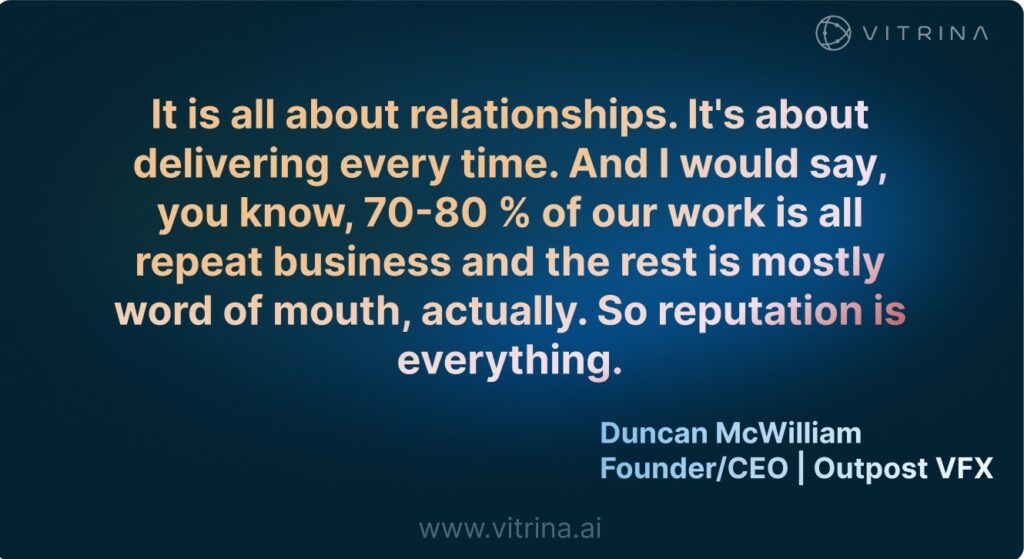
Duncan McWilliam: A pivotal project was News of the World with Tom Hanks during COVID. Universal trusted us to deliver the complex work, including horses and cattle in the Wild West landscape, while flipping to a remote working environment. This built a strong relationship, leading to repeat work with director Paul Greengrass, such as on The Lost Bus. Relationships are everything in this business, as you are there to help solve problems and are ultimately judged on the final product. About 70-80% of our work is repeat business, with the rest mostly word of mouth.
“We found ourselves working with Paul Greengrass as a go-to director on all his work now … It is all about relationships. It’s about delivering every time.”
3. Vitrina: What was the main motivation or trigger point for you to start Outpost, and how did the company scale up? Was it linear, or did you have sudden growth spurts?
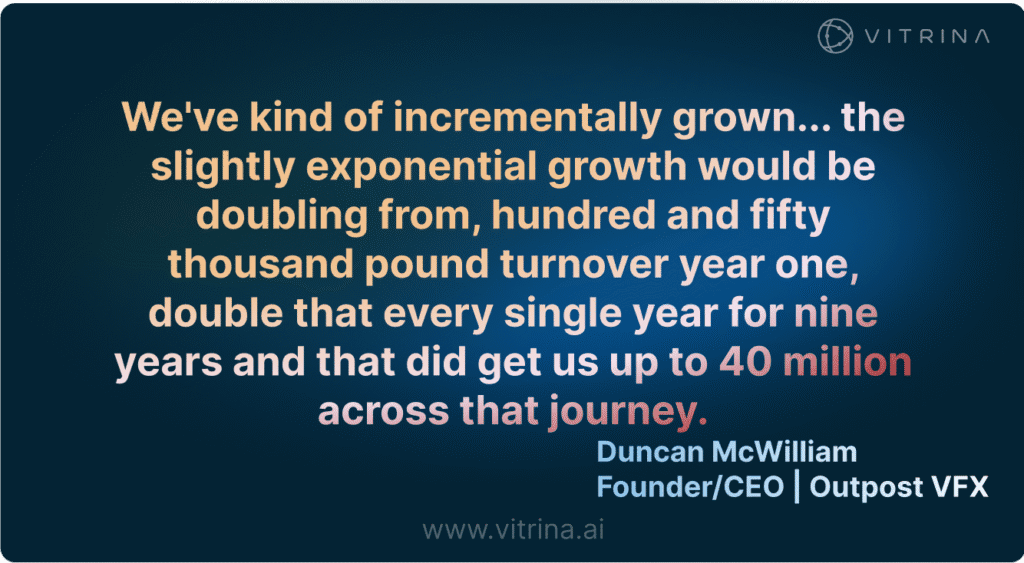
Duncan McWilliam: The catalyst was realizing there was an underserved independent film market that MPC (where I previously worked) considered too small. I saw that we could apply generalist commercial workflows to these underfunded films and still make a profit. I also wanted to set up a company culture that retained knowledge and attracted quality people, as opposed to the knowledge leak I witnessed elsewhere. We haven’t landed a “whale” that caused a sudden growth spurt. Our growth was incremental, doubling our turnover every single year for nine years, which got us up to £40 million.
“I thought, if I set it up in an image of what I would, I wanted to retain the knowledge in the company … It’s basically the most important thing you’ve got.”
4. Vitrina: If you couldn’t name a specific visual effect, how would you describe Outpost’s core specialization or calling card?
Duncan McWilliam: Our real specialization is client service. We aim to make it a good experience: honest, open, and transparent. We bring problems up as they happen and manage expectations to avoid surprises. Because you can’t tell which company created which shot in the cinema, our specialization must be the way we execute the work—the process, the price, and ultimately causing the client the least stress possible.
“The real specialization that we identified early on would be client service … Ultimately, causing your client the least stress possible, giving them the best experience possible is most likely to get you the next show, which is really how the whole industry works.”
5. Vitrina: You’ve experienced significant external crises: Brexit, COVID-19, and the industry strikes. How did these impact the company, and which was the most damaging?
Duncan McWilliam: Brexit was miserable because the end of freedom of movement stopped us from offering job opportunities to our strong European workforce. COVID was very difficult, with investors pulling out, but government support like furlough was “epically good” and helped us survive. However, the strikes were the worst—worse than both COVID and Brexit combined. It was the industry tearing itself apart and a catalyst for a massive market correction, with streamers overproducing and needing a reason for a reset. Our headcount went from 950 globally to 250 in three months during the strikes.
“The strikes were the worst because it was the industry tearing itself apart … it’s just a giant market reset, a big cyclic reset.”
6. Vitrina: What is your assessment of the collapse of Technicolor/MPC? What were the key factors that led to that outcome?
Duncan McWilliam: I was sad for the artists, but culturally, we saw it coming years ago. If you over-trade and under-bid to scoop up market share, it’s a difficult, thin-margin business to predict. Poor treatment of people and not delivering shows on time (delaying marketing strategies) creates enormous warning signals. Fiscally, the IPO raised phenomenal cash that was quickly spent on expensive property, and there was no sense in putting CapEx boxes under desks instead of moving to the cloud. Ultimately, the combination of bad financial management, significant debt, and quality of service issues caused the machine to fall apart.
“The minute you start not delivering shows by a month or two months or three months or one year … These are the things that give you these enormous warning signals of people are going to get scared with where their money’s going, what the quality of service is.”
7. Vitrina: What are the biggest factors that have led to the current resurgence and dominance of the UK market in content production?
Duncan McWilliam: The UK has the best combination in the world of production crew and visual effects, concentrated in a small, efficient ecosystem around London. I also think the British sensibility and diplomacy around creative discussion—the service industry aspect—sits well with American clients. Most importantly, the incentives are economic. The recent reduction of the cap and the ability to adjust the VFX spend has made it a 30% tax rebate, twinning quality of delivery with competitive pricing.
“The biggest, I mean, obviously the initial tax incentive scheme way back when put us on the map, built out the best combination in the world, in my opinion, and many studios’ opinions of both crew, so production, and visual effects.”
8. Vitrina: How are you viewing the current disruption from AI, gaming engines, and other new technologies?
Duncan McWilliam: It is simply another tool; I agree it is “the paintbrush, not the painter”. Humans who operate the machine and align the creative vision will never be replaced. We’ve been using AI for decades. We need to stay ahead, build these tools into our pipelines, and stay on top of them so they become the solution, not the problem. The core principle is to reduce overtime, give people a better work-life balance, and make more money to pay people more, especially if they can do it in less time. The biggest savings the studios are looking for from VFX are actually process driven, not magic silver bullet tools.
“Wherever we put those changes, the whole principle here is to reduce overtime, give people a better work-life balance, give more breathing space to your EBITDA and if you make more money, you can pay people more money.”
——————————————————————————————————————————–
A Leader in Visual Effects: Outpost VFX
Outpost VFX is a high-tier visual effects company specializing in AAA feature film and premium streaming TV productions. Founded in 2013 by Duncan McWilliam, the company was built on an artist-led ethos to retain knowledge and prioritize culture alongside technology. With approximately 650 people across four studios in three countries, Outpost positions itself as a mid-tier scale vendor known for exceptional client service and delivering complex visual work.


More from LeaderSpeak…
Trino Motion Pictures on Africa’s New Distribution Pla…
Uche shares how Trino Motion Pictures evolved from a production-first outfit into a global, distribution-driven powerhouse.


ITV Studios Is Betting Big on Digital-First IP
Julie Meldal-Johnsen discusses ITV Studios’ digital evolution, global partnerships, creative co-productions, and navigating modern drama financing models.
STARZPLAY is Redefining Streaming in the Middle-East
This episode details Starzplay’s hybrid AVOD+SVOD model, strategic content partnerships, and its position as the “home of cricket” in the MENA region. Head of Content Partnerships & Sports Sunil Joy explains how E&’s entertainment arm is navigating a market of 200 nationalities, piracy challenges, and global streaming giants — through bundling, telco distribution, and deep regional partnerships.