IHUB
IHUB
 Private Briefings (Webinars)


 LeaderSpeak Podcast
  Global Entertainment Digest (Newsletter)
  About Vitrina
 About VIQI
 Our Story
 Our Solutions 🔥
 Film+TV Projects Tracker 🚀
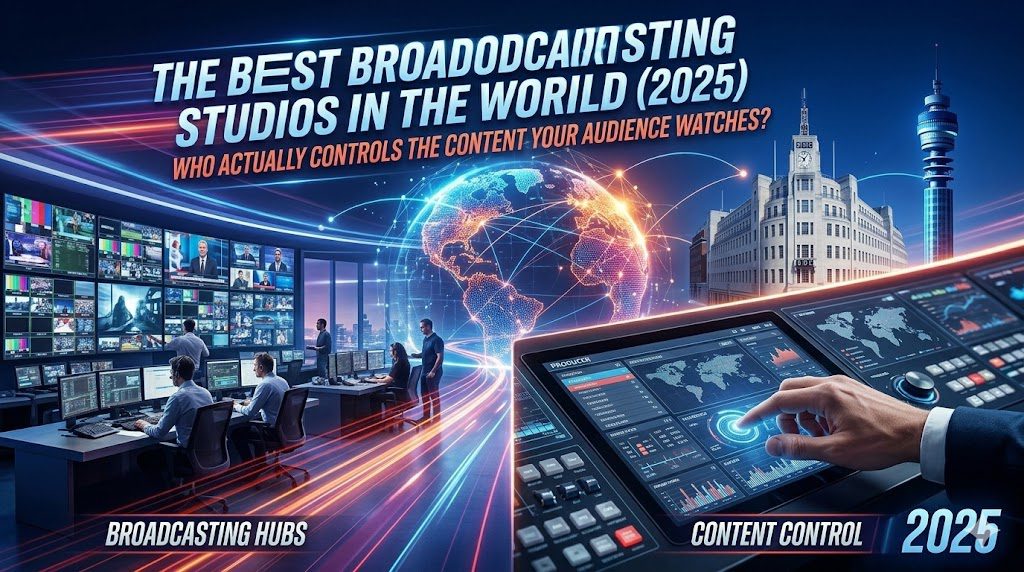
Most rankings sort by revenue and call it a guide. This one ranks 15 global studios by the four criteria that correspond to decisions real professionals in the entertainment supply chain actually face.
Most rankings of the world's best broadcasting studios are built around one number: revenue. Pull the annual reports, sort them largest to smallest, add a paragraph about each company's "impressive portfolio," and call it a guide. It is not a guide. It is a spreadsheet with sentences around it.
The problem is that revenue tells you almost nothing useful if you are trying to make a real decision — whether that is choosing a distribution partner, evaluating a co-production opportunity, or understanding which companies are genuinely positioned for the next five years versus which ones are defending a business model that peaked in 2016. A studio can generate $40 billion in revenue while quietly losing the creative talent, the risk appetite, and the technology infrastructure that made it worth working with in the first place.
This guide is built differently. It ranks the world's top 15 broadcasting studios across four criteria that correspond to decisions real professionals in the entertainment supply chain actually face: distribution control, original content ownership, technology infrastructure, and genuine accessibility as a partner.
The global television broadcasting services market is expected to reach $548.35 billion in 2026, growing at a 6.1% CAGR through 2030 (Mordor Intelligence, 2024). That growth is real. But it is not evenly distributed, and the companies capturing the most valuable share are not always the ones with the biggest logos.

Your AI Assistant, Agent, and Analyst for the Business of Entertainment
VIQI AI helps you plan content acquisitions, raise production financing, and find and connect with the right partners worldwide.
- Find active co-producers and financiers for scripted projects
- Find equity and gap financing companies in North America
- Find top film financiers in Europe
- Find production houses that can co-produce or finance unscripted series
- I am looking for production partners for a YA drama set in Brazil
- I am looking for producers with proven track record in mid-budget features
- I am looking for Turkish distributors with successful international sales
- I am looking for OTT platforms actively acquiring finished series for the LATAM region
- I am seeking localization companies offer subtitling services in multiple Asian languages
- I am seeking partners in animation production for children's content
- I am seeking USA based post-production companies with sound facilities
- I am seeking VFX partners to composite background images and AI generated content
- Show me recent drama projects available for pre-buy
- Show me Japanese Anime Distributors
- Show me true-crime buyers from Asia
- Show me documentary pre-buyers
- List the top commissioners at the BBC
- List the post-production and VFX decision-makers at Netflix
- List the development leaders at Sony Pictures
- List the scripted programming heads at HBO
- Who is backing animation projects in Europe right now
- Who is Netflix’s top production partners for Sports Docs
- Who is Commissioning factual content in the NORDICS
- Who is acquiring unscripted formats for the North American market
How We Actually Ranked These Studios
Here is what most ranking methodologies get wrong: they treat all revenue as equal. A dollar earned from a 40-year cable contract that expires in 2026 is not the same as a dollar earned from a streaming subscription that renews monthly. One signals a business coasting on legacy infrastructure. The other signals a company earning its value in real time.
The four criteria we used reflect decisions, not just size. Distribution control measures whether a studio genuinely owns the premium tier of its core markets. Original content ownership asks how much a company makes versus licenses. Technology infrastructure evaluates streaming platforms, cloud production capability, and AI pipeline integration. Partnership accessibility is the criterion most lists skip entirely — and it is often the most practically important one.
Here is something worth sitting with before reading the profiles: the three companies that score highest on partnership accessibility are not the three biggest by revenue. That gap matters enormously depending on where you sit in the industry.
The Top 15 Best Broadcasting Studios Worldwide in 2026

The version of the Comcast story that gets the most airtime is the crisis version. Peacock lost nearly $3 billion in 2023 before clawing toward profitability. Cable subscribers are leaving by the million. Linear TV advertising keeps shrinking in ways no amount of digital revenue fully offsets. If you read only the media trade coverage, Comcast looks like a company in managed decline.
That framing misses what actually makes Comcast the most structurally resilient broadcaster in the world. The company does not need any single division to win — it needs the whole machine to stay in motion. When Peacock struggles, Sky picks up the slack. When US theatrical underperforms, theme parks compensate. Universal Epic Universe opened in Orlando in 2026 to record pre-booking numbers, and that revenue flows directly back into content investment across the NBCUniversal studio system. No pure-play streaming platform has that kind of buffer.
For independent producers, the most realistic entry point into this ecosystem is NBCUniversal's international studio division, which maintains co-production relationships with independent companies across the UK, Australia, and continental Europe. The deals take longer to close than at a smaller studio. The creative oversight is heavier. But when the distribution guarantee lands, it is genuinely global.
Established independent studios with a proven track record in scripted drama or premium unscripted seeking multi-territory distribution.
First-time producers or companies without existing US broadcast market relationships.
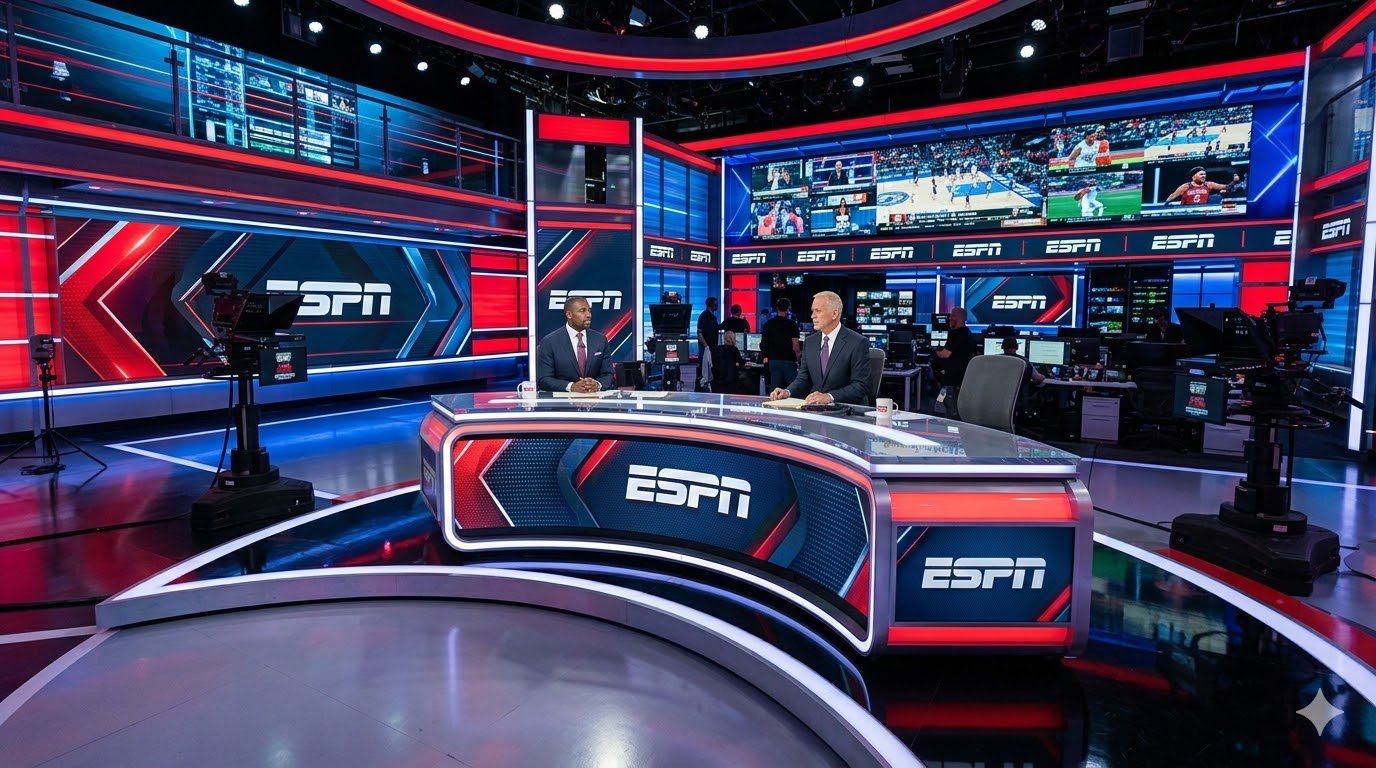
Disney makes a very specific kind of content better than almost anyone else alive, and it has spent a hundred years building a company designed entirely around that fact. The problem — and it is real and underacknowledged — is that "a very specific kind of content" is not always enough to grow a $91 billion company from.
The Disney+ subscriber plateau that unnerved investors through 2023 and 2024 was not fundamentally a streaming problem. It was a brand ceiling problem. The Disney brand, even at its most expansive with Marvel and Star Wars included, appeals deeply to a well-defined audience. That audience has limits. Smart strategy means working within them rather than pretending they do not exist.
ESPN is the piece of Disney's portfolio that most people outside the United States systematically underestimate. It is not just a sports channel. It is the dominant live sports rights aggregator in the US, holding deals with the NFL, NBA, college football, and multiple major leagues simultaneously. When ESPN launches its standalone streaming product — widely expected in late 2026 — it will represent the most consequential event in American sports broadcasting since cable television launched.
For international content partners, National Geographic remains Disney's most accessible commissioning door. It actively seeks documentary and factual programming from non-US producers with genuine global editorial appetite.
Sports rights holders, family and youth entertainment producers, and international documentary filmmakers fitting the National Geographic editorial remit.
Adult-skewing or edgy content that sits outside the brand's defined audience profile.
If you want to understand Warner Bros. Discovery in 2026, forget the subscriber numbers for a moment. Focus instead on what the company did with its content library right after the merger closed — because that decision reveals everything about what WBD is actually building.
When David Zaslav pulled finished, expensive content off Max to take tax write-downs rather than leave it streaming with minimal viewing, the industry reaction was brutal. Shows cancelled before airing. Films shelved indefinitely. From the outside, it looked like chaos with a spreadsheet. What it actually was — and this only becomes clear in retrospect — was a deliberate reset of what HBO means as a brand. Zaslav bet that a smaller, more prestigious library would retain subscribers better than a larger, diluted one. Max's churn rate in 2024 was among the lowest of any major streaming platform. The bet is paying off.
The practical implication for co-production partners is significant. WBD is not interested in volume. If your project could credibly sit alongside Succession or The White Lotus in tone, ambition, and production value, HBO is one of the few places on earth that will pay what that level of content actually costs to make.
Discovery's factual division remains actively acquisitive, with content traveling across more than 220 countries and a genuine commissioning appetite for international natural history, science, and adventure programming.
Premium adult drama producers and international factual content creators with strong scientific or geographic documentary concepts.
Youth content, family entertainment, or reality formats outside the Discovery factual profile.
Paramount's narrative tends to focus on what it lacks compared to Disney or Comcast — the theme parks, the global satellite infrastructure, the sheer scale. What that framing misses is that CBS remains the single most-watched broadcast network in the United States, consistently delivering primetime audiences that every other network would trade its streaming platform to have.
Pluto TV, Paramount's free ad-supported streaming platform, is the quietly growing asset most competitors are not watching closely enough. With over 80 million monthly active users, it is reaching audiences who have left linear cable entirely but are unwilling to pay for multiple subscriptions — a segment that is growing faster than premium SVOD in most Western markets.
Youth content producers, format rights sellers targeting international markets, and advertisers seeking broad reach on ad-supported platforms.
Premium prestige drama or content requiring significant production co-investment.
Here is the thing nobody in a pitch meeting says out loud about Netflix: it is simultaneously the most sought-after commissioning partner in the world and one of the most difficult companies to build a sustainable long-term relationship with as an independent producer.
The company has fundamentally rewritten what international co-production looks like, producing original programming in over 50 countries and generating genuine global phenomena — Squid Game, Money Heist, Dark — that no traditional broadcaster's international strategy ever achieved at that scale. But its data-driven greenlight process means creative decisions are increasingly made by algorithm committee rather than editorial instinct.
International independent studios with local-language content carrying demonstrable cross-border audience potential.
Producers who prioritize creative control and editorial independence over distribution scale.
Vitrina helps producers, distributors, and service companies monitor in-development projects globally, assess partners, and reach the right decision-makers — before the deal closes.

BBC Studios is the most internationally distributed production operation in the world. Its natural history output — the Planet Earth and Blue Planet franchises — represents some of the most valuable non-scripted IP in broadcasting history. Because BBC Studios operates independently of public funding, it is a professionally clean and structurally straightforward partner for international studios.
What most independent producers miss is that BBC Studios actively seeks co-production partners for its natural history and documentary output, specifically to manage production costs that have escalated sharply with 4K and 8K capture requirements. For a well-positioned international production company, this creates a genuine entry point that requires no existing relationship to initiate.
International documentary and natural history producers, drama format sellers, and companies seeking co-production partnerships with strong editorial credentials.
Fast-turnaround commercial content or entertainment formats outside the BBC editorial remit.
Sky is Europe's premium broadcasting infrastructure story, and its value is routinely underappreciated outside the UK. Sky Sports holds Premier League football, Formula 1, and cricket rights across its key territories. The sports rights portfolio is the structural moat that keeps Sky's subscriber base stable in a market where every streaming platform is competing for the same household budget.
Premium drama producers targeting UK and European audiences, and sports rights holders seeking Western European distribution.
Youth or children's content, or producers seeking emerging market distribution.
Fox made a deliberate strategic choice that most of its peers quietly mocked — and are now quietly reconsidering. Instead of spending billions building a global streaming platform, Fox doubled down on live content. News. Sports. Appointment television that streaming platforms still cannot replicate effectively. Fox's live sports strategy generated a 19% jump in advertising revenue in Q2 fiscal 2026, validating the approach entirely.
Live sports rights holders, news content producers, and content owners seeking FAST distribution with minimal editorial friction.
Scripted prestige drama or international co-production seeking multi-territory deals.
ITV Studios' format library is one of the most commercially productive in global television. Love Island, The Voice, Come Dine With Me, I'm a Celebrity — these formats have been adapted across scores of markets, generating licensing revenue that runs independently of ITV's UK ratings performance. The format licensing business is what makes ITV strategically interesting to international partners, and it runs with a professionalism and speed that larger conglomerates rarely match.
Format rights sellers seeking proven international adaptation frameworks, and independent UK producers with a genuine commissioning appetite.
High-budget scripted drama requiring the production investment levels of a Netflix or HBO.
Fremantle: The production and distribution arm of RTL Group responsible for creating and distributing global television format properties, including Got Talent, Idols, and The Price Is Right.
RTL Group is Europe's largest commercial broadcaster by channel count and territory coverage. Got Talent has been adapted in over 70 countries, making it one of the most-licensed format properties in television history. The underappreciated story at RTL right now is the RTL+ streaming buildout across Germany, France, and the Netherlands simultaneously — backed by Bertelsmann's capital resources with the financial runway smaller broadcasters cannot afford.
Format rights sellers seeking European multi-territory distribution, and independent producers targeting German and French-language audiences.
Producers seeking US or Asia-Pacific distribution without additional partnerships.
TV Globo consistently delivers some of the highest primetime ratings of any free-to-air network on earth. Brazil has a population of 215 million people, a deep telenovela culture that generates genuine multi-generational viewing, and a media landscape where Globo's brand carries the kind of institutional trust that Western broadcasters spent the last decade losing. Globoplay's growth trajectory is the number to watch as Brazil's smartphone penetration continues climbing toward 90%. For content partners seeking entry into Latin America's largest advertising market, Globo is not one option among several. It is the gateway.
Content partners seeking access to Brazil and broader Lusophone markets, and format sellers with proven telenovela or drama adaptation track records.
English-language content without a clear localization strategy for Brazilian audiences.
The MENA broadcasting market is being reshaped by capital flows that most Western industry observers are not tracking closely enough. Saudi Arabia's Vision 2030 program includes specific provisions for building a domestic content production industry, and the investment numbers are significant. The combination of state-adjacent capital, dominant regional distribution, and a growing original production infrastructure makes MBC a uniquely positioned entry point for any studio seeking co-production partnerships in the Arab world.
International studios with MENA market experience seeking co-production partnerships in Arabic-language content.
Companies without regional relationships or cultural production fluency in Arabic-language storytelling.
NHK is one of those institutions the global broadcasting industry consistently underestimates. Its investment in 8K content production puts it at the absolute frontier of broadcast resolution globally — years ahead of most commercial broadcasters still completing their 4K transitions. The Japanese public broadcaster holds a content relationship with the anime industry that no other broadcaster on this list can replicate, and as global anime market revenues exceeded $31 billion in 2023 (Statista, 2024), NHK's position becomes more strategically relevant with every passing year.
International documentary producers seeking high-prestige co-production partners, and studios building strategic relationships in the Japanese content market.
Commercial entertainment producers seeking fast-turnaround commissioning or direct audience reach outside Japan.
The 2026 merger of Disney's Indian operations with Reliance Industries' Jio created JioHotstar — and if you are not paying attention to what that combined entity represents, you are missing the most important structural story in global broadcasting right now. India has 1.4 billion people, more than 500 million smartphone users, and an OTT market that PwC projects will be among the fastest-growing globally through 2029. The cricket rights alone make JioHotstar structurally unassailable in the Indian market for the foreseeable future. Every other platform is competing for the audience between matches. JioHotstar owns the matches.
International content producers seeking entry into the Indian subcontinent market, and sports rights holders with cricket or IPL adjacent properties.
Premium scripted drama targeting Indian urban audiences without a localization and language strategy.
Key Industry Trends Reshaping Broadcasting in 2026
The trends below are not predictions. They are already operational realities inside the supply chains of the studios profiled above. The question is not whether they are happening — it is whether your organisation is positioned to work with them or against them.
Free ad-supported streaming television is growing at a rate traditional broadcasters did not model correctly three years ago. Tubi, Pluto TV, Samsung TV Plus, and Peacock's ad-supported tier are collectively reaching audiences that have abandoned linear cable permanently.
FAST (Free Ad-Supported Streaming Television): A distribution model where viewers access content at no cost in exchange for watching advertisements, with revenue shared between the platform and the content rights holder.
For content owners sitting on library titles or finished programming without a current distribution home, FAST platforms represent a genuinely accessible and financially improving channel that most rights holders are still underutilising.
The trade press treats AI in broadcasting as an emerging trend. Inside the actual production and delivery pipelines of the studios on this list, it is already operational infrastructure. Netflix's automated QC workflows are processing localization quality checks at a scale that manual review cannot match.
The practical implication for entertainment supply chain professionals is that AI fluency is now a procurement criterion, not a competitive advantage. Vendors who cannot demonstrate AI integration in their delivery and QC workflows are increasingly being filtered out at the earliest stages of partner evaluation.
Remote production and cloud-based playout solutions are allowing broadcasters to operate globally with dramatically reduced physical infrastructure requirements. The television segment commands an estimated 46.5% share of the global broadcasting solutions market in 2026 (Coherent Market Insights, 2024). BBC's IP-based broadcast delivery transition is the most closely watched model in the industry right now — not because it is the most ambitious, but because it is being executed by an organisation that cannot afford to get it wrong.
Frequently Asked Questions
The mistake most content professionals make when looking at a list like this is treating it as a hierarchy to climb rather than a map to navigate. Comcast's $123 billion revenue does not make it the right partner for a six-part documentary series about water infrastructure in Southeast Asia. BBC Studios' relatively modest commercial revenue does not make it a lesser choice for a natural history co-production that needs to travel to 180 countries.
The right broadcasting partner in 2026 is the one whose content acquisition priorities, territorial focus, and production infrastructure align most precisely with your specific project at its current stage of development. Matching those variables — rather than defaulting to the largest logo with an open door — is what separates producers who close deals from those who accumulate development meetings.
The studios on this list are all operating in a market that is fragmenting and consolidating at the same time. The ones worth watching most closely in the next three years are the ones investing in technology infrastructure, building genuine accessibility for independent partners, and owning their content outright rather than licensing it from someone else. That combination is rarer than it should be. Where you find it, the conversations tend to be shorter and the deals tend to close.
Ask VIQI: Which of These Broadcasting Studios Are Actively Acquiring Content in Your Genre Right Now?
VIQI is trained on 1.6 million titles, 360,000 companies, and 5 million entertainment professionals. Ask it which of the 15 studios ranked above are in acquisition mode for your content type, what genres they're commissioning, and which territories they're prioritising in 2026.
✓ 200 free credits | ✓ No credit card needed
Ask VIQI Now- Mordor Intelligence — Television Broadcasting Services Market: mordorintelligence.com
- PwC Global Entertainment & Media Outlook 2026–2029: pwc.com
- Netflix Investor Relations — Annual Content Spend: ir.netflix.net
- Statista — Global Anime Market Revenue 2023: statista.com
- Coherent Market Insights — Broadcasting Solutions Market: coherentmarketinsights.com