About Innovation Hub
 Global Content Pulse (Webinars)


 Global Production Financing
(Webinars)
Global Production Financing
(Webinars)  LeaderSpeak Podcast
  Global Entertainment Digest (Newsletter)
  About Vitrina
 About VIQI
 Our Story
 Our Solutions 🔥
 Film+TV Projects Tracker 🚀
 Case Studies
 Our Profile
Documentary format licensing is the strategic acquisition of the conceptual and structural rights to a non-fiction series for local adaptation.
This process involves identifying high-potential Intellectual Property (IP) before it reaches the global market saturation point.
According to industry analysis, the modern media supply chain consists of over 600,000 companies, making manual tracking of these rights nearly impossible.
In this guide, you will learn why real-time opportunity alerts are the critical infrastructure for modern buyers, including frameworks for due diligence and regional discovery.
While traditional sourcing relied on relationship-heavy networking and physical trade shows, these legacy methods create a “data deficit” for senior executives. Legacy databases provide surface-level listings, leaving acquisition leads blind to emerging regional hits until the rights have already been bid up.
This guide addresses these gaps by exploring how automated intelligence platforms compress months of manual research into actionable, high-velocity sourcing strategies.

Your AI Assistant, Agent, and Analyst for the Business of Entertainment
VIQI AI helps you plan content acquisitions, raise production financing, and find and connect with the right partners worldwide.
- Find active co-producers and financiers for scripted projects
- Find equity and gap financing companies in North America
- Find top film financiers in Europe
- Find production houses that can co-produce or finance unscripted series
- I am looking for production partners for a YA drama set in Brazil
- I am looking for producers with proven track record in mid-budget features
- I am looking for Turkish distributors with successful international sales
- I am looking for OTT platforms actively acquiring finished series for the LATAM region
- I am seeking localization companies offer subtitling services in multiple Asian languages
- I am seeking partners in animation production for children's content
- I am seeking USA based post-production companies with sound facilities
- I am seeking VFX partners to composite background images and AI generated content
- Show me recent drama projects available for pre-buy
- Show me Japanese Anime Distributors
- Show me true-crime buyers from Asia
- Show me documentary pre-buyers
- List the top commissioners at the BBC
- List the post-production and VFX decision-makers at Netflix
- List the development leaders at Sony Pictures
- List the scripted programming heads at HBO
- Who is backing animation projects in Europe right now
- Who is Netflix’s top production partners for Sports Docs
- Who is Commissioning factual content in the NORDICS
- Who is acquiring unscripted formats for the North American market
Table of Contents
Key Takeaways for Acquisition Leads
-
Eliminate the Data Deficit: Automated intelligence replaces fragmented manual research, providing visibility into 1.6 million titles across the global supply chain.
-
First-Mover Advantage: Opportunity alerts allow buyers to track “paper formats” and early-stage developments 6-12 months before trade announcements.
-
Verified Due Diligence: Using data-driven profiling for 140,000+ companies reduces the risk associated with cross-border licensing and unverified partners.
What is Documentary Format Licensing?
Documentary format licensing involves the transfer of rights to adapt a proven non-fiction structure—such as a specific investigative technique, competition loop, or storytelling framework—for a new territory. This allows platforms to replicate successful audience engagement patterns while tailoring the content to local cultural nuances. Unlike finished tape sales, format rights empower buyers to build localized franchises that resonate deeply with domestic subscribers.
The complexity of this market has grown exponentially as streaming platforms move away from global “walled gardens” toward “weaponized distribution.” This shift means high-value formats are now being licensed to rivals and regional players to maximize ROI. Navigating this landscape requires more than just knowing a title; it requires a deep understanding of who owns the IP and what rights remain available.
Find available documentary formats in your region:
Solving the Executive Data Deficit in Sourcing
Senior executives in content acquisition often operate within a “data deficit,” relying on manually sourced reports and anecdotal evidence from personal networks. In an industry of 5 million professionals, these personal connections—while valuable—are structurally incapable of monitoring the entire global output. This lack of a “single source of truth” leads to missed opportunities in emerging markets where the next major format hit is currently in development.
Data-driven decision-making, pioneered by leaders like Netflix, has transformed acquisition into a science. By leveraging vertical AI to map the entire entertainment ecosystem, executives can now identify trends across 100+ countries simultaneously. This shift from manual searching to automated intelligence ensures that decision-makers are never the last to know about a trending regional IP.
Industry Expert Perspective: James Burstall on Diversified Content Creation
In this conversation, Argonon CEO James Burstall explores how a diversified portfolio—ranging from high-end documentaries to reality formats—is essential for adapting to shifting audience preferences in a post-streamer world.

James Burstall discusses the Argonon Group’s journey and its focus on diversified content production. The group’s seven production companies cover a wide range of genres, emphasizing the need for international co-productions and market adaptability to thrive in the complex modern landscape.
Why Opportunity Alerts are Non-Negotiable
The “paper format” stage is where the most lucrative deals are made. Opportunity alerts provide real-time notification as unreleased projects enter the development pipeline, allowing acquisition leads to engage with creators 6-12 months before a project is announced in trade publications. For a buyer, this “early-warning signal” is the difference between a high-stakes bidding war and an exclusive first-look negotiation.
Without automated alerts, tracking 140,000+ global production and distribution companies becomes a game of chance. By setting custom parameters—such as “True Crime formats in South Korea” or “Environmental docu-series in Scandinavia”—acquisition teams can filter the noise and focus only on projects that fit their current slate requirements. This strategic efficiency increases deal velocity and ensures a consistent pipeline of high-quality IP.
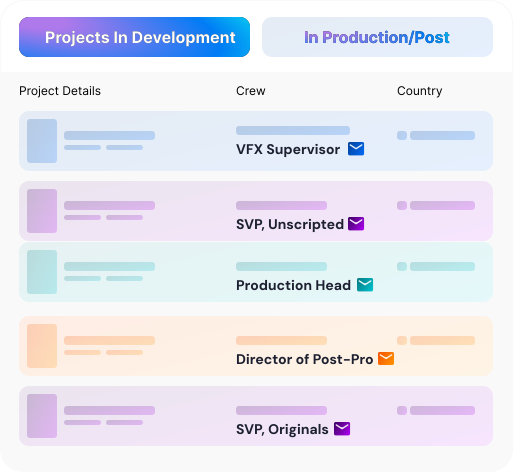
Track early-stage documentary projects:
Mitigating Risk in Cross-Border Licensing
Acquiring formats across borders introduces significant operational and financial risks. A “data trust deficit” often exists when vetting international partners whose track records are not easily verifiable through standard Western trade news. Success requires objective data on a partner’s historical collaborations, specialized capabilities, and verified project history to ensure they can deliver on the format’s promise.
Platforms that map over 30 million industry relationships allow acquisition leads to perform thorough due diligence in minutes. By profiling potential partners based on verifiable deals and reputations, buyers can move forward with confidence. This transformation of partner discovery from a subjective art to a data-driven science is the hallmark of the modern, borderless entertainment supply chain.
“The industry is transitioning from an opaque, relationship-driven ecosystem to a centralized, data-powered framework. For acquisition leads, the primary goal is maximizing revenue while ensuring the right audience reaches your content through strategic partner identification.”
Moving Forward
The documentary format licensing landscape has evolved into a global, high-velocity market where timing is as critical as taste. By integrating automated opportunity alerts and real-time project tracking, acquisition teams can bridge the gap between traditional networking and modern data intelligence. This transformation addresses the core deficits in visibility and trust that once hampered international growth.
Whether you are an acquisition lead looking to secure the next major investigative hit, or a programming director trying to localize a proven unscripted structure, the key is actionable intelligence. Understanding where active creators are and what rights remain available transforms licensing from a speculative effort into a strategic advantage.
Outlook: Over the next 12-18 months, “weaponized distribution” will accelerate, leading to more aggressive format licensing across rival platforms. Buyers who adopt real-time discovery tools now will be best positioned to capture high-value IP before it reaches the open market.
Frequently Asked Questions
What are opportunity alerts in format licensing?
How does documentary format licensing differ from finished tape?
Why is cross-border due diligence difficult?
What is weaponized distribution?
About the Author
Expert in Entertainment Supply Chain Intelligence with over 15 years of experience in global content acquisition and distribution strategy. Connect on Vitrina.
Find Film+TV Projects, Partners, and Deals – Fast.
VIQI matches you with the right financiers, producers, streamers, and buyers – globally.
Producers Seeking Financing, Co-Pros, or Pre-Buys?
Vitrina Concierge helps producers reach the right financiers, commissioners, distributors, and co-production partners — with precision outreach, not cold pitching.
Join Industry Briefings Trusted by Leaders

Micro-Dramas & Mobile-First Storytelling
Micro-dramas are building real audiences and revenue. Understand the platforms, buyers, and economics behind the growth.

Navigating Global Content Licensing Trends
How global content licensing is shifting beyond flat fees to flexible, deal-driven models.
Film & TV Production Financing: 2026 Trends
Production financing conditions are changing quickly. Understanding where money is moving and what buyers are backing is key to getting projects approved and funded in 2026.
Unreleased Film+TV Projects: Opportunities & Showcase
A curated view of unreleased Film and TV projects open for financing and collaboration