About Innovation Hub
 Global Content Pulse (Webinars)


 Global Production Financing
(Webinars)
Global Production Financing
(Webinars)  LeaderSpeak Podcast
  About Vitrina
 Our Story
 Our Solutions 🔥
 Film+TV Projects Tracker 🚀
 Case Studies
 Our Profile
Executive Summary: Strategic Findings
| Strategic Pillar | Executive Impact |
|---|---|
| Incentive Navigation | Offsets 20%–40% of QPE through rebates and transferable credits. |
| Operational De-risking | Accelerated permitting and liaison services with public safety and government bodies. |
| Infrastructure Verification | Real-time intelligence on crew depth, stage availability, and local vendor capacity. |
| Vitrina Relevance | Aggregates 150,000+ vetted global partners to verify commission-backed claims. |
Table of Contents
- Defining the Node: Beyond Administrative Functions
- Core Services: The Production Facilitation Suite
- Top-Rated Commissions for the Indie and International Landscape
- Supporting International Productions on U.S. Soil
- Unlocking Global Supply Chain Intelligence with Vitrina
Defining the Node: Beyond Administrative Functions
In the current 2024–2025 cycle, film commissions have transitioned into active market participants. According to data from the Association of Film Commissioners International (AFCI), these entities now function as “one-stop resources” that harmonize local governmental policy with the high-velocity demands of modern streaming and theatrical slates. The primary mandate of a commission is to attract production capital to their region, generating a “soft-sell” promotional effect for tourism while securing immediate economic impact through local hiring.
For an executive, a film commission represents a sovereign-backed guarantee of cooperation. It is the difference between a production that stalls due to bureaucratic friction and one that proceeds with the full weight of local government support. This is particularly critical in markets like China, which is projected to exceed $22 billion in value by 2025, or India, which continues to lead global output with over 2,500 films annually. The bottom line is this: if you are not engaging the regional commission during the greenlight phase, you are likely leaving 15%–20% of your operational efficiency on the table.
Core Services: The Production Facilitation Suite
What services does a film commission typically offer to filmmakers? The answer is an integrated stack of logistical and financial support systems designed to stabilize the production environment.
- Location Scouting & Digital Libraries: Commissions maintain extensive, searchable databases of “film-friendly” locations. High-tier commissions provide bespoke location presentations and regional scouting services to identify sites in close proximity, drastically reducing travel-time overhead.
- Permitting and Public Space Access: Securing permits for shooting in public spaces is a primary friction point. Commissions act as the central liaison for road closures, fire department coordination, and park ranger clearance.
- Incentive Administration: In 2025, global competition for production business has reached a “fever pitch.” Commissions provide direction and clarification on tax credits, such as the UK’s 39.75% Independent Film Tax Credit (IFTC) or California’s expanded $750M incentive program.
- Local Crew & Infrastructure Intel: They offer real-time data on crew depth and the technical capacity of local soundstages, ensuring that a production doesn’t outscale the local workforce.
Top-Rated Commissions for the Indie and International Landscape
The “New Reality” of 2025 necessitates that indie filmmakers look toward commissions that offer more than just locations. The top-rated film commissions for supporting indie filmmakers are those that bridge the “finance gap” by offering cash-flow friendly mechanisms.
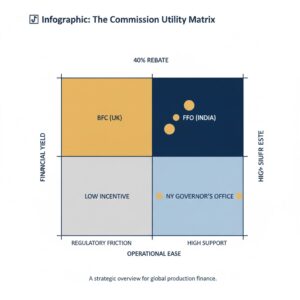
1. British Film Commission (BFC): With the introduction of the Audio-Visual Expenditure Credit (AVEC), the BFC has positioned the UK as a premier hub for both blockbusters like Gladiator II and smaller indies. Their focus on the IFTC for budgets under $19.5 million is a strategic win for the independent sector.
2. New York State Governor’s Office of Motion Picture & Television Development: New York has recently established a dedicated $100 million annual fund specifically for independent film companies. Furthermore, they allow for credits to be claimed in the year of completion, providing much-needed “cash in hand” for agile indie operations.
3. Film Facilitation Office (FFO) – India: Operating under the NFDC, the FFO has revamped its international incentive scheme to offer up to 40% reimbursement for qualifying expenditures, signaling a massive push to attract global co-productions.
Verdict: The British Film Commission (BFC) remains a dominant force, recently facilitating the production of Gladiator II while simultaneously expanding its workforce training accounts to ensure a sustainable talent pipeline through 2031.
Supporting International Productions on U.S. Soil
How do film commissions support international film productions in the US? The support is twofold: regulatory navigation and cultural integration. For a foreign production company, the U.S. regulatory landscape is a patchwork of state-level mandates.
State film offices manage the “Cultural Test” and “Qualified Production Expenditure” (QPE) evaluations. For example, in New Jersey, commissions assist international producers in meeting the 40% qualified expense threshold for studio partners. They also facilitate the required reporting on demographic and geographic inclusion—a growing mandate in the 2025 US production environment to promote workforce diversity.
Furthermore, commissions provide the “Seal of Credibility.” When an international producer approaches a private property owner in a foreign territory, the backing of a state film office transforms a cold outreach into a verified government-sanctioned activity, smoothing negotiations for location access and local vendor contracts.
Unlocking Global Supply Chain Intelligence with Vitrina
While film commissions provide regional expertise, Vitrina provides the global “census-level” data required to cross-verify these opportunities. Executives use Vitrina to map the actual track record of companies and vendors cited by commissions, ensuring that the “vetted” crew list actually has the capacity for a specific genre or scale.
Conclusion: The Path to Production Certainty
The film commission is no longer an optional service; it is a strategic imperative for any production looking to maintain an 8%–25% profit margin in an inflationary environment. By providing free services—from location scouting to incentive guidance—these offices de-risk the massive capital deployment inherent in modern content creation. As global markets like Saudi Arabia and Denmark launch 40% incentives to capture market share, the executive’s first call during pre-production should be to the regional commission.
However, the intelligence gathered from a commission is only as good as the supply chain that supports it. To truly maximize these benefits, leaders must integrate real-time project tracking and company profiling. By utilizing VIQI and the Vitrina platform, you can move beyond static brochures and into a world of verified, data-driven connections that turn regional opportunities into global successes.
Strategic FAQ
What services does a film commission typically offer to filmmakers?
They offer location scouting, digital location libraries, assistance with permitting for public spaces, and guidance on local tax incentives. They also provide vital connections to local crew, vendors, and government liaisons to ensure a smooth production flow.
Can a film commission help secure permits for shooting in public spaces?
Yes, this is a core function. Commissions serve as the central point of contact for municipal and state agencies, coordinating with police, fire departments, and transit authorities to streamline the permitting process for complex urban or public land shoots.
How do film commissions assist with location scouting for movies?
Commissions provide access to high-resolution digital libraries and often provide personalized scouting services. Their deep local knowledge allows them to suggest clusters of locations that minimize travel time and logistical costs for the production team.
How do film commissions support international film productions in the US?
They guide international producers through the “Cultural Test” for incentives and help them navigate state-specific regulations. Additionally, they act as an intermediary, establishing the production’s credibility with local businesses and property owners to facilitate smoother negotiations.