About Innovation Hub
 Global Content Pulse (Webinars)


 Global Production Financing
(Webinars)
Global Production Financing
(Webinars)  LeaderSpeak Podcast
  Global Entertainment Digest (Newsletter)
  About Vitrina
 About VIQI
 Our Story
 Our Solutions 🔥
 Film+TV Projects Tracker 🚀
 Case Studies
 Our Profile

You’ve earned the credit. It’s certified. Your accountant has confirmed it’s real. But it’s still not cash — and you’re not entirely sure how to fix that.
This is one of the most common situations production companies find themselves in, and it’s more solvable than most people realize.
The Three Reasons Credits Don’t Automatically Become Cash
Reason 1: You’re in a Tax Loss Position
State tax credits offset state tax liability. If your production company has no state tax liability — because you’re unprofitable, because you’re in a tax loss position from prior years, or because you’re a pass-through entity where tax liability flows to individual partners — then the credit has nowhere to go.
This is extremely common for independent production companies and project-based entities, which often operate in loss positions by design. The credit is real; the problem is structural.
Reason 2: Your Company Is Domiciled Somewhere Else
Your production company earned credits in Georgia. But your company is registered in Delaware, operates from Los Angeles, and has no Georgia tax liability. The credit exists, but your company has no mechanism to absorb it directly.
This is the domicile mismatch problem. It affects a significant portion of the production companies that earn major US state credits — particularly international companies, streamingfirst entities, and New York or LA based independents shooting in Georgia or Louisiana.
Reason 3: Finance Team Bandwidth
Monetizing a tax credit is a transaction. It requires a buyer, legal documentation, a transfer process, and finance team involvement to close. For production companies in the middle of their next project — or managing multiple productions simultaneously — this gets deprioritized.
“We’ll deal with it after the next production wraps” becomes “we’ve had this credit on the books for two years and haven’t done anything with it.”
The Solution: The Secondary Market
The secondary market for US state entertainment tax credits exists specifically to address all three of these problems.
Here’s how it works: a production company with an unused credit (for any of the reasons above) sells that credit to a buyer who has state tax liability in the same state. The buyer pays a discounted price — something less than the credit’s face value — and uses the credit to reduce their own state tax bill.
Both sides benefit. The production company gets cash now. The buyer gets a credit worth more than they paid. The state gets its tax revenue settled.
This is a legal, well-established, actively-used mechanism. It’s not a loophole — it’s a feature of how state incentive programs are designed. States that create transferable credits intend for there to be a secondary market. The transferability is what gives the incentive its value for companies that can’t use it directly.
What’s Typically Standing in the Way
Finding a qualified buyer
The secondary market has always existed, but accessing it has traditionally required knowing the right broker or having a relationship with the right intermediary. This is why the market has historically been dominated by a small number of brokers with personal networks — they controlled the access to buyers.
Understanding your credit’s value
Without visibility into the current market, it’s difficult to know whether the offer you’ve received is competitive. Credits in the same state can trade at different rates depending on size, current buyer demand, and other factors.
Managing the transaction
Once a buyer is found, the transfer still requires legal documentation, state notification (in some states), and coordination between the seller’s entity, the buyer, and their respective tax advisors. For a finance team already managing other priorities, this friction is a real barrier.
What a Modern Credit Monetization Process Looks Like
The most efficient path through this process — for production companies that want to convert credits to cash without managing each step themselves — looks something like this:
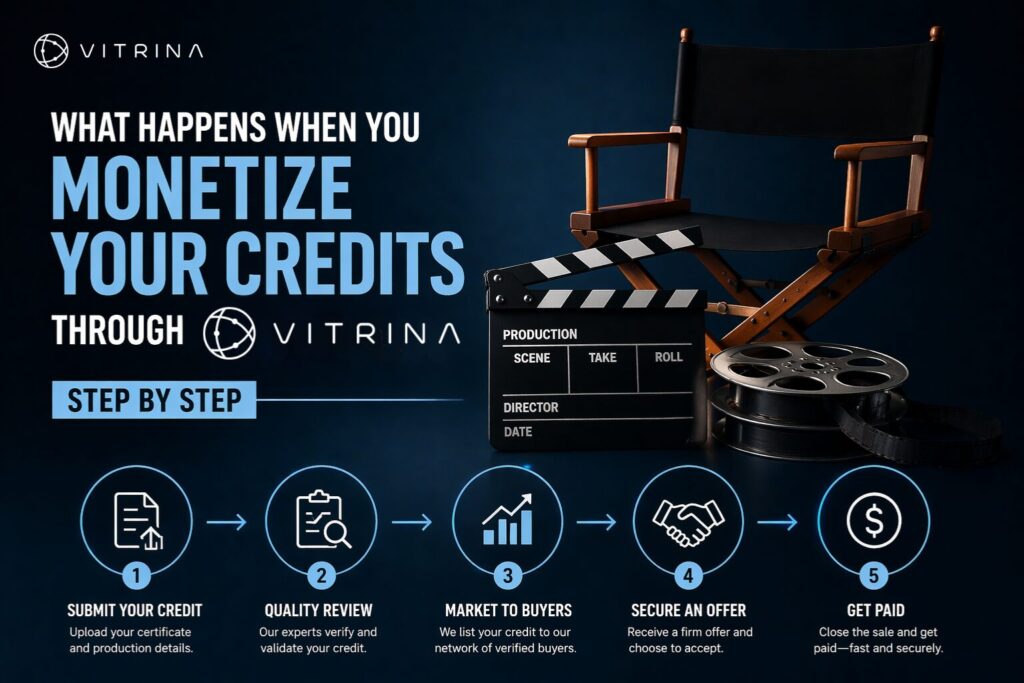
- Register your credit with a platform or intermediary that maintains a qualified buyer network
- Receive a match with a buyer whose state tax profile is suited to your specific credit type and state
- Review and accept an offer at a competitive market rate
- Close the transaction through an established legal and transfer process managed by the intermediary
The seller’s involvement in steps 2 through 4 is minimal. The platform or partner handles the buyer relationship, the negotiation, and the transfer mechanics.
There’s a straightforward way to convert unused credits into cash — vitrina.ai/tax-incentive
Find Film+TV Projects, Partners, and Deals – Fast.
VIQI matches you with the right financiers, producers, streamers, and buyers – globally.
Producers Seeking Financing, Co-Pros, or Pre-Buys?
Vitrina Concierge helps producers reach the right financiers, commissioners, distributors, and co-production partners — with precision outreach, not cold pitching.
Join Industry Briefings Trusted by Leaders

Format Adaptations: Global Trends
Where formats are traveling, which adaptations are breaking out, and how streamers are backing remakes in 2025–2026.

Books, Novels & Comics Adaptations: Global Trends
Books, webtoons, and manga driving the next global screen hits. Discover how in this webinar.

Micro-Dramas & Mobile-First Storytelling
Micro-dramas are building real audiences and revenue. Understand the platforms, buyers, and economics behind the growth.

Navigating Global Content Licensing Trends
How global content licensing is shifting beyond flat fees to flexible, deal-driven models.