About Innovation Hub
 Global Content Pulse (Webinars)


 Global Production Financing
(Webinars)
Global Production Financing
(Webinars)  LeaderSpeak Podcast
  Global Entertainment Digest (Newsletter)
  About Vitrina
 About VIQI
 Our Story
 Our Solutions 🔥
 Film+TV Projects Tracker 🚀
 Case Studies
 Our Profile

The US entertainment tax credit market is worth billions of dollars annually. It’s active, growing, and important to the financial health of production companies of every size. And it remains, in 2026, almost entirely organized around personal relationships.
This isn’t an accident. It’s a structural feature of how the market evolved — and it’s one that has significant consequences for the production companies trying to participate in it.
How the Market Currently Works
When a production company wants to monetize an unused US state tax credit, the standard path is to work through a broker. These brokers — firms that specialize in credit transfers and have established relationships with qualified buyers — are the connective tissue of the secondary market.
The model works. But it has a structural ceiling.
Every broker’s reach is limited by their personal network. A firm with strong Georgia relationships can move Georgia credits efficiently. A firm with New York relationships handles New York well. But no individual broker has deep, verified relationships with qualified buyers across all major incentive states simultaneously — because building that kind of network takes years of relationship development, and the incentive programs vary significantly by state.
The result is a market that is highly effective for large studios with established broker relationships and finance teams sophisticated enough to manage a multi-state credit portfolio.
For the broader universe of production companies — independents, mid-size studios, internationally-headquartered companies with US productions — the market is less accessible.
The Intelligence Gap
There’s a second structural problem beyond buyer access: seller discovery.
The existing broker model is reactive. Brokers wait for sellers to come to them. They don’t have systematic visibility into who is producing, in which states, and at what scale. Their deal flow is limited to companies that already know to seek them out.
This creates a self-reinforcing dynamic: well-resourced production companies with existing relationships access the market regularly. Companies without those relationships often don’t access it at all — even when they’re sitting on credits that could be monetized.
The missing infrastructure is a supply chain map. A platform that knows who is producing in every major US incentive state, what their production volumes look like, and can reach them proactively — rather than waiting for them to find a broker.
What a Platform Changes
A platform with both supply chain intelligence and buyer network access changes the market in two fundamental ways.
First, it expands who can participate. Production companies that have never worked with a credit broker — because they didn’t know one, or didn’t know credits could be monetized — can access the secondary market through a single registration point. The barrier to entry drops from “do you know the right person in the right state?” to “do you have an internet connection?”
Second, it improves outcomes for everyone in the market. Better seller discovery means more credits come to market, which gives buyers more options and tighter pricing. More buyer competition means better rates for sellers. A larger, more liquid market is better for participants on both sides.
What Vitrina Brings to This Problem
Vitrina has spent years building a map of the global entertainment supply chain — 150,000+ companies across every major production market. That map includes production companies shooting in every major US incentive state: who they are, where they’re active, what they’re producing.
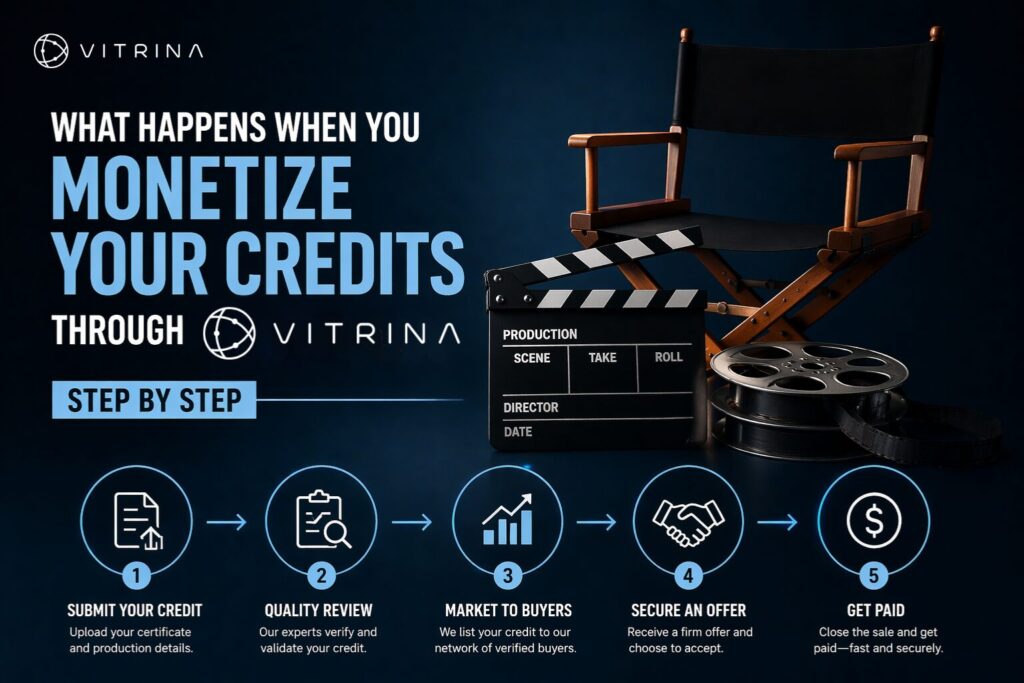
That supply chain intelligence is the foundation for a different kind of credit monetization service — one that can reach sellers proactively, match them to buyers based on specific credit type and state, and coordinate a transaction that neither side would have easily found on their own.
The broker model works for the companies it serves. The platform model works for everyone else — which is a much larger market.
This is what Vitrina is building. Explore it at vitrina.ai/tax-incentive