About Innovation Hub
 Global Content Pulse (Webinars)


 Global Production Financing
(Webinars)
Global Production Financing
(Webinars)  LeaderSpeak Podcast
  Global Entertainment Digest (Newsletter)
  About Vitrina
 About VIQI
 Our Story
 Our Solutions 🔥
 Film+TV Projects Tracker 🚀
 Case Studies
 Our Profile
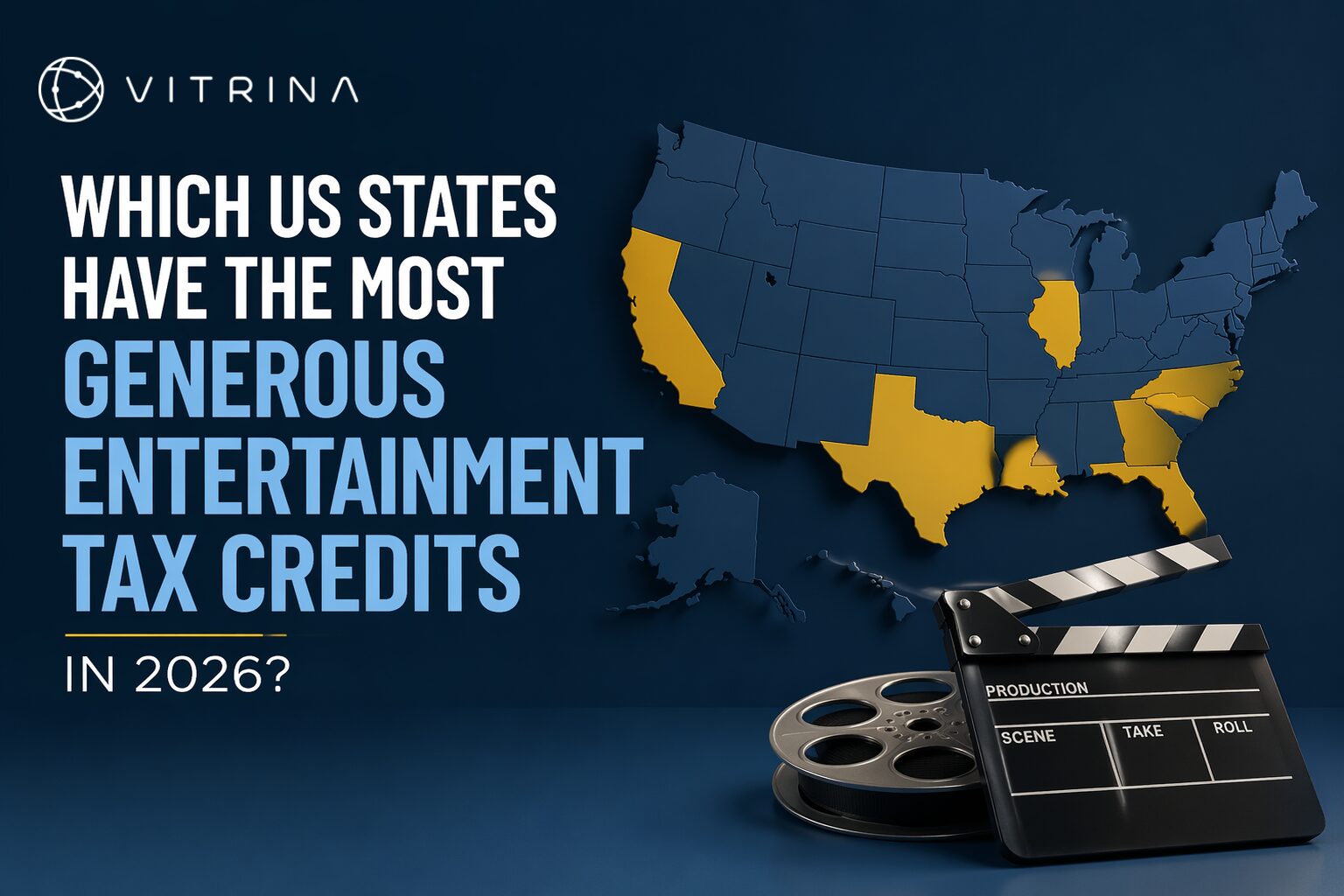
Choosing where to shoot is one of the most consequential financial decisions a production company makes. Creative factors matter, logistics matter — but the economic gap between shooting in a strong incentive state versus a weak one can easily reach millions of dollars on a mid-budget production.
This guide ranks the most generous US state entertainment tax credit programs in 2026, with data on what each state actually pays out and what it takes to qualify
How We Define “Generous”
A generous incentive program isn’t just about headline credit rates. What actually matters to a production company is:
- The effective rate — what percentage of your spend actually comes back
- Transferability or refundability — can you convert the credit to cash, even if you have no in-state tax liability?
- Program stability — is the program capped? Oversubscribed? Likely to change?
- Accessibility — what’s the minimum spend threshold? How complex is the application?
With those criteria in mind, here’s how the major US states rank in 2026.
Tier 1 — Maximum Value
Georgia
Georgia continues to sit at the top of the list for most production companies. The combination of a 30% effective credit rate (20% base plus 10% logo uplift), no annual program cap, no sunset date, full transferability, and a very active secondary market makes it the most consistent incentive state in the US.
The infrastructure that has grown up around Georgia’s film industry — purpose-built studios, deep crew pools, experienced production vendors — makes the effective value even higher when you factor in cost efficiency.
For a $20 million production spending $15 million in Georgia, the credit position is approximately $4.5 million at the 30% effective rate. That’s a material working capital figure — and it can be monetized.
Illinois (for local crew-heavy productions)
Illinois deserves a Tier 1 ranking for productions that are heavily dependent on local talent. The blended rate — 30% on all qualifying spend, plus 15% on Illinois resident wages — can reach 45% on the local labor portion of a budget. No annual cap and a low $100,000 minimum spend threshold make it accessible for a wider range of productions than most comparable states.
Tier 2 — High Value with Conditions
New York
New York’s 25–35% credit (depending on location within the state) is highly competitive, and the refundable structure is a genuine advantage for companies without New York tax liability. The catch is the $700 million annual cap and the first-come, first-served allocation process.
Productions that don’t get in early in the year risk missing the pool entirely. For companies that do secure a New York credit, the refundability removes the need to find a buyer — simplifying the cash conversion process significantly.
Louisiana
Louisiana’s 25–35% credit (including the resident labor uplift) is competitive, and the state’s optional buyback program — which offers a guaranteed floor price for credits that can’t be sold on the open market — is a feature no other major incentive state offers. For production companies that want predictability, Louisiana’s buyback acts as downside protection.
The program has a $150 million annual cap, but Louisiana’s production volume relative to that cap means it rarely hits a hard constraint.
Tier 3 — Competitive but More Complex
New Jersey
New Jersey’s 30–35% rate is competitive, and the proximity to New York makes it practical for productions that want Northeast infrastructure. The $100 million annual cap and the 60% instate spend requirement add some complexity, but for the right production, New Jersey can offer better headline rates than New York with less competition for allocation.
California
California’s 20–25% rate is meaningful, but the program is highly competitive, the allocation process is complex, and the $330 million annual cap is regularly oversubscribed. Productions that don’t receive a California allocation often redirect to Georgia or New York — which is one
reason those states see consistently high volume.
California remains valuable for productions that have creative reasons to stay in-state, or that meet the criteria for an enhanced rate allocation. But for productions that have flexibility on location, the effective value of a California credit relative to alternatives has to be weighed against the uncertainty of getting an allocation at all.
The Transferability Factor
For any incentive ranking to be useful, it has to account for what happens to the credit after it’s earned. A 30% credit in a state with no transfer mechanism is less useful than a 25% credit that can be readily converted to cash.
The states above all have either transferable or refundable credits, which is why they rank at the top. States with non-refundable, non-transferable credits — regardless of their headline rate — don’t appear in this list because the credit can only be used by the company that earned it, which limits its value for many production companies.
What This Means for Production Planning
The difference between Tier 1 and Tier 3 states — on a production with $10 million in qualifying spend — is approximately $500,000 to $1 million in credit value. That’s not a rounding error. It’s a meaningful input to any location decision.
And for companies that have already shot in these states and are sitting on unused credits: the secondary market for Georgia, New York, New Jersey, Illinois, and Louisiana credits is active in 2026. The question isn’t whether your credits can be monetized — it’s whether you’ve found the right channel to do it.
Once your production wraps and credits are earned, register at
vitrina.ai/credits to find out what they’re worth.
Find Film+TV Projects, Partners, and Deals – Fast.
VIQI matches you with the right financiers, producers, streamers, and buyers – globally.
Producers Seeking Financing, Co-Pros, or Pre-Buys?
Vitrina Concierge helps producers reach the right financiers, commissioners, distributors, and co-production partners — with precision outreach, not cold pitching.
Join Industry Briefings Trusted by Leaders

Format Adaptations: Global Trends
Where formats are traveling, which adaptations are breaking out, and how streamers are backing remakes in 2025–2026.

Books, Novels & Comics Adaptations: Global Trends
Books, webtoons, and manga driving the next global screen hits. Discover how in this webinar.

Micro-Dramas & Mobile-First Storytelling
Micro-dramas are building real audiences and revenue. Understand the platforms, buyers, and economics behind the growth.

Navigating Global Content Licensing Trends
How global content licensing is shifting beyond flat fees to flexible, deal-driven models.