

 About Innovation Hub
 Global Content Pulse (Webinars)


 Global Production Financing
(Webinars)
Global Production Financing
(Webinars)  LeaderSpeak Podcast
  About Vitrina
 Our Story
 Our Solutions 🔥
 Film+TV Projects Tracker 🚀
 Case Studies
 Our Profile
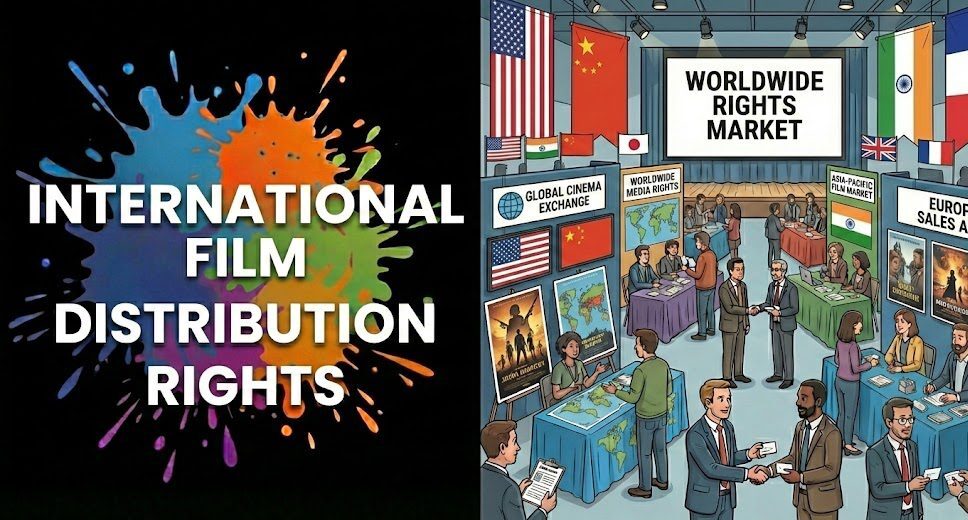
International film distribution rights are legal permissions granted to third-party companies to exhibit, license, and monetize a film in specific territories outside its home country.
This involves complex licensing agreements, territorial windowing, and navigating regional regulations across theatrical, VOD, and FAST platforms.
According to Vitrina AI data, there are over 140,000 specialized distribution companies globally, yet 70% of indie producers struggle to identify the right partner due to fragmented market intelligence.
In this guide, you’ll learn how to identify high-probability distributors, negotiate robust contracts, and leverage supply chain intelligence to compress your sales cycle from months to weeks.
Traditional distribution outreach often relies on shallow listicles and generic trade show networking, leaving producers with limited visibility into active buyer appetite and shifting regional regulations.
This comprehensive guide addresses those gaps by providing actionable strategies—from identifying cross-border partners to understanding the nuances of revenue-sharing models in the modern streaming era.

Your AI Assistant, Agent, and Analyst for the Business of Entertainment
VIQI AI helps you plan content acquisitions, raise production financing, and find and connect with the right partners worldwide.
- Find active co-producers and financiers for scripted projects
- Find equity and gap financing companies in North America
- Find top film financiers in Europe
- Find production houses that can co-produce or finance unscripted series
- I am looking for production partners for a YA drama set in Brazil
- I am looking for producers with proven track record in mid-budget features
- I am looking for Turkish distributors with successful international sales
- I am looking for OTT platforms actively acquiring finished series for the LATAM region
- I am seeking localization companies offer subtitling services in multiple Asian languages
- I am seeking partners in animation production for children's content
- I am seeking USA based post-production companies with sound facilities
- I am seeking VFX partners to composite background images and AI generated content
- Show me recent drama projects available for pre-buy
- Show me Japanese Anime Distributors
- Show me true-crime buyers from Asia
- Show me documentary pre-buyers
- List the top commissioners at the BBC
- List the post-production and VFX decision-makers at Netflix
- List the development leaders at Sony Pictures
- List the scripted programming heads at HBO
- Who is backing animation projects in Europe right now
- Who is Netflix’s top production partners for Sports Docs
- Who is Commissioning factual content in the NORDICS
- Who is acquiring unscripted formats for the North American market
Table of Contents
Key Takeaways for Producers
-
Targeted Data Beats Cold Calls: Producers using supply chain trackers identify active regional distributors 70% faster than those relying on generic listicles.
-
Revenue Integrity: Understanding Net Receipts vs. Gross Corridors is critical; 2025 deals increasingly prioritize performance-based bonuses on FAST and AVOD platforms.
-
Regulatory Compliance: Mastering local quotas and tax incentives across 100+ countries provides the “insider advantage” required to unlock co-production financing.
What is the Scope of International Film Distribution Rights?
In the global entertainment supply chain, distribution rights are not a monolith; they are a collection of “sticks” in a bundle of Intellectual Property (IP). These rights determine who can show your film, where they can show it, and on which devices. For independent producers, the primary challenge is deciding whether to sell “All Rights” to a single global streamer or to carve out territorial rights to multiple local distributors—a strategy known as “Weaponized Distribution.”
This process includes negotiating windows (the time between theatrical, digital, and television release) and territory-specific sub-licensing. With the industry tracking over 1.6 million titles, the complexity of managing these rights across different legal jurisdictions has never been higher. Producers must balance upfront Minimum Guarantees (MG) against long-term revenue potential in fragmented markets.
Find the top distributors for your specific genre and territory:
How Do Revenue Sharing Models and Licensing Agreements Work?
Licensing agreements in 2025 have evolved beyond simple flat fees. While SVOD (Subscription Video on Demand) platforms often prefer “buyouts” that pay a fixed amount for global rights, the rise of FAST (Free Ad-supported Streaming TV)) has reintroduced complex revenue sharing models. These models typically split ad revenue between the platform and the producer, often after a platform fee (20-30%) and delivery costs are recouped.
Producers must also understand “corridors”—guaranteed percentages of gross revenue that flow directly to the creator before the distributor has fully recouped their expenses. As platforms like Netflix and Amazon increasingly “weaponize” their libraries by licensing content to rivals post-release, tracking these downstream royalties becomes a major operational hurdle. Data intelligence platforms now offer “Deals Intelligence” to help strategy teams monitor these shifts in real-time.
Industry Expert Perspective: Inside FilmSharks International: World Sales & Remakes
Guido Rud, CEO of FilmSharks, provides a masterclass on how world sales agents bridge the gap between independent production and global distribution through remake rights and territorial sales.
Guido talks about the inception of FilmSharks International, from its start 25 years ago to its current position as a prominent company in the Ibero-American market, focusing on three business models: world sales, remake distribution, and production.
How to Choose the Right International Film Distributor?
Selecting a distributor is a strategic decision that impacts the project’s financial ceiling and longevity. Producers must evaluate partners based on three pillars: specialization (do they handle your genre?), track record (what have they successfully distributed recently?), and infrastructure (do they have local marketing boots on the ground?). In today’s hyper-competitive market, generic list-based research is insufficient.
Instead, producers are turning to supply chain intelligence to vet the 140,000+ companies worldwide. By mapping 30 million industry relationships, platforms like Vitrina AI allow you to see which distributors recently worked with similar independent titles, identifying active appetite before a trade announcement is ever made. This proactive approach turns partner discovery from a “networking game” into a “data science.”
Vet your potential partners with deep company intelligence:
What Are the Technical Nuances of Global Regional Regulations?
International distribution is governed by a patchwork of regional regulations that can make or break a deal. In Europe, the Audiovisual Media Services Directive (AVMSD) requires streamers to ensure at least 30% of their catalog is European content. Understanding these “local quotas” allows producers to position their projects as “quota-filling” assets for international platforms.
Similarly, mastering territorial tax incentives—such as those in the UK, India, and Brazil—is critical for structuring co-production deals. These regulations impact not only how rights are licensed but how financing is structured. Producers who navigate these technical depths effectively can unlock “soft money” from government funds, reducing the risk for their distribution partners and increasing the project’s overall ROI.
Moving Forward
The international film distribution landscape has shifted from relationship-dependent networking to data-driven platform targeting. This guide addressed the critical gaps in market depth by providing a roadmap for revenue models, partner selection, and regulatory compliance.
Whether you are an independent producer looking to secure pre-sales financing, or a sales agent trying to position catalog titles with emerging FAST channels, the core principle remains: actionable intelligence drives deal velocity.
Outlook: Over the next 12-18 months, platform fragmentation will accelerate, making real-time tracking of “Weaponized Distribution” trends a mandatory skill for every producer.
Frequently Asked Questions
What are international film distribution rights?
How much do international film rights cost?
What is a sales agent in film?
What is a Minimum Guarantee (MG)?
“The distribution model that worked five years ago—festival premieres followed by traditional sales agent representation—no longer serves independent creators in a direct-to-platform era. Data intelligence is the new currency.”
About the Author
Content Strategist at Vitrina AI with over 15 years in media supply chain intelligence. Specializing in data-driven partner discovery and global licensing trends. Connect on Vitrina.