About Innovation Hub
 Global Content Pulse (Webinars)


 Global Production Financing
(Webinars)
Global Production Financing
(Webinars)  LeaderSpeak Podcast
  About Vitrina
 Our Story
 Our Solutions 🔥
 Film+TV Projects Tracker 🚀
 Case Studies
 Our Profile
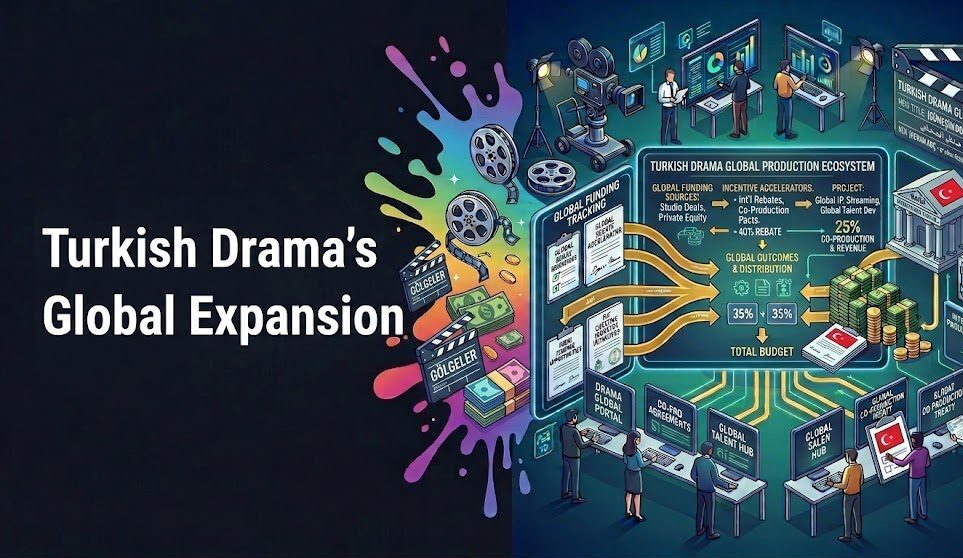
Turkey is the world’s second-largest TV drama exporter after the United States. Full stop. If that surprises you, you’re working from outdated market intelligence — and in Turkish drama global distribution, outdated intelligence is expensive.
Turkish drama (dizi) now reaches audiences in more than 150 countries, generates over $500M annually in export revenues, and lands in the top 5 content categories on premium platforms from Dubai to Buenos Aires. Rolla Karam, SVP Content Acquisition at OSN — the premium pay TV and streaming platform covering 23 countries across MENA — puts it plainly: Turkish content “does amazingly well” on OSN, consistently ranking among the top five performing categories on OSN Plus alongside US scripted drama and Arabic originals. That’s not a regional taste preference. That’s a global distribution phenomenon with a decade of momentum behind it.
But — and this is the part that catches buyers and Turkish distributors alike off guard — the distribution landscape for Turkish drama shifted materially in 2024-2025. New streaming entrants are restructuring territorial rights. Localization requirements are getting more demanding. The Fragmentation Paradox™ in content acquisition is creating serious information gaps between what’s available and what’s discoverable. And the markets that drove Turkish drama’s first wave of international expansion aren’t necessarily the highest-value opportunities anymore.
This guide maps the best markets for Turkish drama in 2026, the distribution strategies that are actually closing deals, and the localization mechanics that determine whether your content travels or sits unsold.
Discover Which Platforms Are Actively Acquiring Turkish Drama Right Now
Ask VIQI — Vitrina’s entertainment AI trained on 1.6 million titles and 360,000 companies. Get real-time acquisition intelligence no trade directory carries.
✓ 200 free credits | ✓ No credit card required
Why Turkish Drama Travels — and What the Best Markets Actually Buy
Here’s the structural reason Turkish drama exports at the scale it does: it occupies a production quality and cultural positioning that almost nothing else does at comparable price points. You’re getting high-production-value scripted series — long-running, character-rich, emotionally dense — at a fraction of what equivalent American or British content costs to license. The format typically runs 120-150 minutes per episode (compressed to 45-60 minutes for most international distributions), which means the raw content volume per license fee is genuinely exceptional.
But not every market buys the same Turkish drama. And this matters enormously for how you structure your distribution strategy.
MENA buys long-running family drama and romance. OSN’s experience across its 23-country coverage is instructive: the platform dubs Turkish content into Syrian colloquial Arabic — not Modern Standard Arabic — to maximize audience accessibility across its GCC and North Africa subscriber base. Rolla Karam describes OSN’s Turkish acquisition as specifically targeting long-running series, citing cultural familiarity and narrative format as the primary appeal drivers for the Saudi and GCC core audience. That dubbing choice isn’t incidental; it’s the distribution decision that converts a Turkish drama from a niche offer to a mainstream hit in the Arab world.
Latin America buys romance, historical epics, and crime drama — genres that evolved directly from the telenovela format Turkish studios studied in their early international expansion. The key markets are Mexico, Chile, Argentina, and Brazil, where telenovela audiences have migrated to Turkish drama at scale over the last decade. The localization requirement here is dubbing into Latin American Spanish (or Portuguese for Brazil), and the buyers are primarily broadcast networks and streaming platforms that serve mass audience demographics.
Eastern Europe and the Balkans — particularly Greece, Bulgaria, Romania, Serbia, and Bosnia — have deep cultural resonance with Turkish narrative traditions. These markets often prefer subtitling over dubbing and have active theatrical and broadcast audiences for Turkish content. Greece is arguably the most sophisticated Turkish drama market in Europe, with dedicated channels and subscription services built entirely around Turkish imports.
South and Southeast Asia represent the next wave. Pakistan’s television market has significant overlap in cultural themes — family honor, romantic conflict, generational drama — that maps naturally onto Turkish dizi content. Indonesia and Malaysia’s large Muslim-majority audiences have demonstrated genuine appetite for Turkish historical dramas, particularly those with Islamic-era themes.
Distribution Strategy by Market: What’s Actually Working in 2026
Distribution strategy isn’t one-size-fits-all for Turkish drama. The structural differences between markets — in platform maturity, localization requirements, rights packaging, and buyer appetite — demand a segmented approach. Here’s what the deals that are actually closing look like.
MENA: The Premium Licensing Route
MENA remains Turkish drama’s highest-value regional market in 2026 — both in terms of license fees per territory and in terms of exclusivity premiums. Rolla Karam’s insight is relevant here: exclusivity is the non-negotiable requirement for any premium MENA platform. OSN won’t license content that’s already available on YouTube or free-to-air — the subscriber fee model depends entirely on exclusive value delivery.
That means Turkish distributors looking at MENA need to structure rights packages that preserve territorial exclusivity. Don’t pre-license your Arabic streaming rights to a free-to-air broadcaster and then try to sell to a premium platform — you’ve already destroyed your premium value. The right sequence is premium SVOD first (OSN Plus, Shahid, Netflix MENA), with AVOD and free-to-air rights retained as a second window after the exclusivity period expires.
The localization investment is non-negotiable. Syrian colloquial dubbing for the Gulf and Egyptian Arabic dubbing for North Africa — these aren’t options; they’re the table stakes for mass-market MENA distribution. Budget the localization cost into your rights package pricing, not as an afterthought.
Recent deals confirm the trajectory: Netflix’s MIPCOM deals for Turkish content signaled that the global platforms view Turkish drama as a programming pillar for their MENA expansion, not a niche supplement. As covered in our Netflix MIPCOM deals coverage, Turkish content is now a recurring acquisition line item for the major global streamers — which changes the pricing dynamics for everyone in the supply chain.
Latin America: The Volume Play
Latin America is where Turkish drama achieved its first international breakthrough at scale — and it remains a high-volume distribution market, but the competitive dynamics have shifted. The broadcast windows that initially drove Turkish drama adoption (free-to-air networks in Chile, Argentina, Mexico) are now competing with Spanish-language streaming platforms that offer both volume and exclusivity value.
The opportunity in 2026 is packaging Turkish drama for multi-platform Latin American deals that bundle broadcast, SVOD, and AVOD rights in a single territory license. This reduces the complexity of managing multiple windowing agreements across a fragmented regional platform landscape while maximizing total rights value. Major Turkish distributors including Inter Medya (which recently entered the vertical drama market, adding to its long-form catalog) and MADD Entertainment have built established Latin American distribution pipelines — but the deals that are outperforming are the ones that moved beyond simple broadcast rights into streaming-first packaging.
Worth noting: the WarnerBros/EcchoRights/Amazon MiniTV Turkish drama collaboration — covered on the Vitrina platform in our WarnerBros Turkish drama deal analysis — signals that the major Hollywood studios are now treating Turkish content as a co-production and licensing asset, not merely acquired programming. That’s a strategic shift with real implications for independent Turkish distributors trying to compete at the top end of the market.
Europe: The Format Licensing Opportunity
Western Europe — particularly Germany, France, Spain, and the UK — presents a different strategic calculus. Direct Turkish-language drama with subtitles has a ceiling in these markets; the mass-market broadcast opportunity is limited by language and cultural distance. But format rights? That’s a different conversation entirely.
Turkish drama format licensing — selling the format rights for local language adaptation rather than the finished program — is arguably the highest-margin distribution model available to Turkish studios in Western Europe right now. Spain and France have active local production industries that can localize the emotional and narrative architecture of successful Turkish dramas into formats with genuine domestic mass-market appeal. The format fee plus ongoing royalties on local productions can outperform traditional finished program licensing by 3-5x over a production run.
Eastern Europe remains a finished-program market. Greece, the Balkans, Bulgaria, Romania — these audiences buy Turkish drama as Turkish drama, with subtitles. The distribution model here is simpler: term licenses to broadcast networks and subscription VOD platforms that have already built their subscriber base on Turkish content. Our streaming distribution models and licensing strategies guide covers the windowing mechanics in detail for multi-platform European deals.
Track Every Active Buyer of Turkish Drama — Across All 150+ Markets
Trusted by Netflix, Warner Bros, Paramount, and Google TV. Join 140,000+ companies using Vitrina to surface acquisition-ready buyers before deals hit the trades.
✓ 200 free credits | ✓ No credit card required | ✓ Cancel anytime
Localization Is Not Post-Production. It’s Distribution Strategy.
This is the insight that separates Turkish distributors who scale internationally from those who don’t. Localization — dubbing, subtitling, cultural adaptation of dialogue — isn’t a line in your post-production budget. It’s a strategic distribution decision that determines which markets your content is actually addressable in and at what price point.
OSN’s choice to dub Turkish content into Syrian colloquial Arabic rather than Modern Standard Arabic is a market-sizing decision. Syrian colloquial reads as culturally warm, emotionally resonant, and accessible to GCC audiences in a way that Classical Arabic simply doesn’t for mainstream drama consumption. The wrong Arabic dubbing voice — too formal, wrong regional accent — can drop a Turkish drama from top-5 performer to mid-tier overnight. OSN handles all its own localization in-house, working with an extensive vendor network they’re currently augmenting with AI-driven efficiency tools.
For Latin America, the dubbing register matters as much as the language. Mexican Spanish and Rioplatense Spanish carry different emotional associations for different audience segments. Distributing a single Spanish dub across all of Latin America is the lazy approach — and it leaves real audience scale on the table in markets where the dialect distance creates friction.
The practical implication: localization investment should be part of your distribution deal structure, not a cost you absorb independently. Build localization costs into your minimum guarantee requirements. Or, where the market volume justifies it, grant the buyer localization rights as part of their license — but charge a premium for the exclusivity of that localized asset. A platform that commissions its own Syrian Arabic dub of your series has created value they can’t easily replicate; that’s leverage in renewal negotiations.
As Deadline has tracked, the major streaming platforms are investing significantly in dubbing quality — not just volume — as they recognize that poor localization is a direct drag on completion rates and subscriber retention. Turkish drama producers who understand this dynamic can use localization quality as a competitive differentiator, not just a cost factor.

Your AI Assistant, Agent, and Analyst for the Business of Entertainment
VIQI AI helps you plan content acquisitions, raise production financing, and find and connect with the right partners worldwide.
- Find active co-producers and financiers for scripted projects
- Find equity and gap financing companies in North America
- Find top film financiers in Europe
- Find production houses that can co-produce or finance unscripted series
- I am looking for production partners for a YA drama set in Brazil
- I am looking for producers with proven track record in mid-budget features
- I am looking for Turkish distributors with successful international sales
- I am looking for OTT platforms actively acquiring finished series for the LATAM region
- I am seeking localization companies offer subtitling services in multiple Asian languages
- I am seeking partners in animation production for children's content
- I am seeking USA based post-production companies with sound facilities
- I am seeking VFX partners to composite background images and AI generated content
- Show me recent drama projects available for pre-buy
- Show me Japanese Anime Distributors
- Show me true-crime buyers from Asia
- Show me documentary pre-buyers
- List the top commissioners at the BBC
- List the post-production and VFX decision-makers at Netflix
- List the development leaders at Sony Pictures
- List the scripted programming heads at HBO
- Who is backing animation projects in Europe right now
- Who is Netflix’s top production partners for Sports Docs
- Who is Commissioning factual content in the NORDICS
- Who is acquiring unscripted formats for the North American market
The Fragmentation Problem: Why Distribution Deals Take Longer Than They Should
Turkish drama has 150+ export markets — but the Fragmentation Paradox™ means the distribution landscape is far harder to navigate than that number suggests. You’re dealing with a global buyer ecosystem of thousands of broadcasters, SVOD platforms, AVOD services, and format buyers, operating across different rights windows, different localization standards, and different acquisition cycles. Without real-time intelligence on who’s actively acquiring, what they’ve bought recently, and what their current content gaps are, your distribution outreach is mostly noise.
The 15-20% margin leakage that the Fragmentation Paradox™ creates in production supply chains applies equally to distribution. Turkish production companies relying on traditional market attendance (MIPCOM, MIPTV, NATPE) for their buyer introductions are closing deals that represent a fraction of the addressable pipeline — because the buyers they don’t know about, the platforms that have just launched in a new territory, the AVOD services building their non-English catalog — these don’t reliably show up in your festival contacts list.
The distributors outperforming in 2026 are the ones who’ve turned distribution into a data operation. They know which platforms in Southeast Asia are in active acquisition mode 6 weeks before a market. They track which Eastern European broadcasters have recently exhausted their Turkish drama library licenses and are entering their renewal cycle. They identify AVOD services in Latin America that have never programmed Turkish content but have audience demographics that would respond to it.
That’s not relationship management. That’s supply chain intelligence. And it’s the difference between closing 15 deals a year from festival attendance and closing 50+ deals from a continuous outreach operation backed by real-time buyer data. Our guide to finding content distributors in 5 steps covers the practical methodology — but the underlying principle is consistent: buyer identification is a data problem, not a networking problem.
Three Emerging Turkish Drama Distribution Opportunities You’re Probably Missing
1. The South Asian AVOD window. Pakistan, Bangladesh, and diaspora markets in the UK and Canada represent an underserved Turkish drama audience that’s been consuming content via unauthorized platforms for years. The monetized opportunity — legitimate AVOD and SVOD licensing to platforms serving these audiences — is largely untapped. Production companies including Calinos Entertainment and TIMS&B Productions have South Asian distribution relationships, but the AVOD window in particular remains structurally underdeveloped. That’s white space for any distributor willing to structure the localization investment.
2. The mythology and historical drama format for global mythology acquisitions. International buyers are actively acquiring mythology and historical epic content in 2026 — and Turkish historical drama (Diriliş: Ertuğrul’s success demonstrated this at a global scale) sits at the intersection of production quality, narrative depth, and cultural authenticity that buyers in this genre segment actively seek. Platforms acquiring global mythology series aren’t just looking at K-drama and Bollywood; Turkish historical epic is a genuine contender for this acquisition category, as we’ve covered in our guide to acquiring global mythology series in 2026.
3. Vertical drama — with appropriate financial caution. Turkish production houses are investing in premium vertical drama format, as Rolla Karam observed firsthand visiting Istanbul production facilities. The production quality is genuine and the viewing habit data is compelling. But — and this is the insider candor moment — the licensing economics don’t yet support the production investment at scale. Rolla put it directly: the fees a platform can reasonably pay for vertical drama content don’t justify what premium Turkish vertical drama costs to produce. Watch this space. It’s a real format opportunity. But structure your vertical drama investment with clear distribution exit routes before you commission at premium budget levels. For more on how content licensing works across these emerging formats, the strategic framework is consistent regardless of format type.
Accelerate Your Turkish Drama Distribution Pipeline — 400,000+ Projects Tracked
Trusted by Netflix, Warner Bros, and Paramount. Vitrina gives you real-time visibility on active buyers, acquisition cycles, and platform content gaps — across all 150+ Turkish drama export markets.
✓ 200 free credits | ✓ No credit card required | ✓ Full platform access
Need direct introductions to Turkish drama buyers across MENA, LatAm, and Europe? Explore Concierge Service →
Frequently Asked Questions
Which countries are the biggest importers of Turkish drama in 2026?
The highest-value markets for Turkish drama export are concentrated in three regions: MENA (Saudi Arabia, UAE, Egypt — via platforms like OSN, Shahid, and Netflix MENA); Latin America (Mexico, Chile, Argentina, Brazil); and Eastern Europe and the Balkans (Greece, Bulgaria, Romania, Serbia). Emerging growth markets include Pakistan, Indonesia, and diaspora markets in the UK, Germany, and Canada. Turkish drama now reaches buyers in 150+ countries globally.
How much does Turkish drama earn in international exports annually?
Turkish drama generates over $500M in annual export revenues, making Turkey the world’s second-largest TV drama exporter after the United States. Export revenues have grown consistently over the past decade, driven by MENA premium platform licensing, Latin American broadcast deals, and more recently, global streaming platform acquisitions by Netflix, Amazon Prime Video, and regional SVODs.
How does OSN distribute Turkish drama across MENA?
OSN (Orbit Showtime Network), the premium pay TV and streaming platform covering 23 MENA countries, distributes Turkish drama through both its linear OSN TV channels and its OSN Plus streaming app. Turkish content consistently ranks in the top 5 content categories on the platform. OSN dubs Turkish content into Syrian colloquial Arabic for maximum audience accessibility across its GCC and North Africa subscriber base, while also offering the original Turkish version with English and Arabic subtitles as an alternative.
What genres of Turkish drama perform best internationally?
Genre performance varies significantly by market. MENA buys long-running family drama, romance, and crime/thriller. Latin America responds strongly to romance, historical epic, and crime drama — formats that evolved directly from the telenovela tradition Turkish studios adapted internationally. Eastern Europe and Balkans favor drama and romance. South and Southeast Asia have strong appetite for family drama and Islamic-era historical content. Historical epics (Ottoman-era, Islamic history) perform across all major Turkish drama markets with particularly strong traction in Muslim-majority territories.
What are the best distribution strategies for Turkish drama in 2026?
The most effective Turkish drama distribution strategies in 2026 follow three models: (1) MENA premium SVOD-first — exclusive licensing to OSN, Shahid, or Netflix MENA before any AVOD or free-to-air deals, to preserve exclusivity premium; (2) Latin America multi-platform bundling — combining broadcast, SVOD, and AVOD rights in single territory deals to maximize total rights value; (3) Western Europe format licensing — selling local adaptation rights rather than finished programs, which can outperform traditional licensing by 3-5x over a production run. All strategies require territory-specific localization investment built into deal structures from the outset.
Who are the major Turkish drama distributors operating internationally?
The primary international distributors of Turkish drama include Inter Medya (which has expanded into vertical drama alongside its long-form catalog), MADD Entertainment, Calinos Entertainment, and TIMS&B Productions, among others. Global studio involvement is increasing — WarnerBros, working with EcchoRights, has structured Turkish drama deals with platforms including Amazon MiniTV, signaling major studio interest in Turkish content as a co-production and licensing asset.
Conclusion: Turkish Drama’s Best Markets Are Still Being Discovered
The scale of Turkish drama’s global reach — 150+ countries, $500M+ in annual export revenues, top-5 platform performance on OSN’s 23-country MENA footprint — tells you how far the format has already traveled. But the distribution ceiling hasn’t been hit. South Asian AVOD, Western European format licensing, global mythology drama acquisitions, and the maturing vertical drama format all represent meaningful pipeline expansion for distributors who have the market intelligence to identify buyers before a market visit.
- MENA is still premium: OSN’s experience confirms Turkish drama is a top-5 content category across 23 MENA countries — but exclusivity and Syrian colloquial dubbing are non-negotiable for premium platform placement.
- Latin America wants platform bundles: Multi-window deals combining broadcast, SVOD, and AVOD rights outperform single-channel licensing in the region’s fragmented platform landscape.
- Western Europe buys formats, not just programs: Format licensing in Spain, France, and Germany can generate 3-5x the value of traditional finished-program deals over a production run.
- Localization is strategy: Dubbing register, dialect choice, and localization timing are distribution decisions — not post-production logistics. Get them wrong and you’ve undercut your market potential before the first episode airs.
- Distribution is a data problem: The Fragmentation Paradox™ means the buyers you don’t know about are where the unrealized revenue lives. Real-time market intelligence closes this gap at scale.
Find Active Buyers for Turkish Drama — Before They Go to MIPCOM
Trusted by Netflix, Warner Bros, Paramount, and Google TV. Join 140,000+ companies on Vitrina — the only platform with real-time acquisition intelligence across all 150+ Turkish drama export markets.
✓ 200 free credits | ✓ No credit card required | ✓ Full platform access
Find Film+TV Projects, Partners, and Deals – Fast.
VIQI matches you with the right financiers, producers, streamers, and buyers – globally.
Producers Seeking Financing & Partnerships?
Book Your Free Concierge Outreach Consultation
(To know more about Vitrina Concierge Outreach Solutions click here)
Producers Seeking Financing, Co-Pros, or Pre-Buys?
Vitrina Concierge helps producers reach the right financiers, commissioners, distributors, and co-production partners — with precision outreach, not cold pitching.
Join Industry Briefings Trusted by Leaders

Streamers – Netflix vs. Amazon – The 2026 Strategy
How Netflix and Amazon’s content and revenue strategies are diverging ahead of 2026.

Format Adaptations: Global Trends
Where formats are traveling, which adaptations are breaking out, and how streamers are backing remakes in 2025–2026.

Books, Novels & Comics Adaptations: Global Trends
Books, webtoons, and manga driving the next global screen hits. Discover how in this webinar.