About Innovation Hub
 Global Content Pulse (Webinars)


 Global Production Financing
(Webinars)
Global Production Financing
(Webinars)  LeaderSpeak Podcast
  About Vitrina
 Our Story
 Our Solutions 🔥
 Film+TV Projects Tracker 🚀
 Case Studies
 Our Profile
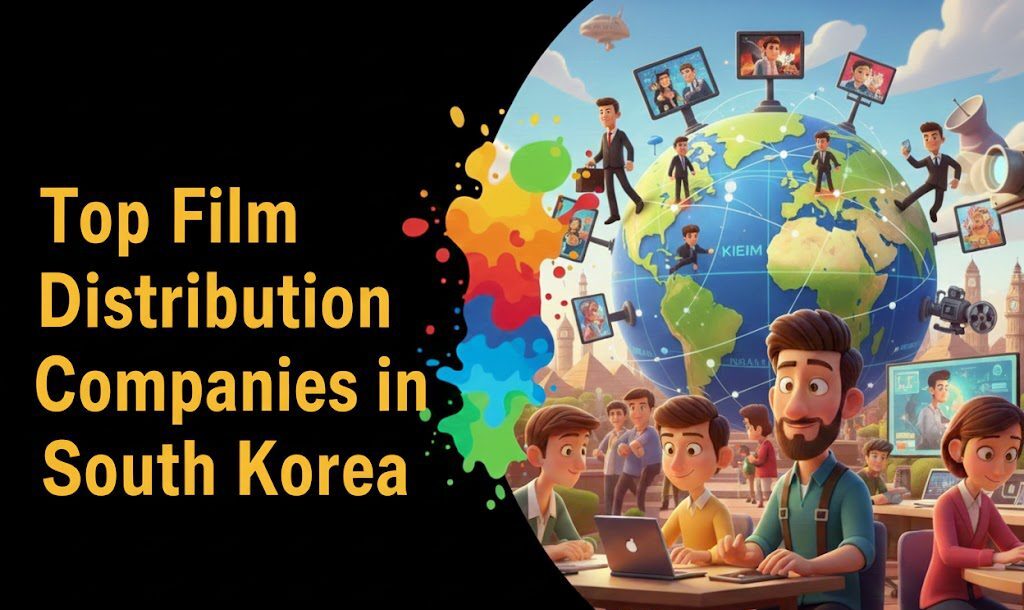
Here’s the honest read on South Korea’s distribution market heading into 2026: it’s the most strategically complex film market in Asia—and right now, it’s also the most structurally distressed. The combined theatrical revenue of the Big Five investment-distribution companies—CJ ENM, Showbox, Lotte Entertainment, Next Entertainment World (NEW), and Plus M Entertainment—collapsed from $568 million in 2019 to $316 million in 2023, according to the Korean Film Council (KOFIC).
The Korea Herald described 2025 as “one of the most challenging years in the history of Korean cinema.” Even Bong Joon-ho’s much-anticipated Mickey 17—a $118 million Warner Bros. production featuring Robert Pattinson—drew fewer than 3.1 million domestic admissions.
And yet—the demand for Korean content has never been higher globally. Netflix committed KRW 700 billion ($524 million) to Korean programming in H1 2025 alone. CJ ENM CEO Yoon Sang-hyun announced a $818 million content spend for 2025. Warner Bros. Discovery signed a multi-year K-drama co-production deal with CJ ENM in October 2025, launching a dedicated TVING hub on HBO Max across 17 Asia-Pacific markets from early 2026.
That’s the paradox every international executive needs to understand before selecting a South Korean distribution partner. Domestic theatrical is in structural contraction. International demand for film distribution companies in South Korea—as both buyers and strategic co-production gateways—is at a historic peak. The companies navigating both realities simultaneously are the ones worth partnering with.
Map South Korea’s Distribution Landscape Before Your First Call Into Seoul
VIQI surfaces verified decision-maker contacts, acquisition mandates, and deal-level intelligence across all major Korean distributors—including verified data on CJ ENM, Showbox, NEW, Lotte, and the growing independent pipeline.
Trusted by Netflix, Warner Bros, Paramount, and Google TV. 140,000+ companies tracked globally.
Ask VIQI About Korean Distribution
200 free credits | No credit card required
Why South Korea Demands a Dedicated Distribution Strategy in 2026
The Fragmentation Paradox cuts in an unusual direction in Korea. On the surface, the theatrical market looks relatively consolidated—three multiplex chains (CGV, Lotte Cinema, Megabox) control almost all exhibition, and the Big Five distributors have historically dominated production investment and release scheduling. But the crisis hitting the theatrical market has fractured that oligarchy. The Big Five plan to release only 10 to 14 Korean commercial films in 2025, compared to dozens in pre-pandemic years. Government-backed ticket discount vouchers—4.5 million distributed, pushing daily attendance up by approximately 80% during the July-September intervention period—are papering over what is a structural audience migration to streaming.
Meanwhile, at the international layer, Korean content has never commanded more leverage. The Hallyu Wave didn’t just survive post-Parasite and post-Squid Game—it institutionalized. Netflix, Amazon, Disney+, and now Max are all actively structuring Korean co-production pipelines. The government earmarked $108 million in its 2026 budget for film sector support—an 80.8% increase—signaling that Seoul understands what’s at stake if the domestic industry hollows out while global demand for K-content accelerates. And KOFIC has increased its location incentive budget by nearly five times for incoming international productions.
Your distribution strategy for Korea, then, isn’t just about finding a theatrical slot. It’s about understanding which companies control the theatrical-streaming interface, which have the international infrastructure to move your content beyond Korean borders, and which are in strong enough financial shape to actually see a deal through to completion.

Your AI Assistant, Agent, and Analyst for the Business of Entertainment
VIQI AI helps you plan content acquisitions, raise production financing, and find and connect with the right partners worldwide.
- Find active co-producers and financiers for scripted projects
- Find equity and gap financing companies in North America
- Find top film financiers in Europe
- Find production houses that can co-produce or finance unscripted series
- I am looking for production partners for a YA drama set in Brazil
- I am looking for producers with proven track record in mid-budget features
- I am looking for Turkish distributors with successful international sales
- I am looking for OTT platforms actively acquiring finished series for the LATAM region
- I am seeking localization companies offer subtitling services in multiple Asian languages
- I am seeking partners in animation production for children's content
- I am seeking USA based post-production companies with sound facilities
- I am seeking VFX partners to composite background images and AI generated content
- Show me recent drama projects available for pre-buy
- Show me Japanese Anime Distributors
- Show me true-crime buyers from Asia
- Show me documentary pre-buyers
- List the top commissioners at the BBC
- List the post-production and VFX decision-makers at Netflix
- List the development leaders at Sony Pictures
- List the scripted programming heads at HBO
- Who is backing animation projects in Europe right now
- Who is Netflix’s top production partners for Sports Docs
- Who is Commissioning factual content in the NORDICS
- Who is acquiring unscripted formats for the North American market
Top Film Distribution Companies in South Korea for 2026
1. CJ ENM — The Sovereign Hub Operator
There’s no point burying the lead. CJ ENM isn’t just South Korea’s leading film distribution company—it’s the most globally ambitious Korean entertainment conglomerate in history, operating simultaneously as theatrical distributor, streaming platform owner, international co-production machine, and cultural export engine. Understanding its current position is essential for any international executive entering this market.
CEO Yoon Sang-hyun called 2025 “the first official year of global expansion,” backing it with a $818 million content spend—up from $750 million announced at Busan 2024, per Deadline. The company’s theatrical distribution arm—backed by Korea’s dominant CGV multiplex chain (1,346 screens nationally)—gives CJ ENM unmatched access to screen allocations and release scheduling leverage. But that theatrical position is increasingly the foundation for something larger.
In November 2024, Warner Bros. Motion Picture Group and CJ ENM announced a deal to jointly develop, finance, and distribute English-language and Korean-language remakes of each studio’s films. Warner Bros. Pictures handles global distribution; CJ ENM retains distribution rights in South Korea, Vietnam, Indonesia, and Turkey on its Korean-language remakes. Then, in October 2025, the two companies went further: a multi-year strategic partnership with Warner Bros. Discovery to co-produce original K-dramas for global distribution on HBO Max, with a dedicated TVING-branded hub launching across 17 Asia-Pacific markets in early 2026. David Zaslav called CJ ENM “a true leader in creating universally popular stories that resonate worldwide.”
That’s not corporate boilerplate—it’s an acknowledgment that CJ’s IP library (Parasite, Crash Landing on You, Reply series, Signal) and production infrastructure have earned parity status with Hollywood majors. CJ ENM’s head of film, Jerry Kyoungboum Ko, framed the remake partnership as “revitalizing hidden gems”—but the real logic is mutual IP arbitrage across two of the world’s deepest studio libraries.
CJ also launched First Light StoryHouse—a new label focusing on Asian and Asian American narratives—co-founded with former Academy of Motion Picture Arts and Sciences president Janet Yang and Dominic Ng, chair and CEO of East West Bank. This is K-content weaponized for the North American market, backed by cultural credibility that no other Korean studio has yet built. For international producers, CJ ENM is both your most powerful potential theatrical partner in Korea and your clearest pathway to structured multi-territory co-production with global streaming reach.
2. Showbox — Genre Strength in a Contracted Market
Showbox has built its identity around exactly the type of content holding up best in the distressed Korean theatrical market: high-concept commercial genre films—action, thriller, horror—that deliver the kind of cinematic experience audiences will still leave home for. The company sits firmly within the Big Five, with a track record that includes some of Korea’s most commercially durable theatrical franchises.
The 2025 domestic theatrical environment hit Showbox alongside its peers, but its genre focus offers more insulation than studios banking on prestige drama. That said—Showbox’s international distribution reach is more limited than CJ ENM’s, making it a stronger fit for producers whose primary need is Korean domestic theatrical release rather than multi-territory licensing. If your content plays to Korean commercial genre audiences and you need a distributor with real exhibition relationships and theatrical marketing expertise, Showbox remains a credible first conversation. Just don’t expect the same international infrastructure you’d get from CJ.
3. Next Entertainment World (NEW)
NEW delivered the single most instructive Korean box office story of 2025. My Daughter is a Zombie—starring Jo Jung-suk as a single father protecting his zombie-infected teenage daughter—attracted 5.6 million viewers to become the highest-grossing Korean domestic production of the year. It wasn’t a prestige film. It wasn’t an auteur statement. It was solidly executed family-genre entertainment with a proven box office draw in the lead, released at precisely the right moment: July, when the government’s 6,000-won ticket discount initiative was driving daily attendance up by approximately 80%.
NEW’s lesson is that survival in 2025’s Korean theatrical market required reading timing and genre alignment more accurately than the competition—and NEW did exactly that. The company has a diverse production-distribution portfolio and a commercial instinct calibrated to what Korean audiences will actually show up for, as opposed to what the industry hopes they will. For international co-producers seeking a theatrical partner with demonstrated 2025 market performance—not just historical reputation—NEW’s track record is the strongest single-year domestic proof point available. CJ ENM’s flagship release of 2025, Park Chan-wook’s No Other Choice, delivered only 2.9 million admissions. NEW’s zombie film nearly doubled that number.
4. Lotte Entertainment / Lotte Cultureworks
Lotte’s distribution situation is the most structurally significant story in Korean theatrical exhibition right now—and it deserves separate analysis from its distribution arm. Lotte Cultureworks operates both Lotte Cinema (Korea’s second-largest multiplex chain) and Lotte Entertainment (its film production and distribution studio). In 2024, Lotte Cultureworks reached breakeven but carried accumulated losses totaling several hundred million dollars.
The major development: Lotte Cinema and Megabox—Korea’s second and third-largest multiplex chains respectively—have signed a memorandum of understanding to merge, pending approval from the Fair Trade Commission. The combined entity would control 1,682 screens, overtaking current leader CGV’s 1,346. Plus M Entertainment, the film studio arm of Megabox parent Contentree JoongAng, would also come under the combined structure, which effectively merges two of the Big Five distribution companies alongside their exhibition infrastructure. This pending merger would create a new competitive dynamic against CJ/CGV’s current dominance—but until Fair Trade Commission approval is secured, the strategic implications remain provisional.
For international partners, the Lotte relationship offers one key advantage the other Big Five don’t uniformly provide: deep integration between distribution and exhibition. A deal with Lotte Entertainment carries implicit screen allocation relationships that purely distribution-focused companies can’t guarantee. If the Lotte-Megabox merger closes, that exhibition leverage increases dramatically.
5. Plus M Entertainment
As the distribution arm of Contentree JoongAng’s Megabox Group, Plus M Entertainment rounds out the Big Five with a focus on mid-budget commercial productions and flexible deal structures. The pending merger with Lotte will likely reshape Plus M’s independent mandate if regulatory approval comes through—but heading into 2026, it remains a distinct player with its own production-distribution pipeline and exhibition relationships through Megabox’s screens. For producers seeking Big Five-level theatrical reach without the strategic complexity of CJ ENM or Lotte’s corporate weight, Plus M offers a more agile entry point.
Track Korean Distributor Deal Flow and Active Production Slates—In Real Time
Vitrina maps every active project across the Korean entertainment supply chain—CJ ENM, Showbox, NEW, Lotte, and the independent pipeline—with verified exec contacts and deal-level data that trade databases won’t show you for another six months.
Join 140,000+ companies. Track 400,000+ projects globally. Access 3 million verified executives.
Get 200 Free Credits
No credit card required | Cancel anytime
6. Netflix Korea — The Dominant Streaming Distributor
Netflix isn’t a Korean distributor in the traditional sense—but to map film distribution in South Korea for 2026 without putting Netflix at the center would be malpractice. The platform committed KRW 700 billion ($524 million) to Korean programming in H1 2025 alone, according to Korea Creative Content Agency data. It planned seven Korean original films for 2025, including The Great Flood—a $22 million apocalyptic spectacle that reached No. 1 in multiple international territories. That’s a feature film budget that rivals what most Korean Big Five companies can deploy.
Netflix’s Korean acquisition approach in 2026 operates in three modes: direct commissioning of Korean originals (where it effectively functions as both financier and global distributor); pre-buy deals with production companies for theatrical-to-SVOD windows; and catalog acquisition of library content. The “bypass theatrical entirely” model—where Netflix-produced Korean films go direct to streaming and still become global sensations—is accelerating. As one industry official told the Korea Herald, “each major production that bypasses theatrical release represents an additional challenge for multiplexes.” For international producers seeking maximum global Korean-language distribution, a Netflix Korea deal is the highest-value single transaction available. The challenge: Netflix’s commissioning standards are rigorous, its creative control expectations are significant, and its selective acquisition volumes mean competition for deals is fierce.
7. Warner Bros. Korea
Warner Bros. Korea has historically operated as a Hollywood theatrical pipeline—distributing WBD’s global studio output in the Korean market. But the dual-track deal structure with CJ ENM has significantly expanded WBD’s Korean ambitions. The film remake partnership (November 2024) and the K-drama streaming deal (October 2025) mean Warner Bros. Korea is now functioning as both theatrical distributor and co-development partner for Korean-language originals. The TVING hub launching on HBO Max in early 2026 across 17 APAC markets creates a new international distribution window for CJ ENM productions that runs through Warner Bros.’ global platform infrastructure—with the Korean theatrical window handled by CJ ENM itself, and Warner Bros. Pictures handling global theatrical beyond CJ’s designated territories. For international producers with content that fits within WBD’s APAC content strategy, this structural partnership creates a useful secondary pathway into Korean audiences that wasn’t available before the October 2025 deal.
8. By4M Studio — The Disruptor Worth Watching
By4M Studio has generated significant industry commentary by doing what the Big Five have largely failed to do in the current market: profitably distribute mid-budget commercial Korean films using innovative marketing strategies and lean operational models. The company represents exactly the kind of agile, risk-taking newcomer that thrives when incumbent distribution models are under structural stress. Big Five companies are contracting their slates precisely because they can’t recalibrate overhead costs quickly enough to match a shrunken theatrical market. By4M has built without those legacy cost structures.
For international co-producers targeting Korean theatrical distribution with modest to mid-range budgets—content that doesn’t require the full machinery of a CJ ENM theatrical push—By4M is worth a serious look. Their marketing creativity and willingness to take commercial positions on films the Big Five would pass on represents real distribution value in a market where the safe middle ground is vanishing. As Screen International noted of the market’s dynamics, this “canary in the coal mine” phase may indeed foreshadow disruption patterns playing out elsewhere—and By4M’s approach is the adaptive playbook that survives it.
9. Independent and Specialist Distributors: Finecut, JOYNCINEMA, NOORI Pictures
Korea’s independent distribution ecosystem plays a critical role that the Big Five conversation tends to obscure. Finecut—one of Korea’s most active international sales agents, run by CEO Suh—has built a 25-year track record in international theatrical sales and festival positioning for Korean independent cinema. As Suh noted in comments to Screen International, “there are many original Korean IP, from webtoons or books, which can be accessed by foreign customers”—a point that speaks directly to the IP arbitrage opportunity that international producers should be mapping independently of theatrical distribution conversations.
JOYNCINEMA, NOORI Pictures, Pop Entertainment, and JinJin Pictures are among the established specialist importers handling non-Hollywood international content for Korean theatrical and platform distribution. According to US government trade data, 28 foreign film buyers and distributors were active in Korea as of the most recent census—and excluding Hollywood studio direct distributors, approximately 90% of US imports were released by local independent importers. If your film doesn’t fit the Hollywood studio pipeline, an independent importer relationship is often the more efficient Korean theatrical entry than trying to force a fit with the Big Five.
The OTT Layer: TVING, Wavve, Coupang Play, and Watcha
No Korean distribution strategy in 2026 is complete without mapping the domestic OTT infrastructure, because streaming windows now determine the recoupment timeline for every Korean theatrical release—and increasingly, for international content entering the market too.
TVING—CJ ENM’s streaming platform—is merging with Wavve (co-operated by terrestrial broadcasters MBC, SBS, KBS, and mobile carrier SK Telecom), a consolidation move that will create a combined domestic challenger to Netflix’s dominant position. The TVING/HBO Max partnership from October 2025 gives the merged entity a significant international distribution amplifier. Coupang Play has differentiated aggressively through exclusive European football broadcasting rights and bundled memberships, growing its base rapidly. Watcha maintains a smaller, more curated subscriber base oriented toward film lovers and international content. For incoming international content, the OTT question isn’t whether Korean streaming platforms are distribution-ready—it’s which platform’s audience composition best matches your content’s genre and demographic targeting.
Jeju Province’s 30% local spend rebate—capped at KRW 100 million—alongside new soundstages is an interesting secondary incentive for international co-producers using Korean locations, stacking Korean incentives against the global distribution deals that Korean partners can unlock. The structural incentive logic for Korean co-production hasn’t weakened—it’s just moved from the domestic theatrical return calculation toward the international licensing and streaming revenue stack.
Identify Your Optimal Korean Distribution Partner—With Data, Not Guesswork
Vitrina’s Smart Pairing engine matches your content profile against verified acquisition mandates, deal histories, and distributor infrastructure across Korea’s Big Five, independent pipeline, and streaming platforms. Stop cold-pitching. Start with intelligence.
Netflix UK contact secured in 48 hours. 140,000+ companies. 400,000+ tracked projects.
Access Korean Distributor Intelligence
200 free credits | No credit card required | Cancel anytime
How to Select the Right South Korean Distribution Partner: A Strategic Framework
The selection question isn’t simply “which company is biggest.” It’s about matching your content profile, revenue model, and timeline to the specific infrastructure each distributor controls.
If your content is international K-drama or Korean-language film targeting global streaming platforms, CJ ENM is your primary conversation—and the Warner Bros. Discovery deal from October 2025 means that CJ ENM co-productions now carry a built-in HBO Max distribution pathway across 17 APAC markets from early 2026. That’s not a secondary benefit. That’s a structural change in what a CJ ENM partnership delivers. But don’t approach CJ ENM expecting a passive theatrical distributor. CEO Yoon Sang-hyun has explicitly stated that 2025 marks the first year of global expansion—they’re seeking co-production relationships, not just distribution mandates.
If your content is mid-budget commercial genre—action, horror, family—and your primary revenue objective is Korean domestic theatrical performance, NEW’s 2025 track record and By4M Studio’s marketing innovation represent the most empirically validated distribution approaches in the current market. Prestige didn’t sell tickets in 2025. Genre did. Time your release for a government subsidy window if possible—the 6,000-won discount initiative’s 80% daily attendance lift demonstrates how dramatically timing can de-risk a Korean theatrical release date.
And if you’re primarily selling international content into Korea rather than distributing Korean content globally—you need an independent importer relationship, not a Big Five pitch. The 28 specialized buyers in the market, including JOYNCINEMA and NOORI Pictures, handle the vast majority of international theatrical imports precisely because their operational model is built around that mandate. A Big Five approach for foreign content acquisitions is usually the wrong door.
Key Takeaways
- The Big Five distributors’ combined theatrical revenue collapsed from $568 million (2019) to $316 million (2023)—structural contraction that’s reshaping every company’s strategy heading into 2026.
- CJ ENM is the market’s clear strategic anchor—$818M content spend, dual Warner Bros. deals (film remakes Nov 2024; K-drama streaming Oct 2025), TVING hub on HBO Max across 17 APAC markets from early 2026, First Light StoryHouse, and CGV’s 1,346 screens.
- Next Entertainment World (NEW) delivered the strongest 2025 Korean domestic performance: My Daughter is a Zombie at 5.6 million admissions—nearly double CJ ENM’s flagship release this year.
- The Lotte Cinema/Megabox merger—pending Fair Trade Commission approval—would create a 1,682-screen exhibition entity overtaking CGV, combining two Big Five distributors under one structure.
- Netflix Korea committed KRW 700 billion ($524M) to Korean programming in H1 2025 alone—making it the single largest financier-distributor for Korean content, with the direct-to-streaming model accelerating.
- The South Korean government allocated $108 million in its 2026 budget—an 80.8% increase—for film sector support, alongside a nearly fivefold increase in KOFIC location incentives for international productions.
- The right distribution partner depends on your content type, revenue model, and target audience—theatrical genre content needs different infrastructure than global streaming originals or international content imports into Korea.
Need a Warm Introduction to Korean Distribution Decision-Makers?
Vitrina Concierge delivers precision outreach to verified acquisition executives at CJ ENM, Showbox, NEW, Lotte, Netflix Korea, and the independent pipeline—backed by data on their active mandates, not cold pitching into a void.
Access 3 million verified entertainment professionals across 140,000+ companies worldwide.
Frequently Asked Questions: Film Distribution Companies in South Korea
What are the top film distribution companies in South Korea for 2026?
South Korea’s top film distribution companies for 2026 are the Big Five theatrical distributors: CJ ENM (the dominant player with CGV exhibition, $818M content spend, dual Warner Bros. deals, and TVING’s HBO Max partnership), Next Entertainment World or NEW (delivered 2025’s highest-grossing Korean domestic film, My Daughter is a Zombie with 5.6M admissions), Lotte Entertainment/Lotte Cultureworks (undergoing strategic merger with Megabox), Plus M Entertainment, and Showbox. Beyond the Big Five, Netflix Korea (KRW 700 billion committed in H1 2025), Warner Bros. Korea, By4M Studio, and independent importers including Finecut and JOYNCINEMA round out the distribution ecosystem.
Why is South Korea’s film distribution market in crisis in 2025?
South Korea’s theatrical distribution market has experienced severe structural contraction since the pandemic. The combined theatrical revenue of the Big Five distributors fell from $568 million in 2019 to $316 million in 2023, according to KOFIC data. The Korea Herald described 2025 as one of the toughest years in Korean cinema history. The Big Five planned only 10-14 Korean commercial films for 2025 release, compared to dozens in earlier years. Audiences have migrated significantly from multiplexes to streaming platforms, a structural shift accelerated by but not caused by COVID-19.
What is the CJ ENM and Warner Bros. deal and why does it matter for distribution?
CJ ENM and Warner Bros. have two distinct deals reshaping Korean film distribution. First, in November 2024, Warner Bros. Motion Picture Group and CJ ENM agreed to jointly develop, finance, and distribute English-language and Korean-language remakes of each studio’s library. CJ ENM distributes its Korean-language remakes in South Korea, Vietnam, Indonesia, and Turkey; Warner Bros. handles global theatrical for all films. Second, in October 2025, CJ ENM and Warner Bros. Discovery signed a multi-year K-drama streaming deal, launching a TVING-branded hub on HBO Max across 17 Asia-Pacific markets in early 2026. Together, these deals give CJ ENM co-productions global theatrical and streaming distribution infrastructure that no other Korean distributor can match.
How much is Netflix investing in Korean film distribution?
Netflix committed KRW 700 billion ($524 million) to Korean programming in H1 2025 alone, according to Korea Creative Content Agency data. The platform planned seven Korean original films for 2025, including The Great Flood—a $22 million apocalyptic spectacle that reached No. 1 in multiple international territories. Netflix’s Korean strategy operates through direct commissioning of originals, pre-buy deals for theatrical-to-SVOD windows, and library acquisition. The direct-to-streaming model, bypassing theatrical entirely, is accelerating and represents an additional competitive pressure on Korean multiplex operators.
What is the Lotte Cinema and Megabox merger, and how does it affect distribution?
Lotte Cultureworks (operating Lotte Cinema, Korea’s second-largest multiplex chain, and Lotte Entertainment distribution) and Contentree JoongAng (operating Megabox, the third-largest chain, and Plus M Entertainment distribution) have signed a memorandum of understanding to merge, pending Fair Trade Commission approval. The combined entity would control 1,682 screens, overtaking CGV’s current 1,346-screen dominance. If approved, the merger would effectively combine two of the Big Five distributors alongside their exhibition infrastructure—creating a structural counterweight to CJ ENM/CGV’s current market leadership.
What government support is available for film distribution in South Korea in 2026?
The South Korean government allocated approximately $108 million in its 2026 budget for film sector support—an 80.8% increase from the previous year. KOFIC (the Korean Film Council) has increased location incentive budgets by nearly five times to attract international productions, and plans to bring IPTV companies into film financing. Jeju Province now offers a 30% local spend rebate up to KRW 100 million alongside new soundstage infrastructure. The government also ran a 6,000-won ticket discount initiative in 2025 that pushed daily attendance up by approximately 80% during its active period.
How do I distribute international content into South Korea?
For international content entering the Korean market, the most effective route is typically through independent specialist importers rather than the Big Five distributors. According to US government trade data, approximately 90% of US films imported to Korea (excluding Hollywood studio direct distributions by Warner Bros., Disney, Universal, and Sony) are released by local independent importers. Key players include JOYNCINEMA, NOORI Pictures, Pop Entertainment, and JinJin Pictures. Major film markets including EFM (Berlin), Cannes Film Market, and AFM are the primary venues for building business relationships with Korean film importers and buyers.
Find Film+TV Projects, Partners, and Deals – Fast.
VIQI matches you with the right financiers, producers, streamers, and buyers – globally.
Producers Seeking Financing & Partnerships?
Book Your Free Concierge Outreach Consultation
(To know more about Vitrina Concierge Outreach Solutions click here)
Producers Seeking Financing, Co-Pros, or Pre-Buys?
Vitrina Concierge helps producers reach the right financiers, commissioners, distributors, and co-production partners — with precision outreach, not cold pitching.
Join Industry Briefings Trusted by Leaders
Streamers – Netflix vs. Amazon – The 2026 Strategy
How Netflix and Amazon’s content and revenue strategies are diverging ahead of 2026.

Format Adaptations: Global Trends
Where formats are traveling, which adaptations are breaking out, and how streamers are backing remakes in 2025–2026.

Books, Novels & Comics Adaptations: Global Trends
Books, webtoons, and manga driving the next global screen hits. Discover how in this webinar.