About Innovation Hub
 Global Content Pulse (Webinars)


 Global Production Financing
(Webinars)
Global Production Financing
(Webinars)  LeaderSpeak Podcast
  About Vitrina
 Our Story
 Our Solutions 🔥
 Film+TV Projects Tracker 🚀
 Case Studies
 Our Profile

Mumbai is where Indian film distribution lives. Not metaphorically — operationally. The theatrical circuits, the satellite rights desks, the OTT pre-buy conversations, the pan-India release decisions that determine whether a film crosses ₹100 crore or disappears in week two — they’re all run from offices in Andheri, Juhu, Bandra, and the handful of studio compounds where Bollywood’s production-distribution axis has operated for five decades. And in 2026, that axis is carrying more commercial weight than at any point in its history.
India’s box office market is projected to grow to $2.95 billion by 2029 at a 5.66% CAGR, per Statista — but that’s the theatrical number alone. Overlay the OTT dimension — India’s 400 million+ streaming users, the federal film incentive enhanced in 2024 to a 40% reimbursement rate on qualifying local spend — and you’re looking at a distribution market whose total commercial scale significantly exceeds its box office footprint. The 62 listed film production and distribution companies in India carried a combined market capitalisation of ₹47,117 crore as of February 10, 2026, per Sharescart market data. That’s not a niche market. That’s a global entertainment asset class.
But the film distribution companies in Mumbai are not a homogeneous group — and the Fragmentation Paradox™ hits this market hard. You’ve got vertically integrated studios that produce and self-distribute; pure-play theatrical distributors who work on percentage-of-gross deals; digital-first operations that have effectively bypassed the multiplex circuit; and the exhibition infrastructure companies whose screen relationships control the actual release machinery. This guide maps who the real players are in 2026, what they each actually control, and the procurement logic for approaching them.
In This Guide
- Why Mumbai Controls Indian Film Distribution
- Top Film Distribution Companies in Mumbai for 2026
- PVR INOX: The Exhibition Infrastructure That Controls the Gate
- OTT & Digital Distribution: The Parallel Revenue Pipeline
- How to Approach Mumbai Film Distributors: Procurement Intelligence
- Frequently Asked Questions
- Key Takeaways
Find Mumbai Film Distributors Before the Competition Does
Ask VIQI to surface verified Mumbai film distribution companies — with active project credits, deal histories, and direct acquisition executive contacts. Trusted by Netflix, Warner Bros, and Paramount. Join 140,000+ companies on Vitrina. No credit card required.
Why Mumbai Controls Indian Film Distribution
The short answer: infrastructure. Mumbai is home to the production facilities, studio headquarters, distribution offices, and satellite rights negotiating desks that collectively process the commercial lifecycle of a Bollywood film from first-cut to final royalty payment. YRF, Dharma, Excel, Reliance Entertainment, ZEE Studios, T-Series Films — they’re all headquartered here, and their distribution operations are staffed and run from Mumbai even when the release covers all 12 theatrical circuits nationally.
But there’s a structural tension in Mumbai’s distribution market that’s defining 2026 strategy across the industry. Hindi-language Bollywood has had a turbulent few years at the box office — several big-budget productions have underdelivered despite star power and massive P&A spend — while pan-India releases from South Indian studios like Mythri Movie Makers (the Pushpa franchise) and Dharma-adjacent productions have repeatedly outperformed their Hindi-market expectations. The theatrical distribution model that worked in 2018 doesn’t automatically work in 2026. Mumbai’s distribution companies are adapting accordingly: building stronger OTT pre-commitment structures, experimenting with compressed theatrical windows, and in some cases actively co-financing productions to control the full rights stack from development through release.
The OTT window is the critical commercial variable. Most Bollywood films hit Netflix, Prime Video, Disney+ Hotstar, or ZEE5 35–40 days after their theatrical release — a compressed window that changes the risk calculus for distributors entirely. The theatrical guarantee that a Mumbai distributor puts on the table now has to be modeled against OTT revenue that arrives within six weeks, not six months. For international content buyers and co-production partners approaching Mumbai’s distribution ecosystem, understanding this compressed timeline — and the pre-negotiated OTT deals that typically run parallel to theatrical release commitments — is the single most important structural insight you can carry into a Mumbai distribution conversation.
And then there’s the international dimension, which is accelerating. As we’ve detailed in our India film distribution power list, the major Mumbai studios are simultaneously the country’s primary theatrical distributors and the gatekeepers through whom international co-production capital enters the Indian film market. NFDC’s bilateral co-production treaty framework — administered under India’s Ministry of Information and Broadcasting — connects international partners directly to the Mumbai studio system. That connectivity is what makes Mumbai the entry point for any serious global strategy targeting Indian cinema.

Your AI Assistant, Agent, and Analyst for the Business of Entertainment
VIQI AI helps you plan content acquisitions, raise production financing, and find and connect with the right partners worldwide.
- Find active co-producers and financiers for scripted projects
- Find equity and gap financing companies in North America
- Find top film financiers in Europe
- Find production houses that can co-produce or finance unscripted series
- I am looking for production partners for a YA drama set in Brazil
- I am looking for producers with proven track record in mid-budget features
- I am looking for Turkish distributors with successful international sales
- I am looking for OTT platforms actively acquiring finished series for the LATAM region
- I am seeking localization companies offer subtitling services in multiple Asian languages
- I am seeking partners in animation production for children's content
- I am seeking USA based post-production companies with sound facilities
- I am seeking VFX partners to composite background images and AI generated content
- Show me recent drama projects available for pre-buy
- Show me Japanese Anime Distributors
- Show me true-crime buyers from Asia
- Show me documentary pre-buyers
- List the top commissioners at the BBC
- List the post-production and VFX decision-makers at Netflix
- List the development leaders at Sony Pictures
- List the scripted programming heads at HBO
- Who is backing animation projects in Europe right now
- Who is Netflix’s top production partners for Sports Docs
- Who is Commissioning factual content in the NORDICS
- Who is acquiring unscripted formats for the North American market
Top Film Distribution Companies in Mumbai for 2026
1. Yash Raj Films (YRF) — Andheri, Mumbai
Founded: 1970 by Yash Chopra. Chairman & CEO: Aditya Chopra (Chairman), Akshaye Widhani (CEO). VP Distribution: Sahdev Ghei. Scope: Theatrical (all-India + international), satellite rights, OTT licensing, home entertainment.
Fifty-plus years. That’s YRF’s distribution credential — and in a market where exhibitor relationships are built over decades, institutional longevity translates directly into screen count advantage. YRF has affiliated offices across all 12 theatrical territories/circuits in India, giving it a genuine pan-India release infrastructure that pure-play distributors without their own office network simply can’t match. Sahdev Ghei runs the distribution operation from YRF’s Andheri Corporate Office, overseeing a network that covers everything from the Mumbai circuit through UP-Bihar, Rajasthan, and the overseas South Asian diaspora market.
But the deal that defines YRF’s 2026 distribution position isn’t theatrical — it’s the multi-year global streaming partnership with Netflix announced November 1, 2025, reported in full by Variety. The deal brings YRF’s 50+ year film library to Netflix subscribers across 190+ countries, rolled out in strategic phases tied to major festivals and star birthdays — Shah Rukh Khan’s 60th birthday collection launched first, followed by Salman Khan titles, Ranveer Singh films, and 34 holiday titles releasing through December. The rollout continues into 2026 with Valentine’s week romance collections. Akshaye Widhani described the partnership as a gateway to five decades of Indian culture for a global audience. Monika Shergill, VP Content at Netflix India, called it a milestone that deepens Netflix’s decade-long commitment to Indian storytelling.
For the theatrical record: YRF distributed Chhava (2025) — which posted ₹797–809 crore worldwide according to multiple trade sources including The Hollywood Reporter — making it one of the biggest Bollywood releases of the year. Add Laapataa Ladies (2024) and Tu Jhoothi Main Makkaar (2023) to the recent credits, and the distribution track record is unambiguous. YRF also operates YRF International for worldwide distribution of Bollywood titles outside India. It’s the benchmark Mumbai distributor — the one whose terms and screen commitments define the market rate for competing productions.
Best for: Hindi-language theatrical releases requiring pan-India coverage, international Bollywood library deals, productions targeting the South Asian diaspora market across US, UK, Middle East, and Australia.
2. Dharma Productions — Mumbai
Founded: 1979 by Yash Johar, now led by Karan Johar. Scope: Theatrical distribution, OTT pre-sales, satellite rights, international co-productions, regional expansion.
Dharma is the Mumbai studio that most successfully navigated the theatrical-to-streaming transition — and its distribution strategy reflects that. Karan Johar’s studio doesn’t just distribute; it packages. Dharma brings talent relationships, production infrastructure, OTT platform access (Netflix originals, Prime Video), and theatrical distribution into a single offering that makes it an unusually flexible co-production entry point for international partners. Raazi, Student of the Year, and Simmba are among the theatrical credits. The OTT slate — Dharma has been a consistent Netflix India original partner — demonstrates the dual-track distribution capability that defines the company’s 2026 position.
The regional expansion move matters for sourcing teams. Dharma Productions has been actively extending beyond Hindi-language Bollywood into regional cinema — a structural shift that mirrors the broader market trend toward pan-India releases that can cross language barriers. For international co-production partners who want access to a Mumbai studio with both Bollywood credibility and growing regional cinema reach, Dharma’s dual track is worth understanding early in your deal-structuring conversation.
Best for: OTT-first co-productions requiring Netflix India platform access, Hindi-language theatrical releases with diaspora distribution requirements, projects benefiting from Dharma’s star and director relationships.
3. Excel Entertainment — Mumbai
Founded by: Farhan Akhtar and Ritesh Sidhwani. Scope: Film distribution (theatrical + OTT), original series production, international co-production partnerships.
Excel is the creative risk-taker among Mumbai’s major distribution companies. Don’t confuse their mid-size with limited reach. The Don franchise, Gully Boy, Dil Dhadakne Do — and on the OTT side, Inside Edge (Prime Video) and Mirzapur (Prime Video) — are a catalogue that signals a studio consistently executing at the intersection of critical and commercial success. Farhan Akhtar and Ritesh Sidhwani have built known co-production relationships with international platforms, which means Excel is one of the few Mumbai companies where an international partner can walk in with a high-concept project and have a genuine conversation about co-production equity alongside theatrical distribution — without being handed off to a junior acquisitions desk.
Excel’s OTT track record is particularly relevant in 2026. The transition from theatrical-first to OTT-first production hasn’t been comfortable for every Mumbai studio — but Excel established its streaming credentials early with Amazon Prime Video original series, and that platform relationship is active and productive. For international streamers or content buyers looking to co-commission Hindi-language content through a Mumbai partner with proven OTT execution, Excel is on the shortlist.
Best for: International co-productions with creative ambition beyond mainstream masala formulas, Prime Video-targeted content, projects requiring theatrical + premium streaming dual-release strategy.
4. Reliance Entertainment / Jio Studios — Mumbai
Parent: Reliance ADA Group / Reliance Industries (Jio Studios). Scope: Theatrical distribution, OTT originals, international co-productions, Hollywood studio partnerships, multi-language releases.
Reliance Entertainment is the corporate studio behemoth of Mumbai’s distribution market. Its strategic investment relationships with major Hollywood partners — including a historic DreamWorks Animation partnership — and its capability to deploy equity capital across multi-language productions simultaneously make it the distribution partner of choice for productions that need genuine financial depth behind their release commitment. The Reliance-Jio infrastructure means content distribution is integrated with one of India’s largest digital telecommunications networks — a structural advantage for OTT reach that no pure-play studio can replicate.
Jio Studios — the content arm operating under Reliance Industries — has rapidly expanded its footprint in theatrical and OTT originals, backing both Hindi blockbusters and regional-language productions with the financial firepower that a company operating at Reliance’s scale can sustain through mixed box office results. For international co-production partners who want corporate-grade financial certainty behind their Indian distribution deal, Reliance Entertainment’s structure and balance sheet depth is genuinely differentiated from the founder-led studios.
Best for: Large-scale international co-productions requiring institutional financial depth, multi-language pan-India releases, productions targeting integrated theatrical + Jio digital distribution simultaneously.
5. ZEE Studios — Mumbai
Parent: ZEE Entertainment Enterprises Ltd. Scope: Theatrical distribution (Hindi + regional), international co-productions, ZEE5 OTT pipeline.
ZEE Studios brings something that most other Mumbai distribution companies don’t: a direct OTT exit pipeline through ZEE5, integrated with theatrical from the same corporate parent. That vertical integration — studio produces, ZEE distributes theatrically, ZEE5 takes the streaming window — creates a predictable revenue path for productions that eliminates the separate OTT rights negotiation that most Mumbai co-productions require. But the more compelling ZEE credential for international partners is its track record with international co-productions. ZEE Studios has structured co-production deals with international partners across multiple territories, building an institutional framework for cross-border productions that’s less ad-hoc than many of its Mumbai peers.
Best for: International co-productions seeking integrated theatrical + ZEE5 streaming release, Hindi and regional theatrical releases, productions targeting ZEE’s Pan-India broadcast and OTT distribution simultaneously.
6. T-Series Films — Mumbai
Scope: Theatrical distribution, music rights exploitation, digital/YouTube distribution, multi-language productions.
T-Series is India’s largest music label — and it distributes films with a music exploitation strategy that no competitor can match. When T-Series backs a film, its music distribution infrastructure activates simultaneously across its YouTube channel (the world’s most-subscribed, with hundreds of millions of subscribers), its digital streaming platforms, and its domestic and international music licensing operation. For productions where music is a key commercial driver — which, in Bollywood, is nearly all of them — T-Series’ distribution reach turns the soundtrack into a pre-release marketing engine that doubles as a revenue stream.
T-Series Films has distributed a broad range of Hindi productions with consistent commercial output. The company’s willingness to work with content across commercial tiers — not just the ₹200 crore-budget productions that YRF or Dharma anchor their slates around — makes it a genuinely accessible distribution entry point for mid-budget productions that have strong musical assets and want nationwide release capability without Bollywood’s most expensive distribution arrangements.
Best for: Productions with strong music components, mid-budget Hindi theatrical releases, content targeting both theatrical and digital music distribution simultaneously.
7. Maddock Films — Mumbai
Scope: Film production and distribution, new talent development, content-first mid-budget Bollywood.
Maddock is the distribution company that the Indian film press calls out as a consistent hitmaker precisely because it doesn’t try to compete on star-power budgets. Fresh scripts, new talent, strong scripts over brand recognition — it’s a production-distribution model that’s been generating reliable commercial returns on mid-budget productions while the big-budget Bollywood tent poles have had a choppier time. For international content buyers who want to access Hindi-language theatrical distribution through a company with a track record of content quality over spectacle, Maddock’s approach is directly aligned with where OTT platforms are putting their commissioning dollars.
Best for: Mid-budget content-driven Hindi theatrical releases, OTT-targeted co-productions that benefit from a distribution partner with strong story development instincts alongside theatrical access.
8. Eros International — Mumbai
Scope: Theatrical distribution, digital distribution (Eros Now), international library licensing, satellite rights.
Eros International is the Mumbai distributor with the deepest international licensing infrastructure. Its model runs simultaneously across theatrical (domestic and diaspora markets), Eros Now (its own OTT platform), satellite rights deals, and international library licensing — a multi-window exploitation approach that maximises the revenue per title across its catalogue. For productions that need an international distribution partner with established relationships in the UK, US, Middle East, and Australia South Asian diaspora markets, Eros’s international reach is a genuine commercial asset that domestic-focused Mumbai distributors can’t replicate from the same infrastructure.
Best for: Productions targeting the Indian diaspora across international markets, theatrical + digital multi-window release strategies, library acquisitions and licensing deals.
Track Mumbai Film Distributors in Real Time
Vitrina maps 400,000+ film and TV projects globally — with verified profiles for Mumbai distribution companies, active project credits, release histories, and direct decision-maker contacts. Get 200 free credits to start. No credit card required.
PVR INOX: The Exhibition Infrastructure That Controls the Gate
PVR INOX deserves separate treatment in any Mumbai distribution analysis — because it’s not a production company or a rights-holder. It’s the theatrical infrastructure layer through which every Mumbai distributor must route their wide release. And its market position is extraordinary: PVR INOX holds approximately 30% of India’s multiplex screen count, projected to generate revenue of around ₹1,800 crore in Q3FY26 on the back of releases including Dhurandhar (which crossed ₹400 crore domestically) and Avatar: Fire and Ash.
But there’s a procurement reality here that matters for anyone working with Mumbai distributors. PVR INOX’s stock has declined approximately 20% year-to-date in 2025 — significantly underperforming the Nifty 500 index — because content volatility creates erratic quarterly performance. Jinesh Joshi, analyst at PL Capital, has specifically flagged content quality and release slate consistency as the primary drivers of PVR INOX’s earnings variability post-pandemic. What this signals operationally: Mumbai distributors negotiating screen count guarantees with PVR INOX are doing so in a commercial environment where the exhibitor has real leverage over which films get priority placement — and demonstrable content quality, not just star power, is increasingly the currency in that negotiation.
The 2026 PVR INOX slate includes The Raja Saab, Border 2 (which posted ₹422.35 crore opening day — the biggest 2026 opener on record so far), Toxic, and Dhurandhar Part 2. Those are the tent-pole events around which theatrical release windows are being negotiated. Any production planning a wide Mumbai-anchored theatrical release in 2026 needs to understand where its release date sits relative to these films — and which distributor has the PVR INOX relationship depth to protect its screen position.
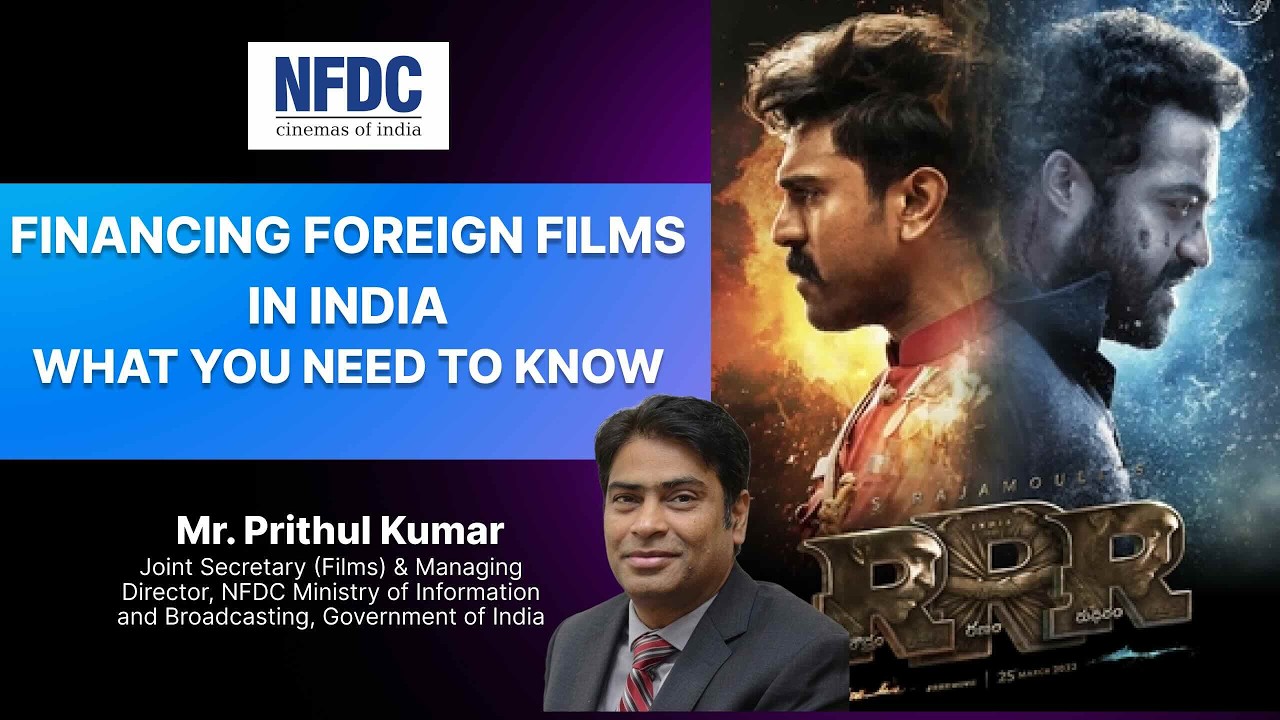
Prithul Kumar — Joint Secretary (Films) & Managing Director at NFDC, Ministry of Information and Broadcasting, Government of India — discusses India’s incentive framework for foreign film productions, co-production treaty access, and how international partners can engage the Mumbai-anchored Indian film system.
OTT & Digital Distribution: The Parallel Revenue Pipeline
Here’s the thing most international buyers miss about Mumbai’s film distribution ecosystem in 2026: the theatrical release and the streaming deal are no longer sequential conversations. They’re parallel negotiations — often with the same company, often for the same title, and almost always with rights structures that are pre-committed before the film even wraps production. The 35–40 day theatrical window that’s become standard for Bollywood means a Mumbai distributor planning a wide theatrical release is simultaneously modeling the OTT revenue that arrives six weeks later. Both numbers are in the deal.
The dominant OTT platforms in this parallel pipeline are Netflix India, Amazon Prime Video India, Disney+ Hotstar, and ZEE5. Each has a different content acquisition mandate. Netflix India — under Monika Shergill (VP Content) — has been actively building its Hindi-language original slate alongside the YRF library deal, prioritizing emotionally resonant narrative content and star-driven productions. Prime Video India leans toward action thrillers and prestige drama series alongside Hindi theatrical acquisitions. Disney+ Hotstar runs a massive volume play with a broad genre range anchored by cricket and family content. ZEE5 is vertically integrated with ZEE Studios on the production side, as noted above.
But the digital distribution layer that most international co-production teams underestimate is satellite rights. India’s satellite broadcast market — Star, Sony, ZEE, Colors — still generates significant per-title revenue for Hindi films, particularly in the ₹50–150 crore budget range where the OTT deal alone may not fully recoup. Mumbai distributors with satellite rights relationships are negotiating these deals simultaneously with theatrical and OTT, constructing a full rights stack that provides downside protection even when box office disappoints. Understanding which Mumbai distributor has active satellite rights relationships — and which is purely theatrical or purely digital — is a critical part of the due diligence before you structure a co-production deal.
For a full picture of how the Indian rights stack works — including NFDC’s role in structuring international co-productions against India’s enhanced 40% federal incentive — our India film financing companies guide maps the capital stack architecture in detail. And for the regional cinema dimension that increasingly intersects with Mumbai’s distribution infrastructure, our Beyond Bollywood regional markets guide covers the South Indian circuits — Tamil, Telugu, Kannada, Malayalam — where pan-India distribution deals are now being actively structured by Mumbai studios alongside their Hindi releases.
How to Approach Mumbai Film Distributors: Procurement Intelligence
The real dynamic in Mumbai’s distribution market — the part that doesn’t show up in company profiles or festival brochures — is relationship architecture. The Indian film distribution business is, as the Vitrina India distribution analysis has previously noted, notoriously fragmented and relationship-driven. You don’t cold-pitch a distribution deal to YRF’s theatrical team or walk into a Dharma acquisitions conversation without an established introduction. The gate is held by the people who’ve been in those rooms for years. That’s not a barrier — it’s a structural fact about how Indian film distribution actually closes.
What you need before the first conversation. Territory specificity matters enormously. India’s theatrical market runs across 12 distinct circuits — Mumbai, Delhi/UP, East Punjab, Rajasthan, CP Berar, CI, Nizam/Andhra, Karnataka, Tamil Nadu, West Bengal/Bihar/Orissa, and Overseas (North America, UK, Middle East). YRF is the only Mumbai distributor with affiliated offices covering all 12. Everyone else either covers their home circuit directly and sub-distributes the rest, or structures territory-by-territory deals with regional distributors. Know which territories your production actually needs coverage for before you start comparing distribution terms across companies.
The NFDC entry point for international partners. If you’re approaching Mumbai’s distribution ecosystem as an international co-production partner — rather than a domestic producer — the NFDC co-production framework is the most reliable institutional entry point. Prithul Kumar, Joint Secretary (Films) & MD at NFDC, has outlined India’s bilateral co-production treaty structure in detail: it provides international producers with institutional access to both the Indian incentive regime and the Mumbai studio relationships that NFDC has built with Yash Raj, Dharma, Excel, and Reliance over decades. The enhanced 40% federal incentive for qualifying Indian expenditure (2024 revision, capped at $3.6M per production with a 5% bonus for significant Indian content) makes the co-production math genuinely compelling before you even reach the distribution conversation.
Film Bazaar as the deal market. The Film Bazaar in Goa — run annually alongside IFFI — is the primary Indian film market where Mumbai distributors actively meet international producers. It’s where acquisitions executives from YRF, Dharma, ZEE Studios, and their peers are accessible for structured meetings. Unlike MIPCOM or AFM, where the Hollywood studio acquisitions teams operate in well-defined formats, Film Bazaar is more founder- and executive-driven — the relationships that close distribution deals there are typically built over multiple years of participation, not a single meeting. Budget for 2–3 years of consistent market presence before expecting Film Bazaar to generate distribution commitments from Mumbai’s top-tier companies.
Rights structure clarity before you negotiate. Mumbai distributors distinguish sharply between all-rights deals (theatrical + satellite + digital combined) and split-rights structures. All-rights deals with YRF or Dharma typically give you the widest release infrastructure but reduce your per-window revenue since the distributor recoup comes first. Split-rights deals — where you retain OTT rights and license only theatrical — are increasingly common for mid-budget co-productions that have pre-committed their streaming window to Netflix India or Prime Video. Know your rights architecture before you open distribution negotiations in Mumbai; the terms you accept in the first meeting tend to define the entire deal structure.
For a deeper look at connecting with the right Mumbai distribution executives — verified contacts, current project slates, active deal mandates — our India film distribution strategic guide covers the full national market beyond Mumbai, including the South Indian distribution companies that are increasingly relevant to pan-India releases structured from Mumbai headquarters.
Get Direct Access to Mumbai Film Distribution Executives
Vitrina Concierge builds targeted Mumbai distributor shortlists and makes warm introductions directly to acquisition decision-makers. Used by teams at Netflix, Globo, and WME. No commitment required to enquire.
Frequently Asked Questions
What are the top film distribution companies in Mumbai for 2026?
The leading film distribution companies in Mumbai for 2026 are Yash Raj Films (YRF), Dharma Productions, Excel Entertainment, Reliance Entertainment/Jio Studios, ZEE Studios, T-Series Films, Maddock Films, and Eros International. YRF is the most comprehensive distributor, covering all 12 theatrical territories in India with affiliated offices, plus the international market through YRF International. The November 2025 multi-year Netflix partnership extending YRF’s library to 190+ countries globally further strengthens its position as India’s benchmark distribution company.
How large is India’s film distribution market in 2026?
India’s box office market is projected to grow to $2.95 billion by 2029 at a 5.66% CAGR, per Statista. The 62 listed film production and distribution companies in India carried a combined market capitalisation of ₹47,117 crore as of February 10, 2026. India’s OTT market has 400 million+ users, and Bollywood films typically release on streaming platforms 35–40 days after their theatrical run. PVR INOX — India’s largest multiplex chain with approximately 30% market share — projected ₹1,800 crore in revenue for Q3FY26 alone.
What was the Netflix–Yash Raj Films deal in 2025?
In November 2025, Netflix and Yash Raj Films (YRF) announced a multi-year global streaming partnership bringing YRF’s 50+ year film library to Netflix subscribers across 190+ countries, as reported by Variety. The rollout launched November 1 with Shah Rukh Khan’s birthday collections (including Dilwale Dulhania Le Jayenge and Chak De India), continued through Salman Khan, Ranveer Singh, and classic YRF titles, and extends into 2026 with Valentine’s week romance collections. Akshaye Widhani (CEO, YRF) and Monika Shergill (VP Content, Netflix India) both confirmed the deal as a milestone for Indian cinema’s global reach.
How do Mumbai film distributors structure their theatrical releases across India?
India’s theatrical market runs across 12 distinct circuits: Mumbai, Delhi/UP, East Punjab, Rajasthan, CP Berar, CI, Nizam/Andhra, Karnataka, Tamil Nadu, West Bengal/Bihar/Orissa, and Overseas. YRF has affiliated offices in all 12 territories, the only Mumbai distributor with that full coverage. Other Mumbai studios either cover their home circuit directly and sub-distribute through regional partners, or structure territory-by-territory release deals. PVR INOX controls approximately 30% of India’s multiplex screen count and is the primary exhibition partner for wide-release theatrical commitments.
What is the OTT window for Bollywood films in 2026?
Most Bollywood films release on OTT platforms — primarily Netflix India, Amazon Prime Video, Disney+ Hotstar, and ZEE5 — between 35 and 40 days after their theatrical release date. This compressed window means Mumbai distributors are simultaneously negotiating theatrical and OTT rights, often with pre-committed streaming deals running parallel to theatrical release planning. The OTT revenue arrives within six weeks of release, fundamentally changing the risk-reward math for distributors compared to the longer satellite rights windows that preceded the streaming era.
How can international producers access India’s film distribution infrastructure?
The most structured institutional entry point for international producers is NFDC (National Film Development Corporation), administered under India’s Ministry of Information and Broadcasting. NFDC manages India’s bilateral co-production treaty framework and the federal film incentive — enhanced in 2024 to a 40% reimbursement rate on qualifying local expenditure, capped at $3.6M per production with a 5% bonus for significant Indian content criteria. Film Bazaar in Goa (held alongside IFFI annually) is the primary deal market where Mumbai distribution companies actively meet international producers. Vitrina’s Concierge service also provides warm introductions to verified Mumbai distribution executives.
What is the difference between all-rights and split-rights distribution deals in Mumbai?
All-rights deals give the Mumbai distributor control over theatrical, satellite, and digital rights combined — providing wider release infrastructure but requiring the distributor’s recoupment before revenue flows to the producer. Split-rights deals retain OTT rights with the producer (often pre-committed to Netflix or Prime Video) while licensing only theatrical rights to the distributor. Split-rights structures are increasingly common for mid-budget co-productions that have already secured OTT pre-buys. Understanding which structure suits your production’s financial architecture is essential before opening distribution negotiations with YRF, Dharma, or their Mumbai peers.
How do I find and vet Mumbai film distribution companies?
Vitrina’s Global Entertainment Supply-Chain Platform maps Mumbai film distribution companies with verified project credits, active release histories, rights structure profiles, and direct acquisition executive contacts. Start with 200 free credits — no credit card required — to access company profiles and project data. VIQI (Vitrina’s AI) can surface distribution companies filtered by genre, budget range, territory coverage, and OTT platform relationships in minutes. Vitrina Concierge also builds custom Mumbai distribution shortlists with warm introductions for productions actively seeking Indian distribution partners.
Key Takeaways
Mumbai’s film distribution landscape in 2026 is more commercially sophisticated — and more structurally complex — than at any previous point in Bollywood’s history. The companies above aren’t just conduits for getting prints to screens. They’re rights management operations, OTT deal-makers, and in several cases active co-production partners who bring capital alongside distribution infrastructure. Here’s what to carry out of this guide.
- YRF is the benchmark — and it’s now globally wired. Founded in 1970, covering all 12 Indian theatrical circuits, with VP Distribution Sahdev Ghei overseeing national infrastructure, and CEO Akshaye Widhani signing a multi-year Netflix deal in November 2025 that brings YRF’s library to 190+ countries. For theatrical breadth plus global streaming reach, nothing in Mumbai matches it.
- The theatrical-OTT parallel is the structural fact that changes everything. Bollywood’s 35–40 day OTT window means theatrical distribution deals and streaming pre-commits are negotiated simultaneously. Any production entering Mumbai distribution conversations without a clear OTT rights strategy is operating half the deal. Sort your streaming commitments first.
- PVR INOX controls the theatrical gate. India’s largest multiplex chain holds ~30% of the country’s screens, projecting ₹1,800 crore in Q3FY26 revenue. Content quality — not just star power — now drives PVR INOX’s screen allocation decisions. Analyst Jinesh Joshi (PL Capital) has flagged content consistency as the key earnings variable. Build your release case around the film, not just the cast.
- NFDC is your institutional entry point as an international partner. India’s 40% federal film incentive (enhanced 2024), capped at $3.6M per production, plus bilateral co-production treaties administered through NFDC, make the co-production math genuinely compelling before you even open distribution negotiations. Engage NFDC before approaching studios directly.
- India has 62 listed entertainment companies — the market cap is ₹47,117 crore. This is not an emerging market curiosity. It’s one of the world’s largest entertainment asset classes, with distribution infrastructure that processes billions in annual revenue across theatrical, satellite, and streaming simultaneously. If you’re not tracking Mumbai distribution companies on Vitrina, you’re navigating this market blind.
Access Mumbai’s Film Distribution Ecosystem on Vitrina
Vitrina maps 140,000+ companies and 400,000+ productions globally — including verified Mumbai distributor profiles, active project credits, rights specialisms, and direct acquisition executive contacts. 200 free credits. No credit card required.
Find Film+TV Projects, Partners, and Deals – Fast.
VIQI matches you with the right financiers, producers, streamers, and buyers – globally.
Producers Seeking Financing, Co-Pros, or Pre-Buys?
Vitrina Concierge helps producers reach the right financiers, commissioners, distributors, and co-production partners — with precision outreach, not cold pitching.
Join Industry Briefings Trusted by Leaders

Format Adaptations: Global Trends
Where formats are traveling, which adaptations are breaking out, and how streamers are backing remakes in 2025–2026.

Books, Novels & Comics Adaptations: Global Trends
Books, webtoons, and manga driving the next global screen hits. Discover how in this webinar.

Micro-Dramas & Mobile-First Storytelling
Micro-dramas are building real audiences and revenue. Understand the platforms, buyers, and economics behind the growth.

Navigating Global Content Licensing Trends
How global content licensing is shifting beyond flat fees to flexible, deal-driven models.