About Innovation Hub
 Global Content Pulse (Webinars)


 Global Production Financing
(Webinars)
Global Production Financing
(Webinars)  LeaderSpeak Podcast
  About Vitrina
 Our Story
 Our Solutions 🔥
 Film+TV Projects Tracker 🚀
 Case Studies
 Our Profile
India’s VFX industry has crossed a threshold that most Western executives didn’t see coming. We’re not talking about the low-cost outsourcing hub of the early 2000s anymore. The top VFX companies in India are now landing credits on Netflix originals, Warner Bros blockbusters, and Marvel tentpoles—delivering work that competes directly with studios in London and Los Angeles, at 30–40% lower cost.
Here’s what that means for your capital stack: if you’re greenlighting a project with VFX line items above $2M, ignoring India’s studios is a financial decision, not just a creative one. The ROI differential is that significant. And yet—the Fragmentation Paradox is real here. With hundreds of studios operating across Mumbai, Hyderabad, Chennai, Bengaluru, and Pune, finding the right partner takes intelligence, not just a Google search.
This guide cuts through the noise. We’ve mapped India’s verified VFX ecosystem—capabilities, hero projects, executive contacts, and the honest breakdown of what each studio can and can’t do at scale.
💡 Vitrina Analyst Note
From what we track on Vitrina, India’s VFX market has moved well past the outsourcing conversation. The 40% federal reimbursement capped at $3.6M per project, combined with crew costs running 35 to 50% below London and Los Angeles rates, makes this a capital stack decision. Our work mapping this ecosystem consistently surfaces the same challenge: fewer than 30 studios can reliably deliver at Hollywood broadcast standard.
In This Guide
Find the Right India VFX Partner in 48 Hours
Join 140,000+ entertainment companies on Vitrina—filter India’s VFX studios by capability, budget range, and verified project credits. No cold calls. No guesswork.
Trusted by Netflix, Warner Bros, and Paramount sourcing teams
Ask VIQI About India VFX Studios
200 free credits · No credit card required
Why India’s VFX Market Is a Sovereign Hub—Not Just an Outsourcing Destination
There’s a framing problem that costs production executives real money. They hear “India VFX” and think vendor, not partner. That framing is five years out of date—and it’s why savvy teams are quietly locking up the best Indian studios while others are still negotiating with Soho.
India now produces the largest volume of films globally—over 1,800 features annually across Hindi, Tamil, Telugu, Malayalam, and Kannada language markets. That volume isn’t just domestic filler. Films like Baahubali 2 and RRR demonstrated to the world what India’s VFX pipeline can produce at scale—and both attracted significant Western industry attention post-release.
But here’s the number that matters most for your deal economics: India’s federal VFX incentive currently sits at 40% reimbursement (increased from 30% in recent years), capped at $3.6M per qualifying project. Stack that against crew costs roughly 35–50% below London or Los Angeles equivalents, and you’re looking at a compelling case that goes straight to the P&L.
The Vitrina Sovereign Hubs framework places India firmly in Tier 1—operational, export-ready, and accelerating. This isn’t emerging market positioning. It’s a competitive ecosystem that’s been quietly maturing for two decades and is now exporting capabilities globally, not just servicing domestic Bollywood demand.
According to Variety, Indian VFX studios are increasingly appearing in the credits of top-tier Hollywood productions—a trend that was virtually nonexistent a decade ago. And Screen International has noted that India’s post-production workforce now numbers in the tens of thousands of trained professionals—a pipeline that’s genuinely hard to replicate elsewhere.
But—and this is the challenge your sourcing team faces—the market’s depth is also its problem. Hundreds of studios claim VFX capability. Fewer than 30 can consistently deliver at Hollywood broadcast standard. Knowing which is which, before you’ve committed your post schedule, is the intelligence gap that selecting VFX companies in India requires.
The Top 15 VFX Companies in India (2026 Rankings)
Rankings are based on verified project credits, studio scale, international client portfolio, and breadth of technical capability—not self-reported marketing claims.
1. Prime Focus VFX (Mumbai)
Prime Focus is India’s largest and most globally integrated VFX operation—full stop. With facilities in Mumbai, London, New York, and Vancouver, this isn’t just an India play; it’s a multinational VFX company headquartered in India. Their cloud-based CLEAR technology pipeline has enabled work on projects including Brahmastra, multiple Warner Bros features, and episodic content for streaming platforms. If you need a studio that can absorb a 2,000+ shot count and deliver on a compressed schedule, Prime Focus is the tier-one choice. Their parent company, Prime Focus Technologies, also powers content management for some of the world’s largest broadcasters.
2. DNEG (Mumbai / Hyderabad)
Technically a British company with deep Indian roots, DNEG‘s Indian operations in Mumbai and Hyderabad handle a significant portion of their global VFX volume. Oscar-winning work on Dune: Part Two, Oppenheimer, and Interstellar flows through this pipeline. If you’re packaging a production that requires DNEG-tier results but want to access the cost efficiency of India’s workforce, routing through their India studios with dedicated supervision is a legitimate strategy that sophisticated producers already use. Their India operation isn’t a satellite—it’s integral to their global delivery pipeline.
3. Red Chillies VFX (Mumbai)
Red Chillies VFX—Shah Rukh Khan’s production-linked studio—has earned its reputation the hard way: by delivering groundbreaking work for Indian blockbusters that demanded capabilities previously unavailable domestically. Their de-aging work on Fan (2016) and the ambitious effects in Zero (2018) demonstrated that Indian studios could tackle technically demanding briefs that rival Western post houses. They’ve also taken on international projects and serve as a benchmark for what a creatively ambitious Indian VFX operation looks like when it’s vertically integrated with a major production company.
4. Makuta VFX (Hyderabad)
You don’t deliver 4,500+ VFX shots for Baahubali 2—one of the highest-grossing Indian films ever made—without building a genuinely elite pipeline. Makuta VFX, founded by V. Srinivas Mohan, did exactly that. Based in Hyderabad, they’ve also handled VFX for 2.0, Rajinikanth’s sci-fi spectacular. Makuta’s strength is creature and environment work at scale—the kind of epic visual storytelling that mainstream Indian cinema demands and that Western studios are increasingly recognizing as world-class.
5. PhantomFX (Chennai)
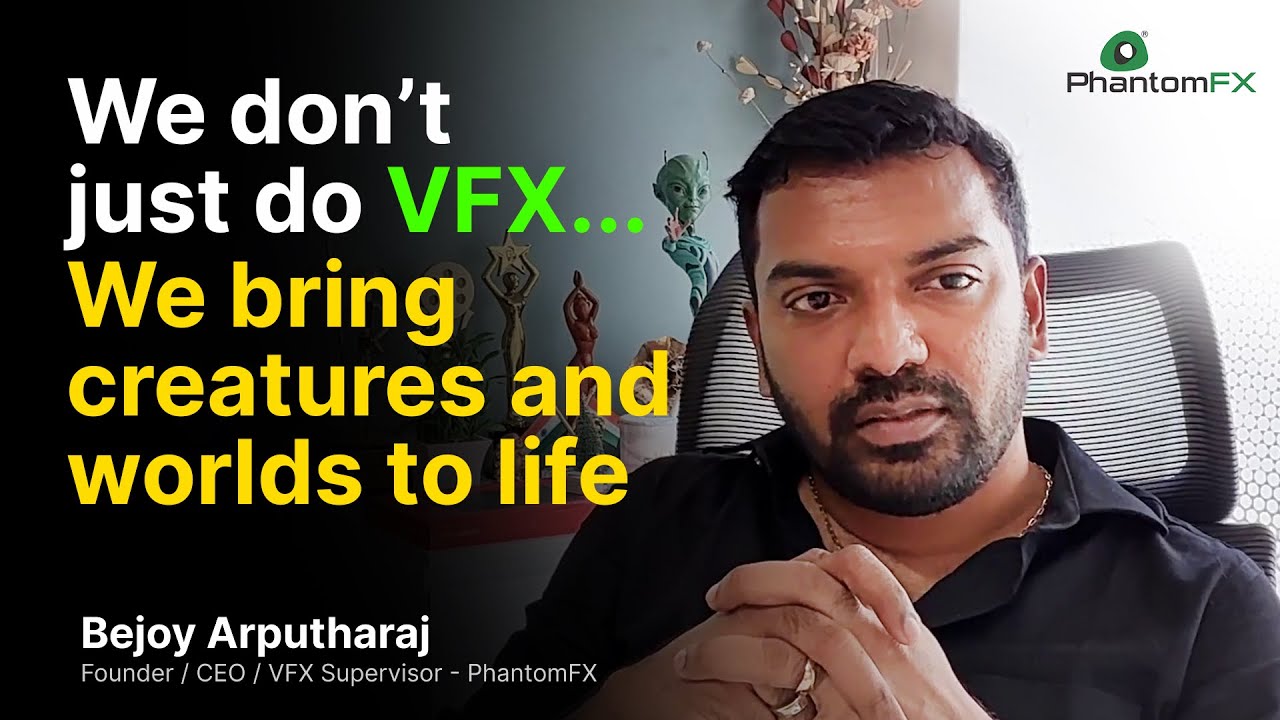
PhantomFX, led by founder and CEO Bejoy Arputharaj, has been one of India’s most aggressive international expansion stories. Based in Chennai, they’ve built a pipeline that handles CGI mastery, compositing, and AI-driven innovation for clients including Hollywood studios and Netflix. Bejoy’s philosophy—blending art with technological innovation rather than choosing between them—shows in their output. They’re not just executing briefs; they’re building proprietary AI tooling to accelerate their pipeline in ways that compress timelines and de-risk delivery for international producers.
Want to go deeper? Bejoy Arputharaj joined the Vitrina Business Network podcast to discuss PhantomFX’s global expansion and AI strategy:
6. DQ Entertainment (Hyderabad)
DQ Entertainment sits at the intersection of VFX, animation, and co-production—making them a different kind of asset for international producers. With co-production credits on animated content for European and North American broadcasters, they’ve demonstrated the ability to meet Western broadcast standards on complex, multi-season projects. Their Hyderabad facility runs a substantial full-time workforce, and their experience navigating international co-production treaties gives them a competitive edge that pure VFX shops lack.
7. Tata Elxsi (Bangalore / Pune)
Tata Elxsi‘s design and technology business includes a dedicated media and entertainment division that handles VFX, post-production, and digital content services. What distinguishes them from pure-play VFX studios is their engineering DNA—they bring technology infrastructure thinking to creative production workflows. This makes them a particularly strong partner for OTT-platform content that demands both creative quality and technical delivery precision across multiple formats and specifications.
8. VFXpick (Mumbai / Hyderabad)
VFXpick has built a reputation as one of India’s most reliable mid-to-large-scale VFX vendors for international productions. Their multi-city presence—with operations in both Mumbai and Hyderabad—gives them capacity flexibility that single-site studios can’t match. They’ve been vocal about their quality-over-volume positioning, emphasizing pipeline robustness and client communication standards that international productions require. As our deep-dive on VFXpick’s quality approach covers, their investment in talent development has been a core differentiator.
9. Prasad Corp (Hyderabad / Chennai)
Prasad Corp is one of India’s oldest post-production institutions—a company that’s been part of the country’s film infrastructure since the analog era and has successfully navigated the digital transition. Their VFX capabilities span compositing, colour grading, and digital intermediate work, with a particularly strong track record on Telugu and Tamil regional blockbusters. For productions that need the security of an established operation with deep industry relationships, Prasad Corp’s track record is hard to argue with.
10. Prana Studios (Mumbai)
Prana Studios occupies a distinct position: a CG animation and VFX studio that has worked on Hollywood features including The Nut Job franchise and Smurfs: The Lost Village. Their focus on high-quality CG character work and environments gives them credibility with international animation buyers that most Indian VFX studios haven’t established. If your project involves significant CG character animation—not just compositing and cleanup—Prana deserves serious consideration.
Connect With Verified India VFX Studios Now
Access Vitrina’s verified database of India VFX companies—with capability filters, project credits, and direct executive contacts. Get your first 200 searches free.
No credit card required · Join 140,000+ entertainment companies
11. SilverSun Pictures (Mumbai)
SilverSun Pictures has carved out a position in episodic VFX—particularly for OTT platform content where turnaround speed and consistency across multi-episode deliveries is as important as any single shot’s quality. Their pipeline is optimized for volume without sacrificing broadcast standards, making them a natural fit for the streaming-era production model where series content moves faster than traditional theatrical pipelines.
12. Reliance MediaWorks (Mumbai)
Reliance MediaWorks is the post-production and VFX arm of one of India’s largest conglomerates. Their scale—multiple facilities, a large trained workforce, and deep financial backing—makes them capable of absorbing large-volume VFX packages that would overwhelm smaller studios. They’ve worked on major Bollywood productions and international co-productions, and their corporate backing means financial stability that matters when you’re signing a long-term post deal.
13. NY VFXwaala (Mumbai)
NY VFXwaala has built a strong reputation in the mid-market—productions with VFX budgets that don’t warrant a Prime Focus engagement but demand more than a boutique studio can reliably deliver. Their Mumbai base gives them access to Bollywood’s constant production flow, and their team’s experience across genres—from action to sci-fi to drama—means they’re not a one-trick shop.
14. Pixelloid Studios (Hyderabad)
Pixelloid Studios gained global attention for their work on RRR—a film that became a worldwide phenomenon and demonstrated that Telugu cinema’s VFX ambitions are now genuinely international in scope. Based in Hyderabad, their team has demonstrably learned how to handle the specific creative demands of mythological and historical epic storytelling—a genre where India’s VFX studios are now genuinely world-class.
15. Greenscar VFX (Mumbai)
Greenscar VFX has been growing its international client base steadily, with particular strength in compositing, roto-paint, and cleanup work that forms the backbone of any large-scale VFX pipeline. They’re the kind of studio that larger productions use to handle high-volume, technically precise work that needs consistent quality across thousands of shots—and they’ve built the QC processes to deliver that consistently.
Need Expert Help Sourcing the Right India VFX Studio?
Vitrina’s concierge team can shortlist verified India VFX studios for your specific project—budget, timeline, and capability-matched. No guesswork. No wasted conversations.
Used by producers at Netflix, Paramount, and Warner Bros
Talk to the Vitrina Concierge Team
No commitment required
India’s VFX City Hubs: Where the Talent Actually Lives
The geography of India’s VFX industry matters for your sourcing strategy. Different cities have different strengths—and in a market this large, sending the wrong type of project to the wrong hub is a common and expensive mistake.
Mumbai is the capital of Bollywood and therefore the natural home of India’s largest VFX operations. Prime Focus, Red Chillies, and Reliance MediaWorks are all Mumbai-based for good reason—proximity to the production decision-makers. But Mumbai also has the highest cost base of any Indian city. If your primary goal is cost efficiency, Mumbai’s tier-one studios will save you money versus London, but not as much as Hyderabad or Chennai.
Hyderabad is the surprise powerhouse. The Telugu film industry—which produced Baahubali, RRR, and a string of other high-spectacle blockbusters—has driven Hyderabad’s VFX ecosystem to elite levels. Makuta VFX and Pixelloid are both based here, as are DNEG’s Indian operations. The talent density is remarkable, and the cost differential versus Mumbai is meaningful. Netflix’s decision to open a creative technology hub in Hyderabad is not a coincidence.
Chennai powers Tamil cinema’s VFX demands and is home to PhantomFX, among others. The Tamil film industry has been pushing visual effects ambition in a way that’s built exceptional creature, environment, and sci-fi VFX capability in the city. Chennai-based studios tend to be technically aggressive innovators—PhantomFX’s AI tooling development is a prime example of that culture.
Bengaluru brings India’s tech ecosystem into play. Studios here, including Tata Elxsi’s media division, blend software engineering capability with creative production in ways that are increasingly relevant as pipelines become more software-dependent. If your production involves complex pipeline integration, proprietary tooling, or cloud-based workflows, Bengaluru-based operations tend to have the strongest technical foundations.

Your AI Assistant, Agent, and Analyst for the Business of Entertainment
VIQI AI helps you plan content acquisitions, raise production financing, and find and connect with the right partners worldwide.
- Find active co-producers and financiers for scripted projects
- Find equity and gap financing companies in North America
- Find top film financiers in Europe
- Find production houses that can co-produce or finance unscripted series
- I am looking for production partners for a YA drama set in Brazil
- I am looking for producers with proven track record in mid-budget features
- I am looking for Turkish distributors with successful international sales
- I am looking for OTT platforms actively acquiring finished series for the LATAM region
- I am seeking localization companies offer subtitling services in multiple Asian languages
- I am seeking partners in animation production for children's content
- I am seeking USA based post-production companies with sound facilities
- I am seeking VFX partners to composite background images and AI generated content
- Show me recent drama projects available for pre-buy
- Show me Japanese Anime Distributors
- Show me true-crime buyers from Asia
- Show me documentary pre-buyers
- List the top commissioners at the BBC
- List the post-production and VFX decision-makers at Netflix
- List the development leaders at Sony Pictures
- List the scripted programming heads at HBO
- Who is backing animation projects in Europe right now
- Who is Netflix’s top production partners for Sports Docs
- Who is Commissioning factual content in the NORDICS
- Who is acquiring unscripted formats for the North American market
How to Vet an India VFX Studio Before You Commit
The showreel will impress you. That’s not useful information—every studio puts their best work forward. Here’s the vetting framework that actually de-risks a sourcing decision:
Verify the credits, not the reel. Ask for IMDB credits and contact the productions directly. “We contributed to” and “we were the primary VFX vendor on” are very different claims. India’s VFX ecosystem has a meaningful number of studios that have touched international productions in a supporting role and present that association as their headline capability.
Assess the supervision structure. Who is the VFX supervisor, and where are they based? Remote supervision across time zones adds risk. Understand exactly how creative decisions get made—and who has authority to make them—before you lock your post schedule.
Test the pipeline with a real brief. The best India VFX relationships start with a small paid test. Give them 15–20 representative shots from your production. Their response—speed, communication, revision process, and final quality—tells you far more than any pitch deck. And it costs you a fraction of what discovering a capability mismatch mid-production would.
Check their current capacity. India’s top studios are not sitting idle. The good ones are booked 6–9 months out. “We can start immediately” from a tier-one studio is a yellow flag, not a green one. Ask about their current production load and get references from productions they’re actively working on—not ones they finished 18 months ago.
Our executive guide to vetting global VFX studios covers this framework in full detail, including the specific questions that separate genuine capability from persuasive marketing.
AI Integration: How India’s VFX Studios Are Weaponizing the Technology Gap
India’s VFX industry isn’t watching AI happen to them—they’re moving fast. And because many Indian studios don’t carry the legacy infrastructure costs of their Western counterparts, they can adopt new tooling without the organizational friction that slows larger studios.
PhantomFX is the clearest example. Bejoy Arputharaj has been explicit about building proprietary AI tools into their core pipeline—not as a marketing claim but as a genuine competitive advantage that reduces shot costs and accelerates review cycles. Their position is that AI doesn’t replace artists; it handles the mechanical volume work so artists can focus on the creative decisions that actually matter.
But the wider picture is nuanced. AI in VFX is most powerful for specific tasks: roto automation, cleanup, sky replacement, crowd augmentation. India’s studios are adopting these tools at varying speeds. The tier-one operations are integrating AI deliberately into specific pipeline stages. Mid-tier studios are experimenting. Some smaller operations are claiming AI capability as a marketing differentiator without the underlying tooling to back it up.
What this means practically: when you’re evaluating India VFX partners in 2026, ask specifically about AI tooling at each pipeline stage. The studios that can point to specific tools, specific applications, and specific time savings are the ones who’ve actually done the work. The ones who talk about “AI-powered workflows” without specifics haven’t.
India’s 40% VFX Incentive: The Financial Case You Need to Make to Your CFO
India’s federal reimbursement for qualifying VFX and animation work sits at 40%—up from 30%—capped at approximately $3.6M per project. For international productions, there’s an additional 5% bonus when Indian content thresholds are met. Let’s run the math quickly.
On a $5M VFX budget executed in India, you’re looking at a $2M reimbursement (40% of the capped $3.6M + the 5% bonus on qualifying spend). That’s before you factor in the underlying cost differential of Indian studio rates versus London or LA equivalents—which might save another $500K–$1.5M on the same scope of work. The combined effect on your capital stack is significant: this is a 25–35% effective cost reduction on your post-production line items that flows directly to recoupment.
The qualification criteria require a minimum local spend threshold, which varies by project type. Documentaries, VFX, and animation all qualify. The application process is managed through the Ministry of Information & Broadcasting, and experienced India-based production service companies can navigate it efficiently—but you need to plan for it before production, not after.
One important caveat: incentive structures can shift with government budget cycles. The current 40% rate was increased relatively recently. Verify the current structure with an India-based production attorney before you build it into your budget. But the strategic direction—India competing aggressively for international production spend—is clearly governmental policy, not a temporary concession.
Frequently Asked Questions: VFX Companies in India
Which is the No. 1 VFX company in India?
By scale, global integration, and technical capability, Prime Focus VFX is broadly considered India’s leading VFX operation. With offices across Mumbai, London, New York, and Vancouver, they’re the closest thing India has to a truly multinational VFX company. For specific project types—creature work, for instance—Makuta VFX commands equal respect. The “best” studio depends heavily on your project’s specific demands and budget tier.
How much does VFX work cost in India compared to the US or UK?
Indian VFX studios typically charge 30–50% less than comparable US or UK operations for equivalent work. On a mid-sized production with a $3M–$5M VFX budget, routing work to India can save $900K–$2M before incentives. The cost differential narrows at the very top tier (Prime Focus and DNEG India operate at near-international pricing for premium work) and widens significantly at the mid-tier level.
Can Indian VFX studios handle Hollywood-level work?
Yes—and they already do. DNEG’s India operations work on Oscar-winning Hollywood films. Prana Studios has CG animation credits on multiple US theatrical releases. PhantomFX and Makuta regularly deliver work for international streaming platforms. The question isn’t whether India’s top studios can handle Hollywood-level work—it’s whether you’re engaging the right studios for your specific brief and managing the relationship with the supervision structure it requires.
What types of VFX work are Indian studios best at?
India’s studios have proven particular strength in compositing, rotoscoping, crowd augmentation, digital environments, creature VFX, and CG animation. The depth of experience with large-scale spectacle work—driven by Bollywood and South Indian cinema’s appetite for epic visual storytelling—means studios like Makuta and Pixelloid are exceptionally strong in environments and creature-heavy sequences. For highly character-driven CG animation, Prana is a tier-one choice.
What is India’s government incentive for VFX work?
India currently offers a 40% reimbursement on qualifying VFX and animation production spend, capped at approximately $3.6M per project. An additional 5% bonus applies when significant Indian content requirements are met. This incentive is administered through the Ministry of Information & Broadcasting and applies to international productions as well as domestic Indian projects. Always verify the current structure before building it into a budget model.
Which Indian city has the best VFX studios?
For scale and access to decision-makers, Mumbai leads. For cost efficiency and technical depth in creature/environment VFX, Hyderabad is arguably India’s strongest VFX city right now—driven by the Telugu film industry’s extraordinary visual ambitions. Chennai is the hub for Tamil cinema’s VFX pipeline and is home to innovative studios like PhantomFX. Bengaluru brings strong technology integration capabilities. The best city depends entirely on your project requirements.
How do I find and vet the best India VFX company for my project?
Start with verified project credits—not showreels. Confirm capability directly with productions the studio claims to have worked on. Run a paid test with representative shots before committing your full post schedule. Use Vitrina’s platform to access 140,000+ verified entertainment companies—filtered by capability, location, budget tier, and verified project history—to build a qualified shortlist before you start conversations.
Is India a good option for VFX outsourcing for streaming platform content?
Yes—and major streamers are already acting on it. Netflix has expanded its India footprint specifically for technology and creative services, including opening a Hyderabad hub. The combination of episodic-capable studios (SilverSun, VFXpick), competitive pricing, and India’s 40% incentive makes the country a compelling VFX sourcing destination for any platform commissioning original content at scale.
Conclusion: India’s VFX Industry Is a Strategic Decision, Not a Budget Compromise
The frame has shifted. Routing VFX work to India’s top studios isn’t a compromise you make because your budget is tight—it’s a strategic decision that intelligent productions are making because the quality, the incentives, and the talent are all there. The producers who locked in relationships with India’s elite studios 3–4 years ago are now watching their competitors scramble to understand a market they’ve already mapped.
But intelligence matters here. The Fragmentation Paradox that makes sourcing VFX partners globally difficult is particularly acute in India—a market with hundreds of studios operating at wildly different capability levels, where the difference between a tier-one operation and a mid-tier studio that overstates its credits can cost you your post schedule. Getting Smart Pairing right—matching your specific production’s VFX demands to the right Indian studio—is the critical variable.
That’s exactly what Vitrina’s platform is built to accelerate: not a static directory, but a live intelligence layer that gives you verified capability data, project credits, executive contacts, and real-time availability—so you can make the sourcing decision with confidence instead of guesswork.
Key Takeaways
- ✓ India is Tier 1, not emerging: Prime Focus, DNEG India, and Makuta VFX are delivering Hollywood-standard work—right now, not eventually
- ✓ The 40% incentive is real money: On a qualifying $5M VFX budget, you’re looking at a $2M+ reimbursement before the cost differential kicks in
- ✓ Hyderabad’s emergence is strategic: Netflix opened a tech hub there for a reason—Hyderabad’s VFX talent density now rivals any Western production center
- ✓ Vet with credits, not reels: Verify IMDB credits directly; many studios over-represent their role on international productions they’ve touched peripherally
- ✓ AI adoption is separating the field: Studios like PhantomFX with genuine proprietary AI tooling are building a sustainable cost and speed advantage over those just talking about it
Find India VFX Partners Instantly
Search 140,000+ verified companies including India’s top VFX studios—filtered by capability, budget, and verified credits
No credit card required
Let Our Team Do the Matching
Tell us your project brief—Vitrina’s concierge team will shortlist the right India VFX studios for your specific production needs
No commitment required