About Innovation Hub
 Global Content Pulse (Webinars)


 Global Production Financing
(Webinars)
Global Production Financing
(Webinars)  LeaderSpeak Podcast
  About Vitrina
 Our Story
 Our Solutions 🔥
 Film+TV Projects Tracker 🚀
 Case Studies
 Our Profile

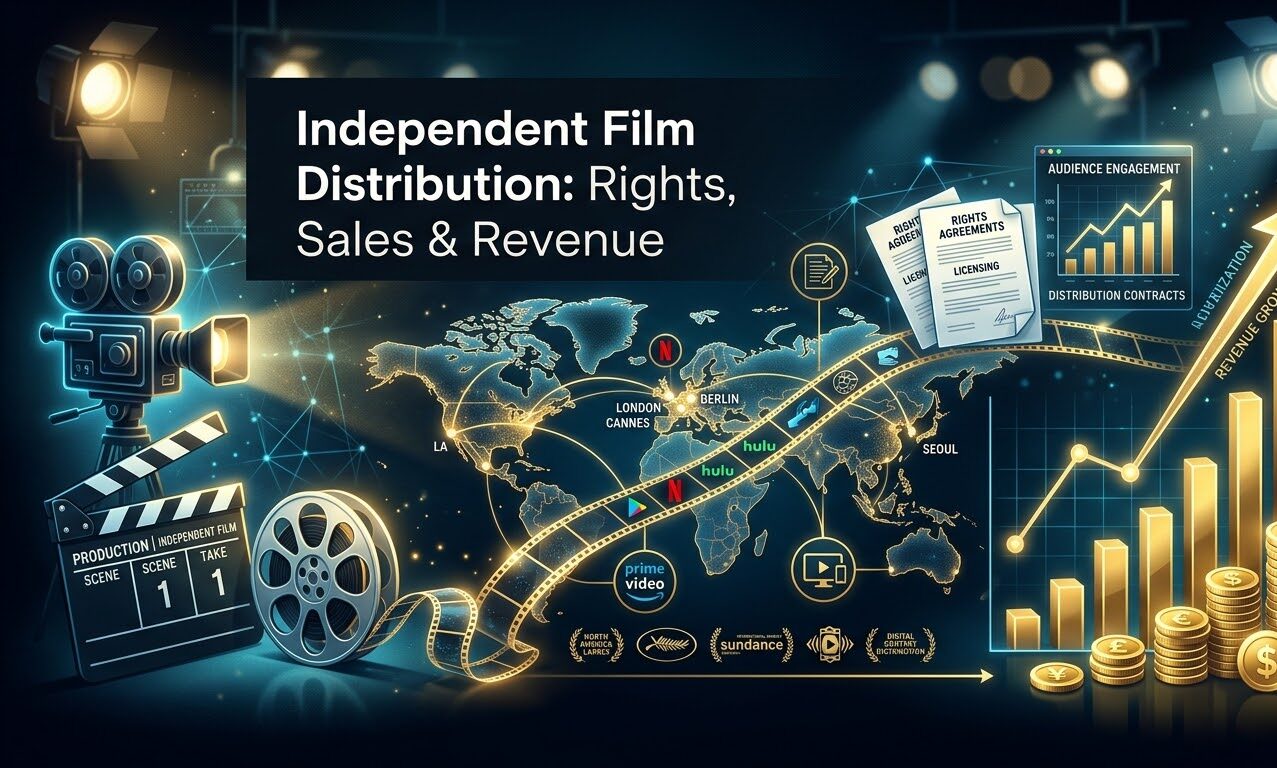
Choosing the wrong film distribution company is one of the most expensive mistakes a producer can make. And here’s the uncomfortable truth most lists won’t tell you: distribution isn’t just about reach. It’s about recoupment.
The wrong partner can leave your film commercially stranded—miswindowed, underspent on P&A, or locked in a territorial deal that blocks your best streaming offer. The right one turns a completed film into a revenue-generating asset that closes your capital stack.
Phil Hunt, Founder and CEO of Head Gear Films—who’s financed 550+ movies across nearly 25 years in the business—captured the current reality precisely: “The whole industry has become much, much harder in terms of getting movies off the ground and getting movies sold.” That’s not pessimism. It’s a market signal. In a tighter landscape, your distributor selection is one of the highest-leverage decisions you’ll make on any project.
This isn’t a generic rankings list. It’s a strategic due diligence guide built for producers, sales agents, and financiers who need to understand not just who the top global film distributors are—but what makes them strategically valuable, where their appetite actually sits in 2026, and how to evaluate any distributor before you sign. Vitrina’s platform maps 140,000+ active entertainment companies globally, and we’ve distilled that intelligence into the framework you’re about to read.
Table of Contents
Ask VIQI: Which distributors are actively acquiring content like mine right now?
VIQI is Vitrina’s AI assistant—trained on 1.6 million titles, 360,000 companies, and 5 million entertainment professionals. Get real-time distributor intelligence before you make your next call.
✓ Included with 200 free credits | ✓ No credit card needed
Why Distributor Due Diligence Matters More Than Ever in 2026
There’s a version of this conversation that happened in 2018 that doesn’t apply anymore. Back then, the streaming boom was creating so many new buyers that a reasonable film could find a home almost regardless of genre or budget. Those days are over. The post-COVID correction, the collapse of traditional presale revenue windows, and the ongoing consolidation among streamers have created a market where—as Phil Hunt told the Vitrina community—”it’s much harder to get movies off the ground and getting movies sold.”
That market tightness makes distributor selection a financial decision, not just a creative one. Here’s why:
Your MG determines your recoupment timeline. A Minimum Guarantee from a credible, A-list distributor unlocks bank financing—banks discount MGs at 70-90% of face value from known entities. A weaker distributor’s MG may not qualify for lending at all, forcing you into equity structures with worse EBITDA outcomes.
Territorial choices affect your financing ceiling. Presale strategy isn’t just about revenue—it’s about which territories you can borrow against. Pre-selling the wrong territories at the wrong time can block your best streaming buyer. Pre-selling Germany to a mid-tier distributor when a Netflix worldwide deal was 6 weeks away? That’s a structural mistake that erodes your capital stack permanently.
The Fragmentation Paradox makes this harder than it looks. More than 600,000 companies operate in the global entertainment supply chain—but fewer than a fraction of them are genuinely positioned to move your title commercially in their market. The information asymmetry between what distributors claim and what their actual track record shows is exactly what Vitrina’s platform was built to resolve.
Bottom line: due diligence on a distributor should be as rigorous as due diligence on a co-production partner or a financier. It’s the same conversation.

Your AI Assistant, Agent, and Analyst for the Business of Entertainment
VIQI AI helps you plan content acquisitions, raise production financing, and find and connect with the right partners worldwide.
- Find active co-producers and financiers for scripted projects
- Find equity and gap financing companies in North America
- Find top film financiers in Europe
- Find production houses that can co-produce or finance unscripted series
- I am looking for production partners for a YA drama set in Brazil
- I am looking for producers with proven track record in mid-budget features
- I am looking for Turkish distributors with successful international sales
- I am looking for OTT platforms actively acquiring finished series for the LATAM region
- I am seeking localization companies offer subtitling services in multiple Asian languages
- I am seeking partners in animation production for children's content
- I am seeking USA based post-production companies with sound facilities
- I am seeking VFX partners to composite background images and AI generated content
- Show me recent drama projects available for pre-buy
- Show me Japanese Anime Distributors
- Show me true-crime buyers from Asia
- Show me documentary pre-buyers
- List the top commissioners at the BBC
- List the post-production and VFX decision-makers at Netflix
- List the development leaders at Sony Pictures
- List the scripted programming heads at HBO
- Who is backing animation projects in Europe right now
- Who is Netflix’s top production partners for Sports Docs
- Who is Commissioning factual content in the NORDICS
- Who is acquiring unscripted formats for the North American market
The 5-Point Framework for Vetting Any Film Distribution Company
Before we get to the list—here’s the framework you should apply to any distributor, including the ones below. Every company on this list earned their position on at least four of these five dimensions. Use this framework as your checklist.
1. Verified Territory Infrastructure
Does the distributor actually operate in the territory they’re selling you, or are they sub-licensing to other distributors and skimming margin? A real territorial operator has boots-on-ground—local marketing teams, exhibitor relationships, and proven P&A spend history. A sub-licensor has a business card and an email chain. The difference in commercial outcome is enormous.
2. Comparable Title Track Record
Find their last 10 films. Not their showreel. Their actual theatrical grosses, VOD performance data, and sales agent feedback. A distributor with a strong track record in commercial thrillers may be completely wrong for your art house drama—even if their overall deal volume looks impressive. Genre-specific track record is what matters.
3. Financial Health and MG Credibility
A distributor who signs an MG they can’t fund on delivery is a time bomb in your financing structure. Entertainment banks rate distributors specifically—A-list entities qualify for 70-90% loan-to-value on their MG contracts. Unknown or financially unstable distributors get rejected entirely. Ask which banks your distributor works with, and verify independently.
4. Active Acquisition Mandate
What are they actually buying right now—not last year? Market conditions shift quarterly. A distributor who was actively acquiring action thrillers in 2023 may have a full slate in that genre and no capacity for your project. A platform that pivoted its content strategy after a leadership change may be targeting entirely different content than their reputation suggests. Real-time acquisition intelligence—not reputation—determines fit.
5. Contract Term Red Flags
License period length, cross-collateralization clauses, expense caps, reporting frequency, and audit rights. Standard distribution agreements are 15-20 year license periods—that’s a long time to be locked in with the wrong partner. Expense caps on P&A, clear audit rights, and reasonable cross-collateralization terms aren’t just legal hygiene—they’re your primary lever for protecting backend revenue.
Phil Hunt (Founder & CEO, Head Gear Films) breaks down why the current distribution market demands more rigorous vetting than ever before—and what the industry’s “big crunch” means for producers evaluating distribution partners:
Track Distributor Deal Flow in Real Time—Not 6 Months Later
Trusted by Netflix, Warner Bros, and Paramount. Join 140,000+ companies using Vitrina to track the global entertainment supply chain before it hits the trades.
✓ 200 free credits | ✓ No credit card required | ✓ Full platform access
Top 10 Best Film Distribution Companies Worldwide
The companies below were evaluated on all five framework dimensions above—not just brand name recognition. This list deliberately includes 3 Sovereign Hub distributors from non-Hollywood markets, because ignoring those players in 2026 is a strategic blind spot that’s costing producers real money.
1. Netflix (Global)
HQ: Los Gatos, California, USA | Reach: 190+ countries | Model: SVOD acquisition + worldwide rights
Netflix is the most strategically consequential distribution partner for any film producer in 2026—not because it’s the biggest (though it is), but because of how it restructures the entire financing conversation. A Netflix worldwide acquisition can replace your entire presale strategy in a single deal. It also creates competitive tension that raises MG offers from theatrical distributors across every major territory, even when you don’t ultimately sell to them.
But Netflix’s acquisition mandate is ruthlessly data-driven. They know, quarter by quarter, exactly what genres, languages, and budget ranges are performing for their subscriber acquisition numbers. Right now their appetite is strongest for local-language drama from Sovereign Hub markets (Korean, Spanish, Turkish, and increasingly Arabic content), premium English-language documentary, and action/thriller under $30M production budget.
Due diligence note: Netflix worldwide deals typically include brutal holdback restrictions—theatrical, SVOD, AVOD, all territories, often 5-7 year minimum. Know your rights before you sign. And know that their offers are firm. Negotiating leverage requires competing offers from Apple TV+, Amazon, or a studio.
Strategic verdict: Best for producers who can build competitive tension. A Netflix deal without competing offers is a below-market deal. This is where sales agents earn their 10-15% commission.
2. Universal Pictures International
HQ: Universal City, California, USA | Reach: Theatrical + home entertainment globally | Model: Studio output deals + acquisition
Universal Pictures International (UPI) is the benchmark for theatrical distribution infrastructure. Their territory-by-territory network—covering Europe, APAC, LATAM, and key emerging markets through owned subsidiaries rather than sub-licensors—is genuinely difficult for independents to match. When UPI puts P&A behind a film, it gets real marketing spend in real markets.
For independent producers, UPI operates through its specialty arm Focus Features internationally—making it the de facto major studio route for art house and prestige independent films seeking theatrical global distribution. Universal’s output deal infrastructure also makes them a primary acquisition target for presales that need to clear bank financing.
Due diligence note: UPI’s MG levels for independent acquisitions are credible collateral for top-tier entertainment banks. Their expense structure is studio-heavy—expect to negotiate P&A caps and recoupment terms carefully.
Strategic verdict: The gold standard for commercial theatrical. If your film is positioned for this tier, their MG will unlock your financing structure—but understand the waterfall before you commit to their terms.
3. Sony Pictures Releasing International
HQ: Culver City, California, USA | Reach: Theatrical + streaming hybrid (Crackle, licensing) | Model: Studio slate + specialty acquisition
Sony Pictures Releasing International (SPRI) occupies a unique position: they’re simultaneously a major theatrical distribution machine and one of the most active studio content licensors in the world. Sony’s decision to license rather than build a first-party SVOD platform (selling output deals to Netflix, Apple, and others instead) creates distinct distribution dynamics for producers working with them.
For international theatrical, SPRI’s footprint is deep—particularly in Asia, where Sony’s historic relationships with Japanese exhibition and their strategic positioning in India, Korea, and Southeast Asia give them reach that other Hollywood studios struggle to match. Their specialty label Sony Pictures Classics remains one of the most credible independent film acquisition brands globally.
Due diligence note: Sony’s streaming deal structures—licensing output to platforms rather than running their own—mean your post-theatrical rights landscape will be different with Sony than with a vertically integrated streamer like Netflix. Understand the licensing chain before signing.
Strategic verdict: Particularly strong for Asian theatrical and prestige independent films. Sony Pictures Classics remains a coveted distribution destination for festival-circuit acquisitions.
4. Warner Bros. Pictures International
HQ: Burbank, California, USA | Reach: Global theatrical + Max streaming | Model: Studio slate + hybrid streaming (Max/WBD)
Warner Bros. Pictures International (WBPI) is operating in a period of significant structural evolution—the WBD/Max integration has reshaped how theatrical and streaming rights interact across their slate, and the company’s relationships with international platform partners continue to evolve. But their theatrical infrastructure remains world-class: the Warner brand carries genuine commercial weight with exhibitors across every major market.
For independent producers, WBD’s distribution infrastructure matters most through their output deals with premium platforms. As reported by Variety, WBD’s ongoing content licensing strategy—including arrangements with competing platforms—demonstrates the “weaponized distribution” model: leveraging owned IP as a licensing revenue stream rather than holding exclusive control. Understanding this means understanding where your film fits in their rights prioritization.
Due diligence note: WBD’s slate prioritization is franchise-driven. Independent acquisitions compete for marketing attention with DC, Wizarding World, and other IP juggernauts. Know your position on their release calendar before committing.
Strategic verdict: Best for event-film positioning. Mid-range independent acquisitions may get lost in the slate. Negotiate P&A commitments explicitly into any deal.
5. Paramount Pictures International
HQ: Hollywood, California, USA | Reach: Theatrical + Paramount+ streaming | Model: Studio slate + hybrid SVOD (Paramount+/Skydance)
Paramount Pictures International has undergone significant strategic repositioning following the Skydance merger, consolidating around a leaner theatrical slate and a more aggressive Paramount+ content strategy. For producers, Paramount’s international theatrical infrastructure remains genuinely strong—particularly in Europe and LATAM—and their specialty arms give independent acquisitions a credible commercial pathway.
Their distribution relationships in emerging markets, particularly through output deal partners, are also commercially meaningful. And Paramount’s willingness to co-produce and co-distribute with international Sovereign Hub partners—including strategic MENA and APAC collaborations—makes them more accessible to non-Hollywood producers than their studio billing suggests.
Due diligence note: Paramount+’s growth strategy creates new pathways for streaming-first deals that bypass traditional theatrical altogether. Know whether you’re being acquired for theatrical or platform-first before you negotiate your MG.
Strategic verdict: Underrated for independent producers who’ve done their homework on Paramount+’s content gaps. The Skydance integration may create new acquisition appetite in genres the old Paramount underweighted.
6. StudioCanal
HQ: Paris, France | Reach: France, UK, Germany, Australia, New Zealand + broader international | Model: Co-production + theatrical distribution + SVOD
StudioCanal is the European independent distribution powerhouse—owned by Canal+ Group and operating through owned subsidiaries in France, the UK (via Studiocanal UK), Germany (via LEONINE), and Australasia. For international independent producers, StudioCanal represents a credible alternative to Hollywood studio distribution that doesn’t require giving up worldwide rights.
They’re active co-producers, not just distributors—meaning they’ll often come into projects earlier in development than a traditional acquisitions play, bringing co-production financing alongside distribution commitments. Their library ownership (including Paddington, Shaun the Sheep, and classic Hammer films) gives them institutional stability that many independent distributors lack.
Due diligence note: StudioCanal’s territorial coverage is genuinely deep in their core markets but requires supplemental distribution in MENA, APAC (outside Australasia), and LATAM. Build your worldwide distribution strategy around them as an anchor, not as a complete solution.
Strategic verdict: The intelligent European distribution anchor. Strong MG credibility, deep theatrical infrastructure in key territories, and genuine co-production appetite. Worth engaging early—before the financing closes.
7. Pathé International
HQ: Paris, France | Reach: France + pan-European theatrical + international sales | Model: Production + theatrical distribution + international sales
Pathé International is one of Europe’s oldest and most commercially resilient film companies—and one of the few that successfully operates as both producer and distributor at scale. In France, Pathé’s theatrical infrastructure is first-tier: they consistently rank among the top distributors by box office, with the P&A muscle to back it up and the exhibitor relationships to compete for prime screens against Hollywood studio product.
Their international sales arm gives producers something rare: a European distributor with genuine worldwide sales capability. They’re not just distributing in their home market—they’re actively selling international rights, attending markets, and competing for acquisition slates at Cannes, EFM, and AFM. For presale-driven independent productions seeking European anchor deals, Pathé’s MG credibility with French banks is unimpeachable.
Due diligence note: Pathé’s acquisitions team has distinct taste preferences—they skew toward prestige drama, event-caliber comedy (French market particularly), and projects with awards potential. Don’t pitch horror unless it’s exceptional.
Strategic verdict: The prestige European production-distribution anchor. If you’re building a European co-production structure and need a French anchor partner who can commit early and credibly, Pathé belongs at the top of your list.
8. Wild Bunch International
HQ: Paris, France | Reach: Pan-European sales + international | Model: International sales agent + territory-by-territory licensing
Wild Bunch International occupies the crucial position between production and theatrical distribution—the international sales agent who packages, sells, and territories-by-territory executes the presale strategy that producers need to close their financing gaps. They’re not a theatrical distributor in the traditional sense; they’re the infrastructure that makes presale-driven independent production financially viable.
Wild Bunch’s festival pedigree is exceptional—their sales slates consistently include Palme d’Or contenders and Berlin Golden Bear nominees. But don’t mistake prestige for commercial conservatism: they handle commercial genre films and mid-budget international productions with the same transactional rigor. Their relationships with distributors in Germany, Benelux, Scandinavia, Eastern Europe, and beyond are deep and deal-generating.
Due diligence note: Sales agents like Wild Bunch charge 10-15% commission on sales plus recoupable expenses ($50-75K typical cap). Make sure your producer’s budget accounts for these costs in your financing waterfall—they’re senior to your equity recoupment.
Strategic verdict: For independent producers seeking to build a presale financing structure through European territory sales, Wild Bunch is one of a handful of genuinely credible options. Access to their Cannes slate position is a commercial asset in itself.
The Sovereign Hub Distributors You Can’t Ignore in 2026
Here’s the Insider Candor most “top 10” lists skip entirely: the most significant distribution story in 2026 isn’t happening in Hollywood or Paris. It’s happening in Seoul, Lagos, and Dubai—where Sovereign Content Hubs are deploying government-backed capital to build distribution infrastructure that can compete with Western majors on their own terms. Ignoring these players isn’t strategic conservatism. It’s leaving money—and reach—on the table.
9. CJ ENM (South Korea)
HQ: Seoul, South Korea | Reach: South Korea + Asia-Pacific + MENA expansion | Model: Theatrical distribution + production + content investment
CJ ENM is the most globally consequential distribution company you’re probably not thinking about enough. They produced Parasite—the first non-English-language film to win Best Picture at the Academy Awards. That’s not a footnote. That’s proof that a South Korean distributor can manage a global content strategy that competes with Hollywood on the world stage.
But CJ ENM’s ambition doesn’t stop at Korean cinema. They’ve established a subsidiary in Saudi Arabia, deepening their MENA presence as that market’s $1B+ Vision 2030 film infrastructure comes online. Their content investment through Studio Dragon (their drama production arm) has made them Netflix’s most important Korean content partner—with drama series routinely ranking in Netflix’s global top 10 across dozens of territories. Their distribution reach in APAC is genuinely first-tier.
Due diligence note: CJ ENM is primarily a content creator and investor—if you’re approaching them as a distribution partner, understand that they’re evaluating strategic fit with their content portfolio as much as commercial viability in isolation.
Strategic verdict: The defining Sovereign Hub distributor. If you’re producing content with Korean market relevance or APAC crossover potential, CJ ENM belongs in your distribution conversation—not as an afterthought, but in the first call.
10. FilmOne Entertainment (Nigeria)
HQ: Lagos, Nigeria | Reach: Nigeria + Sub-Saharan Africa + African diaspora globally | Model: Theatrical distribution + production + streaming
FilmOne Entertainment—led by Moses Babatope—is the leading theatrical distributor in West Africa and the primary infrastructure operator for Nigeria’s booming Nollywood industry, which produces more films annually than any country except India. If your project has African content relevance, West African cast, or diaspora audience potential, FilmOne is non-negotiable in your distribution strategy.
And this isn’t just a regional play anymore. FilmOne’s theatrical release of Nigerian films in the UK, US, and Canada—targeting African diaspora audiences—demonstrates a cross-border distribution model that’s scaling fast. As reported by Deadline, African content’s global commercial profile has risen sharply since streaming platforms began commissioning and acquiring African-origin productions with real marketing spend behind them.
Due diligence note: FilmOne’s Nigerian theatrical infrastructure—including their own cinema circuits—gives them genuine leverage that pure sales agents in the region lack. They’re a vertically integrated operator, not a sub-licensor.
Strategic verdict: If West African or diaspora audiences are part of your commercial proposition, FilmOne gives you reach that no Hollywood distributor can replicate. They’re the right call—and the only call—for this market segment.
How Vitrina Accelerates Your Film Distributor Vetting Process
Here’s the problem with distributor due diligence the traditional way: it takes 3-6 months and depends almost entirely on relationship networks—which are biased by definition. You ask five people you know, they recommend distributors they’ve worked with, and you end up evaluating 0.05% of the actual market. The Fragmentation Paradox at work.
Vitrina De-risks this process at every stage. The platform maps 140,000+ active film and TV companies globally—with verified capabilities, hero project histories, deal flow data, and real-time acquisition activity. You can filter by territory, content type, budget range, and deal structure to get a ranked list of distributors who actually match your project’s profile—not just the ones who are famous.
Ask VIQI—Vitrina’s AI assistant trained on 1.6 million titles and 5 million industry professionals—specific due diligence questions: “Which distributors have acquired English-language thrillers under $8M in the past 18 months across Europe?” “What’s the typical MG range from a France theatrical deal for a $5M independent drama with festival pedigree?” These are intelligence questions that used to take months of relationship-building to answer. VIQI answers them in minutes.
For producers who need to move faster than a self-directed research process allows, Vitrina’s distribution licensing services and the Concierge team facilitate warm introductions to active acquisition executives—the ones who are actually buying, right now, in your genre and budget range. That’s how a Los Angeles producer got introduced to Netflix UK, Fifth Season, and Fox Entertainment within 48 hours. Not cold emails—warm introductions through a network that’s already inside the room.
And for producers tracking the emerging Sovereign Hub distributors—CJ ENM’s latest acquisition slate, FilmOne’s UK expansion, Front Row’s MENA deal flow—Vitrina’s global content acquisition intelligence surfaces the deals before they hit the trades. That’s the Insider Advantage that converts into better MGs and faster recoupment timelines.
Need Warm Introductions to Active Film Distribution Executives?
Vitrina Concierge is your Virtual Agent. We don’t give you a directory—we make targeted warm introductions directly to distribution acquisition decision-makers who are actively buying your content type.
- LA producer → Netflix UK, Fifth Season, Fox Entertainment (48 hours)
- Korean animation studio → Netflix Adult Animation (week one)
- Middle Eastern studio → Legendary Pictures (direct access)
Frequently Asked Questions
What makes a film distribution company “best” in 2026?
The best film distribution companies in 2026 are defined by five factors: verified territory infrastructure (genuine operations, not sub-licensing), comparable title track record in your genre, financial credibility for MG-backed bank financing (banks discount distributor MGs at 70-90% of face value from A-list entities), an active 2025-2026 acquisition mandate in your content type, and clean contract terms including clear audit rights, reasonable P&A expense caps, and fair cross-collateralization clauses. Brand recognition alone is insufficient—a famous distributor whose acquisition mandate doesn’t match your project will generate worse commercial outcomes than a lesser-known specialist who does.
How does a film distribution deal actually work financially?
A standard distribution deal involves a Minimum Guarantee (MG)—a fixed upfront payment from the distributor for the right to distribute the film in a specific territory for a defined period (typically 15-20 years). Typical payment structure: 10% on contract signature and 90% on film delivery. Producers use MG contracts as collateral for bank loans during production—banks lend 70-90% of the MG face value. After the MG is recouped through box office and other revenue, a revenue share kicks in, governed by the waterfall structure in the contract. P&A expenses are typically recouped before the producer sees any backend revenue beyond the MG.
Should I sell worldwide rights to Netflix or territory-by-territory to multiple distributors?
This is one of the highest-stakes decisions in your distribution strategy. A worldwide Netflix deal is faster to close, eliminates territorial execution complexity, and can provide strong upfront capital—but you surrender all backend revenue and often face 5-7 year holdback periods. A territory-by-territory presale strategy is more complex to execute, requires a credible sales agent, and takes longer—but preserves the possibility of outperformance revenue in successful markets. The optimal answer depends on your financing structure, your production cost basis, and whether competing offers exist. Without competing buyer interest, Netflix’s offer is almost always below market. The presale route builds competitive tension and is often worth more economically—but it requires the right sales agent and the right timing.
What red flags should I watch for in a distribution contract?
The biggest contractual risks in film distribution agreements: uncapped P&A expense recoupment (which can eliminate your entire backend), aggressive cross-collateralization across multiple titles (which hides losses in one film against profits in another), absence of audit rights (you can’t verify their revenue reporting), vague delivery requirements (which can trigger MG non-payment on technicalities), and overly broad sub-licensing rights (which let them pass your film to third parties without approval). Don’t sign without entertainment legal review—and not just any entertainment lawyer. One who specifically works in distribution agreements and knows how each of these clauses plays out commercially in practice.
Why should I pay attention to Sovereign Hub distributors like CJ ENM and FilmOne?
Sovereign Content Hubs—backed by government capital in South Korea, Nigeria, Saudi Arabia, UAE, and India—are no longer just regional players. CJ ENM produced the first non-English-language Best Picture winner (Parasite) and operates as Netflix’s primary Korean content partner. FilmOne distributes Nollywood content not just across Sub-Saharan Africa but to diaspora audiences in the UK, US, and Canada. These companies have genuine theatrical infrastructure, credible MG-issuing capacity, and reach into audiences that Hollywood distributors cannot access as effectively. Ignoring them means ignoring a growing percentage of the global theatrical and streaming market.
How do I find out which distributors are actively buying content in my genre right now?
Real-time acquisition intelligence is what separates effective distributor outreach from wasted effort. Trade publications like Variety and Deadline report completed deals—but that’s 6-12 weeks after the decision was made. By then, the acquisition executive has moved to their next project. Vitrina’s platform tracks active deal flow, verified company acquisition mandates, and real-time intelligence across 140,000+ entertainment companies globally. VIQI, Vitrina’s AI assistant, can answer specific questions about genre-level acquisition activity by distributor. For the highest-priority introductions, Vitrina’s Concierge service facilitates direct connections to acquisition executives who are actively buying in your content category—often within 48 hours of engagement.
What role does a sales agent play versus a distributor?
A sales agent (like Wild Bunch International) represents your film at markets—Cannes, AFM, EFM—and sells territorial distribution rights to local distributors, territory by territory. They charge 10-15% commission on sales plus recoupable expenses. A distributor (like Universal Pictures International or StudioCanal) actually executes the release in their territory—booking screens, running marketing, managing the P&A spend, and reporting revenues. You’ll typically work with both: a sales agent structures your presale strategy and sources distributors; each territorial distributor executes your commercial release in their market. The best sales agents have deep distributor relationships that produce faster deals and better MG levels than producers can negotiate independently.
How has the streaming era changed film distribution?
The streaming era fundamentally restructured the distribution waterfall. Where a film once moved sequentially through theatrical → DVD/Blu-ray → pay TV → free TV over 3-4 years, creating distinct revenue windows at each stage, streaming platforms have collapsed or compressed many of these windows. Theatrical releases now often transition to streaming in 30-90 days for mid-budget features. The DVD/physical market is commercially negligible in most Western territories. But the most significant change is structural: streamers can buy worldwide rights in a single deal, eliminating the territory-by-territory presale architecture that independent films relied on for financing. This is why, as Phil Hunt notes, getting movies sold has become structurally harder—and why distributor selection requires more sophistication than it did a decade ago.
Conclusion: The Right Distributor Is a Financing Decision, Not Just a Sales Decision
The best film distribution companies worldwide aren’t the ones with the biggest logos. They’re the ones whose acquisition mandate, financial credibility, territorial infrastructure, and contract terms align with your specific project at this specific moment in the market. And in 2026—where Phil Hunt’s “big crunch” has made it demonstrably harder to get films sold—that alignment requires real intelligence, not reputation-based guesswork.
- Due diligence is non-negotiable: Apply the 5-point framework—territory infrastructure, comparable track record, MG financial credibility, active acquisition mandate, and contract red flags—to every distributor you evaluate, regardless of brand.
- Hollywood majors aren’t always the answer: Netflix, Universal, Sony, WBD, and Paramount have enormous reach—but genre fit, slate prioritization, and contract terms matter as much as scale. A wrong-fit studio deal can commercially strand a film that an independent distributor would have championed.
- European anchors unlock financing structures: StudioCanal, Pathé, and Wild Bunch give independent producers credible MG collateral for European bank financing—often at terms that preserve more producer upside than worldwide deals.
- Sovereign Hub distributors are no longer optional: CJ ENM, FilmOne, and their MENA counterparts represent growing global market share that Hollywood-only distribution strategies are systematically leaving uncaptured.
- Vitrina compresses the vetting timeline from months to days: Real-time acquisition intelligence, verified company profiles across 140,000+ entertainment companies, and Concierge warm introductions to active decision-makers replace the slow, biased, relationship-dependent vetting process that costs producers both time and money.
The producers who’ll recoup fastest in the current market aren’t the ones with the best films. They’re the ones who paired the right film with the right distributor at the right moment—with the intelligence infrastructure to make that match before the window closed. That’s the Insider Advantage. And it’s available to you right now.
Access Real-Time Film Distributor Intelligence—Before It Hits the Trades
Trusted by Netflix, Warner Bros, Paramount, and Google TV. Track 400,000+ projects. Access 3 million verified executives. Ask VIQI what distributors are actively acquiring your content type right now.
✓ 200 free credits | ✓ No credit card required | ✓ Cancel anytime
Need direct introductions to distribution acquisition executives? Explore Concierge Service →
Find Film+TV Projects, Partners, and Deals – Fast.
VIQI matches you with the right financiers, producers, streamers, and buyers – globally.
Producers Seeking Financing & Partnerships?
Book Your Free Concierge Outreach Consultation
(To know more about Vitrina Concierge Outreach Solutions click here)
Producers Seeking Financing, Co-Pros, or Pre-Buys?
Vitrina Concierge helps producers reach the right financiers, commissioners, distributors, and co-production partners — with precision outreach, not cold pitching.
Join Industry Briefings Trusted by Leaders
Streamers – Netflix vs. Amazon – The 2026 Strategy
How Netflix and Amazon’s content and revenue strategies are diverging ahead of 2026.

Format Adaptations: Global Trends
Where formats are traveling, which adaptations are breaking out, and how streamers are backing remakes in 2025–2026.

Books, Novels & Comics Adaptations: Global Trends
Books, webtoons, and manga driving the next global screen hits. Discover how in this webinar.