About Innovation Hub
 Global Content Pulse (Webinars)


 Global Production Financing
(Webinars)
Global Production Financing
(Webinars)  LeaderSpeak Podcast
  About Vitrina
 Our Story
 Our Solutions 🔥
 Film+TV Projects Tracker 🚀
 Case Studies
 Our Profile
The global anime licensing market isn’t slowing down. It’s accelerating — and the supply chain intelligence gap between who’s closing deals and who’s still cold-emailing distributors has never been wider. Netflix committed over $2.5 billion to original content in South Korea alone. Crunchyroll’s subscriber base crossed 13 million paid subscribers globally. And streaming platforms from Prime Video to Apple TV+ are actively hunting for anime titles to fill genre gaps before competitors lock them up.
Here’s the thing, though. The deals that matter — the ones that actually move MGs and lock territory windows — aren’t happening because someone sent a cold pitch. They’re happening because the right acquisition lead got a signal six weeks before anyone else did. And that’s exactly where the Vitrina Network changes the math.
With 140,000+ companies tracked in real time across the entertainment supply chain — including hundreds of Japanese and Korean animation studios, distributors, and streaming platforms actively acquiring anime — Vitrina’s Smart Pairing intelligence doesn’t just give you a list. It gives you Insider Advantage. The difference between tracking what’s already been announced and knowing what’s about to be greenlit.
💡 Vitrina Analyst Note
From our work tracking the anime supply chain on Vitrina, acquisition teams relying on traditional research methods miss 40 to 60 percent of available licensing opportunities per quarter. Japan’s 50% production incentive, FAST back-catalog deals available below $50K, and open simulcast windows in MENA and Southeast Asia are sitting uncontested. The buyers closing them are not better resourced. They simply had the signal earlier.
Table of Contents
- Why Anime Licensing Has Become a $25 Billion Global Opportunity
- The Fragmentation Paradox Costing You Anime Deals
- 7 Anime Licensing Opportunities the Vitrina Network Surfaces First
- Sovereign Hubs Reshaping Anime Production and Distribution
- How Vitrina’s Smart Pairing Accelerates Anime Licensing Deals
- Structuring Your Anime Licensing Deal: What Buyers and Sellers Need to Know
- FAQ
- Conclusion
Ask VIQI: Which anime distributors are actively acquiring titles in my target territory?
VIQI is Vitrina’s AI assistant — trained on 1.6 million titles, 360,000 companies, and 5 million entertainment professionals. Ask it which platforms are greenlighting anime right now, which studios have open licensing windows, and who the right decision-maker is before your competitors find out.
✓ Included with 200 free credits | ✓ No credit card needed
Why Anime Licensing Has Become a $25 Billion Global Opportunity
Numbers first. The global anime market was valued at roughly $25.7 billion in 2023 and is forecast to grow at a CAGR north of 9.8% through 2030. But the really interesting story isn’t the headline number — it’s where that growth is going. Western streaming platforms are no longer buying anime reactively, after hits emerge in Japan. They’re commissioning original titles, co-producing with studios like Toei Animation and Production I.G, and building dedicated anime libraries to lock subscriber retention in 18-34 demographics that churn fastest.
But the distribution pipeline has fractured in ways most executives haven’t fully mapped. Traditional Japanese licensing routes — through sub-agents, territory aggregators, and distribution middlemen — add three to five months to deal timelines and mark up licensing fees by 15-20%. The studios that win anime deals in 2025 and 2026 aren’t navigating those legacy routes. They’re going direct. And to go direct, you need real-time intelligence on who’s available, what their current licensing status is, and whether a competing platform already has a first-look on the title you want.
According to Variety, the competition for exclusive anime titles among streaming platforms intensified sharply over the past 18 months, with Crunchyroll, Netflix, and Prime Video all accelerating acquisition budgets to secure simulcast rights and full library packages from Japanese IP holders. That’s not a trend — it’s a market restructuring. And it rewards whoever has the clearest visibility into supply before demand peaks.
The Fragmentation Paradox Costing You Anime Deals
Here’s something most people won’t tell you straight. The anime supply chain is one of the most fragmented in global entertainment — and not in the way that benefits buyers. There are over 600,000 companies operating in the global film and TV ecosystem, including hundreds of anime production houses, sub-licensors, and IP management firms that don’t show up in any publicly maintained database. Many of the most strategically valuable studios — boutique animation shops in Tokyo, Osaka, and Seoul producing the IP that will dominate streaming three years from now — aren’t reachable through IMDb Pro, LinkedIn, or trade contacts.
That’s the Fragmentation Paradox in action. More suppliers don’t create more access — they create more opacity. And opacity translates directly into margin leakage. If you don’t know the market rate for a 5-year exclusive SVOD license on a mid-tier anime catalog, you’ll either overpay or underbid. Either outcome erodes your ROI before the deal even closes.
The data deficit runs deeper than pricing. Without current intelligence on a studio’s production pipeline, you can’t know whether the title you’re pursuing already has a competing offer, whether the rights holder’s distribution window is opening in 90 days or 18 months, or whether the production company has a first-look deal with a platform that would block your acquisition outright. That’s not a research problem. That’s a supply chain intelligence problem — and it’s exactly what Vitrina was built to solve.
As a practical illustration: our strategic guide to mastering anime licensing and distribution shows that acquisition teams relying on traditional research methods miss 40-60% of available licensing opportunities in any given quarter — simply because they don’t have visibility into the right layer of the supply chain.
7 Anime Licensing Opportunities the Vitrina Network Surfaces First
Let’s get specific. These aren’t hypothetical opportunity categories. These are deal types that Vitrina users are actively closing — because they had the signal before the market did.
1. Catalog Library Packages From Mid-Tier Japanese Studios
Most licensing executives are chasing the same Toei and Bandai Namco IP that every major platform is already bidding on. But there are dozens of mid-tier Japanese animation studios with 50-200 title libraries that carry no advance coverage from major players. These catalog packages offer compelling economics — lower MGs, multi-territory bundle potential, and franchise extension upside — if you find them before someone else does. Vitrina maps these studios in real time, including their current licensing status and which territories remain open.
2. Korean Anime-Style Animation — The Next Wave
Call it what you want — anime-influenced, Korean animation, or simply the Hallyu Wave hitting the animation sector — but Korean studios are producing titles that Western platforms are actively acquiring. Netflix’s $2.5 billion Korean content commitment includes animation, and studios like Mushi Studio and Studio Animal aren’t on most acquisition teams’ radar yet. But they will be. The window to secure first-look deals or territory licenses is opening now, not in 18 months when everyone else has caught on.
3. Simulcast Rights Windows in Underserved Territories
MENA, Southeast Asia, and Eastern Europe represent high-growth, underserved anime territories where simulcast rights are frequently available at pricing well below Western markets. Platforms like OSN and regional OTT players are actively building anime libraries — but the rights acquisition infrastructure in these markets is still developing. For a buyer with the right intelligence on which Japanese IP holders have open windows in these territories, there’s a clear arbitrage opportunity before the market matures.
4. Co-Production Structures That Unlock Japan’s 50% Incentive
Japan’s production incentive program now offers up to 50% cash rebate (capped at approximately ¥1 billion per project) for qualifying international co-productions. That’s one of the most competitive incentive structures in the world — but accessing it requires navigating Japan’s co-production treaty framework and identifying the right local production partners. Vitrina’s co-production intelligence maps verified Japanese animation studios that are actively seeking international partners to qualify for these incentives, which dramatically changes the capital stack economics for your anime licensing deal.

Your AI Assistant, Agent, and Analyst for the Business of Entertainment
VIQI AI helps you plan content acquisitions, raise production financing, and find and connect with the right partners worldwide.
- Find active co-producers and financiers for scripted projects
- Find equity and gap financing companies in North America
- Find top film financiers in Europe
- Find production houses that can co-produce or finance unscripted series
- I am looking for production partners for a YA drama set in Brazil
- I am looking for producers with proven track record in mid-budget features
- I am looking for Turkish distributors with successful international sales
- I am looking for OTT platforms actively acquiring finished series for the LATAM region
- I am seeking localization companies offer subtitling services in multiple Asian languages
- I am seeking partners in animation production for children's content
- I am seeking USA based post-production companies with sound facilities
- I am seeking VFX partners to composite background images and AI generated content
- Show me recent drama projects available for pre-buy
- Show me Japanese Anime Distributors
- Show me true-crime buyers from Asia
- Show me documentary pre-buyers
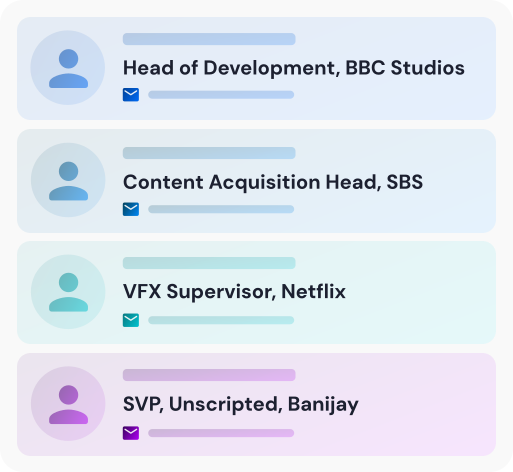
- List the top commissioners at the BBC
- List the post-production and VFX decision-makers at Netflix
- List the development leaders at Sony Pictures
- List the scripted programming heads at HBO
- Who is backing animation projects in Europe right now
- Who is Netflix’s top production partners for Sports Docs
- Who is Commissioning factual content in the NORDICS
- Who is acquiring unscripted formats for the North American market
5. IP Adaptation Opportunities — Manga to Screen
Manga IP with proven readership above 2 million volumes represents one of the safest bets in anime licensing — yet most Western platforms still rely on publishers and sub-agents to surface these opportunities. The challenge is that by the time a manga title reaches a Western distribution agent, the primary licensing window is often gone. Vitrina tracks active manga IP currently in development discussions, allowing your acquisition team to approach rights holders directly — before the title hits the trades and bidding wars start.
Discover Anime Licensing Partners Before Your Competitors Do
Trusted by Netflix, Warner Bros, and Paramount. Join 140,000+ companies tracking the global entertainment supply chain — including the anime studios, rights holders, and distributors that don’t show up in any public database.
✓ 200 free credits | ✓ No credit card required | ✓ Full platform access
6. FAST Channel Anime Catalog Deals
FAST (Free Ad-Supported Streaming TV) channels are rapidly becoming one of the most cost-effective vehicles for monetizing anime catalog libraries — and the licensing economics look nothing like traditional SVOD deals. Rights holders in Japan and Korea are increasingly open to FAST licensing arrangements for back-catalog titles that have exhausted their SVOD window, often at revenue-share structures well below $50K per title. For platforms building anime FAST channels, Vitrina’s supply chain intelligence identifies which studios have available back-catalog inventory and have signaled openness to non-exclusive FAST arrangements.
7. Localization-Ready Titles Waiting for a Distribution Partner
Here’s an underappreciated signal: a surprising number of anime titles are fully produced, JLPT-subtitled, and sitting in a rights holder’s library waiting for a localization partner to unlock international distribution. These titles don’t need production investment — just a distributor willing to fund dubbing and territorial marketing. Vitrina surfaces these localization-ready titles filtered by genre, episode count, and territory availability. For a buyer seeking content that can go from deal signed to platform live in under 90 days, this is one of the most efficient licensing pathways available.
Sovereign Hubs Reshaping Anime Production and Distribution
The anime licensing landscape is being reshaped by something most Western acquisition executives haven’t fully reckoned with yet: the rise of Sovereign Content Hubs. Japan’s long dominance of the anime production chain is real — but it’s no longer uncontested.
South Korea is the most obvious challenger. Government support through KOFIC, combined with Netflix’s and Disney+’s aggressive original commissions, has created a Korean animation ecosystem that’s producing anime-style content at scale. And it’s not just Korea. India’s animation sector — operating out of Mumbai, Hyderabad, and Bangalore — is increasingly handling production services for Japanese studios looking to reduce costs, creating new co-production pathways that weren’t viable five years ago.
Then there’s the wild card: Saudi Arabia’s Vision 2030. With $4 billion+ in film and entertainment infrastructure investment and a 40% cash rebate on qualifying productions, Saudi Arabia is now actively courting Japanese and Korean animation studios for co-productions targeting MENA audiences. It’s early stage. But the capital is committed and the infrastructure is building — which means the strategic window to position as an early licensing partner in this market is open right now, not in three years.
Vitrina’s Sovereign Hub intelligence tracks all of this in real time. Which Saudi-backed production companies are developing anime-influenced content? Which Korean studios have government co-production mandates? Which APAC distributors have territory gaps in their current anime slates? You can explore the full streaming platform acquisition landscape for anime titles through Vitrina’s platform to understand exactly where the licensing opportunities are concentrating.
How Vitrina’s Smart Pairing Accelerates Anime Licensing Deals
Let’s be direct about what Smart Pairing actually does. It’s not a matching algorithm that sends you a list of studios and says “good luck.” It’s a real-time intelligence layer that maps verified company capabilities, current production pipeline status, active deal history, and relationship networks — and uses that data to surface the highest-probability licensing matches for your specific criteria.
Here’s a concrete example of what this looks like in practice. Say you’re an acquisition executive for a European SVOD platform looking for anime series in the shonen and seinen genres, with at least 2 seasons of content, open for a 5-year exclusive license in Germany, France, and the Nordics. Traditional research would involve contacting sub-agents, waiting for festival markets, or relying on your existing relationships. You’d maybe identify 3-5 qualifying titles over 6-8 weeks.
With Smart Pairing, Vitrina surfaces a verified shortlist of studios with qualifying titles, cross-referenced against their current licensing status and known territory availability — in hours, not weeks. And because the data is current (not based on 6-month-old trade reports), you’re identifying opportunities before they hit the market, not after.
That timeline compression translates directly into negotiating advantage. You’re approaching studios before competing platforms have done their research. Your offer comes in cold — but it lands hot, because you’ve already done the qualifier work that demonstrates you know exactly what you’re buying and why it fits your slate. That’s the Insider Advantage the Vitrina Network delivers at scale.
“The challenge isn’t deal flow — it’s the quality of investing and how you structure the investment. Intelligence on who’s available and what’s being developed changes everything about how you approach a deal.
— Andrea Scarso, Managing Partner, IPR VC (Vitrina LeaderSpeak Episode 70)
Structuring Your Anime Licensing Deal: What Buyers and Sellers Need to Know
Anime licensing deals have their own deal architecture — and if you’re approaching them like Western scripted content acquisitions, you’re leaving money on the table or creating recoupment headaches you didn’t price in.
A few things that actually matter in the capital stack of an anime licensing deal:
Territory bundling vs. territory carving. Japanese rights holders historically preferred licensing territories as bundles (e.g., a single deal covering all of APAC). That’s shifting. Platforms increasingly want carve-outs — exclusive rights in specific territories while rights in others remain available for local broadcasters or competing platforms. The economic trade-off is real: bundled deals close faster and require less negotiation, but carved territory deals typically generate 25-40% higher aggregate licensing revenue for the rights holder over a 5-year window.
Simulcast vs. window rights. Simulcast rights — the ability to broadcast episodes within 24 hours of Japanese release — command a significant premium (often 2-3x standard SVOD licensing fees) but drive disproportionate subscriber acquisition value for platforms targeting anime fans. Not every title warrants the premium. But for titles with active manga readers or gaming crossover audiences, simulcast rights represent one of the highest-ROI licensing investments in the anime category.
Merchandising and IP extension rights. This is where a lot of Western executives leave value on the table. Japanese rights holders are often willing to include limited merchandising or format rights as part of a licensing package — but you have to ask for it, and you have to know current market norms for what’s reasonable. Per Screen International, merchandising royalties on major anime properties have become an increasingly important deal term as platforms look to monetize beyond subscription revenue.
Recoupment and P&A commitment. Rights holders — particularly smaller Japanese studios negotiating without a major sub-agent — want assurance that their title will actually be marketed on your platform, not buried in the catalog. Structuring a P&A commitment (even a modest one) into your license agreement demonstrates intent and often unlocks better pricing or extended windows that an unconditioned offer wouldn’t get.
Need Direct Introductions to Anime Rights Holders? We’ll Make the Connection.
Vitrina Concierge doesn’t give you a list — it makes warm introductions directly to decision-makers actively seeking your type of content deal. Real results from our members:
- Korean animation studio → Netflix Adult Animation (week one)
- LA producer → Netflix UK, Fifth Season, Fox Entertainment (48 hours)
- Middle Eastern studio → Legendary Pictures (direct access)
Frequently Asked Questions
What is anime licensing and how does it work for international distributors?
Anime licensing is the process by which rights holders (studios, publishers, or IP management companies in Japan and Korea) grant other companies the right to distribute, broadcast, or stream their animated content in specific territories and platforms for a defined period. International distributors negotiate licensing fees, territory rights, and window structures directly with rights holders or through sub-agents. The most common deal structures are SVOD exclusive licenses, simulcast rights, and catalog bundle agreements — each with distinct pricing and recoupment mechanics.
How big is the global anime licensing market in 2025?
The global anime market was valued at approximately $25.7 billion in 2023 and is projected to grow at a CAGR of roughly 9.8% through 2030. Licensing revenue — from streaming rights, broadcast deals, home entertainment, and merchandising royalties — represents a significant share of that total. Key growth drivers include expanding SVOD platform competition, rising anime fandom in North America and Europe, and the emergence of Korean anime-style animation as a second major supply source.
Which platforms are acquiring the most anime licensing deals right now?
Crunchyroll (owned by Sony) remains the dominant dedicated anime platform globally, with 13 million+ paid subscribers. Netflix has significantly accelerated its anime acquisition and original commission strategy, including co-productions with major Japanese studios. Prime Video and Disney+ are building dedicated anime libraries. In MENA and APAC, regional platforms like OSN and Viu are aggressively adding anime catalog content. The competition is intensifying across all tiers.
How can I find anime licensing opportunities without relying on sub-agents?
Direct access to Japanese and Korean rights holders has historically required either deep personal relationships or established sub-agent networks — both slow and expensive. The Vitrina Network changes this by mapping 140,000+ entertainment companies in real time, including anime studios and IP management firms that don’t surface in standard research. Vitrina’s Smart Pairing surfaces licensing opportunities matched to your genre, territory, and budget criteria — often weeks before they reach the broader market.
What’s the difference between simulcast rights and standard anime streaming licenses?
Simulcast rights allow a platform to broadcast or stream new episodes within 24 hours of their Japanese premiere. This is significantly more valuable for subscriber acquisition among hardcore anime fans, and commands a premium of typically 2-3x standard SVOD licensing fees. Standard streaming licenses grant rights to episodes after a defined window (often 30-90 days post-Japan premiere). The right choice depends entirely on your platform’s anime audience profile and the title’s fanbase characteristics.
Does Japan’s 50% production incentive apply to anime co-productions?
Yes — Japan’s production incentive offers up to 50% cash rebate on qualifying production expenditure, capped at approximately ¥1 billion (roughly $6.7 million) per project. Animation projects, including anime co-productions with international partners, can qualify under certain conditions related to local expenditure and co-production treaty compliance. The incentive dramatically improves the capital stack for productions that would otherwise require higher equity investment or gap financing to close.
How is the Vitrina Concierge service different from a standard talent or distribution agent?
Vitrina Concierge is a tech-enabled virtual agent service that combines Vitrina’s supply chain data with human relationship capital to make warm introductions directly to decision-makers — not cold lists. Unlike traditional agents, Concierge operates on a fixed-fee structure (not commission), covers the anime licensing vertical, and typically delivers verified introductions within days, not weeks. The result is a compressed deal cycle that protects your margins from the legacy intermediary markup that traditional agents embed into their fee structures.
What anime licensing opportunities exist in the FAST channel market?
FAST channel licensing for anime back-catalog titles is one of the fastest-growing opportunity categories in the segment. Japanese studios with libraries that have exhausted primary SVOD windows are increasingly open to FAST licensing at revenue-share structures typically below $50K per title. For platforms building dedicated anime FAST channels, this represents a compelling content acquisition strategy — lower upfront cost, non-exclusive arrangements, and a deep content pool from mid-tier studios whose libraries aren’t aggressively marketed to the FAST market.
Conclusion: The Anime Licensing Window Doesn’t Wait for Better Research
The global anime licensing market is moving faster than traditional research methods can track. Platforms that close the best deals — the ones with first-look rights, simulcast exclusives, and catalog bundles at pre-market pricing — aren’t doing more research than their competitors. They’re doing smarter research, earlier, with better supply chain intelligence than anyone else at the table.
That’s exactly what the Vitrina Network was built to De-risk. With real-time intelligence across 140,000+ companies, verified studio capabilities, and Smart Pairing that surfaces the right opportunities before the market does — you’re no longer reacting to deals. You’re creating them.
Key Takeaways:
- Market Scale: The global anime market exceeds $25 billion and is growing at nearly 10% CAGR — but the best opportunities are in the fragmented mid-market, not in the headline IP that everyone’s already bidding on.
- Fragmentation Paradox: 600,000+ companies in the global film and TV supply chain creates opacity — not access. Without real-time intelligence, you’re missing 40-60% of available licensing opportunities per quarter.
- Sovereign Hub Opportunity: Japan’s 50% production incentive, Korea’s KOFIC-backed animation ecosystem, and Saudi Arabia’s $4B+ entertainment investment are creating new co-production and licensing structures that reward early movers.
- FAST Channel White Space: Back-catalog anime available for FAST licensing at sub-$50K revenue-share structures is one of the most underexploited opportunities in the segment right now.
- Insider Advantage: Vitrina’s Smart Pairing identifies the right licensing partners — verified, current, and matched to your exact criteria — weeks before competitors find the same leads through traditional research.
Start Finding Anime Licensing Partners in Under 48 Hours
Trusted by Netflix, Warner Bros, and Paramount. Join 140,000+ companies using Vitrina to track the global entertainment supply chain — and start closing anime licensing deals before your competitors even start their research.
✓ 200 free credits | ✓ No credit card required | ✓ Full platform access
Need direct introductions to anime rights holders? Explore Concierge Service →