About Innovation Hub
 Global Content Pulse (Webinars)


 Global Production Financing
(Webinars)
Global Production Financing
(Webinars)  LeaderSpeak Podcast
  Global Entertainment Digest (Newsletter)
  About Vitrina
 About VIQI
 Our Story
 Our Solutions 🔥
 Film+TV Projects Tracker 🚀
 Case Studies
 Our Profile
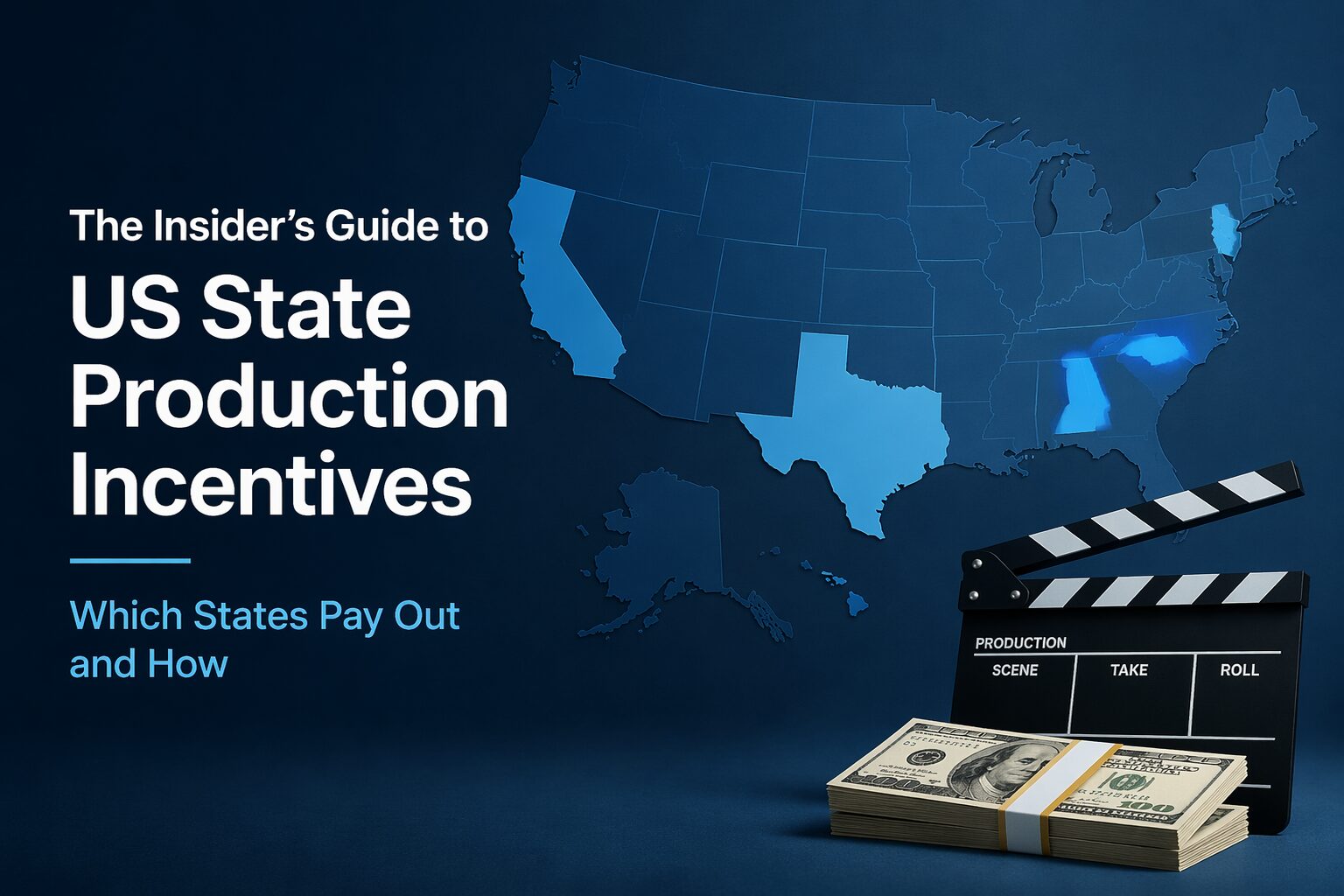
If you’re producing film or television in the United States, state tax incentives are one of the most significant financial levers available to you. The right state can put 20 to 35 cents back on every dollar of qualifying spend. The wrong approach — or no approach at all — leaves that money sitting on the balance sheet as a deferred asset rather than working capital.
This guide covers the six most active and valuable US state incentive programs in 2026: Georgia, New York, New Jersey, California, Illinois, and Louisiana. For each state, we cover credit rates, transferability, eligibility requirements, the application process, and what you actually need to know in practice.
Georgia — Entertainment Tax Credit
Georgia has been the dominant US production incentive state for over a decade, and its program remains one of the most generous and accessible in the country.
- Credit rate: 20% base credit on all qualified production expenditures. An additional 10% uplift applies if the production includes a Georgia promotional logo — bringing the effective rate to 30%.
- Transferability: Georgia credits are fully transferable to third parties. This is one of the key reasons Georgia remains so attractive: production companies that can’t fully absorb the credit internally can sell it to a Georgia-domiciled taxpayer or go through a credit broker/platform.
- Eligibility: Minimum spend of $500,000 in qualified Georgia expenditures per project. Qualifying spend includes above-the-line costs, crew wages, equipment, and facilities — provided the spend occurs in Georgia. Importantly, companies do not need to be headquartered in Georgia to qualify. A UK-based production company shooting in Atlanta qualifies on the same terms as a California-based one.
Application process: Credits must be certified by the Georgia Department of Economic Development and audited by a CPA firm registered with the state. The audit process typically
takes 3–6 months post-production. - Annual cap: No annual program cap — which means Georgia credits don’t disappear in a queue. This distinguishes it from states like California, where demand exceeds available credits.
- Practical note: Georgia is one of the few states with no sunset date on the current program. Stability matters for production planning — you can commit to a Georgia shoot with high confidence the incentive will still be there.
New York — Film Tax Credit Program
New York runs one of the largest and most active state production incentive programs in the country, with over $700 million in annual credit allocations.
- Credit rate: 25% base credit on qualified below-the-line New York expenditures. An additional 10% is available for productions spending in specific upstate counties, making the effective rate
up to 35% in those regions. A separate 5% credit applies to qualified post-production expenditures. - Transferability: New York credits are refundable — meaning the state will pay out the value of the credit directly if a company has no offsetting tax liability. This is a meaningful distinction from transferable programs: rather than selling the credit to a third party, a qualifying company can receive the cash directly from the state. The refundable structure is particularly valuable for independent production companies in a tax loss position.
- Eligibility: The production must spend at least $1 million in qualified New York expenditures per project. Feature films, TV series, and certain other formats qualify. Animation and postproduction have separate eligibility tracks.
- Application process: Applications are submitted to the Governor’s Office for Motion Picture & Television Development. Credits are allocated on a first-come, first-served basis from the annual pool. Getting into the queue early matters.
- Annual cap: $700 million per year. Demand regularly approaches this ceiling, so early filing is important.
- Practical note: New York’s refundability is a major advantage for companies that don’t have New York state tax liability. It removes the need to find a buyer for the credit — the state effectively becomes the buyer.
New Jersey — Film & Digital Media Tax Credit
New Jersey has significantly expanded its incentive program and is now one of the more competitive states in the Northeast corridor.
- Credit rate: 30% base credit on qualified New Jersey production expenses. The rate increases to 35% for certain productions that meet additional in-state spend thresholds.
- Transferability: New Jersey credits are transferable and can also be applied against corporate business tax or gross income tax. The transfer mechanism is well-established and the state has an active secondary market for credits.
- Eligibility: Minimum spend of $1 million in qualified New Jersey production costs. The production must spend a minimum percentage of its total budget in-state (typically 60% of below-the-line costs). Feature films, TV, streaming, and digital content all qualify.
- Application process: Applications are processed through the New Jersey Economic Development Authority. Credits are issued post-production following audit and certification.
- Annual cap: $100 million per year, expandable by the state. Applications that exceed the annual cap carry over to the following year’s allocation.
- Practical note: New Jersey’s proximity to New York makes it a practical alternative for productions that want Northeast infrastructure without competing for New York’s oversubscribed credit pool.
California — California Film Commission Tax Credit
California’s program is specifically designed to retain high-value productions in-state and has become more competitive in recent years following a significant program expansion.
- Credit rate: 20–25% on qualified California expenditures, depending on production type and whether the project meets certain employment criteria. Independent films and relocating productions may qualify for enhanced rates.
- Transferability: California credits are transferable to other California taxpayers or can be sold back to the state through the state’s own credit transfer program. The state program creates an
additional liquidity option that isn’t available in most other states. - Eligibility: Minimum spend thresholds vary by production type. Feature films: $1 million. TV series: $1 million per episode for series with budgets over $10 million. The production must shoot a minimum number of days in California and meet minimum California labor thresholds.
- Application process: Applications are submitted through the California Film Commission’s online portal. Credits are allocated through a scoring system that considers economic benefit to the state, jobs created, and other criteria — not purely first-come, first-served.
- Annual cap: $330 million per year. Competition is significant and not all applicants receive an allocation.
- Practical note: The California program is highly competitive and the allocation process is more complex than most states. Productions that don’t receive a California allocation often pivot to Georgia or New York — which is why the secondary market in those states is so active.
Illinois — Film Production Tax Credit
Illinois has a well-established incentive program and an active production hub in Chicago, with infrastructure to support both film and television.
- Credit rate: 30% on qualified Illinois production spending. An additional 15% applies specifically to wages paid to Illinois residents, making the effective blended rate attractive for productions with heavy local crew usage.
- Transferability: Illinois credits are transferable. The state has a functioning secondary market and credits are regularly bought and sold.
- Eligibility: Minimum spend of $100,000 on Illinois production activities — a notably lower threshold than most comparable states. This makes the program accessible to smaller and midbudget productions that might not qualify elsewhere.
- Application process: Credits are administered by the Illinois Department of Commerce & Economic Opportunity. The application process is straightforward, and credits are typically issued within 6–9 months post-production following audit.
- Annual cap: No program cap — similar to Georgia, Illinois doesn’t operate a first-come queue. This makes it easier to plan around.
- Practical note: The low minimum spend threshold is Illinois’s most distinctive feature. It opens the program to a wider range of productions and makes Illinois a viable option for projects that would fall below the qualification bar in New York or California.
Louisiana — Motion Picture Tax Credit
Louisiana was one of the original US film tax credit states and has one of the most developed secondary markets for credit transfers in the country.
- Credit rate: 25% base credit on all qualified Louisiana expenditures. An additional 10% applies to in-state resident labor — bringing the effective rate to 35% on local payroll.
- Transferability: Louisiana credits are highly transferable and the state maintains an active, liquid secondary market. The program has been running for long enough that buyers, brokers, and legal frameworks are well-established.
- Eligibility: Minimum spend of $300,000 in qualified Louisiana production costs. The production must spend the majority of its principal photography days in Louisiana. Feature films, TV, commercials, and video games qualify.
- Application process: Applications are processed through the Louisiana Office of Entertainment Industry Development. The certification and audit process runs 3–9 months post-production.
- Annual cap: $150 million per year, with a buyback option through the state for credits that can’t be sold on the secondary market. The state buyback program at a fixed rate (typically around 85– 88 cents on the dollar) provides a floor price for Louisiana credits.
- Practical note: Louisiana’s state buyback program is a unique backstop that most states don’t offer. It means Louisiana credit holders always have a minimum price option, which reduces uncertainty and can simplify monetization for companies that want a guaranteed exit at a predictable rate.
Summary Comparison
| State | Base Rate | Transferable / Refundable | Annual Cap | Min Spend |
| Georgia | 20–30% | Transferable | None | $500K |
| New York | 25–35% | Refundable | $700M | $1M |
| New Jersey | 30–35% | Transferable | $100M | $1M |
| California | 20–25% | Transferable | $330M | $1M |
| Illinois | 30–45%* | Transferable | None | $100K |
| Louisiana | 25–35% | Transferable + State Buyback | $150M | $300K |
*Illinois blended rate including resident labor uplift
What to Do With Your Credits
Understanding which states pay out and how is step one. Step two is knowing what to do with the credits once you’ve earned them — especially if your company isn’t in a position to absorb them internally.
If you have credits in any of these states and want to know what they could be worth — register your intent at vitrina.ai/credits. Takes under 5 minutes. No obligation.
Find Film+TV Projects, Partners, and Deals – Fast.
VIQI matches you with the right financiers, producers, streamers, and buyers – globally.
Producers Seeking Financing, Co-Pros, or Pre-Buys?
Vitrina Concierge helps producers reach the right financiers, commissioners, distributors, and co-production partners — with precision outreach, not cold pitching.
Join Industry Briefings Trusted by Leaders

Format Adaptations: Global Trends
Where formats are traveling, which adaptations are breaking out, and how streamers are backing remakes in 2025–2026.

Books, Novels & Comics Adaptations: Global Trends
Books, webtoons, and manga driving the next global screen hits. Discover how in this webinar.

Micro-Dramas & Mobile-First Storytelling
Micro-dramas are building real audiences and revenue. Understand the platforms, buyers, and economics behind the growth.

Navigating Global Content Licensing Trends
How global content licensing is shifting beyond flat fees to flexible, deal-driven models.