

 Global Content Pulse (Webinars)


 Global Production Financing
(Webinars)
Global Production Financing
(Webinars)  LeaderSpeak Podcast
  About Vitrina
 Our Story
 Our Solutions 🔥
 Film+TV Projects Tracker 🚀
 Case Studies
 Our Profile
The Economics of Season Renewals vs. New Productions: A Strategic Guide to Content Portfolio Management

Author: vitrina
Published: December 13, 2025
Hardik, article writer passionate about the entertainment supply chain—from production to distribution—crafting insightful, engaging content on logistics, trends, and strategy
Introduction
For the senior executive managing a multi-billion dollar content portfolio, the decision to greenlight a fresh concept versus ordering another season of an established hit is the most critical operational action.
It is the moment where capital is deployed against either high potential upside (New Production) or proven audience retention (Renewal). Failure to analyze this choice through a purely financial and supply-chain lens results in suboptimal returns.
The strategic error is treating Renewals vs. New Productions as an “either/or” creative choice rather than a portfolio risk management decision.
New productions carry an expensive failure premium; renewals, while predictable, carry escalating costs and a diminishing marginal return.
This guide dissects the economic calculus, providing the framework necessary to move beyond simple viewership metrics to a true Life Cycle Value (LCV) model for your content assets.
Table of content
- The Core Strategic Problem: Renewals vs. New Productions
- The Economics of Certainty: Cost Amortization and Renewals
- The Cost of Uncertainty: The Risk Premium in New Productions
- The Operational Divide: Supply Chain Efficiency in Renewals vs. New Productions
- How Vitrina Transforms Content Portfolio Management
- Strategic Imperative: Mastering the Capital Lifecycle
- Frequently Asked Questions
Key Takeaways
| Core Challenge | Strategic Solution | Vitrina’s Role |
| The inability to objectively compare the LCV of established titles (Renewals) against the systemic risk of unproven concepts (New Productions). | Implementing a dynamic content portfolio strategy that uses supply chain intelligence to de-risk new project development and benchmark renewal cost escalations. | Providing the real-time, verified data on talent, IP movement, and supplier track records to accurately model the future cost and execution risk of both new and renewed projects. |
The Core Strategic Problem: Renewals vs. New Productions
The primary function of a content portfolio manager is to balance the cost of acquisition with the value of retention. When analyzing Renewals vs. New Productions, you are essentially comparing two distinct financial strategies: Amortization and Discovery.
Renewals (The Amortization Strategy): This path leverages the sunk cost of the first season. The initial investment in IP acquisition, set building, pilot production, and core casting is already amortized over the first season’s life.
Subsequent seasons should—in theory—provide a higher marginal return because the audience is secured, and the fixed costs are absorbed. The primary financial challenge here is managing the inevitable escalation of above-the-line costs (talent negotiation) and retaining audience engagement.
New Productions (The Discovery Strategy): This represents a high-risk, high-reward deployment of capital. The cost is high because the entire financing structure must be rebuilt, the IP has zero proven audience value, and the supply chain (studio, vendors, crew) must be constructed from scratch.
The financial risk is that up to 70% of new projects may not be profitable, or worse, may fail to reach an audience at all, leading to rapid financial write-downs.
The Economics of Certainty: Cost Amortization and Renewals
Renewals are an investment in continuity and audience life cycle value (LCV). The financial model is grounded in the principle of diminishing marginal cost of acquisition (MCoA) and rising production costs.
The Amortization Advantage
The most significant financial benefit of a renewal is the amortization schedule. Assets created in Season 1 (sets, core VFX models, IP licensing, character design) are re-used.
This front-loaded expense is spread across the useful life of the asset, making the net cost of the second or third season significantly lower than the first, even if the gross budget is higher.
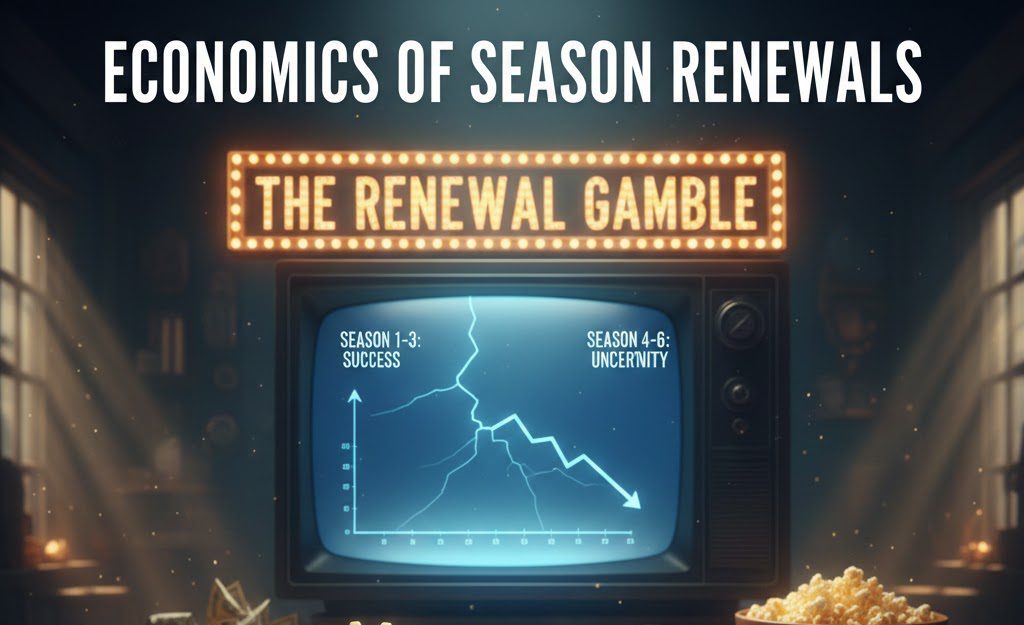
However, this advantage erodes quickly. Beyond Season 3 or 4, the financial benefits of amortization are often overtaken by contractual pressures.
The Cost of Success: Above-the-Line Escalation
Success is expensive. The primary risk in renewal economics is the rising cost of retaining key creative talent—writers, directors, and especially actors. Their compensation demands are directly linked to the show’s success and market leverage.
- Talent Negotiation: These costs often rise non-linearly, quickly consuming the marginal savings gained from amortization. Strategic executives must model the projected ROI against anticipated talent cost hikes, using competitive intelligence to anticipate negotiating positions.
- Contingency Creep: Renewals also suffer from “success inflation” in production—larger scope, more complex locations, and higher technical demands that expand the operational budget baseline.
The Cost of Uncertainty: The Risk Premium in New Productions
A new production is, fundamentally, an unhedged bet. The capital must absorb the entire development-pre-production risk spectrum. The financial model is weighted by a significant failure premium.
The Financial Write-Down Risk
The single greatest cost in a New Production is the possibility of a complete write-down. The entire sunk cost of the pilot, development, and marketing is lost if the project fails to gain traction and is canceled after one season. This failure premium must be mathematically factored across the entire slate—the success of a few must cover the losses of the many.
A visual comparison of the high initial investment curve for new content against the flatter, but gradually escalating, cost profile of renewed series.
The Opportunity Cost of Capital
Deploying capital on a new, unproven IP carries a hidden opportunity cost. That same capital could have been used for:
- High-Margin Acquisitions: Licensing known, high-performing library content.
- Strategic Co-Productions: Securing subsidized funding for a more de-risked project.
- Core IP Investment: Funneling resources into proven franchises.
Every new greenlight must be justified not just on its own potential, but on its superior expected value compared to every alternative use of the capital in the content acquisition strategy.
The Operational Divide: Supply Chain Efficiency in Renewals vs. New Productions
The strategic difference between Renewals vs. New Productions is most visible in the supply chain—the operational layer where capital is converted into a finished asset.
Renewal Efficiency (The Supply Chain Machine)
Renewed series leverage established operational flows:
- Vendor Lock-In: The same VFX house, post-production studio, and equipment supplier are often retained, leading to workflow familiarity and speed. This predictability reduces execution risk.
- Crew Continuity: A known crew reduces onboarding and training time, directly translating into less time on location and a tighter shooting schedule—a critical factor in controlling costs.
To manage a renewal effectively, executives must use tools like the Vitrina project-tracker to monitor the operational status and delivery cadence of established partners, mitigating the risk of performance fatigue or over-commitment.
New Production Inefficiency (The Supply Chain Build)
A new production requires the building of a supply chain from scratch, introducing multiple layers of execution risk.
- Partner Scouting: The finance and production teams must vet and contract new partners—from overseas studios to specialized VFX vendors—all while adhering to an aggressive pre-production schedule. This scouting process is often fragmented, leading to reliance on unverified or poorly benchmarked partners. The lack of verified partner data increases the risk of delay and cost overrun, a direct threat to the project’s financial structure.
- Compliance Risk: New cross-border productions require new co-production agreements and compliance with different tax incentive regimes, making the financial and legal structure inherently more fragile.
How Vitrina Transforms Content Portfolio Management
The core function of Vitrina is to provide the intelligence necessary to convert the high-risk unknowns of the M&E supply chain into actionable, predictable variables. For strategic executives making Renewals vs. New Productions decisions, Vitrina is the essential tool for objective analysis.
De-Risking New Production Scouting
Vitrina’s platform provides the only reliable mechanism for auditing the execution partners for a new project before capital is deployed.
The ability to filter a database of 300,000+ companies by specific, verifiable criteria—such as deal track record, genre expertise, and compliance history—means a new production’s supply chain can be built on fact, not speculation.
- Rapid Co-Production Vetting: Quickly identify companies in key tax-incentive territories with a proven track record of securing local soft money, reducing the project’s senior debt requirement and minimizing its exposure to high-interest financing.
- Talent Mobility Tracking: Monitor the movement of key above-the-line talent across competing projects, providing early warning signs of potential scheduling conflicts that could jeopardize a renewal or delay a new project.
Benchmarking Renewal Cost Escalation
For established hits, Vitrina provides the data to benchmark future costs:
- Competitive Cost Analysis: By tracking the global flow of talent and projects, executives can benchmark the compensation demands of their core cast and crew against similar successes across the industry, strengthening their position in talent negotiation.
- Vendor Performance Audit: Verify the operational health and capacity of key vendors (VFX, Post) who are retained for renewed seasons. If a long-time partner is suddenly overloaded with other high-profile work, this serves as an early indicator of potential operational drag and subsequent cost overruns for the renewal.
The strategic integration of this intelligence elevates content acquisition strategy from a creative gamble to a measurable, data-driven financial process.
Strategic Imperative: Mastering the Capital Lifecycle
In an era of rising production costs and audience saturation, the most critical skill for the M&E executive is the mastery of content asset valuation.
The economic analysis of Renewals vs. New Productions must be framed by the ability to quantify risk in both scenarios.
Renewals offer predictability but demand strict management of cost creep. New productions offer upside but require deep, verified intelligence to avoid catastrophic write-downs.
The strategic imperative is to leverage intelligence platforms to move all projects—whether established hits or high-risk concepts—out of the realm of speculation and into the domain of measurable execution, ensuring every capital decision is optimized for long-term portfolio value.
Frequently Asked Questions
Generally, the first season of an established hit (a renewal) is cheaper than a brand new production due to the amortization of initial fixed costs like sets, IP acquisition, and pilot production. However, this cost advantage diminishes rapidly due to escalating talent compensation and creative scope creep.
The main financial risk of a new production is the risk of total failure, resulting in a full write-down of the capital deployed. Since the project has no proven audience, there is a high probability that the entire investment in development and the first season will be lost if the series is cancelled early.
Cost amortization allows fixed, non-recurring expenses from the first season (e.g., sets, costumes, IP setup) to be spread across subsequent seasons. This lowers the effective production cost per season, making renewals financially attractive until rising talent and production costs eventually outweigh the amortization benefit.
Major cost savings in a season renewal come from two primary areas: the amortization of assets and the operational efficiencies of using an established production workflow, including a pre-vetted crew and vendor base, which reduces time-consuming and expensive pre-production delays.