

 Companies
  Content
 Global Content Pulse (Webinar)

 Global Production Financing (Webinar)
  LeaderSpeak Podcast
  Latest Projects
 Global Trends
 About Projects Tracker
 About Vitrina
 Our Story
 Our Solutions 🔥
 Case Studies
 Our Profile
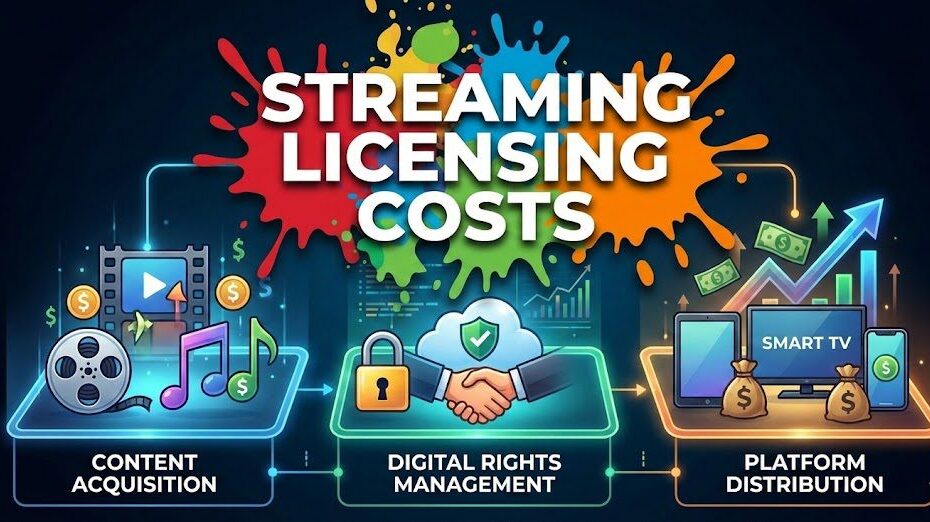
Streaming licensing costs are the fees paid by platforms to content owners for the legal right to distribute media across digital channels, typically structured as flat fees, revenue shares, or minimum guarantees.
This process involves negotiating territorial rights, duration of exclusivity, and platform-specific usage (SVOD, AVOD, or FAST) to ensure financial viability.
According to recent industry analysis, the average cost for premium episodic content has surged by 45% since 2022, forcing platforms to adopt “Weaponized Distribution” strategies to recoup sunk assets.
In this guide, you will learn the nuances of licensing agreements, compare the long-term profitability of different financial models, and discover how to leverage supply chain intelligence to optimize ROI.
While traditional resources provide basic listicles of service costs, they often lack the technical depth required to navigate complex royalty structures and the long-term financial shifts impacting the industry.
This comprehensive guide fills those gaps by providing an expert-level analysis of licensing frameworks, from educational content nuances to commercial profitability optimization.
Table of Contents
- 01What are Streaming Licensing Costs?
- 02Nuances of Licensing Agreements: Distribution Rights
- 03Commercial vs. Educational Content Pricing
- 04SVOD vs. AVOD vs. FAST: Financial Implications
- 05Optimizing Profitability in Licensing Deals
- 06Using Supply Chain Intel for Licensing Negotiation
- 07Key Takeaways
- 08FAQ
- 09Moving Forward
Key Takeaways for Acquisition Leads
-
Structural Nuances: Content types (educational vs. commercial) dictate pricing; educational licenses often involve multi-year institution-wide rights, while commercial deals target transactional or ad-supported models.
-
Model Impact: While SVOD offers upfront cash through flat fees, AVOD and FAST models leverage revenue-share structures that provide long-tail earnings but require higher audience volume to reach profitability.
-
Strategic Co-opetition: “Frenemy Pacts”—like Amazon licensing content to Netflix—demonstrate a shift toward weaponized distribution where ROI is prioritized over platform exclusivity.
-
Intelligence Advantage: Acquisition teams tracking 140,000+ global distributors through supply chain data identify active titles and available rights 5x faster than manual sourcing.
What are Streaming Licensing Costs?
Streaming licensing costs represent the financial engine of the digital media ecosystem. They are the expenses incurred by Over-the-Top (OTT) platforms to secure distribution rights for films, TV series, and documentaries. These costs are rarely fixed; they fluctuate based on the popularity of the IP, the number of territories covered, and the duration of the license window.
As the industry shifts away from the “Streaming Wars” toward a more collaborative market, licensing has become a critical tool for “Weaponized Distribution.” Platforms are no longer just hoarding content; they are licensing high-value assets to rivals to maximize ROI on “sunk” production costs. Understanding the underlying financial structures of these deals is essential for any acquisition lead aiming to build a profitable library.
Analyze recent content acquisition trends for major streamers:
Nuances of Licensing Agreements: Distribution Rights
Licensing agreements in 2025 are significantly more complex than the binary “buy/sell” deals of the past. Modern contracts include granular clauses for “rotational windows,” where content may be exclusive to a platform for 18 months before moving to a shared or ad-supported window. These nuances directly impact the upfront licensing cost and long-term revenue potential.
- Territorial Fragmentation: Rights are often sliced by region, requiring platforms to manage dozens of individual licenses for a single “global” title.
- Language & Localization: Costs for dubbing and subtitling are often shared or negotiated as part of the primary license fee to ensure cross-border appeal.
- Royalty Calculations: Modern deals incorporate “viewing data” metrics, where a portion of the fee is contingent on performance, a strategy Netflix pioneered to align cost with actual consumption.
Industry Expert Perspective: AVOD, FAST, and Beyond with Whip Media
Carol Hanley, CEO of Whip Media, explains how platforms are navigating the future of streaming solutions through advanced analytics. This is critical for understanding how royalties and revenue tracking impact the final licensing cost.
Whip Media discusses tailored solutions for FAST and SVOD owners, focusing on audience insights and automated reporting to manage the complex licensing fees associated with fragmented digital distribution.
Commercial vs. Educational Content Pricing
Pricing structures vary wildly between genres. Commercial licensing for blockbusters or premium episodic series typically follows a “High-Value, Low-Duration” model, where platforms pay significant minimum guarantees for short, exclusive windows. In contrast, educational or documentary content often utilizes a “Library Growth” model with lower upfront fees but longer-term, non-exclusive rights.
For educational content, licensing is often negotiated with institutional aggregators (e.g., Kanopy or Alexander Street) rather than direct-to-consumer platforms. These deals prioritize accessibility and citation rights over mass-market viewership, creating a stable, albeit lower-revenue, stream compared to the volatile commercial market.
Find regional documentary content with available rights:
SVOD vs. AVOD vs. FAST: Financial Implications
The choice between Subscription (SVOD), Advertising (AVOD), and Free Ad-Supported Streaming TV (FAST) has profound long-term financial implications. SVOD relies on high retention and “perceived value,” often justifying massive flat-fee licensing for flagship originals like “Stranger Things.” However, as churn increases, platforms are shifting toward AVOD and FAST models.
AVOD and FAST licensing often involves revenue-share models (e.g., 50/50 split of ad revenue). While this reduces the platform’s upfront risk, it requires the content to maintain consistently high viewership to be profitable for the creator. Strategic acquisition teams are now balancing their libraries with a mix of these models to mitigate the “sunk cost” of underperforming premium assets.
Optimizing Profitability in Licensing Deals
To optimize profitability, acquisition leads are moving toward “Data-Driven Acquisitions.” By analyzing vast amounts of viewing data—including what users pause, rewind, or stop watching—platforms can predict the ROI of a licensing deal before the contract is signed. This predictive analysis reduces the likelihood of overpaying for content that doesn’t align with audience habits.
“The shift from licensing to controlling Intellectual Property (IP) through Netflix Originals was a strategic move to build a competitive moat and create long-term value not subject to expiring deals.”
Using Supply Chain Intel for Licensing Negotiation
Vitrina AI functions as a “digital lighthouse” for the media supply chain, providing the structured intelligence needed to identify active content and available rights. By mapping 30 million industry relationships, Vitrina’s VIQI AI Assistant allows acquisition leads to ask complex questions like “Who is currently licensing K-dramas for the Latin American market?” or “What are the recent licensing trends for WBD’s animation slate?”
This supply-chain visibility empowers teams to qualify partners based on verifiable track records and specialization. For example, SBT Brazil utilized Vitrina’s custom solutions to streamline the acquisition of international content, curating a library of acclaimed films for their viewers while managing cost-efficiency.
Explore trending content and available IP:
Frequently Asked Questions
Quick answers to complex queries about streaming licensing costs.
What are typical streaming licensing fees?
How do AVOD licensing costs differ from SVOD?
What is ‘Weaponized Distribution’ in streaming?
How long do content licensing agreements usually last?
What are ‘territorial rights’ in streaming?
Can data intelligence help reduce licensing costs?
What is the ‘rotational window’ strategy?
How do FAST channels monetize licensed content?
Moving Forward
The digital distribution landscape has moved beyond simple subscription models to a complex, multi-layered financial ecosystem. This transformation addresses the identified market gaps: the need for deep licensing insights, the comparison of SVOD/AVOD profitability, and the role of supply chain intelligence in optimizing ROI. By adopting data-driven negotiation strategies, platforms can transform licensing from a significant expense into a strategic growth lever.
Whether you are an acquisition lead looking to secure trending regional titles or a strategy officer balancing ad-supported and premium windows, the principle remains: actionable intelligence drives deal velocity. Understanding where rights are available and how to structure them for maximum profitability is the defining skill of the modern media executive.
Outlook: Over the next 12-18 months, revenue-share models and performance-based licensing will likely become the dominant deal structure, as platforms seek to share financial risk with content creators.
About the Author
Lead Supply Chain Analyst at Vitrina AI with over 12 years of experience in content acquisition and vendor evaluation for global streamers. Connect on Vitrina.