About Innovation Hub
 Global Content Pulse (Webinars)


 Global Production Financing
(Webinars)
Global Production Financing
(Webinars)  LeaderSpeak Podcast
  About Vitrina
 Our Story
 Our Solutions 🔥
 Film+TV Projects Tracker 🚀
 Case Studies
 Our Profile
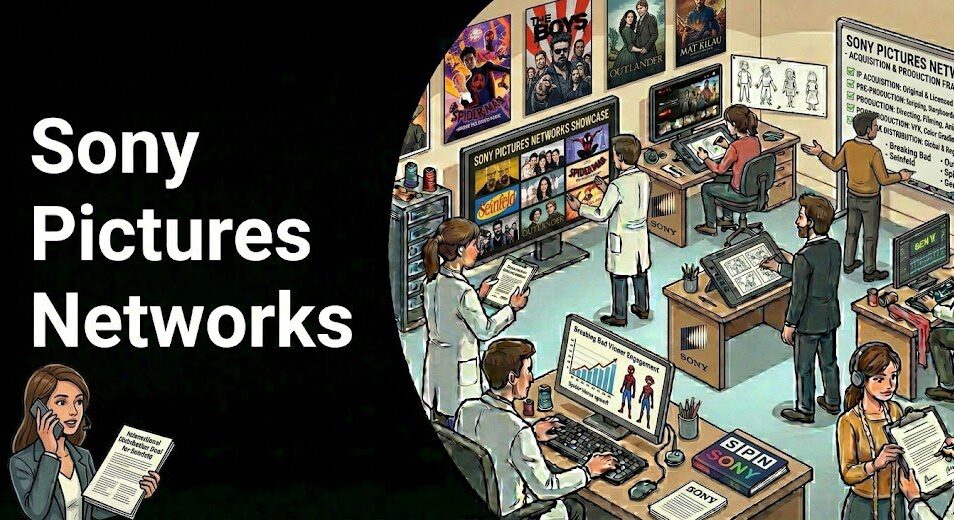
When you look at how Sony Pictures Networks has evolved over the past decade, it’s a case study in what it actually means to build a multi-platform entertainment powerhouse in the world’s most competitive content market. India isn’t a side market for Sony anymore. It’s the engine—a 1.4 billion person Sovereign Content Hub where linear channels, OTT, sports rights, and original production have to work as a single integrated strategy or they don’t work at all.
Sony Pictures Networks India—operating across 26+ channels spanning entertainment, sports, movies, kids, and factual—sits at the intersection of one of the most dramatic shifts in global media: the simultaneous compression of the traditional broadcast window and the explosion of digital-first demand from an audience that’s young, mobile-first, and increasingly sophisticated about what they want to watch.
For producers, distributors, and co-production partners trying to get into Sony’s content pipeline, understanding that strategic context isn’t optional. It’s the difference between pitching to the right desk and disappearing into a slush pile.
TABLE OF CONTENTS
- Sony Pictures Networks: The Multi-Channel Architecture
- Sony LIV and the OTT Acceleration Play
- Sports Rights as Strategic Infrastructure
- Content Acquisition and Original Production Strategy
- How Sony’s Global Supply Chain Creates Opportunity for Sellers
- India’s Sovereign Hub Status and What It Means for Sony’s Future
- Frequently Asked Questions
- Key Takeaways
Track Sony’s Content Pipeline Before It Hits the Trades
Vitrina maps active acquisition, co-production, and commissioning activity across 140,000+ companies—including Sony’s complete supply chain across channels, OTT, sports, and originals. Know what Sony’s buying before it’s announced.
200 free credits · No credit card required · Trusted by teams at Netflix, Warner Bros, Paramount, and Google TV
Sony Pictures Networks: The Multi-Channel Architecture
Sony Pictures Networks India (SPN) isn’t a single broadcaster with a streaming add-on. It’s a deliberately layered content infrastructure—linear, digital, sports, kids, factual—each channel serving a distinct audience segment while feeding a unified distribution pipeline. That architecture matters enormously if you’re trying to sell content into it or partner with it.
The flagship Sony Entertainment Television (SET) anchors the general entertainment channel category—one of the most fiercely contested spaces in Indian television, where Zee, Star, and Colors compete for the same primetime appointment viewing. SET’s programming has historically balanced mass-market drama and reality formats, with shows like Kaun Banega Crorepati (the Indian Who Wants to Be a Millionaire) representing the kind of tentpole event television that still commands extraordinary linear ratings.
Sony SAB targets a younger, urban comedy audience—a deliberate counter-programming strategy against the soap-heavy competition. Sony MAX and Sony MAX2 carry the Bollywood and Hollywood theatrical catalogue. And Sony LIV, launched as the digital flagship, increasingly becomes the destination for what the Indian industry calls “prestige content”—limited series, originals, and exclusive international acquisitions that don’t fit the mass-market linear template.
Then there’s the kids and factual tier: Sony YAY! in children’s entertainment and Sony BBC Earth—a joint venture with BBC Studios that gives Sony access to some of the world’s most globally valuable natural history and factual IP. That BBC Earth partnership alone is a case study in how Weaponized Distribution creates mutual value: BBC Studios gains domestic India penetration; Sony gains BBC’s premium content identity and international IP pedigree.
The breadth of this channel architecture means Sony’s content acquisition needs are genuinely multi-dimensional. Drama, comedy, reality formats, sports, kids animation, factual documentaries, Hollywood titles—all of these feed different channels simultaneously. For content sellers, the question isn’t “does Sony buy your genre?” It almost certainly does. The question is which desk, which channel, and which acquisition window you’re targeting.
Vitrina’s Sony supply chain intelligence maps these distinct buying arms and their active acquisition patterns—so you can approach the right decision-maker at the right time, rather than carpet-bombing a generic content submission inbox.

Your AI Assistant, Agent, and Analyst for the Business of Entertainment
VIQI AI helps you plan content acquisitions, raise production financing, and find and connect with the right partners worldwide.
- Find active co-producers and financiers for scripted projects
- Find equity and gap financing companies in North America
- Find top film financiers in Europe
- Find production houses that can co-produce or finance unscripted series
- I am looking for production partners for a YA drama set in Brazil
- I am looking for producers with proven track record in mid-budget features
- I am looking for Turkish distributors with successful international sales
- I am looking for OTT platforms actively acquiring finished series for the LATAM region
- I am seeking localization companies offer subtitling services in multiple Asian languages
- I am seeking partners in animation production for children's content
- I am seeking USA based post-production companies with sound facilities
- I am seeking VFX partners to composite background images and AI generated content
- Show me recent drama projects available for pre-buy
- Show me Japanese Anime Distributors
- Show me true-crime buyers from Asia
- Show me documentary pre-buyers
- List the top commissioners at the BBC
- List the post-production and VFX decision-makers at Netflix
- List the development leaders at Sony Pictures
- List the scripted programming heads at HBO
- Who is backing animation projects in Europe right now
- Who is Netflix’s top production partners for Sports Docs
- Who is Commissioning factual content in the NORDICS
- Who is acquiring unscripted formats for the North American market
Sony LIV and the OTT Acceleration Play
Sony LIV has become the most strategically interesting asset in Sony’s Indian portfolio—and the one that signals where the company’s long-term content investment is headed. India’s OTT market has exploded: as reported by Variety, India’s streaming subscriber base crossed 100 million paid subscriptions across platforms, with mobile-first consumption driving content requirements that look nothing like traditional linear television.
Sony LIV’s strategy is built around three distinct content pillars. First, exclusive sports rights—particularly cricket, which is effectively India’s must-have streaming acquisition and which we’ll address in more depth below. Second, exclusive international content—deals with HBO, Showtime, and other premium Western networks give Sony LIV a prestige programming layer that differentiates it from the Bollywood-heavy competition. Third, originals—a growing slate of limited series and event dramas commissioned specifically for the LIV platform.
But here’s what most outside observers miss about Sony LIV’s positioning. Unlike Netflix’s India strategy—which targets a premium, internationally-minded urban audience—Sony LIV is explicitly trying to serve both the urban streaming-native audience and the traditional Sony television viewer making the shift to on-demand. That means you don’t need prestige credentials to get into LIV’s content mix. Mass-market drama, event reality, and high-volume genre content all have a place in their acquisition pipeline. The distribution calculus is different from what you’d use when pitching to Disney+ Hotstar or Netflix.
Sports Rights as Strategic Infrastructure
You can’t understand Sony Pictures Networks’ strategy without understanding how sports rights function in the Indian market. This isn’t about sports programming in the traditional sense. In India, cricket rights are effectively the gateway to mass streaming adoption—they’re the reason households download and maintain OTT subscriptions, and they’re the anchor around which entire content slates are built.
Sony’s sports infrastructure includes the Sony Ten channel family—Ten 1, Ten 2, Ten 3—covering football, tennis, motorsport, WWE, and international cricket. These aren’t peripheral channels. They’re the ROI engine that justifies Sony’s entire platform investment, because live sport drives both linear ratings and streaming subscription conversions in ways that scripted drama simply cannot.
The strategic insight here is replicable for international sports rights holders. If your sports IP has Indian audience appeal—and increasingly, Premier League football, Formula 1, and tennis do—Sony’s sports acquisition desk represents one of the most active buyers in the Asia-Pacific region. The deal structures they’re comfortable with, the windowing arrangements between linear and digital, and the sub-licensing appetite across their channel portfolio all create multiple entry points that aren’t obvious from the outside.
Identify Sony’s Active Acquisition Windows Across Every Channel
Vitrina tracks deal flow across 400,000+ projects globally—including Sony’s channel-by-channel acquisition activity, commissioning patterns, and co-production partnerships. Get in front of the right desk before the window closes.
200 free credits · No credit card required · Join 140,000+ entertainment companies worldwide
Content Acquisition and Original Production Strategy
Sony’s content acquisition strategy in 2025 operates across two very different logic systems—and confusing them is one of the most common mistakes international sellers make when approaching the company.
The linear channel acquisition model is volume-driven and cost-sensitive. Sony’s GEC channels need hundreds of hours of content annually to fill prime time, weekend slots, and afternoon programming across 26+ channels. The economics here are built around MGs (minimum guarantees), licence fees, and territorial exclusivity windows that Indian broadcasters have refined over decades. International sellers who understand Indian broadcast deal structures—episode volumes, dubbed language requirements, clearance for broadcast in India including certification compliance—can access a genuinely large buying appetite.
The Sony LIV originals model is different. Here, the acquisition criteria look more like a streaming platform’s commissioning logic—concept-driven, talent-attached, with a pitch process that rewards strong IP fundamentals and cultural specificity. Sony LIV’s original commissions have included drama series, reality formats, and event specials. And unlike linear acquisitions, original commissions typically involve the platform retaining broader digital rights across territories and windows—so the deal structure looks closer to what you’d negotiate with a regional SVOD player than a traditional network.
International formats have historically been a significant part of Sony’s content strategy. Who Wants to Be a Millionaire, launched as KBC in India, is the template—an international format localised with a local host, local cultural references, and Indian audience sensibilities. Sony SAB has also been an active format buyer across comedy and reality. For format rights holders, Sony is one of the most sophisticated buyers in the APAC region, with a track record of format longevity that most markets can’t match.
If you want a framework for evaluating whether your content fits Sony’s acquisition appetite, our guide to Sony Pictures Entertainment’s content strategy breaks down the full acquisition logic across their global portfolio—not just India.
How Sony’s Global Supply Chain Creates Opportunity for Sellers
Here’s the insight that most content sellers miss. Sony Pictures Networks India doesn’t operate in isolation from the broader Sony Pictures Entertainment global structure. What looks like a local broadcaster from the outside is actually a node in a global content supply chain that spans production, acquisition, format rights, international distribution, and technology—all the way up to Sony’s Tokyo parent.
That means deals made in India can have global implications. Content that performs on SET or Sony LIV becomes data that informs Sony’s international distribution pipeline. Format rights acquired in India can trigger adaptation discussions in Southeast Asia, the Middle East, and beyond. And Sony’s relationship with BBC Studios through Sony BBC Earth creates a pathway for international factual and natural history content that isn’t available through any other Indian broadcaster.
But—and this is the Fragmentation Paradox in action—most producers and distributors trying to access Sony’s supply chain have no visibility into how that network actually connects. Which Sony entity handles which acquisition category? Who are the commissioning contacts for Sony LIV originals versus SET? How does a deal with Sony India connect to Sony’s international distribution arm?
These are intelligence questions, not just relationship questions. And without verified data on Sony’s active deal flow across channels, platforms, and territories, you’re approaching one of the world’s most complex media companies with a cold pitch and a prayer. That’s a 6-month timeline problem masquerading as a content quality problem. As we’ve explored in our analysis of Sony, Zee, Fremantle, and FilmCity’s virtual production trends, the complexity of India’s media ecosystem means intelligence advantages compound across every deal cycle.
India’s Sovereign Hub Status and What It Means for Sony’s Future
India is Vitrina’s definition of a fully operational Sovereign Content Hub—a territory where government-backed cultural policy, massive domestic market scale, and a globally-competitive production infrastructure combine to create an environment that doesn’t just service Western productions but competes with them.
With a 1.4 billion person domestic audience, a film industry producing more films annually than Hollywood, and a streaming market adding tens of millions of subscribers per year, India’s entertainment infrastructure is growing faster than most Western markets can track. Sony Pictures Networks sits at the centre of that expansion—with a channel portfolio, a streaming platform, and a sports rights infrastructure that gives it structural advantages no new entrant can quickly replicate.
What does this mean for the global content market? Several things. First, India’s content—drama, comedy, reality, factual—has proven international export value that’s only beginning to be systematically tapped. Korean drama’s global moment took years to materialise; India’s could follow a similar trajectory. Sony’s international distribution infrastructure, backed by Sony Pictures Entertainment’s global reach, gives SPN content a potential global window that most Indian broadcasters simply don’t have. Second, India’s cost competitiveness as a production hub means international co-productions routed through India can access both Sony’s domestic distribution and significant cost advantages versus Western production—particularly for VFX, post-production, and animation work.
For producers and content companies trying to connect with Sony Pictures Networks’ supply chain—whether as content sellers, co-production partners, or service vendors—Vitrina’s real-time intelligence maps the full picture: which Sony entities are actively buying what, at what price points, through which deal structures, and which contacts are making those decisions right now.
Need a Direct Route into Sony’s Acquisition Team?
Vitrina’s Concierge Service gives you dedicated intelligence support—mapping Sony’s active acquisition contacts by channel and platform, identifying the right pitch window, and connecting you with verified co-production partners who already operate inside Sony’s supply chain. No cold-call cycles. No months lost in the wrong inbox.
Used by teams at Netflix, Warner Bros, Paramount, and Google TV to accelerate supply chain deal flow
Frequently Asked Questions: Sony Pictures Networks
What channels does Sony Pictures Networks India operate?
Sony Pictures Networks India operates over 26 channels across multiple genres. Key channels include Sony Entertainment Television (SET) for general entertainment, Sony SAB for comedy, Sony MAX and Sony MAX2 for movies, Sony LIV for streaming, Sony Six and Sony Ten for sports, Sony YAY! for children’s programming, and Sony BBC Earth for factual and natural history content through its joint venture with BBC Studios.
What is Sony LIV’s content strategy?
Sony LIV’s content strategy is built around three pillars: exclusive sports rights (particularly cricket), exclusive international content from premium Western networks including HBO, and a growing slate of original commissions developed specifically for the platform. Unlike Sony’s linear channels, LIV targets both urban streaming-native audiences and traditional Sony viewers transitioning to on-demand consumption, making its acquisition appetite broader than most international streaming platforms.
How does Sony Pictures Networks acquire international content?
Sony Pictures Networks acquires international content through multiple pathways: format rights (for adaptation on linear channels like SET and SAB), finished programme acquisitions for linear transmission windows, exclusive streaming rights for Sony LIV, and sports rights through its Sony Ten channel portfolio. The acquisition desk, required rights clearances, deal structures, and episode volume requirements differ significantly between linear and streaming acquisition tracks.
What is the Sony BBC Earth partnership?
Sony BBC Earth is a joint venture between Sony Pictures Networks India and BBC Studios, operating as a factual and natural history channel in India. The partnership gives Sony access to BBC Studios’ globally renowned natural history and factual IP—including Planet Earth and Blue Planet titles—while providing BBC Studios with premium domestic India distribution across one of the world’s largest television markets.
How does Sony Pictures Networks fit within Sony Pictures Entertainment globally?
Sony Pictures Networks India operates as a subsidiary of Sony Pictures Entertainment—the US-based film and television studio backed by Sony Group Corporation. This global structure means content deals with Sony India can have international distribution implications, format acquisitions can trigger adaptation discussions across Sony’s global network, and co-production partnerships routed through India can access Sony’s worldwide distribution infrastructure.
How can producers and content sellers connect with Sony Pictures Networks?
Effective engagement with Sony Pictures Networks requires targeting the correct acquisition desk by channel type and content category—SET, SAB, Sony LIV, Sony Ten, and Sony BBC Earth each have separate commissioning and acquisition functions. Vitrina maps Sony’s complete supply chain including active acquisition contacts, deal patterns, and co-production partnerships. With 140,000+ verified companies tracked and 400,000+ projects monitored, Vitrina gives content sellers the intelligence to approach the right Sony desk at the right time.
What role does India play in Sony’s global content strategy?
India functions as a fully operational Sovereign Content Hub for Sony—a 1.4 billion person domestic market with globally competitive production infrastructure and an exploding streaming subscriber base. For Sony Pictures Entertainment globally, SPN India provides both a massive distribution platform for Sony’s international IP and an origination base for Indian content with genuine international export potential. India’s cost competitiveness in VFX, post-production, and animation also makes it an increasingly attractive co-production partner for international projects seeking both APAC distribution and production cost advantages.
Key Takeaways: Accessing Sony Pictures Networks’ Supply Chain
Sony Pictures Networks’ global entertainment strategy is more accessible than it looks from the outside—if you understand its structure. Here’s what to act on:
- Target the right desk, not the company: Sony Pictures Networks India operates 26+ channels across distinct content categories. Linear acquisition, Sony LIV streaming rights, format commissioning, and sports rights are all separate purchasing decisions handled by different teams with different criteria.
- Understand the dual acquisition logic: Linear channels operate on volume and cost-efficiency; Sony LIV operates on concept quality and digital-first audience fit. Both are real opportunities—but they require different pitch strategies and deal structures.
- The Sony BBC Earth partnership opens a factual entry point: Natural history, science, environment, and premium factual content has a dedicated channel and acquisition track through the BBC Studios joint venture—one that most international factual producers overlook.
- India’s Sovereign Hub status amplifies Sony’s co-production value: A co-production routed through Sony’s India infrastructure gives you both domestic Indian distribution across 26+ channels and access to Sony Pictures Entertainment’s global rights and distribution network—with India’s production cost advantages baked in.
- Use Vitrina to map the supply chain before you pitch: With 200 free credits and no credit card required, you can start tracking Sony’s active acquisition windows, commissioning patterns, and supply chain relationships today—and approach the right contacts with real intelligence behind you.
Map Sony’s Complete Supply Chain with Vitrina
Track Sony’s active acquisition activity across channels, platforms, and territories. Access verified contacts. Identify co-production partners. Get deal flow intelligence on 400,000+ projects before they hit the trades—with 200 free credits to start.
No credit card required · Trusted by Netflix, Warner Bros, Paramount, Google TV, and 140,000+ entertainment companies worldwide
Find Film+TV Projects, Partners, and Deals – Fast.
VIQI matches you with the right financiers, producers, streamers, and buyers – globally.
Producers Seeking Financing, Co-Pros, or Pre-Buys?
Vitrina Concierge helps producers reach the right financiers, commissioners, distributors, and co-production partners — with precision outreach, not cold pitching.
Join Industry Briefings Trusted by Leaders
Streamers – Netflix vs. Amazon – The 2026 Strategy
How Netflix and Amazon’s content and revenue strategies are diverging ahead of 2026.

Format Adaptations: Global Trends
Where formats are traveling, which adaptations are breaking out, and how streamers are backing remakes in 2025–2026.

Books, Novels & Comics Adaptations: Global Trends
Books, webtoons, and manga driving the next global screen hits. Discover how in this webinar.

Micro-Dramas & Mobile-First Storytelling
Micro-dramas are building real audiences and revenue. Understand the platforms, buyers, and economics behind the growth.