About Innovation Hub
 Global Content Pulse (Webinars)


 Global Production Financing
(Webinars)
Global Production Financing
(Webinars)  LeaderSpeak Podcast
  About Vitrina
 Our Story
 Our Solutions 🔥
 Film+TV Projects Tracker 🚀
 Case Studies
 Our Profile

Choosing between a Single-Purpose Vehicle (SPV) and a Slate Equity deal is the most critical structural decision in modern media finance, dictating both capital efficiency and “Weaponized Distribution” potential.
As the entertainment supply chain metamorphoses into a data-powered ecosystem, the traditional “one-off” model is increasingly reserved for high-agility, single-territory projects, while slates are becoming the institutional standard for global “Weaponized” licensing.
Recent market data indicates that slate-based financing structures offer a 25% better loss-mitigation profile compared to isolated project investments.
This guide analyzes the trade-offs between project concentration and portfolio diversification, providing actionable signals for when to pivot your deal structure.
While legacy finance blogs focus on basic tax credits, they miss the supply chain maturity metrics that separate a successful slate from a fragmented collection of failures.
This comparison leverages Vitrina’s 1.6M title tracker to provide a data-validated roadmap for private equity and institutional investors.
Strategic Comparison
Structural Comparison at a Glance
-
SPV Advantage: Ideal for high-net-worth (HNW) investors targeting a specific “A-List” asset or territory-specific tax credit (e.g., UK EIS/SEIS or Saudi rebate).
-
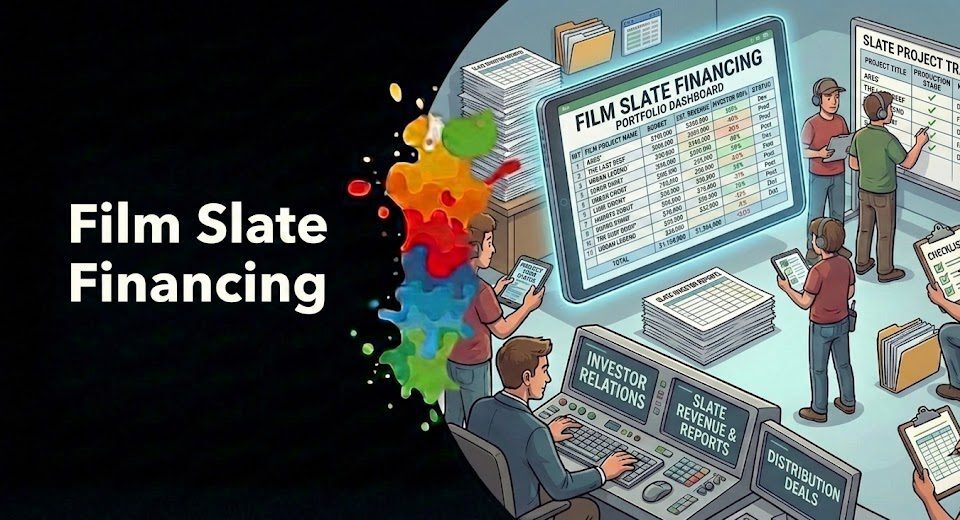
Slate Advantage: Better for institutional capital and family offices looking to spread risk across 3-10 projects, leveraging “Weaponized Distribution” across rival platforms.
-
Decision Metric: If the project relies on a single “hit” narrative, use SPV. If it relies on a sustainable “supply chain” narrative, use Slate.
The SPV Model: High-Precision, Single-Asset Agility
Single-Purpose Vehicles (SPVs) are the surgical tools of film finance. They allow for the isolation of liability and the precise allocation of rights for a single title. For independent producers, the SPV is essential when a project has a “star-driven” financing model where the primary value is tied to a specific cast or director’s availability.
However, the “data deficit” in SPVs can be catastrophic. Without a diversified portfolio, a single delay in the supply chain—such as a post-production bottleneck—can lead to total capital loss. This is where Vitrina’s Global Film+TV Projects Tracker becomes vital, allowing SPV managers to monitor real-time vendor activity and reputation scores for their specific supply chain partners.
Analyze production risks for single assets:
Institutional Perspective: Bridging Art and Enterprise
Kirsty Bell of Goldfinch explains how shifting from one-off projects to disciplined slate models ensures financial sustainability and creative freedom.
Structural Insight
Goldfinch’s model proves that “Slate Equity” is not just about more movies—it is about creating a sustainable ecosystem where diverse revenue streams (vertical series, global creative economies) de-risk the investor’s core capital.
The Slate Strategy: Portfolio De-Risking and Cross-Collateralization
Slate Equity deals are designed for the “Streaming Era.” They allow for cross-collateralization, where the profits of a breakout hit can cover the “sunk costs” of underperforming titles. This is the bedrock of “Weaponized Distribution,” where a slate of 10 titles can be licensed as a package to rival platforms, maximizing the recoupment waterfall for private equity investors.
To build a successful slate, producers must tap into Global Creative Economies across the Middle East, Africa, and Asia. Using Vitrina’s Market Intelligence Webinars, slate managers can identify which regions are offering the highest “Tax Alpha”—subsidizing production costs by up to 40%—to ensure the slate remains financially robust even if individual titles underdeliver.
Build your slate with global incentives:
The Tipping Point: When to Pivot Deal Structures
When should a producer move from an SPV to a Slate? The signal is usually tied to Supply Chain Maturity. If your data reveals a “Weaponized Distribution” opportunity—where you can license a specific genre across multiple platforms—you have the infrastructure for a slate.
According to Vitrina AI benchmarks, projects in territories with over $1B in annual production activity are prime candidates for slate financing. At this volume, the market has enough verified vendors (140,000+) and decision-makers (3M+) to sustain a multi-project throughput without the single-point-of-failure risks associated with smaller hubs.
Vetting Your Deal Ecosystem with Vertical AI
The metamorphosis of the media supply chain has made manual networking obsolete. Investors in 2026 are using VIQI, Vitrina’s Vertical AI assistant, to qualify the specialized deals within their portfolios. VIQI understands industry context, mapping 30 million relationships to provide strategic answers on project status and executive movements.
Whether you are pitching an SPV for a prestige drama or a Slate for an animated series, you must provide Reputation Scores for your partners. Using Vitrina’s “Authorized AI” ensures that the data backing your deal structure isn’t just a generic web scrape, but a proprietary, industry-specific intelligence feed that de-risks the entire financing lifecycle.
Qualify your financing partners with VIQI:
Moving Forward
The choice between SPV and Slate is ultimately a choice between agility and durability. As global production hubs hit record volumes, the “Slate” model is emerging as the primary vehicle for sustainable, cross-border filmmaking.
However, the core requirement for both structures remains the same: supply chain visibility. By leveraging Vitrina AI as your “digital lighthouse,” you can navigate the fragmented data of the $3.5 trillion M&E market and secure the right partners for your specific deal structure.
Outlook: Expect institutional investors to demand “Slate-first” models for any financing over $25M in 2026, driven by the need for rotational licensing windows and diversified risk.
Frequently Asked Questions
What is an SPV in film finance?
A Single-Purpose Vehicle (SPV) is a legal entity created to isolate the financial and legal risks of a single film or TV project, ensuring that liabilities do not affect the parent company.
How does a Slate Equity deal differ from an SPV?
A Slate deal covers multiple projects simultaneously, allowing for cross-collateralization where profits from one hit can offset losses from others.
What is cross-collateralization?
It is a mechanism in slate deals where the earnings of all projects in the slate are pooled together to pay back investors, reducing the risk of total capital loss.
When is an SPV better than a Slate?
SPVs are better for unique, high-value assets with specific talent or territory-linked financing that doesn’t benefit from being bundled with other projects.
How do slates support “Weaponized Distribution”?
Slates provide a critical mass of content that can be licensed in “rotational windows” across competing platforms, ensuring continuous ROI on sunk costs.
What data metrics are needed for a slate?
You need supply chain maturity scores, vendor reputation data, and territory-specific production volumes to prove to investors that the slate is sustainable.
How does Vitrina help with SPV management?
Vitrina tracks over 1.6M titles and 140,000 companies, allowing managers to vet the single supply chain supporting their SPV with granular accuracy.
What is the “data deficit” risk?
It is the financial vulnerability caused by relying on manual networks and fragmented data rather than verified, real-time supply chain intelligence.
Can AI identify successful deal structures?
Vertical AI (like VIQI) can map 30 million industry relationships to identify which structures have historically succeeded in specific genres or territories.
How do I pivot from SPV to Slate?
The pivot should happen when you have identified a recurring production hub or a distribution channel that can absorb a high volume of specialized content.
About the Author
Lead Financial Strategist at Vitrina AI, with deep expertise in media supply chain architecture and institutional capital placement. Expert in leveraging Vertical AI to de-risk complex film and TV equity structures.