About Innovation Hub
 Global Content Pulse (Webinars)


 Global Production Financing
(Webinars)
Global Production Financing
(Webinars)  LeaderSpeak Podcast
  About Vitrina
 Our Story
 Our Solutions 🔥
 Film+TV Projects Tracker 🚀
 Case Studies
 Our Profile
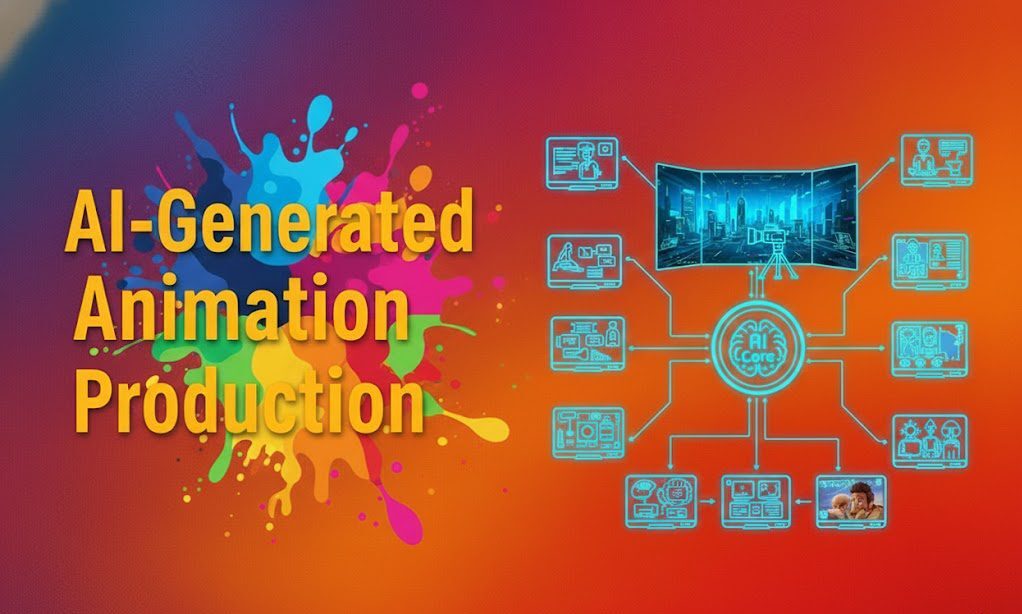
Here’s something worth saying plainly: showrunner AI-generated animation production isn’t a future conversation anymore. It’s happening in studios right now—and the producers who understand the workflow, the legal requirements, and the sourcing realities will greenlight faster, spend smarter, and de-risk their IP in ways traditional animation pipelines simply can’t match.
But there’s a hard truth buried in the excitement. Most teams rushing into AI animation are walking directly into one of two traps: IP contamination from unauthorized training data, or the Fragmentation Paradox—sourcing human finishing partners through disconnected relationship networks that cost 15-20% margin before a single frame renders. Both are avoidable. Neither is forgivable at this stage of the technology’s maturity.
This guide gives you the operational framework—seven clear steps—to build an AI-generated animation production that’s creatively sharp, legally clean, financially viable, and actually executable with the global partner network you’ll need to finish what the AI starts. If you’re a showrunner, EP, or studio head already tracking where this technology is going, you’re in the right place.
Table of Contents
- What Is Showrunner AI Animation and Why It Matters Now
- How Showrunner AI Actually Works: From Prompt to Episode
- Step 1: Define Your IP Before You Touch the AI
- Step 2: Build Your Authorized AI Workflow
- Step 3: Manage the Pipeline With Real-Time Intelligence
- Step 4: Source the Right Animation Partners Globally
- Step 5: Protect Your IP and Secure Financing
- The Fragmentation Paradox in AI Animation Sourcing
- FAQ
- Conclusion
Find Verified Animation Studios for AI-Assisted Productions in Minutes
Ask VIQI which studios have active AI animation capabilities—across budget, territory, and project type. Trusted by Netflix, Warner Bros, and Paramount. Join 140,000+ companies using Vitrina intelligence.
✔ Free to explore | ✔ Real-time verified data | ✔ No credit card required
What Is Showrunner AI Animation and Why It Matters Now
Showrunner AI-generated animation is the use of AI platforms—most prominently Showrunner by Fable Studios, which allows users to create animated TV episodes through text and voice prompts—to compress the traditional animation pipeline dramatically. What once required hundreds of artists, months of production, and multi-million dollar budgets can now move from concept to rough cut in a fraction of that time.
But here’s what most coverage gets wrong. Showrunner AI isn’t a replacement for the entertainment supply chain—it’s a transformer of it. You still need voice artists, post-production supervisors, music composers, legal clearances, financing structures, and distribution partners. What changes is where creative control sits, how quickly you can iterate, and how dramatically you can de-risk the early production stages before committing full capital.
According to Variety, Fable Studios’ Showrunner simulation lets users generate animated TV episodes through prompts, with the explicit goal of reaching more complex narrative structures in future development cycles. That ambition trajectory tells you exactly where this is going—and why the producers building their AI workflow knowledge now will have a 12-18 month head start over those who wait.
And the competitive pressure is real. As The Hollywood Reporter has noted, major studios and independent producers alike are racing to understand how AI-generated animation fits into their production models—not whether it will. The question is execution.
How Showrunner AI Actually Works: From Prompt to Episode
Let me walk you through the actual mechanics—because understanding the pipeline is the only way to spot where it breaks.
At its core, a platform like Showrunner works through a layered prompt-response architecture. You define characters, tone, world rules, and episode parameters. The AI generates performance outputs—character movement, dialogue delivery, environmental staging—which you then direct and refine. Think of it less like automated animation and more like a digital actor system where you’re simultaneously director, writer, and casting agent.
The workflow broadly runs in three phases:
- Pre-production intelligence: IP definition, character bible, episode outline, legal clearance structure
- AI generation and direction: Prompt-driven scene creation, performance iteration, assembly editing
- Human finishing: Voice integration, music, sound design, final polish, delivery mastering
That third phase is where most producers underestimate the supply chain complexity. You still need verified, capable finishing partners—voice studios, audio post houses, localization providers, delivery specialists. And finding them quickly, at the right quality level, for your specific territory and budget? That’s where the data deficit kills productions that the AI phase handled beautifully.
Jayakumar P (CEO, Toonz Media Group) has talked openly about how AI tools are reshaping the animation production lifecycle, from workflow integration to market expansion strategies. His perspective on AI adoption within established animation infrastructure is worth understanding before you plan your own pipeline—because Toonz’s evolution shows what hybrid human-AI workflows actually look like in practice. Watch his full conversation below:
Jayakumar P (CEO, Toonz Media Group) on AI integration, animation strategy, and market expansion:
Discover Animation Studio Partners for AI Productions in 48 Hours
Trusted by Netflix, Warner Bros, and Paramount. Join 140,000+ companies tracking global animation supply chain intelligence on Vitrina.
✔ 200 free credits | ✔ No credit card required | ✔ Full platform access
Step 1: Define Your IP Before You Touch the AI
This is the step most excited producers skip. Don’t.
Your characters, universe rules, tone document, and episode structure need to exist—in writing, with ownership clearly established—before you generate a single AI frame. Why? Because completion bond insurers and gap lenders work from chain of title. If your IP ownership is ambiguous at the moment you’re applying for financing, you’ve already lost weeks, possibly the deal entirely.
The creative bible for an AI-animated series needs to capture more than traditional animated shows require. You’re not just defining characters visually—you’re defining the behavioral parameters that will inform AI prompt outputs over potentially dozens of episodes. That means documented personality matrices, consistent world physics, tone guardrails, and style constraints that the AI can be trained to respect.
Think of it this way: in a traditional animated production, your character consistency is maintained by a lead animator who internalized the style guide. In AI production, that role moves to the creative bible and the quality of your prompting architecture. The creative document isn’t a nice-to-have—it’s your production’s structural backbone.
Step 2: Build Your Authorized AI Workflow
Here’s where the Authorized AI framework becomes non-negotiable. Not every AI platform is equal from a legal standpoint—and the distinction matters enormously when you’re trying to finance, insure, and distribute your production.
Authorized AI means your platform has verified licensing agreements for its training data. This isn’t a formality. Studios increasingly require authorized AI tools specifically to protect completion bond insurability. Unauthorized training data = potential IP liability = a distribution deal that collapses at the finish line after you’ve already spent your budget.
Your authorized AI workflow checklist should include:
- Platform licensing verification: Confirm your AI tool has cleared training data rights
- Output rights documentation: Get explicit confirmation you own generated content
- Legal counsel sign-off: Your entertainment attorney needs to review the platform TOS before production begins
- Insurer pre-approval: Talk to your completion bond provider early—some already have preferred authorized AI tool lists
The upfront cost of authorized AI is higher. But the back-end exposure from unauthorized tools isn’t just expensive—it’s potentially fatal to your distribution deals. That’s not a trade-off that makes financial sense.
Step 3: Manage the Production Pipeline With Real-Time Intelligence
Traditional animation pipeline management runs on spreadsheets, email chains, and institutional memory about which vendors can deliver what. That approach—fragmented, static, relationship-dependent—breaks down fast when you’re managing an AI-generated production at compressed timelines.
What you need instead is real-time supply chain visibility. Who’s currently at capacity? Which post-production house just delivered a project similar to yours? Which voice studios have the language capability you need for your first distribution window? This is live intelligence, not a six-month-old trade report.
Vitrina’s platform surfaces exactly this data across 140,000+ verified companies in the global entertainment supply chain. For AI animation producers specifically, you can track which studios have active AI workflow experience, filter by territory and budget, and verify deal history before you commit to a partner conversation. That’s the difference between a pipeline decision made on intelligence and one made on assumption.
As we covered in our AI in animation strategic report for 2026, the production teams that collapse timelines most effectively are those with the clearest view of their available supply chain—not just their preferred vendors, but the full landscape of capable partners they can activate at speed.

Your AI Assistant, Agent, and Analyst for the Business of Entertainment
VIQI AI helps you plan content acquisitions, raise production financing, and find and connect with the right partners worldwide.
- Find active co-producers and financiers for scripted projects
- Find equity and gap financing companies in North America
- Find top film financiers in Europe
- Find production houses that can co-produce or finance unscripted series
- I am looking for production partners for a YA drama set in Brazil
- I am looking for producers with proven track record in mid-budget features
- I am looking for Turkish distributors with successful international sales
- I am looking for OTT platforms actively acquiring finished series for the LATAM region
- I am seeking localization companies offer subtitling services in multiple Asian languages
- I am seeking partners in animation production for children's content
- I am seeking USA based post-production companies with sound facilities
- I am seeking VFX partners to composite background images and AI generated content
- Show me recent drama projects available for pre-buy
- Show me Japanese Anime Distributors
- Show me true-crime buyers from Asia
- Show me documentary pre-buyers
- List the top commissioners at the BBC
- List the post-production and VFX decision-makers at Netflix
- List the development leaders at Sony Pictures
- List the scripted programming heads at HBO
- Who is backing animation projects in Europe right now
- Who is Netflix’s top production partners for Sports Docs
- Who is Commissioning factual content in the NORDICS
- Who is acquiring unscripted formats for the North American market
Step 4: Source the Right Animation Partners Globally
Showrunner AI generates your foundational content. But your final product still requires human expertise—and the animation partner you choose for finishing, refinement, or co-production fundamentally determines whether your product is broadcast-ready or demo-quality.
What does smart partner sourcing look like in 2026? It means looking beyond the obvious names. The Sovereign Content Hubs—Saudi Arabia, UAE, India, South Korea, Brazil—have invested heavily in animation infrastructure precisely because domestic content mandates are creating local demand. These aren’t emerging markets anymore. They’re operational production centers with cost advantages, government backing, and crews who’ve worked on global-scale productions.
Paul Robinson (President, Kartoon Studios), who built his career at the BBC, Walt Disney Company, and NBC Universal, has spoken to how cross-border collaboration in animation creates content that travels more effectively across global markets. It’s worth internalizing: the studio you partner with for finishing isn’t just a service provider—it’s shaping your distribution optionality.
For AI-animated productions specifically, you’re looking for partners who understand:
- AI output integration: The ability to work with AI-generated frames and refine them to broadcast standard
- Style consistency: Maintaining character integrity across AI-generated and human-finished scenes
- Localization readiness: Built-in workflow for dubbing, subtitling, and territory-specific delivery
- IP protection protocols: NDA frameworks and output ownership structures suited to AI productions
Don’t limit your search to who you already know. The producers closing the best deals in AI animation are casting wider—and using data, not just reputation, to qualify partners before the first call.
Track AI-Ready Animation Studios Before the Market Moves
Access 140,000+ verified animation companies—filter by AI workflow capability, territory, and budget. Netflix, Warner Bros, and Paramount trust Vitrina for supply chain intelligence.
✔ 200 free credits | ✔ No credit card required | ✔ Set up in minutes
Step 5: Protect Your IP and Structure Financing Around It
AI-generated animation introduces financing complexity that most traditional entertainment lawyers—let alone gap lenders—haven’t fully processed yet. You’re ahead of the curve if you’re reading this. Use that advantage.
The financing conversation for an AI-animated series runs through three questions:
First: Is your AI-generated content insurable? Completion bond providers are increasingly developing AI content frameworks. But they need clear evidence of authorized AI tool use, clean chain of title, and human creative oversight throughout the pipeline. Build your documentation to answer these questions before the bond conversation, not during it.
Second: What does your capital stack look like? AI animation can reduce your production budget significantly—estimates of 20-40% cost reduction in early production phases are credible for teams with mature AI workflows. But that doesn’t mean your financing needs drop proportionally. Pre-sales, co-production equity, and tax incentives still play against the full project cost including finishing, marketing, and distribution. Don’t let AI-driven cost savings create false confidence about your overall financing gap.
Third: How are you protecting the output? Register your creative bible, episode outlines, and character designs before production begins. Work with counsel experienced in AI-generated content—specifically someone who understands the distinction between AI tool output rights and underlying IP ownership. These are different legal questions, and confusing them is expensive.
And if you’re pursuing co-production financing across territories—which the Sovereign Content Hubs of the Middle East, South Korea, and India increasingly make financially attractive—your IP ownership structure needs to be bulletproof before you get into the co-production agreement. The cash rebate isn’t worth it if the deal clouds your downstream rights.
The Fragmentation Paradox: Why Most AI Animation Productions Stall at the Sourcing Stage
Let’s be specific about a systemic problem. The Fragmentation Paradox describes what happens when 600,000+ companies in the entertainment supply chain operate in opaque silos—creating information asymmetry that costs producers 15-20% margin and adds 3-6 months to deal closure through legacy markup and manual verification.
For AI animation production, this problem is amplified. You’re not just sourcing a traditional animation studio—you’re sourcing partners with specific AI workflow experience, authorized AI tool compatibility, and the finishing capability to bring AI-generated content to broadcast standard. That’s a narrower capability set. And the fragmented, relationship-dependent search process that still dominates the industry is uniquely bad at surfacing these specialists.
What does fragmentation cost you in practice? Here’s the honest math:
- Time: Manual vendor qualification through relationship networks adds weeks to sourcing timelines that AI was supposed to compress
- Margin: Legacy markup through intermediary relationships adds 15-20% to vendor costs vs. direct partner intelligence
- Risk: Limited visibility into vendor capacity means you discover availability problems after commitment, not before
- Opportunity: The best AI-capable partners in emerging Sovereign Content Hubs are invisible through traditional relationship networks
Vitrina resolves the Fragmentation Paradox by mapping real-time capabilities across 140,000+ active entertainment companies—including the AI-capable animation studios, finishing houses, and post-production partners your AI-generated production needs. The intelligence layer connecting showrunner AI productions to verified global partners is exactly what compresses the sourcing stage from months to days.
Weaponize that data advantage. The teams that close AI animation productions in 2026 will be the ones who see the full supply chain—not just the partners they already know.
What Smart Showrunners Are Doing Right Now to Get Ahead
The executives already ahead of this curve share three behaviors that separate them from the field.
They’re building AI production literacy inside their teams now. Not waiting for the technology to mature further—understanding the current workflow ceiling, the current quality floor, and the current legal requirements well enough to execute an authorized production today. The producers who treat AI animation as a future conversation are already behind.
They’re qualifying AI-ready partners before they need them. The time to identify which animation studios have AI integration experience isn’t when you’re three weeks from production. It’s now—while you have the bandwidth to evaluate properly. Vitrina’s animation studio data for 2025 and 2026 gives you that full market picture before you need to move fast.
They’re structuring financing conversations around the AI cost reduction upfront. Not hiding the AI element from lenders and completion bond providers—bringing it to the conversation proactively, with documentation of authorized tool use, to position the production as a lower-risk investment rather than an experimental one. That framing changes the terms you’ll receive. And at 20-40% reduced early production costs, the ROI case for investors is genuinely compelling when you present it correctly.
But none of this is possible without real-time intelligence on where the market is, who’s capable, and what deals are moving right now. The data deficit is what slows everyone else down. Accelerate past it.
Frequently Asked Questions
What is showrunner AI-generated animation production?
Showrunner AI-generated animation production refers to using AI platforms—most notably Showrunner by Fable Studios—to create animated TV episodes through text and voice prompts. Instead of traditional pipelines requiring large animation crews, directors use AI to generate character performances, environments, and episode sequences. Fable Studios launched this technology to allow creators to produce animated content at dramatically reduced timelines, aiming for increasingly complex narrative structures in future iterations.
How does Showrunner by Fable Studios work?
Showrunner by Fable Studios allows users to create animated TV episodes by entering text and voice prompts. The platform simulates character behavior, dialogue, and visual environments. Users direct scenes, choose character expressions, and assemble episode sequences. The system is designed to produce episodic animated content with more complex narratives over time—representing a fundamental shift from traditional frame-by-frame animation pipelines to a prompt-driven, AI-mediated production workflow.
Is AI-generated animation legally financeable and insurable?
Yes—but only when you use authorized AI tools with verified licensing agreements. Completion bond insurers and gap lenders require a clean chain of title. Unauthorized AI training data creates IP liability that can block distribution deals entirely. Studios increasingly mandate authorized AI workflows to protect completion bond insurability. The shift to authorized AI adds upfront cost but eliminates the back-end IP exposure that would otherwise make a project unfinanceable.
What does a showrunner AI animation production budget look like?
AI-assisted animation production can reduce per-episode costs significantly compared to traditional pipelines—industry estimates range from 20-40% reduction in early production stages. However, platform licensing fees, human creative supervision, legal clearances for authorized AI use, and final finishing work still require meaningful budget allocation. Productions using hybrid models—AI for rough scene generation, human artists for refinement—tend to achieve the best balance between speed and broadcast-quality output.
How do you find animation studio partners for AI-generated productions?
The fastest route is through Vitrina’s platform, which lists 140,000+ companies in the global entertainment supply chain, including animation studios verified by project history, capability, and capacity. You can filter by territory, specialization (2D, 3D, hybrid AI workflows), and budget range. This removes the Fragmentation Paradox—the information asymmetry that costs producers 15-20% margin through legacy markup when sourcing partners through unverified relationship networks alone.
What is the biggest risk in showrunner AI animation production?
IP contamination is the single biggest risk. If your AI platform trains on unlicensed third-party content, your entire production could face distribution blocks or legal challenges post-completion. The second major risk is pipeline fragmentation—sourcing human finishing artists, voice talent, and post-production partners through disconnected relationship networks creates margin leakage and timeline slippage. Solving both requires authorized AI tools and real-time supply chain intelligence.
Can Vitrina help producers working on AI-generated animated series?
Yes. Vitrina’s platform gives producers access to 140,000+ verified companies across the global animation supply chain, including studios equipped for AI-assisted workflows. VIQI, Vitrina’s AI intelligence layer, lets you ask questions like “which animation studios in Southeast Asia have experience with AI-generated content” and receive verified, real-time results. Trusted by Netflix, Warner Bros, and Paramount, Vitrina connects production executives to the right partners before projects hit the open market.
How does AI change the showrunner role in animation?
AI fundamentally shifts the showrunner from managing large production crews to becoming a creative director of AI-generated content. The showrunner’s job now involves prompt engineering, quality supervision, creative bible management, and IP protection oversight—rather than traditional production management. This is both an expansion of creative control and a contraction of budget requirements. The executives who adapt fastest to this model will have a significant competitive advantage in the next production cycle.
Conclusion: AI Animation Is Here—Your Pipeline Determines Who Wins
Showrunner AI-generated animation production isn’t experimental anymore. It’s operational—and the producers building structured, authorized workflows right now are already closing the gap on traditional animation economics in ways that will compound significantly over the next 18-24 months. But the technology alone doesn’t close productions. Your supply chain intelligence does.
Key Takeaways:
- IP First: Your creative bible and chain of title documentation must precede any AI generation. Completion bonds and gap financing depend on it.
- Authorized AI Only: Unauthorized training data creates IP liability that blocks distribution. Platform licensing verification isn’t optional—it’s structural.
- Cost Reduction Is Real: AI-assisted production can reduce early-stage costs by 20-40%, but your full capital stack still requires pre-sales, co-production equity, and territory-specific incentives.
- The Fragmentation Paradox Kills Timelines: Sourcing human finishing partners through unverified relationship networks costs 15-20% margin and 3-6 months you don’t have. Real-time supply chain intelligence resolves this.
- Sovereign Content Hubs Are Ready: Saudi Arabia, UAE, South Korea, India, and Brazil offer animation infrastructure, cost advantages, and government-backed financing that your AI-generated production can access now.
Ready to Source AI-Ready Animation Partners? Start With 200 Free Credits.
Trusted by Netflix, Warner Bros, and Paramount. Join 140,000+ companies using Vitrina to discover verified animation partners, track active productions, and accelerate deal flow.
✔ 200 free credits | ✔ No credit card required | ✔ Full access from day one
Need direct introductions to AI-capable animation studios? Explore Concierge Service →