

 About Innovation Hub
 Global Content Pulse (Webinars)


 Global Production Financing
(Webinars)
Global Production Financing
(Webinars)  LeaderSpeak Podcast
  About Vitrina
 Our Story
 Our Solutions 🔥
 Film+TV Projects Tracker 🚀
 Case Studies
 Our Profile
A film financial blueprint is a strategic, data-backed roadmap that integrates production costs with verified global acquisition trends and financing intelligence.
This involves moving beyond traditional equity models to leverage real-time supply chain data, identifying active commissioning patterns and co-production opportunities before the first frame is shot.
According to Vitrina AI market intelligence, filmmakers utilizing data-driven partner discovery identify active financiers 70% faster than those relying solely on traditional festival networking.
In this guide, you’ll learn how to transition from speculative pitching to strategic architecture—securing the partners, capital, and distribution deals your project deserves.
While most resources focus on the creative “script-to-screen” journey, they often leave the financial blueprint to chance, relying on outdated contact lists and anecdotal “insider” tips that fail in a fragmented digital market.
This comprehensive guide addresses these critical gaps by providing actionable strategies for data-driven structuring, development tracking, and real-world intelligence on active buyer behavior.
Table of Contents
- 01
What is a Modern Film Financial Blueprint? - 02
The Shift to Data-Driven Financial Structuring - 03
Tracking Development for Financing Success - 04
Mapping Real-World Commissioning Behavior - 05
Expert Perspective: BondIt Media Capital - 06
Key Takeaways for Producers - 07
Frequently Asked Questions - 08
Moving Forward
Key Takeaways for Producers
-
Data-Driven Structuring: Replace speculative funding requests with blueprints backed by verified acquisition data and real-time commissioning editor movement.
-
Early-Stage Engagement: Use Global Project Trackers to identify co-production partners in development windows, long before projects reach trade announcements.
-
VIQI AI Advantage: Leverage vertical AI to map historical collaborations and find financiers currently funding similar genre and budget ranges.
What is a Modern Film Financial Blueprint?
A modern film financial blueprint is a comprehensive document that goes beyond simple budget projections to include a strategic layer of supply chain intelligence. It identifies the exact “money movement” within specific genres and territories, providing producers with a verified map of active commissioning editors and financiers. This blueprint acts as a shield against the “data trust deficit” that often plagues cross-border negotiations.
In today’s hyper-competitive market, relying on a “closed network” of contacts is structurally incapable of handling the volume of modern content mandates. A data-driven blueprint uses structured, verifiable intelligence—like that provided by Vitrina AI—to transform partner discovery from a manual art into a predictable science. This shift ensures that every funding request is targeted toward partners with a documented track record of similar investments.
Find active financiers for your thriller project:
The Shift to Data-Driven Financial Structuring
Traditional film finance relies on a reactive model: finishing a script, attaching talent, and then “shopping” it around to known distributors. Data-driven structuring flips this by analyzing acquisition metadata first. By understanding which territories are currently under-served and which platforms are aggressively spending on specific genres, producers can structure co-production deals that meet the immediate needs of the market.
This “authorized data” approach reduces risk for investors by providing tangible evidence of market demand. When a producer can show that 12 regional streamers in Asia recently licensed similar “high-concept action” IP, the financial blueprint becomes a compelling investment thesis rather than a creative plea. This transformation allows independent filmmakers to access capital pools that were previously reserved for major studios.
Industry Expert Perspective: Media Finance: Navigating a Post-Streamer World
Matthew Helderman, CEO of BondIt Media Capital, discusses how their firm fills the critical gap in reliable capital for content creators, emphasizing the need for disciplined financial models in today’s landscape.
Matthew Helderman shares the journey of BondIt Media Capital from a small post-production firm to a major player in media financing, highlighting how they leverage financial acumen to support creative industries during credit shifts.
Tracking Development for Financing Success
The biggest failure in independent film financing is entering the market too late. By the time a project is announced in trade publications, the “financing window” for co-productions has often closed. Tracking development cycles globally—monitoring when projects are green-lit or enter pre-production in specific regions—allows producers to pitch themselves as partners when budgets are still being allocated.
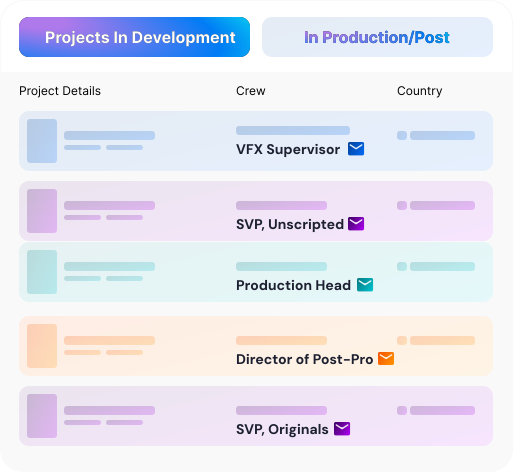
Tools like the Global Film+TV Projects Tracker monitor over 1.6 million titles, providing a digital lighthouse for unreleased content. This intelligence enables “precision outreach,” where producers can connect with 100 high-value targets monthly, focusing on companies that are actively building slates in their genre. This proactive tracking replaces “hoping for luck” with a systematic business development pipeline.
Track active projects in your genre:
Mapping Real-World Commissioning Behavior
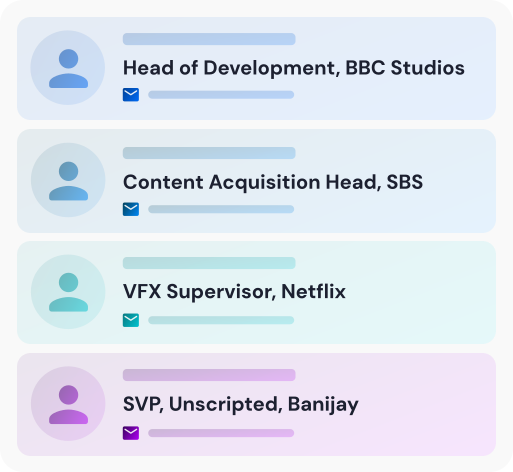
The “who” is as important as the “how much.” A financial blueprint must map the decision-makers—the 72,000+ key executives who actually control the budgets. Understanding their personal deal-making patterns, historical collaborations, and current appetite for regional IP allows for a “concierge-level” approach to outreach. For example, a Middle Eastern studio with a superhero IP used Vitrina’s intelligence to secure development talks with Legendary Pictures within days.
This “Weaponized Distribution” era requires producers to think like acquisition leads. By tracking money movement and deals across 100+ countries, filmmakers can identify “authorized data” markets where their content has the highest ROI potential. This level of granularity transforms the financial blueprint from a static PDF into a dynamic intelligence asset that evolves with the market.
Moving Forward
The shift from relationship-driven networking to data-powered financial architecture is the single greatest competitive advantage for modern independent filmmakers. By filling the gaps in development tracking and active commissioning behavior, you transform your project from a creative risk into a strategic asset.
Whether you are an independent producer looking to secure co-production financing, or a sales agent trying to position a new slate with emerging streamers, the principle remains: actionable intelligence drives deal velocity.
Outlook: Over the next 18 months, the integration of authorized generative AI and centralized supply chain platforms will further compress the discovery-to-deal timeline for creators who embrace data-first models.
Frequently Asked Questions
Quick answers to the most common queries about film financial blueprints and data-driven production.
What is a film financial blueprint?
How does supply chain intelligence help with film funding?
What tools are best for tracking film development?
About the Author
Entertainment Content Architect with over 15 years of experience in entertainment supply chain intelligence and data-driven production strategy. Specializing in helping independent creators navigate global distribution networks through vertical AI solutions. Connect on Vitrina.