About Innovation Hub
 Global Content Pulse (Webinars)


 Global Production Financing
(Webinars)
Global Production Financing
(Webinars)  LeaderSpeak Podcast
  About Vitrina
 Our Story
 Our Solutions 🔥
 Film+TV Projects Tracker 🚀
 Case Studies
 Our Profile
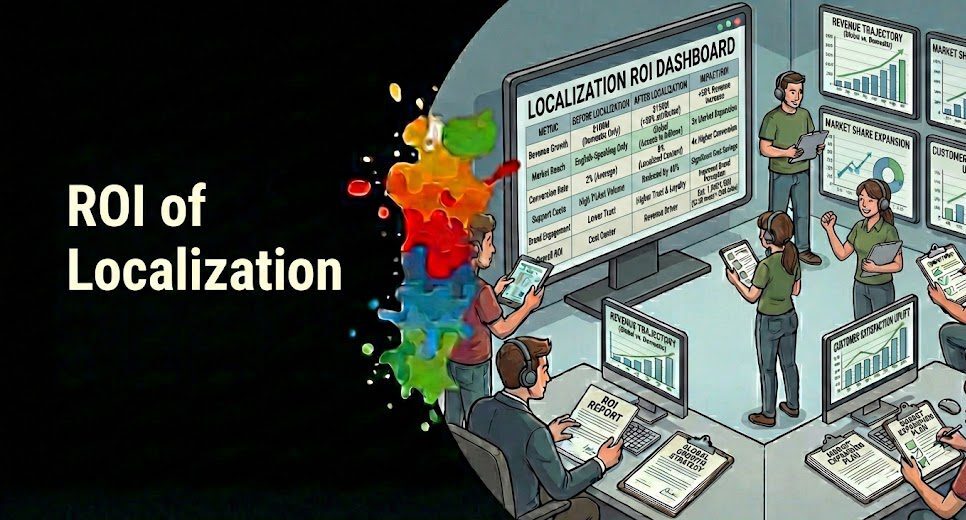
The ROI of localization is the measurable financial multiplier achieved by adapting content to the linguistic, cultural, and regulatory nuances of a specific territory.
It isn’t just about translation—it’s about de-risking your global distribution strategy. For major streamers and independent producers, cultural adaptation typically drives a 3x to 5x increase in territory-specific revenue compared to non-adapted releases, fundamentally shifting the project’s internal rate of return (IRR).
In today’s market, generic content is a liability. As capital becomes more discerning, investors aren’t just looking at the “package”—they’re looking at the reach. If your content can’t resonate locally, it can’t recoup globally. Here’s why culturally adapted content is no longer a post-production afterthought, but a core investment thesis.
Table of Contents
Stop Guessing Who’s Financing. Get Targeted Outreach.
Stop searching and start getting funded. We identify the exact decision-makers currently backing projects like yours, turning raw data into risk-aligned capital partnerships.
Major Studios
Scouting early stage projects, IP, and Regional partners for global studio pipelines.
IP Owners & Leads
Connecting creative leads with qualified financiers and major streaming platforms.
Streamers
Securing high-value pre-buy content and discovering early-stage global IP for platforms.
Indie Producers
Bridging the gap for indie filmmakers to reach executive production partners and capital.
Global Financing Ecosystems
Mapping complex markets and pairing projects with disciplined, risk-aligned capital across global territories worldwide.
Why Cultural Adaptation is the New Table Stakes for Investment
Behind closed doors, the conversation among distributors has shifted. It’s no longer “Can we sell this to Japan?” but “Is this package ready for the Japanese viewer?” Investors recognize that localization is the ultimate tool for de-risking. When you culturally adapt content, you aren’t just changing the language; you’re weaponizing your distribution rights.
What the trades don’t always report is the cost of failure. Releasing unoptimized content in a major hub like the MENA region or APAC often leads to a “dead on arrival” scenario where the marketing spend is wasted because the content feels foreign. As Rolla Karam, former Chief Content Officer at OSN, has noted in our research, local relevance is the primary driver for subscription retention. Without it, the churn is brutal.
Rolla Karam (OSN) on the MENA Content Opportunity:

The capital reality is that distribution licensing agreements now frequently include “localization clauses” that dictate the quality and depth of cultural adaptation. If you don’t meet these specs, your MGs are at risk. That’s a position no CFO wants to defend.
The Vitrina Cultural Resonance Multiplier™
To help producers and investors evaluate the ROI of localization, we’ve developed a strategic framework. The Vitrina Cultural Resonance Multiplier™ measures how deeply a project is integrated into its target market’s psyche.
The Vitrina Cultural Resonance Multiplier™ (CRM)
| Level | Adaptation Depth | ROI Expectation |
|---|---|---|
| 1. Linguistic | Standard Subtitles/Dubbing | 1.2x – 1.5x |
| 2. Idiomatic | Localized humor, slang, and puns | 1.8x – 2.2x |
| 3. Structural | Editing for local pacing and censorship | 2.5x – 3.0x |
| 4. Contextual | Metadata, marketing, and title adaptation | 3.5x – 4.5x |
| 5. Absolute | Full co-production/Cultural remake | 5.0x + |
Applying this multiplier isn’t just a creative exercise—it’s a capital efficiency play. By moving from Level 1 to Level 3, a producer can effectively double their engagement metrics in a territory, which directly translates to higher license fees during the next windowing cycle.
Producers looking to optimize their post-production workflows for these levels can explore 500+ specialized localization vendors on Vitrina.
Find the Financiers Backing Your Genre
Stop searching and start getting funded. We identify the exact decision-makers currently backing projects like yours, turning raw data into risk-aligned capital partnerships.
Measuring the Spread: Dubbing vs. Subtitling ROI
The real dynamic in the localization business case often comes down to a simple question: dub or sub? The “spread” here is significant. While subtitling is roughly 10% of the cost of high-quality dubbing, the ROI of localization through dubbing often justifies the spend for high-profile assets.
Dubbing yields a 4x higher completion rate on streaming platforms in non-English speaking markets like France, Germany, and Brazil compared to subtitled versions. For kids’ content and high-octane action, that multiplier can climb even higher.
Here’s the catch: bad dubbing is worse than no dubbing. Strategic players understand that “cheap” dubbing erodes the brand value of the IP. If the lip-sync is off or the voice acting is wooden, your “culturally adapted content” becomes a meme, not a revenue driver. You’ve got to invest in the performance, not just the translation.
Does Localization Actually Increase Minimum Guarantees (MGs)?
Absolutely. When a sales agent approaches a local distributor with a project that has a locked localization plan—pre-approved voice talent, culturally vetted scripts, and local marketing hooks—the risk profile of that project drops. And as the risk drops, the MGs rise.
Insiders recognize that production financing is increasingly tied to these pre-sale values. If your localization strategy adds $500k to your aggregate MGs across five territories, that’s $500k in additional senior debt you can leverage to close your budget. In that context, the localization spend isn’t a cost—it’s a capital unlock.
Can AI-Assisted Localization Protect My Margins?
Now, look, AI is the elephant in the room. Strategic players aren’t using AI to replace humans; they’re using it to compress timelines and protect margins. Authorized AI™ tools can now handle the heavy lifting of initial translation and spotting, allowing human experts to focus on the cultural idiomatic Level 2 adaptation.
The margin protection comes from efficiency. If you can reduce your localization timeline by 30% without sacrificing quality, you’re accelerating your windowing strategy. You’re getting the content to market faster, recouping capital sooner, and reducing the carry cost of your debt. That’s how you weaponize technology for a better IRR.
Frequently Asked Questions
What is the typical ROI of localization for an indie film?
While it varies, culturally adapted content typically sees a 40-60% increase in licensing value across non-English speaking territories. For a $5M indie film, a $100k investment in high-quality localization can often net an additional $400k-$600k in territory sales.
How does cultural adaptation drive investment from Sovereign Content Hubs™?
Sovereign hubs like Saudi Arabia or South Korea prioritize content that respects local cultural values while maintaining global quality. Projects that demonstrate a deep commitment to cultural adaptation are much more likely to secure local government grants and 40-50% cash rebates.
Is dubbing always better than subtitling for ROI?
Not always. Subtitling is sufficient for niche arthouse films or “prestige” TV where the original performance is the draw. However, for “four-quadrant” tentpoles and children’s content, dubbing is the only way to achieve the audience scale needed for a positive ROI.
Does the Fragmentation Paradox™ affect localization?
Yes. The Fragmentation Paradox™ describes how thousands of small localization vendors operate in silos. This makes it hard for producers to find reliable partners. Vitrina solves this by consolidating these 600,000+ supply chain companies into a single, searchable database.
How Vitrina Helps with Localization Strategy
Finding the right localization partner is the difference between a global hit and a local embarrassment. Vitrina’s database allows you to filter 1,200+ localization and post-production companies by territory, language pair, and verified hero projects.
- Explore the database to find vetted dubbing and subtitling houses.
- Ask VIQI for specific localization requirements in the MENA or APAC regions.
- Contact Concierge for hands-on help structuring your global distribution deals.
The Bottom Line
The ROI of localization isn’t just a marketing metric—it’s a financial imperative. In a fragmented global market, culturally adapted content is the only way to protect your margins and accelerate your recoupment. If you’re ready to de-risk your next project, Vitrina’s Concierge team can connect you with the world’s leading localization experts in 48 hours.
Find Film+TV Projects, Partners, and Deals – Fast.
VIQI matches you with the right financiers, producers, streamers, and buyers – globally.
Producers Seeking Financing, Co-Pros, or Pre-Buys?
Vitrina Concierge helps producers reach the right financiers, commissioners, distributors, and co-production partners — with precision outreach, not cold pitching.
Join Industry Briefings Trusted by Leaders

Format Adaptations: Global Trends
Where formats are traveling, which adaptations are breaking out, and how streamers are backing remakes in 2025–2026.

Books, Novels & Comics Adaptations: Global Trends
Books, webtoons, and manga driving the next global screen hits. Discover how in this webinar.

Micro-Dramas & Mobile-First Storytelling
Micro-dramas are building real audiences and revenue. Understand the platforms, buyers, and economics behind the growth.

Navigating Global Content Licensing Trends
How global content licensing is shifting beyond flat fees to flexible, deal-driven models.