About Innovation Hub
 Global Content Pulse (Webinars)


 Global Production Financing
(Webinars)
Global Production Financing
(Webinars)  LeaderSpeak Podcast
  About Vitrina
 Our Story
 Our Solutions 🔥
 Film+TV Projects Tracker 🚀
 Case Studies
 Our Profile
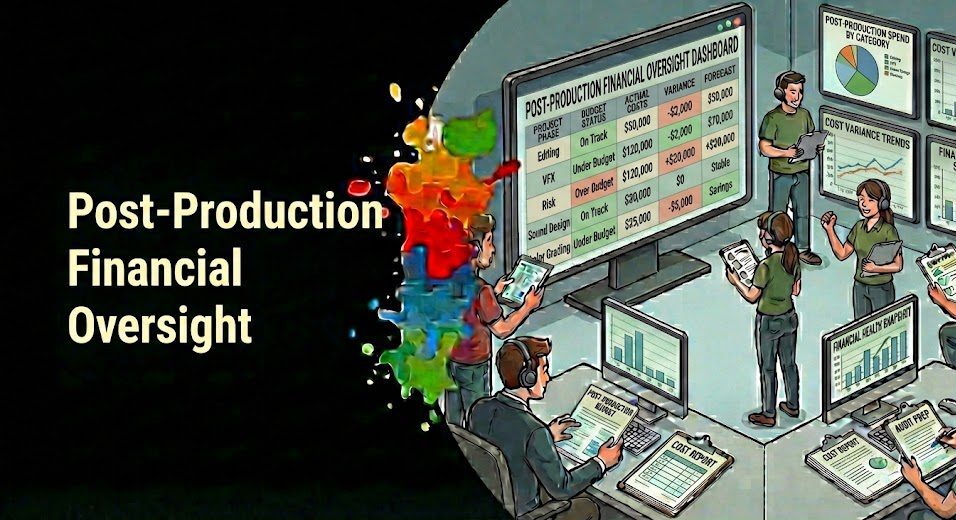
Post-production financial oversight is the strategic management of a film’s capital after the cameras stop rolling—a phase where 30-50% of the total budget is often deployed.
It’s not just about tracking receipts; it’s about managing the “burn rate” of VFX pipelines, editorial timelines, and marketing delivery to protect your IRR and ensure the project reaches its recoupment window without hitting the debt ceiling.
Let’s be honest: most indie films don’t die in production—they bleed out in the edit suite or under the weight of unmanaged VFX change orders. When your post-production cash flow isn’t optimized, you aren’t just losing time; you’re eroding the equity position of your investors. Based on our analysis of 62 expert interviews with the world’s leading lenders and producers, here’s how strategic players weaponize financial oversight to de-risk the final leg of the supply chain.
In this guide:
Stop Guessing Who’s Financing. Get Targeted Outreach.
Stop searching and start getting funded. We identify the exact decision-makers currently backing projects like yours, turning raw data into risk-aligned capital partnerships.
Major Studios
Scouting early stage projects, IP, and Regional partners for global studio pipelines.
IP Owners & Leads
Connecting creative leads with qualified financiers and major streaming platforms.
Streamers
Securing high-value pre-buy content and discovering early-stage global IP for platforms.
Indie Producers
Bridging the gap for indie filmmakers to reach executive production partners and capital.
Global Financing Ecosystems
Mapping complex markets and pairing projects with disciplined, risk-aligned capital across global territories worldwide.
VFX Budgeting: Managing the Invisible Margin Killer
VFX isn’t a line item; it’s a variable debt facility if you don’t control it. The real dynamic in VFX budgeting is the tension between creative ambition and technical reality. Producers often underestimate the “iteration cost”—the financial impact of a director asking for “just one more tweak” to a CGI asset.
To maintain oversight, you’ve got to move away from flat-fee assumptions. Smart producers use “unit-based” budgeting for shots, categorizing them by complexity (Simple, Medium, Complex, Hero). This allows you to track the burn rate against the remaining shot count in real-time. If you’re seeing a 20% overage on “Medium” shots early on, you can adjust the creative scope before it threatens the production financing stack.
“The iteration loop is where the margin goes to die. If you haven’t locked your VFX spotting session with a hard financial cap per sequence, you’re essentially handing the keys of your bank account to the render farm.” — Insider Candor.
Producers need to de-risk this by implementing a strict “Change Order Protocol.” No creative change happens without a signed-off financial impact statement. It sounds bureaucratic—because it is. But it’s the only way to protect your EBITDA when the pixel count starts climbing. Want to find VFX partners that fit your specific budget tier? Explore verified VFX studios on Vitrina filtered by project scale.
The Vitrina Post-Production Burn Rate Matrix™
We’ve developed a proprietary framework to help CFOs and Senior Producers track the health of their post-production spend. This isn’t about how much you’ve spent; it’s about the velocity of that spend relative to the “milestone delivery.”
| Phase | Ideal Burn Rate (%) | Risk Signal | Strategic Action |
|---|---|---|---|
| Assembly / Rough Cut | 15% | Over 25% spent without a lock date | Audit editor efficiency; freeze creative shifts |
| VFX Integration | 45% | Shot count increasing post-lock | Trigger Change Order Protocol; weaponize contingency |
| Sound & Color | 20% | Expedited delivery fees surfacing | Compress timeline; enforce IMF delivery specs |
| Marketing & Delivery | 20% | Asset creation stalling trailer release | Deploy P&A reserves; finalize territory delivery |
Editorial Oversight & Cash Flow Logistics
Editorial is the brain of the post-production process, but it’s also where many projects lose their momentum. From a financial oversight perspective, the “editor-to-timeline” ratio is your primary efficiency metric. If your editor is spending three weeks on a single sequence without achieving a “cut that sticks,” your overhead—rentals, assistant editors, storage—is compounding.
Here’s the capital reality: Every week added to the edit is a week delayed in triggering your distribution guarantees. Most gap financing facilities have a “drop dead” delivery date. If editorial drags, you risk defaulting on your delivery requirements, which can lead to lenders taking control of the waterfall.
Phil Hunt, CEO of Head Gear Films, discusses the importance of financial discipline in today’s market:

To accelerate this phase, producers are increasingly using VIQI, Vitrina’s AI assistant, to research more efficient post-production workflows and compare regional tax incentives that can be applied to post-production spend (like the UK’s uplifted 34% credit or Saudi’s 40% rebate).
Find the Financiers Backing Your Genre
Stop searching and start getting funded. We identify the exact decision-makers currently backing projects like yours, turning raw data into risk-aligned capital partnerships.
Budgeting for Delivery & Marketing ROI
Marketing and delivery are often the “forgotten children” of the initial budget, yet they are critical for triggering recoupment. If you haven’t budgeted $50k-$100k for “technical delivery” (IMFs, DCPs, localization, M&E tracks), you’re going to have a heart attack when the sales agent sends their first statement.
Strategic players understand that “Marketing Spend” in post isn’t just about trailers; it’s about **Weaponized Distribution™**. By creating high-quality localized assets (dubbing/subtitling) during the initial post-production window, you can compress the time-to-market in non-English territories by 3-6 months. This accelerates the recoupment cycle and improves the project’s overall IRR.
How Vitrina Helps with Post-Production Oversight
Managing the financial complexity of post-production requires access to the right partners at the right price point. Vitrina’s global supply chain database provides the transparency needed to de-risk your selection process.
- Search 600,000+ companies to find VFX and post-houses that match your budget tier.
- Use VIQI to analyze regional tax incentives for post-production and VFX.
- Contact Vitrina Concierge for hands-on help structuring your post-production financing stack.
Frequently Asked Questions
What is the typical contingency for VFX budgeting?
Standard contingency is 10%, but for VFX-heavy films, we recommend 15-20%. This isn’t just for mistakes; it’s for the inevitable “creative evolution” that happens when shots are seen in context during the assembly cut. Don’t touch this reserve until the second pass of the edit.
How can I reduce post-production costs without sacrificing quality?
The most effective way is through “Sovereign Content Hubs™” and regional incentives. By moving your VFX or color grade to a territory with a high cash rebate (like Canada, Colombia, or Saudi Arabia), you can reduce your effective spend by 30-40% while maintaining top-tier quality. It’s about production economics, not just hourly rates.
Does gap financing cover post-production costs?
Yes, gap financing is frequently used to bridge the final 10-20% of the budget specifically for post and delivery. Lenders will look at your “Cost to Complete” report to ensure the funds will actually result in a deliverable asset. Without a clear path to delivery, gap lenders won’t deploy.
The Bottom Line
Post-production financial oversight isn’t about saying “no” to the creative team; it’s about ensuring the project remains a viable commercial asset. By managing iteration loops, leveraging regional incentives, and protecting your cash flow from editorial drift, you de-risk the investment and accelerate the path to profit. If you’re ready to optimize your post-production stack, Vitrina’s Concierge team can connect you with the right vendors and financing partners in 48 hours.
Find Film+TV Projects, Partners, and Deals – Fast.
VIQI matches you with the right financiers, producers, streamers, and buyers – globally.
Producers Seeking Financing, Co-Pros, or Pre-Buys?
Vitrina Concierge helps producers reach the right financiers, commissioners, distributors, and co-production partners — with precision outreach, not cold pitching.
Join Industry Briefings Trusted by Leaders

Format Adaptations: Global Trends
Where formats are traveling, which adaptations are breaking out, and how streamers are backing remakes in 2025–2026.

Books, Novels & Comics Adaptations: Global Trends
Books, webtoons, and manga driving the next global screen hits. Discover how in this webinar.

Micro-Dramas & Mobile-First Storytelling
Micro-dramas are building real audiences and revenue. Understand the platforms, buyers, and economics behind the growth.

Navigating Global Content Licensing Trends
How global content licensing is shifting beyond flat fees to flexible, deal-driven models.