About Innovation Hub
 Global Content Pulse (Webinars)


 Global Production Financing
(Webinars)
Global Production Financing
(Webinars)  LeaderSpeak Podcast
  Global Entertainment Digest (Newsletter)
  About Vitrina
 About VIQI
 Our Story
 Our Solutions 🔥
 Film+TV Projects Tracker 🚀
 Case Studies
 Our Profile
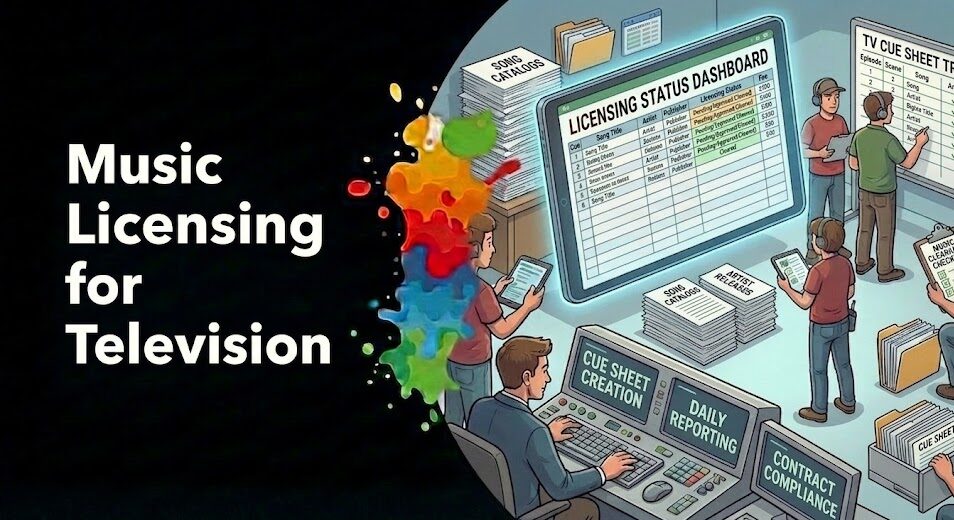
Music licensing for television in 2026 isn’t complicated. It’s just expensive—and getting more so if you don’t know where the costs are hiding.
Here’s the real dynamic: streaming platforms have rewritten sync deals from the ground up. Netflix, Amazon Prime Video, and Apple TV+ don’t want per-territory, per-window arrangements. They want global buyouts. And they’re getting them. That pressure ripples down to every music supervisor negotiating a license for a mid-budget drama or a prestige limited series.
If you’re budgeting a television project right now, you need to understand seven deal structures, two mandatory licenses, and one clause that could either save or sink your music budget. Let’s get into it.
In This Guide
- Why TV Music Licensing Has Gotten More Expensive
- The Two Licenses Every TV Deal Needs (And What They Cost)
- Sync Licensing Rates by Platform in 2026
- How Streaming Platforms Rewrote the Royalty Playbook
- Film Score Deals: Work-for-Hire vs. Backend Structures
- PROs, Performance Royalties, and Your P&L
- The MFN Clause: What It Is and When to Use It
- AI-Generated Music: The 2026 Licensing Wild Card
- Frequently Asked Questions
Ask VIQI: Who Are the Right Music Rights Partners for My TV Project?
VIQI is Vitrina’s AI assistant—trained on 1.6 million titles, 360,000 companies, and 5 million entertainment professionals. Ask it which music supervisors, publishers, or rights management firms have cleared tracks for projects like yours.
✓ Included with 200 free credits | ✓ No credit card needed
Why TV Music Licensing Has Gotten More Expensive
A few things collided in the last 24 months. Streaming platforms consolidated their content strategies, compressing per-episode budgets while demanding broader rights packages. Music publishers—led by Warner Chappell Music and Universal Music Publishing Group—pushed back, driving sync fees higher on catalog titles that streamers desperately want for their prestige originals.
The result? You’re paying more for music and getting fewer rights in return. A sync deal that cleared for $15,000 for US broadcast three years ago now runs $30,000–$45,000 for even limited digital rights. Global streaming rights on the same track push past $75,000 easily—and that’s before you’ve secured the master use license.
But here’s what the trades don’t fully report: it’s not just catalog prices driving costs. It’s the structural shift in how platforms define “rights.” Broadcast deals used to be territory-specific, window-specific, and time-limited. Streaming deals are none of those things. Global, in-perpetuity, all-platform—that’s the new baseline, and publishers price accordingly.
As part of your rights and licensing negotiation strategy, music clearance needs to be planned pre-production—not scrambled at delivery. Productions that leave music to post are paying a 20–35% premium on the same tracks.
The Two Licenses Every TV Deal Needs (And What They Cost)
You can’t legally sync music to a TV scene with just one license. Two are required—and the costs compound.
The synchronization license comes from the music publisher (or the songwriter, if self-published). It covers the right to match that composition—notes, lyrics, arrangement—to your visuals. The master use license comes from whoever owns the original recording, usually a record label. Both must be cleared separately, and the rights holders don’t coordinate their pricing.
Here’s where budgets get ambushed: you might clear a sync for $12,000 only to find the master costs $25,000 from a major label that’s not negotiating. Or a label quotes you a reasonable master fee—then the publisher’s sync rate doubles it. Standard industry practice is to negotiate both simultaneously and build in a Most Favored Nations clause if you’re dealing with multiple rights holders. More on that below.
Typical All-In Sync + Master Fees for TV Placement in 2026
Find Music Rights Partners Before the Clock Runs Out
Trusted by Netflix, Warner Bros, and Paramount. Join 140,000+ companies tracking the global entertainment supply chain—including music supervisors, publishers, and rights management firms who’ve cleared tracks for productions like yours.
✓ 200 free credits | ✓ No credit card required | ✓ Full platform access
How Streaming Platforms Rewrote the Royalty Playbook
What’s actually happening—and what most producers don’t catch until it’s too late—is that Netflix doesn’t pay performance royalties the way broadcasters do. Because streaming is classified differently from broadcast in most territories, the PRO royalty structure doesn’t generate the same backend composers expect from traditional TV deals.
For commissioned scores on Netflix originals, the platform typically acquires publishing rights outright—or retains administrative control over the score. Performance royalties that would flow through ASCAP or BMI on a traditional broadcast deal simply don’t appear in the same volume for composers on streaming projects. Amazon Prime Video and Apple TV+ operate similarly.
It’s a cleaner deal from a rights-management perspective. But it transfers the risk and upside entirely to the composer’s upfront fee. Music supervisors who built careers on broadcast backend are renegotiating their entire approach for streaming clients. The per-episode fee isn’t just compensation—it’s the whole revenue event.
According to Variety, streaming platforms’ demand for broader music rights has contributed to a sustained upward pressure on sync fees across the entire market—not just for front-line releases, but for catalog titles that platforms want for nostalgia-driven programming.
Film Score Deals: Work-for-Hire vs. Backend Structures
Most scores for television productions—particularly streaming originals—are structured as work-for-hire arrangements. The composer gets paid a flat fee, delivers the score, and the platform owns everything. No backend. No performance royalty tail.
Typical fee ranges in 2026:
- Major streaming original series (per episode): $12,000–$40,000
- Network TV drama (per episode): $8,000–$25,000
- Miniseries or limited event: $75,000–$250,000 flat
- Premium cable drama (per episode): $10,000–$30,000
But there’s a variant that better-positioned composers are successfully negotiating: the hybrid backend deal. The composer accepts a lower upfront fee in exchange for retaining publishing rights on the score—or a negotiated portion of them. If the show hits, they collect performance royalties through their PRO every quarter. The upside can justify the reduced upfront, especially on series with strong international licensing potential.
That structure works best on co-productions where the platform doesn’t hold exclusive rights. If you’re building a deal with a European broadcaster or a co-production partner in the Sovereign Content Hubs™—Saudi Arabia, UAE, South Korea—the rights architecture is different enough that backend retention stays viable. The platform-owns-everything model is largely a US streaming phenomenon, not a global standard.
PROs, Performance Royalties, and What Actually Hits Your P&L
ASCAP, BMI, and SESAC collectively represent the majority of US music rights. Internationally, you’re working with PRS (UK), SOCAN (Canada), APRA AMCOS (Australia/NZ), and SACEM (France), among others. When a TV network broadcasts your production, it pays a blanket license to these organizations—not to you. The PRO then distributes royalties to the songwriter (writer’s share: 50%) and publisher (publisher’s share: 50%).
What changes your P&L calculation is how these territories interact with your co-production structure. As covered in our guide to IP rights in entertainment deals, territory-by-territory rights management directly affects recoupment timelines. A show airing in the UK generates PRS royalties. The same show on a UK streaming platform generates considerably less—because the performance royalty calculation for streaming differs from traditional broadcast formulas.
Your music budget planning needs to account for that gap. Productions that budget based on broadcast royalty projections, then end up on a streaming-first platform, routinely find themselves $80,000–$200,000 short on expected music revenue. Budget the upfront cost right. Don’t bank on the backend to save you.

Your AI Assistant, Agent, and Analyst for the Business of Entertainment
VIQI AI helps you plan content acquisitions, raise production financing, and find and connect with the right partners worldwide.
- Find active co-producers and financiers for scripted projects
- Find equity and gap financing companies in North America
- Find top film financiers in Europe
- Find production houses that can co-produce or finance unscripted series
- I am looking for production partners for a YA drama set in Brazil
- I am looking for producers with proven track record in mid-budget features
- I am looking for Turkish distributors with successful international sales
- I am looking for OTT platforms actively acquiring finished series for the LATAM region
- I am seeking localization companies offer subtitling services in multiple Asian languages
- I am seeking partners in animation production for children's content
- I am seeking USA based post-production companies with sound facilities
- I am seeking VFX partners to composite background images and AI generated content
- Show me recent drama projects available for pre-buy
- Show me Japanese Anime Distributors
- Show me true-crime buyers from Asia
- Show me documentary pre-buyers
- List the top commissioners at the BBC
- List the post-production and VFX decision-makers at Netflix
- List the development leaders at Sony Pictures
- List the scripted programming heads at HBO
- Who is backing animation projects in Europe right now
- Who is Netflix’s top production partners for Sports Docs
- Who is Commissioning factual content in the NORDICS
- Who is acquiring unscripted formats for the North American market
The MFN Clause: What It Is and When to Use It
The Most Favored Nations clause—MFN in every music supervisor’s shorthand—means no rights holder gets a worse deal than anyone else in the same transaction.
Here’s why you want it: if you’re clearing five songs for an episode and negotiate $10,000 for Song A, an MFN clause means Songs B through E are cleared at the same $10,000—regardless of what each publisher originally quoted. It creates price parity and budget predictability when you’re dealing with multiple rights holders simultaneously.
Use MFN aggressively for catalog tracks where all rights holders are negotiating at once. Be more careful on front-line releases from Sony Music Publishing or Universal’s premium catalog—they know what those tracks command, and they’ll push back on MFN if the rate undersells their asset.
As detailed in our 2026 licensing negotiation strategies guide, MFN works best as a protection mechanism in multi-track clearances—not as an opening salvo that signals you’re trying to cap the room’s ceiling.
Need Music Rights Partners or a Music Supervisor for Your Project? We’ll Find Them.
Vitrina Concierge is your Virtual Agent. We don’t hand you a list—we make warm introductions directly to music supervisors, rights holders, and clearance specialists who are actively working on productions like yours.
- LA producer → Rights clearance specialist matched in 48 hours
- No commitment needed to start the conversation
AI-Generated Music: The 2026 Licensing Wild Card
Nobody has fully solved this. Not the platforms, not the publishers, not the PROs.
AI-generated music sits in a legal gray zone in most territories. The fundamental question is authorship: if no human composer created the work, does copyright attach? And if copyright doesn’t attach, what exactly are you licensing—and from whom?
The practical answer for producers right now: treat AI-generated music as a chain-of-title risk, not a cost-saver. Warner Chappell Music and Universal Music Publishing Group have both challenged AI music platforms over unauthorized training datasets. If the tool that generated your score trained on copyrighted material without clearance—and most did—you could be holding a liability that surfaces at distribution, not now.
The safer play is AI-assisted composition, where a human composer uses AI tools as part of their creative process, retaining authorship and delivering a fully cleared work-for-hire. It’s becoming standard in network TV workflows precisely because it threads the legal needle while still compressing production timelines.
As The Hollywood Reporter noted, at least three major US networks added AI music disclosure clauses to their standard production agreements in 2025—a clear signal that the Authorized AI™ question in music licensing isn’t hypothetical. It’s already in your contract.
But that’s the 2026 reality. The Fragmentation Paradox™ hits nowhere harder than AI music rights—where there are dozens of competing platforms, no standard clearance framework, and conflicting legal positions across the US, EU, and UK. De-risk your production by sticking to human-authored scores with AI assistance until the legal frameworks catch up.
Frequently Asked Questions About Music Licensing for Television
The Bottom Line on TV Music Licensing in 2026
Music licensing for television isn’t a post-production afterthought—it’s a rights management challenge that shapes your budget from day one of pre-production. Accelerate your clearance strategy early and you’ll negotiate from a position of strength. Leave it to delivery and you’re paying premium rates under deadline pressure.
For co-productions navigating multiple territory rights, understanding how your music budget connects to your broader content licensing revenue model is the difference between a project that recouped and one that didn’t.
Key Takeaways:
- Always clear both sync and master use licenses simultaneously—one without the other creates liability, not clearance.
- Global streaming buyouts now run $30,000–$150,000+ per track—budget accordingly before you fall in love with a song.
- MFN clauses protect your budget across multi-song clearances; use them on catalog, not front-line premium releases.
- PRO performance royalties work differently on streaming vs. broadcast—don’t build your music budget around backend projections that don’t apply to your platform.
- AI-generated music carries chain-of-title risk in 2026—use AI-assisted composition with a human composer retaining authorship instead.
- Work-for-hire is the streaming standard for commissioned scores; backend retention requires co-production structures outside single-platform deals.
Track Music Rights Partners, Supervisors, and Clearance Specialists on Vitrina
More than 140,000 entertainment companies are tracked on Vitrina—including music services, post-production vendors, and rights management firms. Netflix, Warner Bros, and Paramount use the platform to surface the right partners before deals close. Start with 200 free credits and no credit card required.
✓ 200 free credits | ✓ No credit card required | ✓ Cancel anytime
Find Film+TV Projects, Partners, and Deals – Fast.
VIQI matches you with the right financiers, producers, streamers, and buyers – globally.
Producers Seeking Financing, Co-Pros, or Pre-Buys?
Vitrina Concierge helps producers reach the right financiers, commissioners, distributors, and co-production partners — with precision outreach, not cold pitching.
Join Industry Briefings Trusted by Leaders

Format Adaptations: Global Trends
Where formats are traveling, which adaptations are breaking out, and how streamers are backing remakes in 2025–2026.

Books, Novels & Comics Adaptations: Global Trends
Books, webtoons, and manga driving the next global screen hits. Discover how in this webinar.

Micro-Dramas & Mobile-First Storytelling
Micro-dramas are building real audiences and revenue. Understand the platforms, buyers, and economics behind the growth.

Navigating Global Content Licensing Trends
How global content licensing is shifting beyond flat fees to flexible, deal-driven models.