About Innovation Hub
 Global Content Pulse (Webinars)


 Global Production Financing
(Webinars)
Global Production Financing
(Webinars)  LeaderSpeak Podcast
  Global Entertainment Digest (Newsletter)
  About Vitrina
 About VIQI
 Our Story
 Our Solutions 🔥
 Film+TV Projects Tracker 🚀
 Case Studies
 Our Profile

Localization companies are the specialized service providers responsible for adapting film, television, and digital content for global audiences through translation, subtitling, and dubbing.
This involves managing complex workflows that synchronize linguistic accuracy with cultural nuance across over 100 territories.
According to industry analysis, the global localization market has reached $6.5 billion as studios prioritize “weaponized distribution” to maximize ROI on sunk content assets.
In this guide, you will learn how localization is evolving from a post-production afterthought into a core driver of global supply chain velocity.

Your AI Assistant, Agent, and Analyst for the Business of Entertainment
VIQI AI helps you plan content acquisitions, raise production financing, and find and connect with the right partners worldwide.
- Find active co-producers and financiers for scripted projects
- Find equity and gap financing companies in North America
- Find top film financiers in Europe
- Find production houses that can co-produce or finance unscripted series
- I am looking for production partners for a YA drama set in Brazil
- I am looking for producers with proven track record in mid-budget features
- I am looking for Turkish distributors with successful international sales
- I am looking for OTT platforms actively acquiring finished series for the LATAM region
- I am seeking localization companies offer subtitling services in multiple Asian languages
- I am seeking partners in animation production for children's content
- I am seeking USA based post-production companies with sound facilities
- I am seeking VFX partners to composite background images and AI generated content
- Show me recent drama projects available for pre-buy
- Show me Japanese Anime Distributors
- Show me true-crime buyers from Asia
- Show me documentary pre-buyers
- List the top commissioners at the BBC
- List the post-production and VFX decision-makers at Netflix
- List the development leaders at Sony Pictures
- List the scripted programming heads at HBO
- Who is backing animation projects in Europe right now
- Who is Netflix’s top production partners for Sports Docs
- Who is Commissioning factual content in the NORDICS
- Who is acquiring unscripted formats for the North American market
Table of Contents
Key Takeaways for Localization Professionals
- Market Velocity Advantage: Localization companies using automated dubbing tools compress delivery windows by 60%, enabling day-and-date global premieres for episodic content.
- Regional Growth Hubs: Demand is surging in Southeast Asia and the Middle East, requiring vendors to map localized supply chains across 100+ countries.
- Authorized Data Strategy: Leading vendors are transitioning to “Authorized Data” models, licensing their proprietary voice stacks for ethical AI training and long-term IP protection.
What is the Role of Localization in the Supply Chain?
In a globalized entertainment ecosystem, localization companies act as the bridge between regional production and international monetization. The traditional “walled garden” era of content exclusivity has ended, replaced by a model where high-value IP is licensed across rival platforms to maximize Average Revenue Per User (ARPU).
This transition requires localization vendors to move beyond simple translation. They must now integrate into the broader supply chain, providing verified intelligence on regional buyer preferences and territorial licensing requirements.
Find localization partners for your upcoming project:
How is AI Reshaping Localization Workflows?
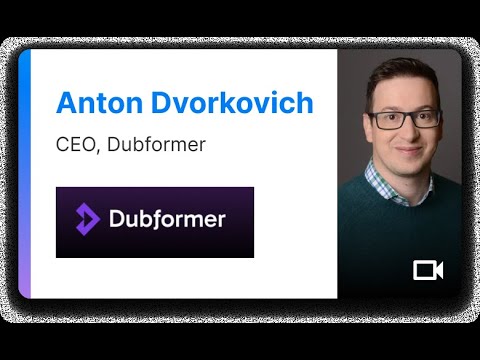
Industry Expert Perspective: Dubformer’s AI-Powered Localization
In this deep dive, Anton Dvorkovich, CEO of Dubformer, explores how AI is disrupting the traditional dubbing industry to break down language barriers for creators globally.
Key Insights
Anton Dvorkovich discusses the journey of Dubformer, specializing in AI-powered video localization to adapt content for global audiences. The $6.5 billion market is shifting toward AI dubbing, which provides unprecedented scale and speed, though subtitling remains a cultural preference in specific territories.
The integration of Generative AI has transitioned from a theoretical concept to a core business strategy. Localization companies are leveraging vertical AI models trained on proprietary datasets to deliver emotional, natural-sounding voiceovers that sync with visual performances.
Why are Regional Content Hubs Driving Demand?
Global streamers like Netflix and Disney+ are investing heavily in local-language content—such as Korean dramas, Spanish thrillers, and Brazilian comedies—to drive international subscriber growth. This “global domination” strategy relies on localization companies to turn regional hits into international phenomena.
Localization companies are now mapping 140,000+ companies globally to identify emerging distribution hubs in the Middle East and Southeast Asia, ensuring content reaches these growing audiences with high cultural fidelity.
Identify trending regional content for acquisition:
The Shift Toward Authorized AI Training Data
As the industry matures, the legal landscape for AI is tightening. Major players like Disney are formalizing “Authorized Data” markets, as seen in their $1 billion investment in OpenAI. This shift creates a massive opportunity for localization companies that own high-quality, legally cleared linguistic data.
By providing structured, verifiable datasets for AI training, localization vendors ensure that automated dubbing respects IP rights while delivering the technical precision required for professional broadcast standards.
“The localization sector is no longer just about translation; it is about data sovereignty. Companies that control authorized, high-fidelity linguistic datasets will define the next decade of global content distribution.”
Moving Forward
Localization companies have evolved from utility providers into strategic architects of the global supply chain. By embracing AI dubbing and mapping regional hubs, they enable studios to navigate the “Weaponized Distribution” era with precision.
Whether you are a Localization Vendor looking to scale your AI workflows, or an Acquisition Lead trying to source trending regional hits, the future of the industry lies in data-driven discovery and localized storytelling.
Outlook: Over the next 18 months, we expect a consolidation of localization vendors as large streamers acquire specialized AI-dubbing houses to secure “Authorized Data” pipelines.
Frequently Asked Questions
What are localization companies?
Localization companies are specialized vendors that adapt media content for international markets. They provide services like translation, subtitling, and dubbing to ensure content is linguistically accurate and culturally relevant for specific global territories.
How does AI impact content localization?
AI impacts localization by automating dubbing and subtitling workflows. Tools like Dubformer use generative AI to create emotional, high-fidelity voiceovers, significantly reducing costs and time-to-market while maintaining broadcast-quality standards.
What is authorized data in AI dubbing?
Authorized data refers to IP-protected linguistic and voice data that is licensed for AI training. This ensures that AI-generated content respects copyright laws and protects the likenesses and voices of performers while enabling scalable localization.
About the Author
Vitrina Intelligence Team specializes in mapping the global entertainment supply chain. With decades of experience in metadata and media-tech, we provide the “single source of truth” for industry professionals. Connect on Vitrina.
Find Film+TV Projects, Partners, and Deals – Fast.
VIQI matches you with the right financiers, producers, streamers, and buyers – globally.
Producers Seeking Financing, Co-Pros, or Pre-Buys?
Vitrina Concierge helps producers reach the right financiers, commissioners, distributors, and co-production partners — with precision outreach, not cold pitching.
Join Industry Briefings Trusted by Leaders
Format Adaptations: Global Trends
Where formats are traveling, which adaptations are breaking out, and how streamers are backing remakes in 2025–2026.

Books, Novels & Comics Adaptations: Global Trends
Books, webtoons, and manga driving the next global screen hits. Discover how in this webinar.

Micro-Dramas & Mobile-First Storytelling
Micro-dramas are building real audiences and revenue. Understand the platforms, buyers, and economics behind the growth.

Navigating Global Content Licensing Trends
How global content licensing is shifting beyond flat fees to flexible, deal-driven models.