About Innovation Hub
 Global Content Pulse (Webinars)


 Global Production Financing
(Webinars)
Global Production Financing
(Webinars)  LeaderSpeak Podcast
  About Vitrina
 Our Story
 Our Solutions 🔥
 Film+TV Projects Tracker 🚀
 Case Studies
 Our Profile
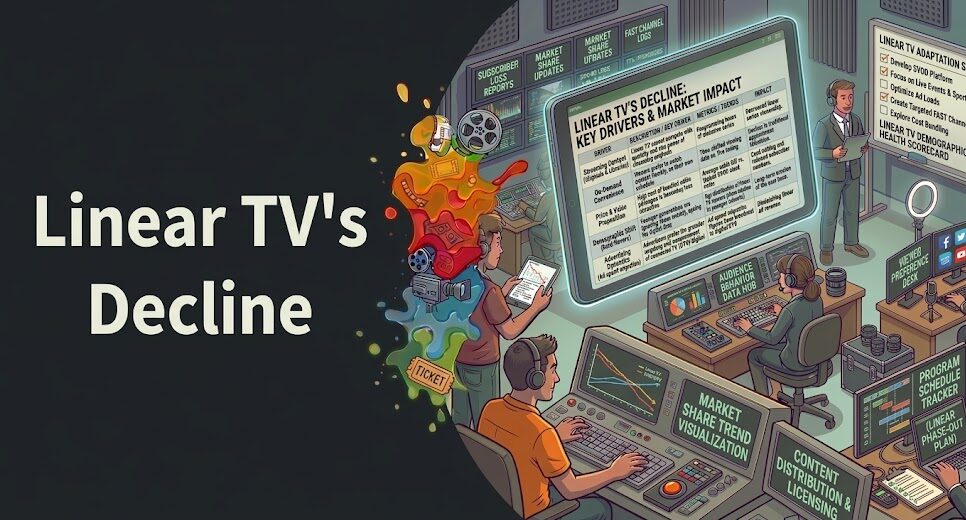
The linear TV decline has moved past debate. It’s a structural condition broadcasters are now managing—not waiting out. Linear audiences dropped another 8–12% year-over-year across major Western markets in 2025, and what’s happening inside commissioning departments reflects that reality with unusual candour. Budgets are being reallocated. Long-term output deals are being binned. And the “we commission what the audience wants” cliché is finally being backed by actual data infrastructure.
But here’s what’s actually interesting: the smartest broadcasters aren’t treating this as a survival story. They’re treating it as a reset—a chance to shed legacy commissioning models that were bloated, relationship-dependent, and structurally incapable of competing with the algorithmic precision of Netflix, Amazon Prime Video, and the growing slate of regional streamers. And in some cases, they’re winning.
This piece breaks down exactly what that looks like in practice—the five commissioning shifts that are actually moving the needle in 2026, with specific examples from broadcasters navigating the transition in real time. If you’re a producer, a distributor, or a rights holder trying to read where the commissioning money is flowing, this is the map.
In This Guide
- How Deep the Linear TV Decline Actually Runs in 2026
- Shift 1: The End of Long Output Deals
- Shift 2: Co-Commissioning as the New Default Financing Model
- Shift 3: FAST Channels as the Strategic Monetization Layer
- Shift 4: Data-Driven Commissioning Replacing Relationship Gut Feel
- Shift 5: Regional Commissioning via Sovereign Content Hubs™
- What This Means for Producers Pitching Broadcasters in 2026
- Frequently Asked Questions
Ask VIQI: Which Broadcasters Are Actively Commissioning in My Genre Right Now?
VIQI is Vitrina’s AI assistant—trained on 1.6 million titles, 360,000 companies, and 5 million entertainment professionals. Get real-time commissioning intelligence on broadcasters, streamers, and co-production partners before the pitch.
✓ Included with 200 free credits | ✓ No credit card needed
How Deep the Linear TV Decline Actually Runs in 2026
Let’s anchor this in numbers rather than narrative. According to Variety, traditional broadcast viewership among adults under 50 has dropped by more than 40% since 2019 across the US and major European markets. The collapse is concentrated but not uniform—live sports, major news events, and tentpole reality formats still hold audiences. Everything else is draining fast.
The advertising model is getting squeezed from both ends. Audiences are leaving, and the advertisers that remain are paying less per impression because the demographic mix has skewed significantly older—which means lower CPMs for most verticals. Traditional broadcasters are now competing for a shrinking, less valuable linear audience while simultaneously building streaming infrastructure that requires entirely different content economics.
But—and this is the part the obituaries miss—total content demand hasn’t declined. It’s shifted. The same audiences that have left linear are consuming more content than ever across streaming platforms, FAST channels, and social video. The Fragmentation Paradox™ applies here too: 600,000+ production companies are competing to supply content into a distribution environment that’s more complex, more fragmented, and more opaque than at any point in television history.
For broadcasters, that complexity creates both a commissioning challenge and a strategic opportunity. Those reinventing their approach to commissioning—not just cutting budgets—are finding defensible positions. Those waiting for linear audiences to stabilise are running out of runway.
Here are the five strategies defining the broadcasters that are getting it right. As we explore in our analysis of co-commissioning models shaping streamer-studio partnerships, the structural shift is well underway—and accelerating.
Rolla Karam (SVP Content Acquisition, OSN) discusses how the shift away from traditional linear output deals is reshaping content acquisition strategy across 23 MENA countries in this Vitrina LeaderSpeak episode:
Shift 1: The End of Long Output Deals
The multi-year output deal—where a broadcaster commits to taking everything a studio produces over a fixed period—was the backbone of broadcast commissioning for decades. It gave studios predictable revenue and gave broadcasters assured supply. It also locked both parties into content strategies that couldn’t adapt when audience behaviour changed. And it was expensive.
Rolla Karam, Senior Vice President of Content Acquisition at OSN—the premium pay TV and streaming platform operating across 23 countries in MENA and North Africa—is direct about where this is going. In a 2025 Vitrina LeaderSpeak interview, she stated that she no longer does long output deals with major studios. Her position: why commit to content from five years ahead when audience preferences, platform mix, and content strategy are all in flux? A two-year deal at most—then it’s back up for negotiation.
That’s OSN. But it’s not just OSN. Across European public broadcasters, US cable networks, and regional pay TV operators, the multi-year blanket output deal is being retired in favour of title-by-title commissioning, shorter windows, and more granular rights structures. The logic is sound: why pay for a guaranteed flow of content when you can be selective and only acquire what your data tells you your audience will actually watch?
For producers, this is a seismic change. You can no longer rely on a broadcaster relationship to sustain a slate. Every title has to justify itself independently—on projected audience data, on IP value, on multi-territory appeal. That’s harder. But it also opens the door to independent producers who couldn’t previously break into broadcasters’ closed output deal ecosystems.
Track Which Broadcasters Are Commissioning—Before It Hits the Trades
Trusted by Netflix, Warner Bros, and Paramount. Join 140,000+ companies using Vitrina to monitor greenlit projects, active commissioners, and co-production windows across 195 countries.
✓ 200 free credits | ✓ No credit card required | ✓ Full platform access
Shift 2: Co-Commissioning as the New Default Financing Model
The single-broadcaster commission—one network funds a series, takes domestic rights, and optionally sells internationally—is increasingly untenable at the budget levels required to compete with streaming originals. A prestige drama that would have cost a UK public broadcaster £2M per episode in 2018 now needs closer to £5–8M to look competitive against what Netflix and Apple TV+ are putting on screen. No single linear broadcaster can justify that spend against a declining audience base.
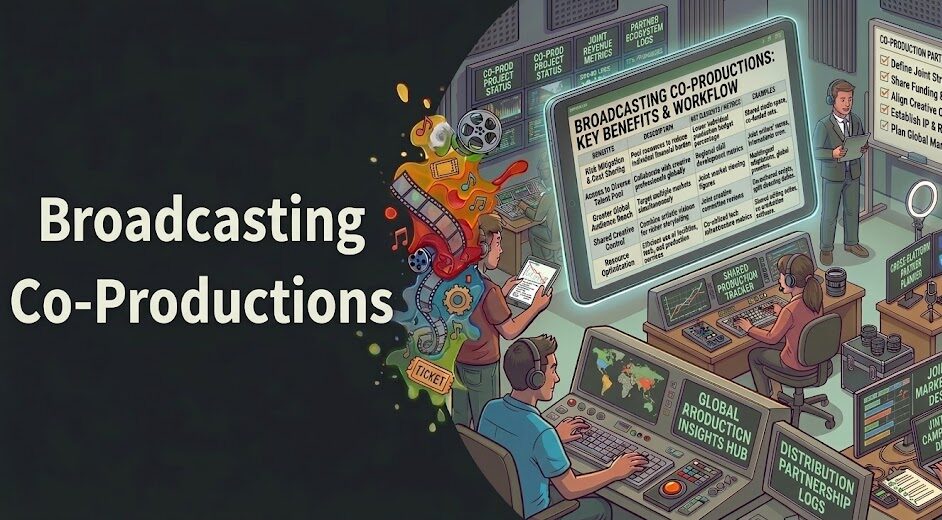
Enter co-commissioning. Rather than one broadcaster owning a series outright, two or more commissioners—from different territories or platforms—each contribute funding in exchange for distribution rights in their markets. The capital stack looks more like a film financing model, and it’s changing how commissioning conversations happen.
The TF1 and France Télévisions model demonstrates this clearly. Both French broadcasters have entered into streaming partnerships with Netflix and Prime Video that are structured as co-commissioning arrangements—not just content licensing deals. The broadcaster brings the domestic audience relationship and the regulatory benefit; the streamer brings scale financing and global distribution. Both get content they couldn’t justify solo.
What this means for the Weaponized Distribution™ playbook: content ownership—not exclusive platform control—is now the primary value driver. Warner Bros. Discovery executed this precisely with its licensing arrangement with Netflix, turning HBO’s premium library into a recurring revenue stream while retaining IP ownership. Broadcasters watching that deal are learning that being a platform monopolist is less valuable than being an IP owner with multiple distribution levers.
For independent producers, co-commissioning means the pitch has to address multiple commissioners simultaneously—or have a financial partner who can assemble the consortium. But it also means that a project with genuine international appeal can attract budget that would have been structurally impossible under the old single-broadcaster model. That’s not a small opportunity.
As Andrea Scarso, Managing Partner at IPR.VC—which manages content investment funds for institutional investors across Europe—notes, the co-production and co-commissioning space has become critically more important for producers navigating local incentives, broadcaster requirements, and financing structures simultaneously. Smart producers are treating it as a given from development stage, not a fallback if the first commissioner passes.

Your AI Assistant, Agent, and Analyst for the Business of Entertainment
VIQI AI helps you plan content acquisitions, raise production financing, and find and connect with the right partners worldwide.
- Find active co-producers and financiers for scripted projects
- Find equity and gap financing companies in North America
- Find top film financiers in Europe
- Find production houses that can co-produce or finance unscripted series
- I am looking for production partners for a YA drama set in Brazil
- I am looking for producers with proven track record in mid-budget features
- I am looking for Turkish distributors with successful international sales
- I am looking for OTT platforms actively acquiring finished series for the LATAM region
- I am seeking localization companies offer subtitling services in multiple Asian languages
- I am seeking partners in animation production for children's content
- I am seeking USA based post-production companies with sound facilities
- I am seeking VFX partners to composite background images and AI generated content
- Show me recent drama projects available for pre-buy
- Show me Japanese Anime Distributors
- Show me true-crime buyers from Asia
- Show me documentary pre-buyers
- List the top commissioners at the BBC
- List the post-production and VFX decision-makers at Netflix
- List the development leaders at Sony Pictures
- List the scripted programming heads at HBO
- Who is backing animation projects in Europe right now
- Who is Netflix’s top production partners for Sports Docs
- Who is Commissioning factual content in the NORDICS
- Who is acquiring unscripted formats for the North American market
Shift 3: FAST Channels as the Strategic Monetization Layer
Free ad-supported streaming television has gone from a niche play to a mainstream broadcaster strategy in roughly 36 months. And it’s changing the commissioning calculus in ways that aren’t yet fully priced into how producers pitch.
Here’s the structural logic. A broadcaster sitting on decades of library content now has a monetization channel for that asset that didn’t exist 5 years ago. FAST channels allow you to programme themed linear experiences—true crime, home renovation, classic drama—at essentially zero incremental content cost. The ad revenue is additive, the audience is incremental (predominantly cord-cutters who wouldn’t have watched linear anyway), and the marginal cost of delivery is low.
Fremantle and Pluto TV extended their partnership to launch 25 FAST channels globally across 13 new markets, programming content including Baywatch and Three’s Company. That’s a clear signal: legacy library titles with built-in audience recognition translate into FAST channel programming that generates advertising revenue without requiring new commissioning spend.
But FAST channels are also changing how new commissioning is evaluated. Content that fits FAST channel formats—episodic, genre-defined, re-watchable, lower-cost—now has a secondary monetization path baked into its value calculation from day one. A broadcasters’ commissioning exec today is asking not just “will this work on our linear prime-time?” but also “does this have FAST channel legs after its linear window?” That changes the types of content getting greenlighted.
For factual, reality, and lower-budget scripted formats, this is genuinely good news. The economics now stack differently. A series that might have struggled to justify a linear commission on audience projections alone can now be assessed against a combined linear + FAST + SVoD monetization model. The ceiling is lower—but so is the barrier.
Check our analysis on how ad-supported streaming is reshaping production budgets for the full financial breakdown on what FAST-viable content economics look like in 2026.
Shift 4: Data-Driven Commissioning Replacing Relationship Gut Feel
This is the one that’s making traditional producers uncomfortable—and rightly so. The informal network that used to govern commissioning decisions (who you knew at a broadcaster, which executive had championed your last project, which format had performed well enough to give you another shot) is being systematically replaced by data infrastructure. Not eliminated—but subordinated.
Rolla Karam at OSN is explicit about this transition. When asked about how OSN’s content acquisition decisions are made, she described a dedicated research department that furnishes data to guide what to acquire, from which territories, in which genres. The platform is actively developing AI-driven tools for content curation and acquisitions analysis. Her framing: “we are becoming, and have been, or are becoming a data-driven platform.” The shift from intuition to intelligence is organisational, not just technical.
But OSN isn’t unusual. As reported by The Hollywood Reporter, the shift toward data-informed commissioning is now standard practice at major broadcast and streaming groups—with audience demand signals, search behaviour, social engagement metrics, and retention data all feeding into greenlight decisions that used to depend heavily on editorial instinct.
What does this mean in practice for producers pitching broadcasters in 2026?
- Your pitch now competes against data, not just other projects. A commissioner who runs your concept against their internal demand signals and sees weak audience search intent isn’t going to override that with enthusiasm about your track record.
- Genre and format specificity matter more than ever. Vague concepts don’t parse well against data tools. The clearer and more specific your format, the easier it is for a commissioning executive to model audience demand.
- Comparative titles are a currency. If you can point to a comparable title that overperformed on your target broadcaster’s platform—with numbers, not just reputation—you’re speaking the language of data-driven commissioning.
- Window and territory strategy needs to be pre-built. Broadcasters using data tools are modelling not just domestic performance but multi-territory value from the start. Arrive with a territory strategy, not just a story.
And for broadcasters themselves, the data infrastructure build is a genuine competitive differentiator. The platforms with the most granular real-time audience intelligence will be commissioning earlier, more precisely, and with less capital wasted on content that misses. That’s EBITDA protection built directly into the commissioning model.
Shift 5: Regional Commissioning via Sovereign Content Hubs™
The fifth shift is the one that changes the global map—not just the strategy of any single broadcaster. Sovereign Content Hubs™ are creating commissioning ecosystems in markets that, five years ago, had no meaningful domestic production infrastructure. And broadcasters who’ve noticed are repositioning their co-production and acquisition strategies accordingly.
Saudi Arabia is the most dramatic example. Since the cinema ban was lifted in 2018, the country has built 17 operational studios, grown to over 630 cinema screens, and released 35 Saudi films in 2024 alone. The Vision 2030 entertainment allocation—$71.2 billion across the sector, with $4 billion+ specifically directed at film infrastructure—is creating a commissioning and co-production market that didn’t exist at all less than a decade ago.
The strategic implication for regional broadcasters is direct. OSN’s move to develop original Arabic-language content—announced through its WBD partnership to co-develop and produce regional scripted series—is the broadcaster response to a commissioning environment that’s simultaneously more competitive (more platforms competing for regional content) and more opportunity-rich (more government-backed production capital available). Rolla Karam describes it clearly: the immediate focus for 2026 and 2027 is Arabic content that resonates in the region, local to local, with aspirations to become local to global.
That “local to global” framing is the Sovereign Hub commissioning strategy in its most succinct form. It’s not about servicing Hollywood—it’s about building IP with domestic roots and global export potential. And it’s creating commissioning opportunities for producers who understand how to structure content for regional audiences while retaining international licensing value.
Beyond MENA, South Korea‘s Hallyu-driven content export machine and India‘s multi-language production capacity are both generating regional commissioning windows that global broadcasters are actively competing to tap into. The capital stack implications are significant: co-production treaties, local incentive stacking (UAE offers up to 50% rebates, Saudi Arabia 40%), and sovereign fund backing make regional co-commissions materially cheaper than fully self-financed Western productions.
For producers, this represents the most structural opportunity the linear TV decline has created. Not just a gap left by retreating linear budgets—but a genuinely new commissioning frontier, backed by patient government capital, with built-in distribution in some of the world’s fastest-growing entertainment markets.
Need to Find Co-Commissioning Partners for Your Next Project?
Vitrina Concierge identifies and makes warm introductions to active commissioners, co-production partners, and regional financiers—matched specifically to your project’s genre, territory, and budget profile.
- LA producer → Netflix UK, Fifth Season, Fox Entertainment in 48 hours
- MENA studio → 3 qualified co-commission partners in 1 week
- No commitment | No credit card | Tailored to your brief
What This Means for Producers Pitching Broadcasters in 2026
The five shifts above share a common implication for anyone in the market pitching projects to broadcasters: the old playbook doesn’t work anymore. The pitch that used to get you in the room—strong producer track record, a familiar relationship with the commissioner, a comparable title that performed—is now table stakes, not a differentiator.
What moves the needle in 2026 is intelligence. Knowing which broadcasters are actively commissioning in your genre right now—not which ones commissioned 18 months ago. Knowing which co-commission partnerships are live and which are in development. Understanding where Sovereign Content Hub capital is being deployed and what co-production mandates are attached. And arriving with a financing structure that already reflects the multi-party commissioning reality, rather than expecting the broadcaster to build it for you.
This is exactly the Data Deficit problem that kills deals before they start. You walk into a pitch at a broadcaster who quietly pivoted their commissioning focus 6 weeks ago—before it hit the trades—and you’re presenting a project that no longer fits their 2026 strategy. Not because the project is wrong. Because your intelligence was stale.
Vitrina maps 400,000+ active projects and 140,000+ companies across the global supply chain in real time. That means you can track commissioning shifts as they happen—active development slates, greenlit projects by genre and territory, executive movements that signal strategic pivots. The Insider Advantage™ used to require decades of market relationships. Now it’s a search query.
And for regional commissioning—the Sovereign Content Hub opportunity—Vitrina’s Smart Pairing capability maps co-production partners and active commissioners across MENA, APAC, and LATAM with the same verified intelligence available for traditional Western markets. So you can arrive at a Saudi or UAE broadcaster conversation knowing what they’re actively developing, what their content mandates are, and who else in their network is positioned for a co-commission structure. That’s not intelligence you can develop in a meeting. It’s intelligence you need before you get one.
Frequently Asked Questions: Linear TV Decline and Broadcaster Commissioning
What is causing the linear TV decline in 2026?
The linear TV decline is being driven by a structural shift in viewing behaviour, particularly among audiences under 50, who have moved their viewing time to streaming platforms, social video, and gaming. Cord-cutting accelerated through COVID and hasn’t reversed. The advertising model that sustained broadcast TV is simultaneously under pressure as brands follow audiences to digital platforms with more precise targeting capabilities. Linear audiences in Western markets dropped 8–12% year-over-year in 2025, continuing a trend that began well before streaming matured.
How are broadcasters reinventing their commissioning strategies in response to linear TV decline?
The five main commissioning strategy shifts in 2026 are: ending long output deals in favour of selective title-by-title acquisitions; moving to co-commissioning models that spread budget risk across multiple platforms and territories; building FAST channel strategies that monetise existing library content; investing in data infrastructure that replaces editorial gut feel with audience demand signals; and actively developing content through Sovereign Content Hub partnerships in MENA, APAC, and other regional markets where government capital supports production investment.
What is a co-commissioning model and why is it becoming the default?
Co-commissioning is a financing and rights structure where two or more broadcasters or platforms jointly fund a production in exchange for distribution rights in their respective territories or platforms. It’s becoming the default because no single linear broadcaster can justify the budget levels required to compete with streaming originals on their own, given declining audiences and advertising pressure. The model mirrors film co-production economics and allows broadcasters to commission prestige content they couldn’t fund solo while sharing risk across the capital stack.
Are output deals dead in broadcasting?
Long multi-year blanket output deals are being retired by major broadcasters and distributors. Rolla Karam, SVP Content Acquisition at OSN—which covers 23 countries in MENA—has stated publicly that she no longer does long output deals, preferring short-term or title-by-title arrangements that preserve commissioning flexibility as audience preferences and platform strategies evolve. The logic is consistent across markets: why commit capital to a guaranteed content flow when data-driven selective acquisition produces better audience alignment at lower risk?
How are FAST channels changing broadcaster commissioning economics?
FAST (free ad-supported streaming TV) channels are giving broadcasters a new monetisation layer for library content that doesn’t require new commissioning spend. This changes the value calculation for new commissions—content that works in FAST format (genre-specific, episodic, re-watchable) now has a secondary monetisation path beyond its linear window. Fremantle and Pluto TV’s 25-channel FAST partnership across 13 markets is a benchmark: library titles generating ad revenue from cord-cutters who would never watch the original broadcast.
What are Sovereign Content Hubs and why do they matter for broadcaster commissioning?
Sovereign Content Hubs are territories where government-backed capital—sovereign wealth funds, state incentives, infrastructure investment—has created vertically integrated production ecosystems capable of competing with and exporting content globally. Saudi Arabia, UAE, South Korea, and India are the primary examples. For broadcaster commissioning, they matter because they offer access to patient capital (not quarterly earnings driven), generous incentives (40–50% rebates), and built-in regional distribution. OSN’s WBD partnership for Arabic originals is a direct example of broadcasters tapping this capital through co-commission structures.
How can producers adapt their pitching strategy to data-driven commissioning?
Producers pitching to data-driven commissioners in 2026 need to arrive with more than creative credentials. Your pitch should include: verifiable audience demand signals for your genre and format (search volume, social engagement, streaming performance of comparable titles); a territory strategy that models multi-market value, not just domestic performance; a financing structure that already reflects co-commission reality; and intelligence on the specific broadcaster’s current development priorities. Real-time supply chain intelligence platforms like Vitrina allow producers to track greenlit projects, active commissioners, and development slate shifts before they hit the trades.
Which types of content are broadcasters still commissioning strongly despite linear TV decline?
Live sports, major tentpole reality formats, and breaking news remain strong linear performers and continue to attract significant commissioning spend. Beyond live, broadcasters are prioritising content with demonstrated multi-platform performance—formats that work on linear, on-demand, and in FAST channel scheduling. Regional and culturally-specific content is being increasingly prioritised, particularly in MENA, APAC, and LATAM markets where Sovereign Content Hub capital is amplifying commissioner budgets and local audience appetite for homegrown productions is growing strongly.
The Bottom Line: Linear TV’s Decline Is a Commissioning Opportunity, Not Just a Problem
The broadcasters treating linear TV’s decline as an existential threat—rather than a forcing function to build better commissioning strategies—are the ones running out of time. The ones leaning into co-commissioning models, data infrastructure, FAST monetisation, and Sovereign Hub partnerships are finding that the structural shift has created real strategic advantages for those willing to move.
But here’s the uncomfortable truth: most of the intelligence gaps that make broadcasters slow—and most of the information deficits that make producer pitches miss—exist because the market still doesn’t have a reliable, real-time view of what’s actually getting commissioned, where, and by whom. The trades run 6 weeks behind the deals. Relationships surface a fraction of the market. And the Fragmentation Paradox™ means that 600,000+ companies competing for commissioning windows are largely invisible to each other.
That’s the gap Vitrina closes. For broadcasters doing competitive intelligence on peer commissioning strategies. For producers tracking where active development slates are moving before their window closes. And for anyone navigating the Sovereign Content Hub opportunity in markets where the commissioning infrastructure is building in real time, right now.
Key Takeaways
- Linear TV decline is structural, not cyclical: Audiences under 50 have shifted permanently. Broadcasters designing for linear recovery are designing for the wrong future.
- Long output deals are over: Title-by-title, data-validated commissioning is replacing multi-year blanket commitments—even at major premium platforms like OSN across 23 MENA markets.
- Co-commissioning is the new capital stack: No single broadcaster can fund prestige content alone. Multi-party financing structures are now the baseline for anything competing with streaming originals.
- FAST channels monetise the library and change new content economics: Content with FAST legs has a higher combined value—producers who understand this get more competitive commission offers.
- Sovereign Content Hubs™ are creating entirely new commissioning windows: Saudi Arabia’s $71B+ entertainment investment, UAE’s 50% rebates, and regional broadcaster partnerships represent a commissioning frontier that barely existed 5 years ago.
Stop Pitching the Last Cycle. Start Tracking the Next One.
Trusted by Netflix, Warner Bros, and Paramount. Join 140,000+ companies using Vitrina to track active commissioners, greenlit projects, and co-production windows before they hit the trades.
✓ 200 free credits | ✓ No credit card required | ✓ Full platform access from day one
Find Film+TV Projects, Partners, and Deals – Fast.
VIQI matches you with the right financiers, producers, streamers, and buyers – globally.
Producers Seeking Financing, Co-Pros, or Pre-Buys?
Vitrina Concierge helps producers reach the right financiers, commissioners, distributors, and co-production partners — with precision outreach, not cold pitching.
Join Industry Briefings Trusted by Leaders
Format Adaptations: Global Trends
Where formats are traveling, which adaptations are breaking out, and how streamers are backing remakes in 2025–2026.

Books, Novels & Comics Adaptations: Global Trends
Books, webtoons, and manga driving the next global screen hits. Discover how in this webinar.

Micro-Dramas & Mobile-First Storytelling
Micro-dramas are building real audiences and revenue. Understand the platforms, buyers, and economics behind the growth.

Navigating Global Content Licensing Trends
How global content licensing is shifting beyond flat fees to flexible, deal-driven models.