About Innovation Hub
 Global Content Pulse (Webinars)


 Global Production Financing
(Webinars)
Global Production Financing
(Webinars)  LeaderSpeak Podcast
  Global Entertainment Digest (Newsletter)
  About Vitrina
 About VIQI
 Our Story
 Our Solutions 🔥
 Film+TV Projects Tracker 🚀
 Case Studies
 Our Profile
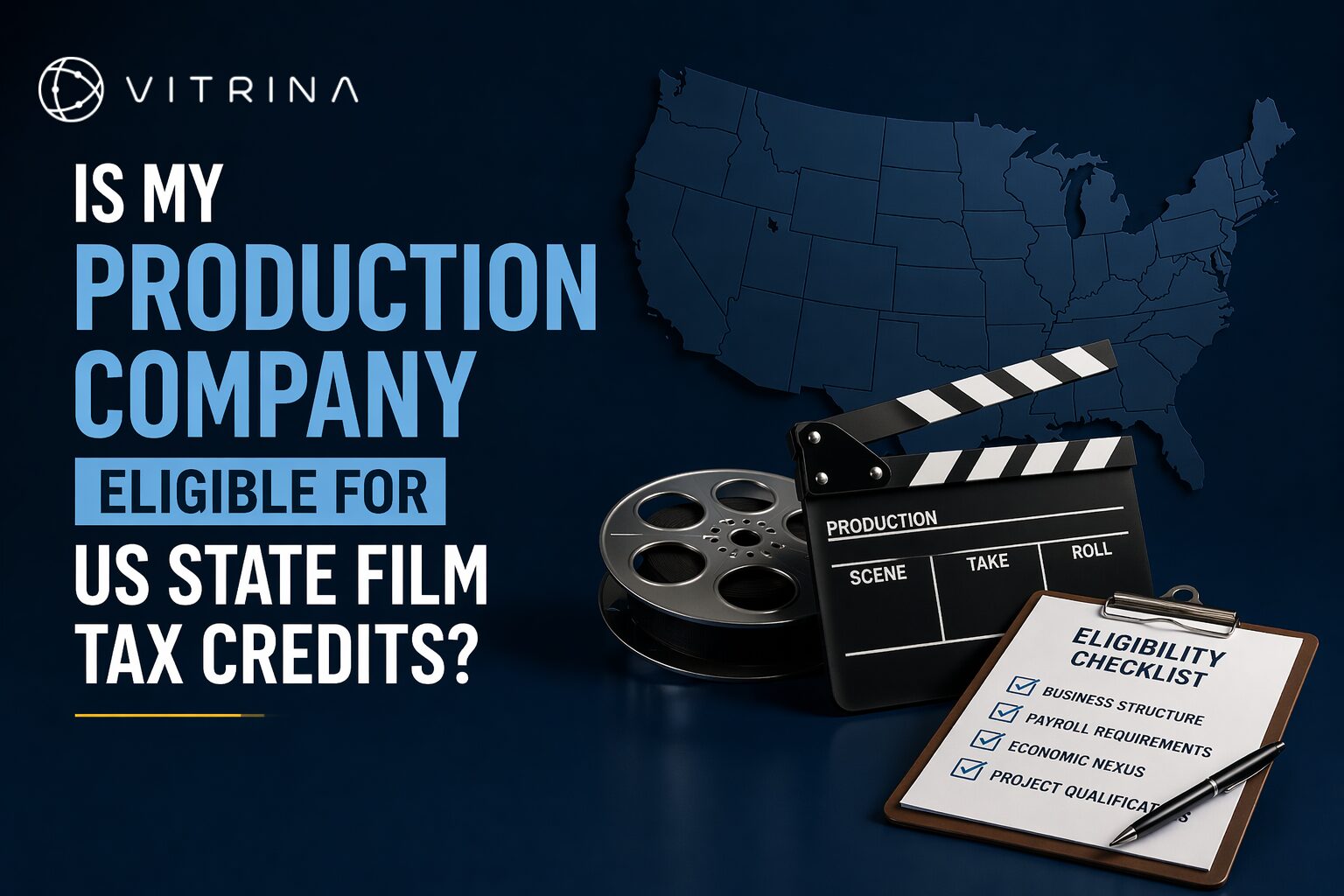
A surprising number of production companies either don’t know they’ve earned state tax credits — or assume they don’t qualify when they do. This guide covers the eligibility requirements for major US state incentive programs and walks through the most common scenarios where companies qualify without realising it.
The Core Eligibility Rule: It’s About Where You Shoot
The single most important thing to understand about US state production incentives is that eligibility is almost always based on where the production activity happens — not where your company is headquartered or registered.
This means:
- A Canadian production company shooting in Georgia qualifies for Georgia credits
- A UK-based studio shooting in New York qualifies for New York credits
- A streaming production entity domiciled in Delaware but shooting in Louisiana qualifies for Louisiana credits
If you’re spending money on a production in a qualifying US state, the incentive is available to you.
What Types of Productions Qualify?
Most major US state incentive programs cover a broad range of content types:
- Feature films (theatrical and direct-to-streaming)
- Scripted television series
- Unscripted and reality television (in most states)
- Animated content (covered in most states, with some variations)
- Commercials and branded content (varies by state)
- Video games (covered in some states — Illinois and Louisiana notably)
- Documentary films (varies by state and budget size)
The most common exclusions are news programming, sports broadcasts, political advertising, and very short-form content. If you’re producing any of the above content types in a major incentive state, it’s worth checking eligibility before assuming you don’t qualify.
Eligibility Checklist by State
Georgia
✅ Minimum $500,000 in qualified Georgia production expenditures per project
✅ Production activity (principal photography or significant post) occurs in Georgia
✅ Expenditures are on qualifying above or below–the–line costs
✅ Company registered to do business or has a production entity registered in Georgia
New York
✅ Minimum $1 million in qualified New York below-the-line expenditures
✅ At least 75% of post-production costs are incurred in New York (if claiming post credit)
✅ Production is a qualified film or TV project under New York’s definition
✅ Application filed with the Governor’s Office for Motion Picture & Television Development before or during production
New Jersey
✅ Minimum $1 million in qualified New Jersey production expenditures
✅ At least 60% of total below-the-line budget is spent in New Jersey
✅ Content qualifies under New Jersey’s program (film, TV, streaming, digital media)
✅ Application filed with the New Jersey Economic Development Authority
California
✅ Minimum spend thresholds met (varies by production type — $1 million for features)
✅ Minimum percentage of filming days completed in California
✅ California labor thresholds met
✅ Application submitted through the California Film Commission portal before principal photography
Illinois
✅ Minimum $100,000 in qualified Illinois production expenditures (lowest threshold of major states)
✅ Production activity occurs in Illinois
✅ Content is a qualifying production under Illinois program definitions
✅ Application filed with the Illinois Department of Commerce & Economic Opportunity
Louisiana
✅ Minimum $300,000 in qualified Louisiana production expenditures
✅ Majority of principal photography days in Louisiana
✅ Content is a qualifying production type
✅ Application filed with the Louisiana Office of Entertainment Industry Development
Common Scenarios Where Companies Qualify but Don’t Know It
International companies shooting in the US
As noted above, domicile doesn’t matter. An internationally headquartered production company that is spending money in Georgia is earning Georgia credits. The most common reason these companies miss out is simply not knowing the credit exists, or assuming it doesn’t apply to them.
Co-productions
If you’re a co-producer on a US production, your share of the qualifying expenditures may generate a credit allocation proportional to your stake. Co-production structures add complexity, but they don’t automatically disqualify you.
Streaming production entities
Many streaming production companies are structured as project-specific entities domiciled in a state with no production activity (Delaware, for example). The credit eligibility is based on where you’re shooting, not where the entity is registered — so a Delaware LLC shooting in New York is still eligible for New York credits.
Post-production and VFX companies
Several states — including New York, Georgia, and New Jersey — extend incentives to qualifying post-production and VFX work. If you’re a post or VFX company doing work on a qualifying production, your own expenditures may be eligible even if you didn’t handle principal photography.
The Documentation You’ll Need
If you believe you qualify, start assembling:
- A breakdown of production expenditures by state
- Records showing the production type and format
- Payroll records distinguishing in-state from out-of-state labor
- Any co-production agreements
- Entity documentation (the production entity registered in or doing business in the qualifying state)
Most state programs require applications to be filed before or during production — not after. If your production is currently in development or pre-production, the time to apply is now.
Already Have Credits and Want to Know What to Do With Them?
If you’ve already produced in one of these states and have unused credits sitting on your balance sheet, the next question isn’t eligibility — it’s monetization.
vitrina.ai/credits
Find Film+TV Projects, Partners, and Deals – Fast.
VIQI matches you with the right financiers, producers, streamers, and buyers – globally.
Producers Seeking Financing, Co-Pros, or Pre-Buys?
Vitrina Concierge helps producers reach the right financiers, commissioners, distributors, and co-production partners — with precision outreach, not cold pitching.
Join Industry Briefings Trusted by Leaders

Format Adaptations: Global Trends
Where formats are traveling, which adaptations are breaking out, and how streamers are backing remakes in 2025–2026.

Books, Novels & Comics Adaptations: Global Trends
Books, webtoons, and manga driving the next global screen hits. Discover how in this webinar.

Micro-Dramas & Mobile-First Storytelling
Micro-dramas are building real audiences and revenue. Understand the platforms, buyers, and economics behind the growth.

Navigating Global Content Licensing Trends
How global content licensing is shifting beyond flat fees to flexible, deal-driven models.