About Innovation Hub
 Global Content Pulse (Webinars)


 Global Production Financing
(Webinars)
Global Production Financing
(Webinars)  LeaderSpeak Podcast
  About Vitrina
 Our Story
 Our Solutions 🔥
 Film+TV Projects Tracker 🚀
 Case Studies
 Our Profile
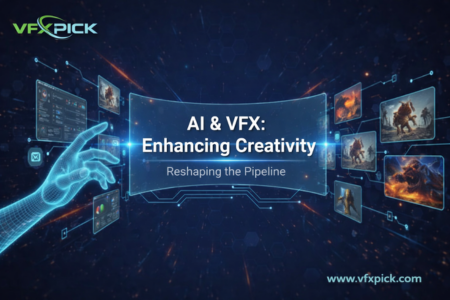
Artificial intelligence is increasingly being applied across global visual effects production. The studios use AI-driven tools to handle complex tasks and boost their operational efficiency while delivering consistent results from their work on high-end feature films and episodic series and OTT originals. AI transforms artistic work processes because it helps artists to concentrate their efforts on elements that create cinematic storytelling. Studios use AI technology in a responsible manner, which helps artists to work more efficiently through automated processes while staff members maintain power over creative decisions.
AI as a Production Support, Not a Replacement
The most powerful capabilities of artificial intelligence systems emerge when they execute tasks that involve handling predefined patterns and doing repetitive work activities. The visual effects production process benefits from this technology because it enables faster processing times and produces consistent results. The visual effects industry depends on human creative abilities and aesthetic decision-making skills and storytelling knowledge. AI functions as a production support system rather than an autonomous creator.
AI Across the VFX Pipeline
Pre-Production and Planning
AI-assisted tools help teams generate rapid visual references, previs layouts, and technical simulations. Filmmakers can explore multiple directions quickly, establishing a strong foundation for production decisions. Early AI support reduces iteration cycles while leaving conceptual work and storytelling choices to directors and VFX supervisors.
Rotoscoping and Cleanup
The process of rotoscoping, object masking and plate cleanup requires extensive manual labor. The machine learning models have the capability to identify subjects and track their movements while generating initial mattes, which artists will later refine. The system decreases manual tasks, enabling compositors to dedicate their efforts toward accurate work, maintaining consistency and developing artistic improvements.
Matchmove and Camera Tracking
AI-driven tracking systems enhance their capabilities by using advanced camera solving methods to track moving objects. Human validation remains essential to ensure integration with downstream departments. The hybrid approach enables faster production work while maintaining complete accuracy.
Asset Generation and Environments
AI assists with generating textures and creating procedural asset variations and populating virtual environments. The outputs function as initial stepping stones, which lead to the development of final assets. The artists create refined elements, which they use to develop the visual style of the project according to its established artistic direction.
Compositing and Consistency
The AI system performs automatic execution of three operations, which include noise elimination, basic plate restoration and overall sequence consistency assessment. The tools provide two benefits, which include decreased operator exhaustion and enhanced operational productivity, while they sustain perfect visual effects. Artists maintain control over all final compositing choices, which involve lighting elements, depth components and realistic details.
Artist-Led Execution in AI-Supported Pipelines
AI shifts the focus of skilled VFX professionals toward supervision, problem-solving, and creative decision-making. Studios that prioritize artist-led execution ensure AI outputs are guided by visual judgment, narrative context, and production intent, avoiding template-driven results and preserving bespoke quality.
Production Reliability and Scalability
Artificial intelligence enables feature films and episodic series and high-volume OTT workflows to achieve predictable results while developing their content. Studios can handle their operational challenges, which include urgent timeframes and unexpected creative modifications and varying shooting schedules, because they have reduced their operational delays. Studios can deliver content on time while preserving high quality and creative integrity through the combination of structured pipelines and thorough review systems and skilled management.
Final Perspective
AI is transforming the VFX workflow because it boosts productivity while maintaining system robustness, but it does not change how creative rights are established. Human beings retain control over creative ownership, artistic judgment and storytelling sensitivity. The most effective pipelines combine automated systems, which function with automatic processing capabilities to enhance production processes, while artists maintain their primary role in creating visual stories. Examples from Indian studios, as referenced on vfxpick.com, show how AI can improve the production process without diminishing creative authority.