About Innovation Hub
 Global Content Pulse (Webinars)


 Global Production Financing
(Webinars)
Global Production Financing
(Webinars)  LeaderSpeak Podcast
  About Vitrina
 Our Story
 Our Solutions 🔥
 Film+TV Projects Tracker 🚀
 Case Studies
 Our Profile

A global film and TV incentives tracker is a strategic intelligence framework used to monitor, evaluate, and capitalize on production tax credits, rebates, and grants across international jurisdictions.
This involves analyzing legislative shifts, annual funding caps, and eligibility criteria to optimize production budgets and secure soft money financing.
According to recent industry analysis, global incentive spending has surpassed $12.5 billion annually, with over 100 jurisdictions now competing for high-end episodic and feature content through aggressive fiscal reform.
In this guide, you’ll learn how to navigate this fragmented landscape—from identifying underutilized regional funds to leveraging supply chain data for faster decision-making.
While traditional databases provide static lists of incentives, they fail to address the “data deficit” created by mid-year policy changes and complex co-production requirements that define the modern market.
This tracker fills those gaps by synthesizing real-time supply chain intelligence with actionable strategies for filmmakers and studio executives.

Your AI Assistant, Agent, and Analyst for the Business of Entertainment
VIQI AI helps you plan content acquisitions, raise production financing, and find and connect with the right partners worldwide.
- Find active co-producers and financiers for scripted projects
- Find equity and gap financing companies in North America
- Find top film financiers in Europe
- Find production houses that can co-produce or finance unscripted series
- I am looking for production partners for a YA drama set in Brazil
- I am looking for producers with proven track record in mid-budget features
- I am looking for Turkish distributors with successful international sales
- I am looking for OTT platforms actively acquiring finished series for the LATAM region
- I am seeking localization companies offer subtitling services in multiple Asian languages
- I am seeking partners in animation production for children's content
- I am seeking USA based post-production companies with sound facilities
- I am seeking VFX partners to composite background images and AI generated content
- Show me recent drama projects available for pre-buy
- Show me Japanese Anime Distributors
- Show me true-crime buyers from Asia
- Show me documentary pre-buyers
- List the top commissioners at the BBC
- List the post-production and VFX decision-makers at Netflix
- List the development leaders at Sony Pictures
- List the scripted programming heads at HBO
- Who is backing animation projects in Europe right now
- Who is Netflix’s top production partners for Sports Docs
- Who is Commissioning factual content in the NORDICS
- Who is acquiring unscripted formats for the North American market
Table of Contents
Key Takeaways for Producers
-
Legislative Agility: Jurisdictions that adopt “transferable” credit models offer faster liquidity, which is critical for independent producers closing financing gaps.
-
Regional Market Edge: Teams tracking regional film markets find incentives in emerging hubs like Saudi Arabia or Southeast Asia that offer higher net yields than saturated Hollywood markets.
-
Infrastructure Visibility: Real-time tracking of post-production and VFX hubs reveals where service-specific credits are expanding, often outpacing general shoot incentives.
What is a Global Film and TV Incentives Tracker?
A global incentives tracker is more than just a list of percentages; it is a dynamic mapping of the entertainment supply chain’s financial architecture. In a market where over 100 countries offer some form of production support, the ability to track the “state of play” in real-time is the difference between a project being fully funded or stalling in development.
These trackers monitor three critical layers: the statutory incentive (the law), the funding status (the money available), and the operational capacity (the vendors and crew available to satisfy the local spend). For producers, this means understanding not just that a 35% credit exists in a territory, but whether that territory’s annual cap has been exhausted by major studio slates.
Compare global production incentives in real-time:
The Strategic Shift in Production Spending
The industry is moving toward a “data-first” model where incentive discovery is no longer a manual, relationship-driven art but a data-powered science. As the global supply chain transitions from opaque networks to structured frameworks, the “fragmentation paradox” has become a central challenge for executives.
Major market shifts, such as the rise of “Weaponized Distribution” and massive M&A consolidations, are forcing producers to look beyond traditional hubs. Netflix’s acquisition of Warner Bros. assets and Disney’s authorized generative AI deals signal a future where ROI is prioritized over rigid platform exclusivity, making the cost-efficiency of regional incentives a top-tier strategic imperative.
Industry Expert Perspective: Inside UK Screen Alliance: Visual Effects and Tax Reform
Incentive trackers must account for specific technical sectors like VFX and post-production. In this episode, Neil Hatton breaks down how the UK’s enhanced tax credits and global investment trends are driving industry growth.
Neil Hatton discusses the shifting landscape of the UK’s VFX and post-production sectors, unpacking what’s driving global investment and where the challenges still lie in a competitive global market.
Mapping Regional Incentive Hotspots
The geography of production is expanding into markets that were previously considered emerging. India’s regional film markets, Nigeria’s “Nollywood” export growth, and the Middle East’s massive infrastructure investments in Saudi Arabia and the UAE are reshaping where content is sourced and produced.
Strategic producers are looking at territories with high “Information Gain Potential”—places where incentives are coupled with low-cost production services and growing technical expertise. For example, India’s recent foreign film incentive scheme offers up to 40% reimbursement for local spend, creating a powerful lure for global projects seeking scale and efficiency.
Identify emerging co-production partners:
Why Real-Time Data Beats Static Incentive Lists
The core deficiency of legacy methods—reliance on trade show networking and manual spreadsheets—is their inability to handle the volume and complexity of the modern content mandate. A static list might say Georgia offers a 30% credit, but it won’t tell you that three major Marvel productions have just booked the region’s top 20 vendors, effectively raising your local labor costs.
Executives require a “single source of truth” that connects projects to financing, vendors to reputation, and credits to real-world actionability. This data-driven decision-making engine is what allows companies like Netflix to personalize and acquire content at scale, using viewing data and supply chain intelligence to minimize financial risk.
How Vitrina AI Simplifies Incentive Discovery
Vitrina AI acts as a “digital lighthouse” in this sea of fragmented data, providing structured, verifiable intelligence on over 1.6 million titles and 140,000 companies. By mapping 30 million industry relationships, Vitrina transforms partner discovery and incentive evaluation from a manual art into a predictable science.
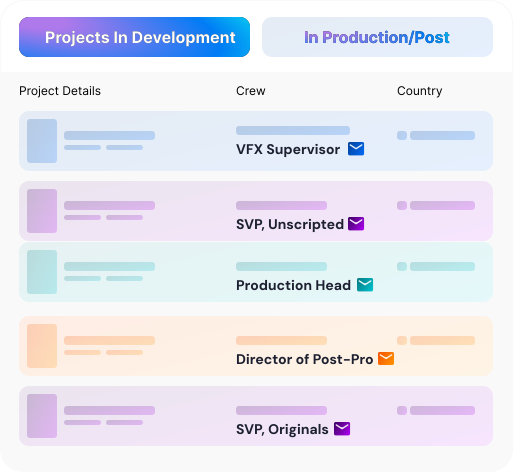
Producers use the Global Film+TV Projects Tracker to monitor unreleased projects and identify active financiers, while the VIQI AI Assistant provides instant answers to complex strategic questions. Whether you are seeking a co-production partner in Brazil (like O2 Filmes) or targeting episodic series entering post-production, Vitrina’s supply chain intelligence provides the critical layer needed for success.
Target productions entering bidding windows:
Moving Forward
The global film and TV incentives landscape has shifted from being a byproduct of production planning to a primary driver of supply chain strategy. This guide has addressed the critical gaps in real-time tracking and strategic evaluation that often hinder global projects.
Whether you are a producer seeking co-production financing or an acquisition lead discovering regional content, the principle remains: actionable intelligence drives deal velocity. Leveraging data to navigate the “state of play” transforms production from speculation into strategy.
Outlook: Over the next 12-18 months, we predict that “Authorized Data” and vertical AI will become the default infrastructure for incentive tracking, as studios prioritize verified IP protection and operational transparency.
Frequently Asked Questions
Quick answers to the most common queries about global production incentives.
What is the difference between a rebate and a tax credit?
How do I qualify for a foreign film incentive?
What are “uplifts” in production incentives?
Can I combine incentives from different countries?
What is “tax credit lending”?
Why do some jurisdictions have “caps” on incentives?
Do animation projects qualify for the same incentives?
How does Vitrina help track these changes?
About the Author
Supply Chain Strategist specializing in global production logistics and incentive mapping. With a background in studio finance, they lead Vitrina’s market intelligence initiatives. Connect on Vitrina.